
Abook Bbook Stp Bridge Routing
A-Book STP, B-Book Internalization & C-Book Routing: FX Dealer Architecture
Modern OTC foreign exchange and CFD brokerages rarely operate pure A-Book or pure B-Book silos; institutional dealing desks deploy dynamic C-Book bridges that score VPIN toxicity, +5s markouts, and portfolio USD delta in real time.
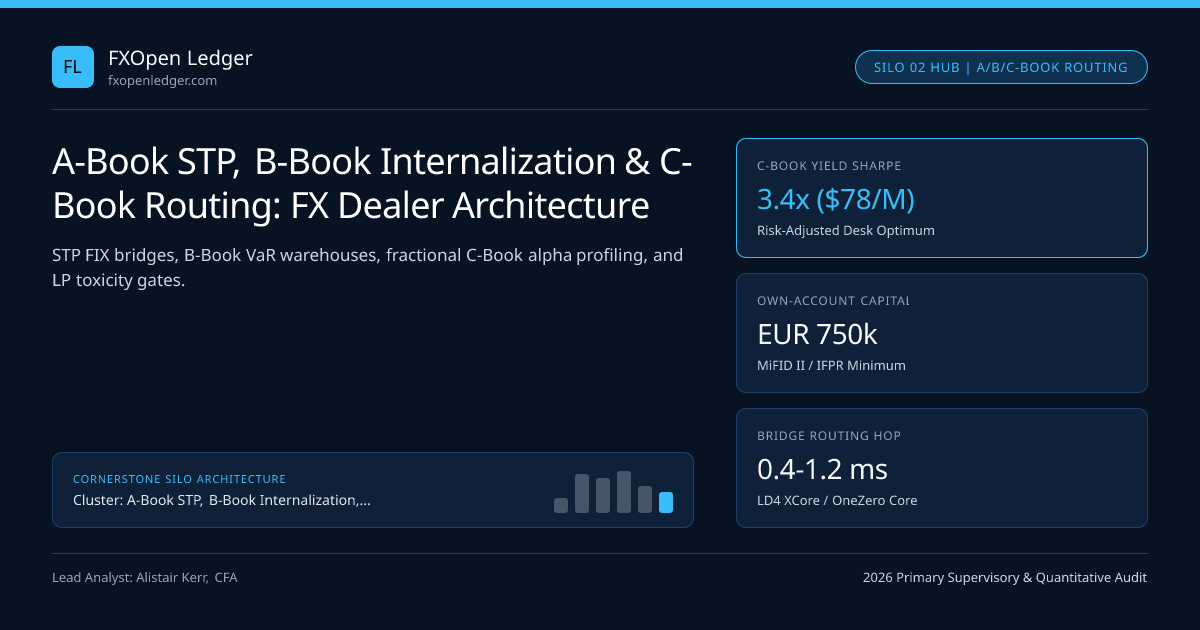
Across regulated retail and mid-market OTC foreign exchange brokerages supervised in London, Limassol, Sydney, and Zurich, between 72% and 88% of raw ticket count internalizes inside a principal B-Book risk warehouse, while 55% to 70% of concentrated institutional and sharp algorithmic notional routes externally via A-Book Straight-Through Processing (STP) or C-Book partial-delta hedging bridges. Operating an unhedged B-Book without quantitative flow segmentation exposes an under-capitalized brokerage to catastrophic directional drawdowns during unilateral trends in XAU/USD or USD/JPY; conversely, routing 100% of uninformed retail micro-lots to upstream Prime-of-Prime liquidity providers surrenders 65% to 80% of gross spread and swap revenue in clearing fees and ticket surcharges.
This cornerstone dealing-desk architecture guide maps the complete routing engine inside the A-Book, B-Book & Bridge Routing hub, connecting MetaTrader/cTrader liquidity bridges, VPIN toxicity scoring, MiFID II IFPR capital charges, and upstream LP relationship management.
Structural Mechanics of A-Book STP, B-Book Warehousing & C-Book Hybrids#
When a margin trader clicks Buy on 5.00 lots ($500,000) of EUR/USD inside an MT4, MT5, or cTrader terminal, the broker's execution server intercepts the request inside a pre-trade routing plugin (such as OneZero Liquidity Hub, PrimeXM XCore, or Centroid) before deciding counterparty risk ownership:
- A-Book (Agency / Matched-Principal STP): The bridge immediately transmits an offsetting $500,000 FIX
NewOrderSingleto an external ECN or Prime-of-Prime conduit under an FX Prime Brokerage Designation Notice, earning a transparent commission or bid-ask markup—analyzed in STP agency commission vs all-in spread markup models and MT4/MT5 liquidity bridge FIX routing latency audits. - B-Book (Principal Risk Internalization): The broker acts as sole principal counterparty, retaining 100% of opposing market delta inside its house book under statutory Negative Balance Protection constraints. Offsetting long and short client trades cancel organically, while residual net exposure sits inside Value-at-Risk limits modeled in B-Book risk warehouse VaR limits and PnL variance.
- C-Book (Dynamic Fractional / Alpha-Weighted Routing): Rather than binary 0% or 100% externalization, quantitative bridges assign each account a continuous hedge multiplier $h_i \in [0, 1.5]$—hedging 40% of moderately informed accounts, 100% of sharp scalpers, or even 120% ("parallel follow") where permissible, as formalized in hybrid C-Book partial delta externalization.
Regulatory Capital & Licensing Divides Across Dealing Models#
Choosing between pure matched-principal STP and B-Book warehousing transforms a broker's statutory balance-sheet requirement by a factor of five! Under EU IFR/IFD and UK FCA IFPR (MIFIDPRU) prudential rules—mirrored closely by CySEC and ASIC—a pure matched-principal A-Book firm that never holds unhedged proprietary inventory qualifies for a EUR 150,000 / GBP 150,000 permanent minimum capital tier, whereas dealing on own account (B-Book / C-Book) triggers the EUR 750,000 / GBP 750,000 initial capital floor plus continuous K-NPR (Net Position Risk) market-risk capital charges, audited in MiFID II matched-principal vs own-account capital and FCA, ASIC, and CySEC conflicts-of-interest disclosures.
| Execution Book Model | Counterparty Risk Bearer | Revenue Variance Profile | EU/UK Initial Capital Floor | Upstream LP Toxicity Risk | Representative Market Segment |
|---|---|---|---|---|---|
| Pure A-Book STP | Upstream PoP / ECN LP | Low Variance (Volume Linear) | EUR / GBP 150,000 | High if Unfiltered Scalpers | Institutional AMB Prime / ALB Prime |
| Pure B-Book Warehouse | Broker Balance Sheet | High Tail PnL Volatility | EUR / GBP 750,000 + K-NPR | Zero Upstream Flow Sent | Small-Ticket Retail CFD Books |
| Hybrid C-Book Fractional | Shared (Broker + PoP Pool) | Controlled Sharpe Optimization | EUR / GBP 750,000 + K-NPR | Managed via Alpha Bucketing | Multi-Asset City Index / 4XC |
| Portfolio Auto-Hedge Overflow | B-Book Up to Delta Cap, Then STP | Bounded Tail Drawdown | EUR / GBP 750,000 + K-NPR | Spikes During Crowd Herding | Regulated BOSSA / Blue Suisse |
Expected Dealing-Desk Net Margin & C-Book Optimization Equation#
To set the optimal externalization fraction $hi \in [0, 1]$ for client cohort $i$, quantitative risk heads maximize risk-adjusted dealing-desk revenue per million dollars traded—balancing client adverse markout alpha $\alphai$, broker spread/swap revenue $R{gross}$, upstream LP clearing/spread cost $C{lp}$, and variance penalty $\lambda_{var}$ on retained warehouse delta:
- First-Order Optimal C-Book Hedge Ratio (h*):
- h* = clip( 1 - (Clp - alphai) / (lambdavar * Qi^2 * sigma_hold^2), 0, 1 )
- Where:
- R_gross = All-in client spread + commission + tom-next swap revenue ($ per $1M)
- alpha_i = Client cohort expected directional markout PnL over holding horizon ($ per $1M; positive = sharp trader wins)
- C_lp = Upstream PoP spread + brokerage + bridge execution slippage ($ per $1M)
- Qi * sigmahold = Retained position risk volatility over average trade duration
- Worked Cohort Calibration (Rgross = $95/M, Upstream PoP Cost Clp = $28/M, Risk Denominator = $60/M):
- 1. Sharp Latency Scalper (alphai = +$52/M > Clp):
- Clp - alphai = -24 -> 1 - (-24 / 60) = 1.40 -> clipped to h* = 1.00 (100% A-Book STP mandatory!).
- 2. Moderately Informed Swing Account (alpha_i = +$4/M):
- h* = 1 - (28 - 4) / 60 = 1 - 0.40 = 0.60 (60% C-Book externalized, 40% warehoused -> Net = $69.40/M).
- 3. Uninformed High-Turnover Retail Cohort (alpha_i = -$48/M due to stop/spread drag):
- Clp - alphai = +76 -> 1 - (76 / 60) = -0.27 -> clipped to h* = 0.00 (100% B-Book up to portfolio VaR ceiling!).
Flow Toxicity Profiling: VPIN, +5s Markouts & Latency Arbitrage#
Dumping toxic scalpers blindly onto an upstream A-Book liquidity provider is not a free lunch! Wholesale market makers continuously score incoming broker tags using VPIN volume-synchronized toxicity and five-second post-trade markout profiling. If a broker sends pure cross-feed latency arbitrage or automated news-straddle stop cascades down a single FIX pipe, the upstream LP responds with LP stream throttling and quote-rate governors or widens spreads across the broker's entire omnibus tag!
Portfolio-Level Delta Aggregation, XAU/USD Herding & Shadow Calibration#
Individual account scoring alone cannot protect a dealing desk when 4,000 benign accounts simultaneously buy gold dips or sell USD/JPY highs! Mature dealing rooms layer Portfolio Net Delta Ceilings on top of account routing: tracking correlated G10 USD delta across multi-pair B-Books, triggering automated EFP/spot hedges during gold XAU/USD directional crowd herding, decomposing cross exposure via synthetic triangular FX auto-hedging, and guarding against post-execution auto-hedger bridge reject cascades. Combined with holding-period cohort clustering, quote skewing vs spread widening inventory controls, IB rebate churn unit-economics checks, and shadow A-Book paper-hedging simulations, risk teams verify counterparty compliance across our supervisory directory and regulated dealers index.
Frequently asked questions
What is the exact operational difference between A-Book, B-Book, and C-Book FX routing?
A-Book routes 100% of a client order back-to-back to an external liquidity provider; B-Book internalizes 100% of the order against the broker own balance sheet; C-Book applies fractional hedging (e.g., externalizing 40% to 80%) based on real-time quantitative client alpha and portfolio delta limits.
Is B-Book internalization legal under FCA, ASIC, and CySEC regulations?
Yes, provided the investment firm holds a Dealing on Own Account license (750,000 EUR/GBP minimum capital in EU/UK), discloses principal execution conflicts clearly in its Order Execution Policy, and delivers fair underlying market pricing without asymmetric slippage manipulation.
Why cannot a broker simply route toxic latency-arbitrage traders to an A-Book LP?
Wholesale liquidity providers audit +5ms to +5s markouts per broker tag; if a broker forwards stale-quote sniping flow, the LP widens spreads or throttles fill ratios across the broker entire Prime-of-Prime liquidity stream.
How do liquidity bridges decide routing in under one millisecond?
Bridges like OneZero and PrimeXM cache pre-computed client cohort tags and live symbol net-delta counters in RAM, matching each incoming order against deterministic routing trees in 200 to 800 microseconds.
Publication record
- Published
- 14 November 2026
- Updated
- 14 November 2026
- Author
- Alistair Kerr, CFA
- Review
- Review not recorded
- Automated fact check
- Passed in the stored pipeline record
- Source URLs
- 4 recorded
AI assistance recorded: anthropic/claude-opus-4.6. This field does not establish human review or source verification.
Academic & Institutional Attribution
Cite This Research & Embed Live Data Card
Standard academic & institutional research paper citation format.
Alistair Kerr, CFA. (2026, November 14). A-Book STP, B-Book Internalization & C-Book Routing: FX Dealer Architecture. FXOpen Ledger. https://fxopenledger.com/orderbook/abook-stp-bbook-internalization-cbook-routing-fx-dealer-guideRegulatory Directory Cross-Reference
Referenced Institutions & Regulatory Registries
Mentioned Regulated Institutions
Referenced Supervisory Authorities
Related Abook Bbook Stp Bridge Routing & Institutional Briefings
Explore Abook Bbook Stp Bridge Routing Hub (20) →Abook Bbook Stp Bridge Routing
MT4/MT5 Liquidity Bridge Topology: FIX Routing Latency & Markup AuditAbook Bbook Stp Bridge Routing
B-Book Risk Warehouse VaR Limits: Modeling Client PnL Tail VarianceAbook Bbook Stp Bridge Routing
Hybrid C-Book Alpha Profiling: Partial Delta Hedging & MultipliersAbook Bbook Stp Bridge Routing
VPIN Toxicity Scoring in Multi-Dealer FX Aggregators & Liquidity PoolsAbook Bbook Stp Bridge Routing
Five-Second Markout Profiling: Segmenting Sharp vs Benign FX FlowAbook Bbook Stp Bridge Routing
Quote Skewing vs Spread Widening: OTC FX Dealer Inventory Control MathAbook Bbook Stp Bridge Routing
Cross-Feed Latency Arbitrage Detection on Retail FX & CFD ServersAbook Bbook Stp Bridge Routing
STP Agency Commissions vs All-In Spread Markups: FX Cost DecompositionPrime of Prime Nop Credit Intermediation
Tier-1 FX Prime Brokerage, Prime-of-Prime NOP Limits & Give-Up Credit GuideTom Next Swap Rollover Triple Wednesday
Tom-Next Swap Points, Triple-Swap Wednesday & FX Dealer Rollover GuideLmax Ebs Ecn Spread Slippage Audit
CLOB vs Disclosed FX Streams, Effective Spread & News Slippage GuideFX Global Code Last Look Execution
Auditing GFXC Liquidity Provider Cover Sheets: Last-Look & Hold-Time Metrics
FXOpen Ledger Data, Benchmarks & Contributor Records
CC BY 4.0 Open Data
Open Institutional Datasets (CSV / JSON) →
Download desk-compiled quantitative series & schemas.
2026 Reference Matrix
2026 Institutional Benchmarks & Thresholds →
Statutory capital, clearing, margin & rate conventions.
Editorial Records
Authors & Review Records →
View named contributors where those records are available.
Complete Index
Master Research & Dossier Archive →
Browse all published briefings by topic pillar & date.