
Abook Bbook Stp Bridge Routing
VPIN Toxicity Scoring in Multi-Dealer FX Aggregators & Liquidity Pools
Clock-time volatility gauges react too slowly when macro algorithms sweep OTC foreign exchange books in milliseconds; Volume-Synchronized Probability of Informed Trading (VPIN) samples imbalance in volume buckets to forecast adverse selection.
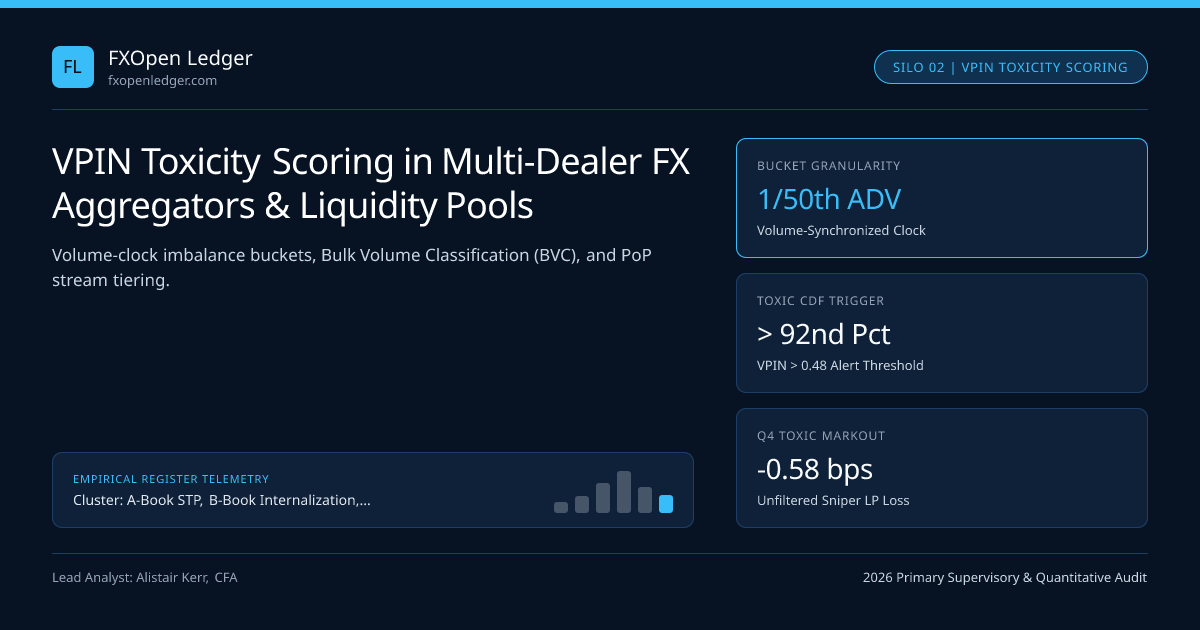
Why do fixed 1-minute or 5-minute clock-bar risk indicators fail catastrophically during flash crashes and surprise central bank headlines? Because during the quiet Asian lunch hour, $50 million of EUR/USD volume takes twelve minutes to trade, whereas during an unscheduled Bank of Japan intervention rumor, $50 million trades in 140 milliseconds! Developed by Easley, Lopez de Prado, and O'Hara, Volume-Synchronized Probability of Informed Trading (VPIN) replaces physical wall-clock intervals with equal-notional Volume Buckets ($V$), directly measuring directional order-flow imbalance at the exact speed information arrives in the foreign exchange market.
Anchored in our A-Book, B-Book & C-Book FX Dealer Architecture guide and indexed inside the A-Book, B-Book & Bridge Routing hub, real-time VPIN scoring governs both upstream LP protection and internal dealing-desk spread defense.
Adapting VPIN to Decentralized OTC Foreign Exchange Feeds#
In centralized futures (such as CME 6E or 6J), every trade prints exact aggressor volume on a single public tape. In fragmented OTC spot FX, an ECN aggregator or Prime-of-Prime desk lacks a global tape and adapts VPIN across two complementary telemetry streams:
- Direct Aggregator Trade-Bucket VPIN: Uses actual executed buy ($V\tau^B$) and sell ($V\tau^S$) taker notional across the venue's own FIX API sessions, partitioning daily turnover into 50 equal volume buckets ($V = \text{ADV}_{venue} / 50$).
- Bulk Volume Classification (BVC) Composite Tick VPIN: For external primary/ECN mid-feeds lacking public trade sizes, BVC maps standardized tick-price changes $\Delta Pi / \sigma{\Delta P}$ through the standard normal CDF $Phi(cdot)$ to infer probabilistic buy versus sell volume inside synthetic tick-activity buckets!
Exact VPIN & Bulk Volume Classification (BVC) Equations#
Let $V$ denote fixed bucket notional (e.g., $25 million on an institutional EUR/USD aggregator handling $1.25 billion daily) and $n = 50$ denote the rolling memory window:
- Vtau^B = Sum{i in tau} vi * Phi( (Pi - P{i-1}) / sigmaDeltaP )
- Vtau^S = V - Vtau^B
- Rolling Volume-Synchronized Toxicity Metric:
- VPIN = (1 / (n * V)) * Sum{tau = k - n + 1 .. k} | Vtau^B - V_tau^S | where 0 <= VPIN <= 1
- Worked Flash-Event Early Warning (USD/JPY Institutional Pool, V = $20M, n = 50 -> $1,000M Rolling Window):
- Baseline Tokyo Morning (Buckets 1..42): Mean |V^B - V^S| = $4.6M per $20M bucket -> Baseline VPIN = 4.6 / 20 = 0.230.
- Informed Sweep Onset (Buckets 43..50 fill in just 9.4 seconds! Mean |V^B - V^S| = $16.8M sell-skew per $20M bucket):
- Updated VPIN = (42 * 4.6 + 8 * 16.8) / (50 * 20) = (193.2 + 134.4) / 1000 = 0.3276 (Fast n=15 VPIN jumps to 0.542 -> 98th CDF Percentile!).
- Action: At T + 9.4s (before realized 1-minute volatility reacts), bridge widens house USD/JPY buffer +0.35 pips and switches C-Book h -> 1.00!
Client-Cohort VPIN Segmentation for Prime-of-Prime Liquidity Pools#
Wholesale Prime-of-Prime conduits—comparable to institutional liquidity architectures at AMB Prime, ALB Prime, and Climax Prime—compute VPIN both at the market level and per downstream broker FIX tag ($VPIN{client}$). Pairing $VPIN{client}$ with five-second post-trade markout profiling prevents a single toxic API sub-account from contaminating a clean institutional liquidity pool:
| Downstream FIX Stream Tier | Rolling $VPIN_{client}$ Range | Empirical +5s LP Markout | Assigned Liquidity Pool | LP Defensive Action |
|---|---|---|---|---|
| Tier-A Benign Real-Money / Retail | 0.15 - 0.27 | +0.28 bps (Healthy) | Tight Top-of-Book ZAHT Pool | Full Depth ($5M-$10M) @ Raw Spread |
| Tier-B Mixed Multi-Asset Broker | 0.28 - 0.39 | +0.09 bps (Marginal) | Standard Institutional Pool | Normal Depth; Monitor Burst CDF |
| Tier-C Directional Momentum / EA | 0.40 - 0.52 | -0.18 bps (Underwater) | Widened / Skew-Guarded Stream | +0.25 pip Defensive Spread Offset |
| Tier-D Toxic Cross-Feed Sniper | > 0.53 (CDF > 0.95) | -0.64 bps (Severe Loss) | Firm Speed-Bump CLOB Only | Remove Conditional LP Access |
Empirical VPIN Lead-Time Performance Ahead of Liquidity Shocks#
Volume-clock bucket distributions across major G10 spot streams reveal sharp toxicity separation well before chronological spread-widening defenses react:
Pairing VPIN Reset Triggers With Order-Book Resiliency Half-Life#
When should a dealing desk step down its defensive VPIN spread widening after a shock passes? Supervised under algorithmic trading resilience mandates (ESMA MiFID II RTS 6 and UK FCA rules), risk engines couple VPIN decay with Order-Book Depth Resiliency Half-Life and quote skewing vs spread widening controls—restoring tight baseline spreads only after both CDF(VPIN) < 0.70 AND primary top-5-level book depth recovers above 75% of pre-event norm.
Frequently asked questions
Why does VPIN outperform 1-minute ATR or Bollinger volatility during FX flash crashes?
A 1-minute ATR bar waits up to 60 seconds to close—long after a 3-second liquidity sweep has already moved USD/JPY 120 pips. Volume clocks close buckets as fast as notional trades, completing 8 buckets inside 9 seconds during a burst.
How is VPIN calculated on spot FX feeds that do not report exact trade volumes?
Quantitative FX desks use Bulk Volume Classification (BVC), weighting tick-activity or L1 depth turnover by the standard normal CDF of normalized price changes to split each bucket into buyer-initiated and seller-initiated fractions.
What is a normal versus toxic VPIN reading on G10 spot currency streams?
Balanced two-way G10 institutional or retail aggregator streams typically post 50-bucket VPIN values between 0.20 and 0.30; sustained readings above 0.45-0.50 (above the 92nd historical CDF percentile) signal severe one-sided informed toxicity.
How do retail FX brokers protect their upstream A-Book LP VPIN score?
Rather than sending only toxic scalpers upstream (which drives tag VPIN > 0.55), smart C-Book bridges blend a measured slice of benign two-way flow or route toxic flow strictly to anonymous firm CLOB venues that welcome HFT takers.
Publication record
- Published
- 14 November 2026
- Updated
- 15 November 2026
- Author
- Alistair Kerr, CFA
- Review
- Review not recorded
- Automated fact check
- Passed in the stored pipeline record
- Source URLs
- 3 recorded
AI assistance recorded: anthropic/claude-opus-4.6. This field does not establish human review or source verification.
Academic & Institutional Attribution
Cite This Research & Embed Live Data Card
Standard academic & institutional research paper citation format.
Alistair Kerr, CFA. (2026, November 15). VPIN Toxicity Scoring in Multi-Dealer FX Aggregators & Liquidity Pools. FXOpen Ledger. https://fxopenledger.com/orderbook/vpin-volume-synchronized-toxicity-scoring-for-fx-liquidity-poolsRegulatory Directory Cross-Reference
Referenced Institutions & Regulatory Registries
Top Regulated Institutions in This Coverage Slice
Referenced Supervisory Authorities
Related Abook Bbook Stp Bridge Routing & Institutional Briefings
Explore Abook Bbook Stp Bridge Routing Hub (20) →Abook Bbook Stp Bridge Routing
A-Book STP, B-Book Internalization & C-Book Routing: FX Dealer ArchitectureAbook Bbook Stp Bridge Routing
Five-Second Markout Profiling: Segmenting Sharp vs Benign FX FlowAbook Bbook Stp Bridge Routing
Quote Skewing vs Spread Widening: OTC FX Dealer Inventory Control MathAbook Bbook Stp Bridge Routing
Cross-Feed Latency Arbitrage Detection on Retail FX & CFD ServersAbook Bbook Stp Bridge Routing
STP Agency Commissions vs All-In Spread Markups: FX Cost DecompositionAbook Bbook Stp Bridge Routing
Holding-Period Cohort Clustering & Time-Decayed B-Book HedgingAbook Bbook Stp Bridge Routing
LP Stream Throttling & Quote-Rate Governors in Institutional FX PoolsAbook Bbook Stp Bridge Routing
Correlated G10 USD Delta Aggregation Across Multi-Pair FX B-BooksPrime of Prime Nop Credit Intermediation
SNB EUR/CHF Flash-Crash Contagion & Negative-Balance ControlsPrime of Prime Nop Credit Intermediation
ISDA 2016 VM-CSA Daily Variation Margin Calls & MTA DisputesPrime of Prime Nop Credit Intermediation
Omnibus Prime-of-Prime Margin Accounts vs Individual Give-UpsPrime of Prime Nop Credit Intermediation
FCA CASS 7 & Title Transfer Collateral Arrangements (TTCA) in PoP
FXOpen Ledger Data, Benchmarks & Contributor Records
CC BY 4.0 Open Data
Open Institutional Datasets (CSV / JSON) →
Download desk-compiled quantitative series & schemas.
2026 Reference Matrix
2026 Institutional Benchmarks & Thresholds →
Statutory capital, clearing, margin & rate conventions.
Editorial Records
Authors & Review Records →
View named contributors where those records are available.
Complete Index
Master Research & Dossier Archive →
Browse all published briefings by topic pillar & date.