
Abook Bbook Stp Bridge Routing
LP Stream Throttling & Quote-Rate Governors in Institutional FX Pools
Wholesale foreign exchange liquidity providers defend electronic market-making engines against toxic broker tags using quote-rate governors, fill-ratio penalties, and tiered FIX stream throttling.
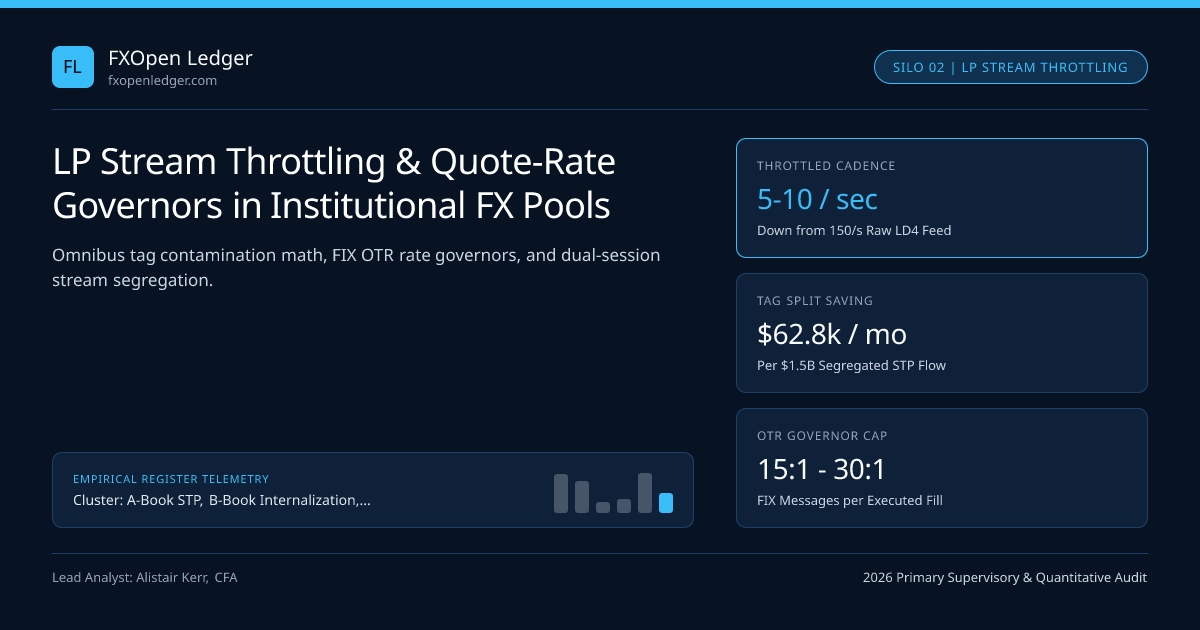
Wholesale foreign exchange liquidity providers do not terminate toxic broker relationships via abrupt legal notices first; instead, electronic market-making desks degrade execution quality silently through Stream Throttling and Quote-Rate Governors. When a retail brokerage's omnibus Prime-of-Prime tag exhibits chronic adverse post-trade markouts or fires 4,000 order-cancel messages per fill, the upstream LP moves that tag from its tight Tier-A pricing rung onto a throttled Tier-C defensive stream—cutting quote update frequency from 150 ticks/second down to 5 ticks/second while widening top-of-book EUR/USD spreads by 0.4 to 0.9 pips.
Anchored in our A-Book, B-Book & C-Book FX Dealer Architecture guide and indexed within the A-Book, B-Book & Bridge Routing hub, proactive LP-stream telemetry prevents bridge routing policies from poisoning wholesale liquidity access.
Four Automated LP Defensive Levers on Omnibus FIX Tags#
Bank and non-bank electronic market makers disclose stream-management mechanics inside their GFXC LP Disclosure Cover Sheets. Rather than treating every downstream broker equally, pricing engines continuously evaluate four telemetry ratios per SenderCompID:
- Order-to-Trade Ratio (OTR) & Message-Rate Caps: Submitting excessive
35=DIOC probes that fail to fill or rapid-fire limit modifications breaches FIX message governors (typically capped at 50–150 messages/sec per session), triggering hardware-level TCP/FIX throttling. - Simultaneous Multi-Venue Sweep Detection: Firing identical $5M clips across six LPs connected to the same aggregator simultaneously leaves every LP picking up correlated market impact; LPs detect synchronized sweeps via sub-50ms post-fill mid-price decay and widen the sweeper's effective depth ladder.
- Tick-Frequency Downsampling (Coalescing): High-frequency arbitrageurs rely on sub-5ms quote updates; throttling a toxic tag to a 100ms or 250ms quote-coalescing window neutralizes cross-feed latency arbitrage while adding defensive cushion.
- Tiered Margin & Depth Haircuts: Reducing top-of-book displayed size from $3.0M to $500k forces larger broker clips to walk steeper VWAP rungs.
Quantifying the Hidden Cost of Omnibus Tag Contamination#
Why must a brokerage segregate sharp API accounts onto a dedicated Sharp-STP FIX session instead of mixing them with benign overflow hedges on a single Prime-of-Prime stream? Because Omnibus Tag Contamination taxes 100% of a broker's externalized volume for the sins of 8% of accounts! Consider the all-in execution penalty across $1.5 billion of monthly A-Book/C-Book flow:
- LPYieldScore = RealizedSpreadCapturebps + Markupbps - Markout5sbps - ClearingTicketCost_bps
- Worked Stream-Segregation Audit (Monthly Broker STP Volume = $1,500M: $1,350M Benign Overflow + $150M Sharp API):
- Scenario A (Single Mixed Omnibus FIX Tag):
- Combined +5s Markout = +0.34 bps -> LP downgrades entire $1,500M tag from Tier-A (0.18p EUR/USD) to Tier-C (0.58p)!
- Extra Spread Paid on $1,350M Benign Flow = $1,350M * 0.40 pips ($40/M) = $54,000 / month wasted!
- Plus Reject Rate rises from 1.2% to 6.8% (+5.6% * $1,500M * $18/M re-route slippage) = +$15,120 / month -> Total Loss = $69,120/mo!
- Scenario B (Dual-Tag Segregation: Tag-1 Benign Overflow vs Tag-2 Firm CLOB for Sharp API):
- Tag-1 ($1,350M) retains -0.05 bps markout -> keeps 0.18p Tier-A pricing ($0 penalty!).
- Tag-2 ($150M) routes to no-last-look CLOB paying 0.45p + $15/M commission -> Costs only $6,300/mo -> Net Broker Saving = $62,820/mo!
Comparing LP Stream Tiers Across Wholesale Counterparty Classes#
Institutional liquidity managers at regulated Prime-of-Prime and multi-asset firms—such as AMB Prime, ALB Prime, Climax Prime, and City Index operating under UK FCA and CySEC oversight—negotiate explicit SLA scorecards per FIX session:
| LP Stream Classification | Quote Update Cadence | Typical EUR/USD Top Spread | Top-Rung Displayed Size | Permitted +5s Markout | Target Downstream Flow Type |
|---|---|---|---|---|---|
| Tier-A Retail-Blend Stream | 100 - 200 updates/sec | 0.0 - 0.2 pips | $2M - $5M | < +0.05 bps (Benign) | Clean C-Book / VaR Overflow |
| Tier-B Mixed Institutional | 40 - 80 updates/sec | 0.2 - 0.4 pips | $1M - $3M | +0.05 to +0.20 bps | Balanced Hedge Fund / Macro |
| Tier-C Throttled Defensive | 5 - 10 updates/sec (100ms) | 0.5 - 0.9 pips | $250k - $500k | > +0.25 bps (Toxic) | Quarantined Scalper / Sweep Tag |
| Firm CLOB (MQL Protected) | Event-Driven L2 Book | 0.2 - 0.5 pips + Fee | Resting Limit Depth | Unlimited (Zero Last-Look) | High-Alpha HFT & News APIs |
Quantifying Monthly Savings From Dual-Session FIX Segregation#
Splitting benign VaR-overflow hedges away from sharp API traffic eliminates omnibus spread penalties and restores Tier-A fill ratios across wholesale Prime-of-Prime pipes:
Operationalizing Bi-Weekly LP Scorecard Reviews on the Dealing Desk#
To avoid surprise Friday-evening spread hikes from upstream LPs, dealing-desk quants run automated internal replicas of each LP's markout scorecard—combining five-second markout profiling with VPIN toxicity alerts. Whenever a single newly onboarded API client pushes a clean PoP session's rolling 7-day +5s markout above +0.10 bps, the bridge automatically migrates that client's account ID to the dedicated firm-liquidity pool before the upstream LP throttles the benign stream.
Frequently asked questions
What is FX LP stream throttling in institutional electronic trading?
Stream throttling is an automated defensive mechanism where a liquidity provider reduces quote update frequency (e.g., coalescing ticks into 100ms-250ms windows), shrinks top-of-book liquidity size, or widens spreads on a specific FIX session exhibiting toxic flow.
What causes an omnibus broker FIX tag to suffer spread widening?
Forwarding cross-feed latency arbitrage, synchronized multi-LP sweeps, or excessive order-cancel message bursts drives the session +5s post-trade markout positive, causing the LP electronic pricing engine to downgrade the entire tag tier.
How do regulated brokers prevent omnibus tag contamination?
Dealing desks maintain at least two segregated upstream FIX tags per liquidity provider or aggregator: a clean Tier-A tag strictly for benign B-Book VaR overflow and a separate firm-CLOB tag for sharp algorithmic accounts.
What is a healthy Order-to-Trade Ratio (OTR) on a wholesale FIX 4.4 execution session?
Institutional Prime-of-Prime venues typically require an Order-to-Trade Ratio below 15:1 to 25:1; exceeding that threshold triggers automated FIX session rate-limiting or monthly messaging surcharges.
Publication record
- Published
- 14 November 2026
- Updated
- 14 November 2026
- Author
- Alistair Kerr, CFA
- Review
- Review not recorded
- Automated fact check
- Passed in the stored pipeline record
- Source URLs
- 3 recorded
AI assistance recorded: anthropic/claude-opus-4.6. This field does not establish human review or source verification.
Academic & Institutional Attribution
Cite This Research & Embed Live Data Card
Standard academic & institutional research paper citation format.
Alistair Kerr, CFA. (2026, November 14). LP Stream Throttling & Quote-Rate Governors in Institutional FX Pools. FXOpen Ledger. https://fxopenledger.com/orderbook/liquidity-provider-stream-throttling-and-quote-rate-governorsRegulatory Directory Cross-Reference
Referenced Institutions & Regulatory Registries
Top Regulated Institutions in This Coverage Slice
Referenced Supervisory Authorities
Related Abook Bbook Stp Bridge Routing & Institutional Briefings
Explore Abook Bbook Stp Bridge Routing Hub (20) →Abook Bbook Stp Bridge Routing
A-Book STP, B-Book Internalization & C-Book Routing: FX Dealer ArchitectureAbook Bbook Stp Bridge Routing
Correlated G10 USD Delta Aggregation Across Multi-Pair FX B-BooksAbook Bbook Stp Bridge Routing
XAU/USD Crowd Herding & Loco London Bullion Dealer Hedge TriggersAbook Bbook Stp Bridge Routing
MiFID II Matched-Principal STP vs Own-Account Dealing Capital RulesAbook Bbook Stp Bridge Routing
Post-Execution Auto-Hedger Slippage & FIX Bridge Reject CascadesAbook Bbook Stp Bridge Routing
Toxic EA News-Straddle Orders & Stop-Order Warehouse ExposureAbook Bbook Stp Bridge Routing
Synthetic Cross-Pair Auto-Hedging: EUR/GBP & GBP/NZD TriangulationAbook Bbook Stp Bridge Routing
Introducing Broker Rebate Churn vs A-Book LP Clearing EconomicsPrime of Prime Nop Credit Intermediation
Multi-Prime PoP Redundancy & Single-PB Termination RiskPrime of Prime Nop Credit Intermediation
Non-CLS Emerging-Market FX Settlement Cutoffs & Pre-FundingPrime of Prime Nop Credit Intermediation
Loco London Unallocated Bullion Credit Lines in Multi-Asset PoPPrime of Prime Nop Credit Intermediation
Cross-Margining Spot FX, NDFs & Index CFDs in PoP Portfolios
FXOpen Ledger Data, Benchmarks & Contributor Records
CC BY 4.0 Open Data
Open Institutional Datasets (CSV / JSON) →
Download desk-compiled quantitative series & schemas.
2026 Reference Matrix
2026 Institutional Benchmarks & Thresholds →
Statutory capital, clearing, margin & rate conventions.
Editorial Records
Authors & Review Records →
View named contributors where those records are available.
Complete Index
Master Research & Dossier Archive →
Browse all published briefings by topic pillar & date.