
Abook Bbook Stp Bridge Routing
MiFID II Matched-Principal STP vs Own-Account Dealing Capital Rules
Operating a pure A-Book matched-principal STP brokerage requires five times less permanent initial regulatory capital under EU IFR and UK IFPR than running a B-Book or C-Book own-account warehouse.
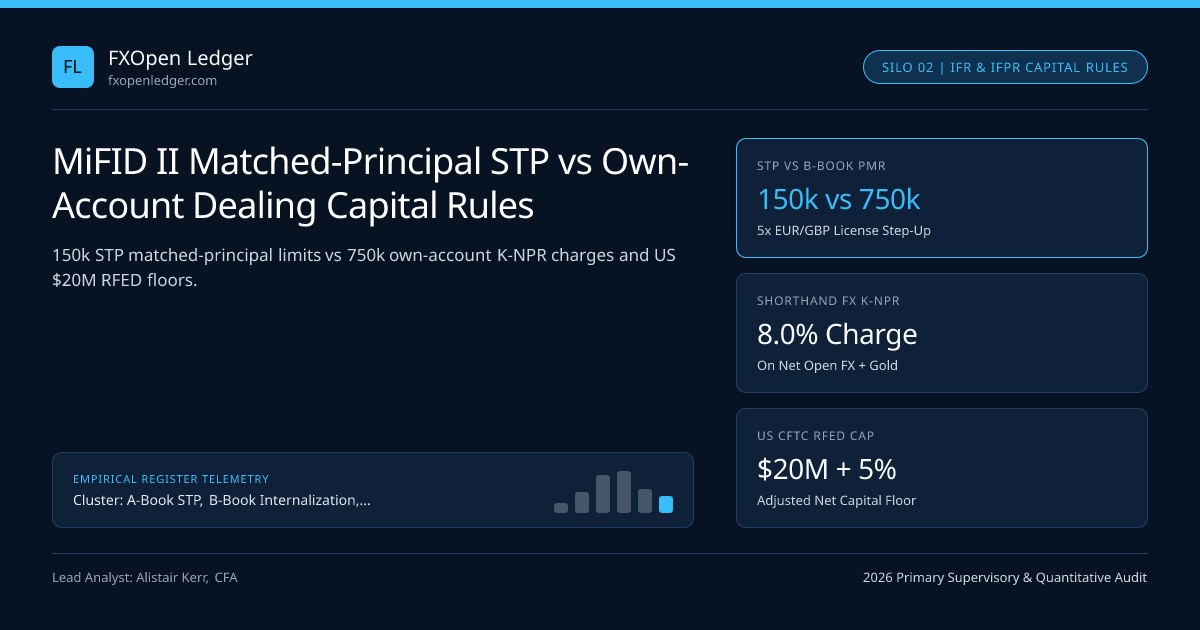
Before writing a single line of liquidity-bridge routing logic, an OTC foreign exchange or CFD investment firm's board must align its execution model with its Prudential Regulatory License Perimeter. Across the European Union (Regulation (EU) 2019/2033 IFR / Directive IFD) and the United Kingdom (FCA IFPR / MIFIDPRU), a bright statutory red line separates Matched-Principal STP Intermediation (EUR 150,000 / GBP 150,000 Permanent Minimum Capital) from Dealing on Own Account (EUR 750,000 / GBP 750,000 Permanent Minimum Capital plus continuous market-risk K-factor add-ons). Warehouse even a single unhedged 0.10-lot B-Book residual—or delay an A-Book hedge by 15 seconds to capture internal netting—and a 150k firm commits a serious regulatory license breach!
Anchored in our A-Book, B-Book & C-Book FX Dealer Architecture guide, reinforced by CySEC, ASIC & FCA conflict disclosures and STP agency commission vs spread models, and indexed inside the A-Book, B-Book & Bridge Routing hub, compliance and treasury officers engineer bridge locks around IFR/IFPR K-factor thresholds.
Strict Statutory Conditions for Matched-Principal Exemption#
Under MiFID II Article 4(1)(38) and FCA MIFIDPRU Handbook rules, Matched Principal Trading occurs only when the facilitator interposes itself between buyer and seller to a transaction in such a way that:
- Simultaneous Execution: Both legs (client CFD leg and offsetting wholesale LP leg) execute simultaneously on a back-to-back basis via Straight-Through Processing—zero time-decayed B-Book delay buffers are permitted!
- Zero Market-Risk Exposure: The firm is never exposed to market risk throughout the execution of the transaction, other than counterparty credit risk if a party defaults.
- Remuneration Limited to Disclosed Fee/Markup: The firm earns only a previously disclosed commission, fee, or deterministic spread markup—never speculative price changes between entry and hedge.
- NBP Gap-Risk Caveat: Both ESMA and CySEC warn that if a
150kSTP broker offers retail Negative Balance Protection without obtaining mirror NBP or contractual loss-capping from its upstream Prime-of-Prime LP, weekend gap asymmetry can constitute unhedged market risk requiring ICARA/ICAAP add-ons!
Calculating Binding IFR / IFPR Own Funds Across Both Models#
Under IFR Article 11 and FCA MIFIDPRU 4.3, a Class 2 investment firm's Own Funds Requirement (OFR) is the highest of three pillars: Permanent Minimum Capital ($PMR$), Fixed Overheads Requirement ($FOR = 0.25 \times Annual\Fixed\Costs$), or Total K-Factor Requirement ($KFR = K\text{-}RtC + K\text{-}RtM + K\text{-}RtF$). Let us compute the exact capital impact of warehousing a $18M B-Book versus pure STP:
- Shorthand FX K-NPR = 0.08 * ( MAX(SumNetLongFX, SumNetShortFX) + NetGoldNotional )
- Worked Prudential Comparison (Mid-Market Broker: EUR 3.2M Annual Fixed Overheads -> FOR = EUR 800,000; Daily Deriv Flow = EUR 250M):
- 1. Pure Matched-Principal A-Book Firm (Zero Net Open FX; Zero Unhedged Gold):
- PMR = EUR 150,000 | FOR = EUR 800,000.
- KNPR = EUR 0 | KDTF (0.01% of avg daily deriv flow * 9m scale) = ~EUR 25,000 | K_TCD (hedged PoP margin) = ~EUR 95,000 -> KFR = EUR 120,000.
- Binding Statutory OFR = MAX(150k, 800k, 120k) = EUR 800,000 (Driven purely by Fixed Overheads!).
- 2. Hybrid B-Book / C-Book Own-Account Firm (EUR 14.0M Net Shorthand FX + EUR 4.0M Net XAU/USD + EUR 320k K_TCD):
- PMR = EUR 750,000 | FOR = EUR 800,000.
- K_NPR = 0.08 * (14,000,000 + 4,000,000) = EUR 1,440,000!
- Total KFR = 1,440,000 (K-NPR) + 320,000 (K-TCD) + 25,000 (K-DTF) = EUR 1,785,000!
- Binding Statutory OFR = MAX(750k, 800k, 1,785k) = EUR 1,785,000 (+123% higher regulatory capital lockup!).
Global Licensing & Capital Comparison Across Key FX Hubs#
Institutional counterparties compare statutory capital floors and B-Book permissions across major supervisory regimes—verifiable inside our supervisors index across FCA, CySEC, ASIC, FINMA, and CFTC:
| Regulatory Regime | Matched-Principal STP Floor | Own-Account B-Book Floor | Dynamic Risk Add-On Framework | Retail FX Leverage Ceiling |
|---|---|---|---|---|
| UK FCA (IFPR) | GBP 150,000 | GBP 750,000 | K-NPR + K-TCD + ICARA Pillar 2 | 30:1 Majors / 20:1 Gold (City Index) |
| CySEC / ESMA (IFR) | EUR 150,000 | EUR 750,000 | EU IFR K-Factors + ICAAP | 30:1 Majors / 20:1 Gold (BOSSA) |
| ASIC (RG 166) | AUD 1,000,000 NTA | AUD 1,000,000+ NTA (10% Rev) | Adjusted Surplus Liquid Funds | 30:1 Majors / 20:1 Gold |
| US CFTC (RFED) | N/A (RFED Principal Rule) | USD 20,000,000+ Adjusted Net Cap | +5% of Retail Liabilities >$10M | 50:1 Majors / 20:1 Minors |
Statutory Capital Lockup Across Global FX Supervisory Regimes#
Contrasting permanent minimum capital floors and dynamic K-NPR position charges across UK, EU, Australian, and US rulebooks clarifies balance-sheet efficiency trade-offs:
Optimizing Return on Regulatory Capital (RoRC) Before Midnight Reporting#
Notice a critical treasury insight in the K-NPR equation: regulatory snapshots capture end-of-day and intraday net open currency exposure. A 750k hybrid C-Book firm that allows $18M of lazy unhedged G10 + Gold delta to sit overnight ties up EUR 1.44M of CET1 cash in K-NPR alone! By flattening non-alpha directional drift via low-cost wholesale EOD hedges while retaining intraday benign netting, dealing desks boost Return on Regulatory Capital (RoRC) by 40% to 65% while staying well inside ICARA liquid-asset thresholds.
Frequently asked questions
Can a EUR 150,000 matched-principal STP broker hold small odd-lot residuals in a B-Book?
No. Under MiFID II Article 4(1)(38) and IFR/IFPR rules, holding proprietary market risk—even via micro-lot aggregation buckets or delayed hedging—constitutes Dealing on Own Account and requires the EUR/GBP 750,000 license tier.
How is the 8% K-NPR foreign-exchange capital requirement calculated?
Under the IFR/IFPR shorthand FX method, the firm converts net positions in each foreign currency into reporting currency, takes the larger of total net long or total net short currency positions, adds net gold exposure, and multiplies by 8%.
Why do US retail forex dealers require $20 million minimum capital?
Under CFTC Regulation 5.7 and NFA Financial Requirements Section 11, Retail Foreign Exchange Dealers (RFEDs) and FCMs must maintain at least $20,000,000 in Adjusted Net Capital plus 5% of total retail forex liabilities exceeding $10 million.
What happens if Fixed Overheads exceed both PMR and K-Factor totals?
Because Own Funds Requirement equals the maximum of PMR, Fixed Overheads Requirement (25% of prior-year fixed expenses), and K-Factors, a lean STP firm with high technology/staff overheads is bound by its 25% Fixed Overheads floor.
Publication record
- Published
- 14 November 2026
- Updated
- 14 November 2026
- Author
- Alistair Kerr, CFA
- Review
- Review not recorded
- Automated fact check
- Passed in the stored pipeline record
- Source URLs
- 3 recorded
AI assistance recorded: anthropic/claude-opus-4.6. This field does not establish human review or source verification.
Academic & Institutional Attribution
Cite This Research & Embed Live Data Card
Standard academic & institutional research paper citation format.
Alistair Kerr, CFA. (2026, November 14). MiFID II Matched-Principal STP vs Own-Account Dealing Capital Rules. FXOpen Ledger. https://fxopenledger.com/orderbook/mifid-ii-matched-principal-vs-dealing-on-own-account-capitalRegulatory Directory Cross-Reference
Referenced Institutions & Regulatory Registries
Top Regulated Institutions in This Coverage Slice
Related Abook Bbook Stp Bridge Routing & Institutional Briefings
Explore Abook Bbook Stp Bridge Routing Hub (20) →Abook Bbook Stp Bridge Routing
A-Book STP, B-Book Internalization & C-Book Routing: FX Dealer ArchitectureAbook Bbook Stp Bridge Routing
Post-Execution Auto-Hedger Slippage & FIX Bridge Reject CascadesAbook Bbook Stp Bridge Routing
Toxic EA News-Straddle Orders & Stop-Order Warehouse ExposureAbook Bbook Stp Bridge Routing
Synthetic Cross-Pair Auto-Hedging: EUR/GBP & GBP/NZD TriangulationAbook Bbook Stp Bridge Routing
Introducing Broker Rebate Churn vs A-Book LP Clearing EconomicsAbook Bbook Stp Bridge Routing
FCA, ASIC & CySEC Execution-Venue Conflicts-of-Interest DisclosuresAbook Bbook Stp Bridge Routing
Shadow A-Book Paper-Hedging Analytics for Dealing-Desk CalibrationAbook Bbook Stp Bridge Routing
MT4/MT5 Liquidity Bridge Topology: FIX Routing Latency & Markup AuditPrime of Prime Nop Credit Intermediation
Cross-Margining Spot FX, NDFs & Index CFDs in PoP PortfoliosPrime of Prime Nop Credit Intermediation
FXPB Give-Up Ticket Surcharges & Small-Clip Aggregation MathPrime of Prime Nop Credit Intermediation
Treasury-Bill Collateral Haircuts & Rehypothecation at FXPBsPrime of Prime Nop Credit Intermediation
Close-Out Netting & Default Waterfalls Under the 2002 ISDA Master
FXOpen Ledger Data, Benchmarks & Contributor Records
CC BY 4.0 Open Data
Open Institutional Datasets (CSV / JSON) →
Download desk-compiled quantitative series & schemas.
2026 Reference Matrix
2026 Institutional Benchmarks & Thresholds →
Statutory capital, clearing, margin & rate conventions.
Editorial Records
Authors & Review Records →
View named contributors where those records are available.
Complete Index
Master Research & Dossier Archive →
Browse all published briefings by topic pillar & date.