
Abook Bbook Stp Bridge Routing
FCA, ASIC & CySEC Execution-Venue Conflicts-of-Interest Disclosures
Claiming "Pure ECN / No Dealing Desk" marketing while internalizing retail orders on a B-Book triggers severe enforcement fines under FCA Consumer Duty, ESMA MiFID II, and ASIC RG 227.
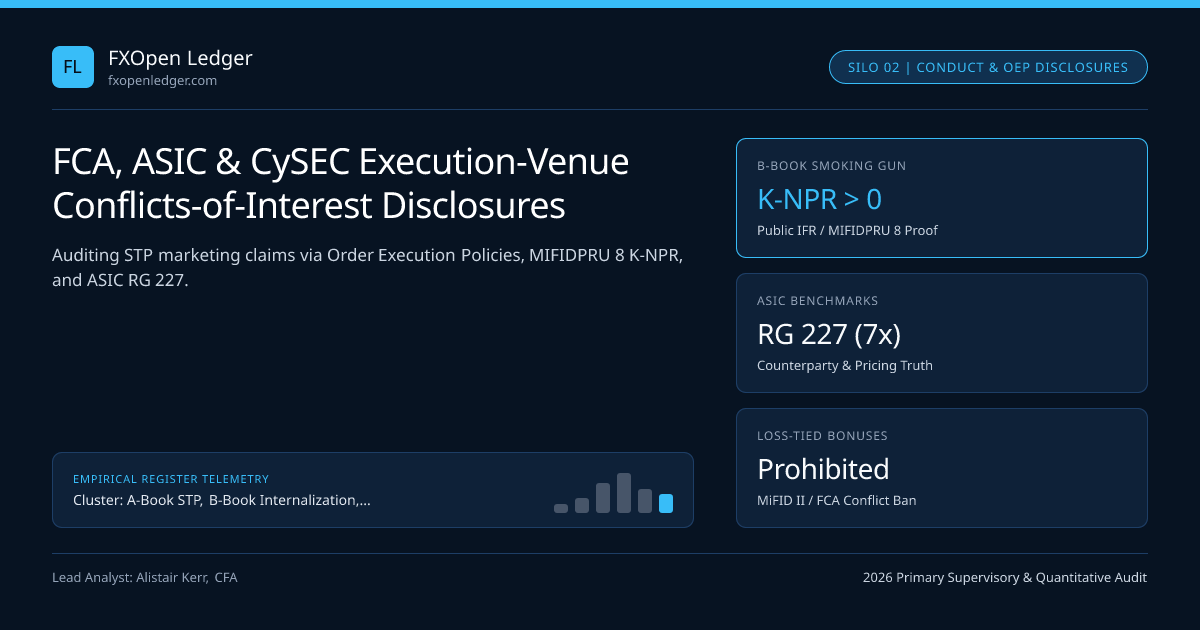
Nothing triggers a multi-million-dollar regulatory enforcement action faster in retail and institutional OTC derivatives than Misleading Execution-Model Marketing—advertising "100% Pure ECN / True STP / Zero Dealing Desk" on a homepage while quietly warehousing 85% of client orders inside a principal B-Book! Across the UK FCA (COBS 11.2A & Consumer Duty), ESMA / CySEC (MiFID II Articles 23, 24 & 27), ASIC (Regulatory Guide 227), and the US CFTC, internalizing flow as a principal counterparty is completely lawful under an Own-Account license—provided the firm discloses its counterparty capacity truthfully, manages conflicts of interest structurally, and proves reference prices track independent wholesale benchmarks.
Anchored in our A-Book, B-Book & C-Book FX Dealer Architecture guide and indexed inside the A-Book, B-Book & Bridge Routing hub, institutional due-diligence teams cross-check marketing claims against statutory Order Execution Policies (OEP) and audited Pillar 3 / IFPR disclosures.
Four Mandatory Disclosures in a Compliant Order Execution Policy#
How can an investor or institutional allocator tell in three minutes whether a broker operates as a pure MiFID II matched-principal STP conduit or a principal B-Book/C-Book market maker? Read four legally binding sections of its statutory disclosure pack:
- Execution Venue Identification: If the Order Execution Policy states "“[Firm Legal Name] acts as the sole Execution Venue for all client CFD transactions, dealing as Principal on Own Account,”" then the client's legal counterparty is 100% the broker itself—regardless of whether the broker subsequently hedges 0%, 40%, or 100% of its corporate market risk upstream!
- Underlying Reference Price Construction: Under ASIC RG 227 Benchmark 5 and MiFID II Article 27, a principal dealer must specify how it derives quotes from independent external liquidity providers without arbitrary dealer skew against stop-losses.
- Remuneration & Dealing-Desk Compensation Firewall: Staff compensation inside Risk and Dealing rooms must never be tied directly to daily client B-Book trading losses (
Client Loss Bonus Prohibition). - Symmetric Slippage & Re-Quote Policy: Explicit confirmation that positive price improvement passes to Limit and Market orders symmetrically alongside negative slippage.
The Pillar 3 / MIFIDPRU Smoking Gun: Auditing K-NPR & Revenue Split#
Even when a brokerage writes vague legalese in its Order Execution Policy, its annual audited IFPR MIFIDPRU 8 / EU IFR Part Six Public Disclosure and statutory income statement expose exact B-Book internalization mathematically:
- ImpliedNetOpenBBookExposure = ReportedShorthandFXKNPRCapital / 0.08
- Worked Public-Filing Forensic Audit (Comparing Two EU/UK Regulated Broker Entities):
- Entity Alpha (Claims "Institutional ECN/STP"):
- Public MIFIDPRU 8 Filing reports K-NPR (Net Position Risk) = GBP 1,920,000; K-DTF = GBP 35,000.
- Implied Net Open Unhedged FX + Gold Warehouse = GBP 1,920,000 / 0.08 = GBP 24,000,000!
- Income Statement: GBP 38.4M Net Principal Dealing Revenue vs GBP 4.1M Commission -> 90.4% Principal B-Book Driven!
- > Marketing "No Dealing Desk / Pure STP" would constitute a direct FCA Consumer Duty / MiFID II Art. 24 violation!
- Entity Beta (True Matched-Principal Prime-of-Prime):
- Public Filing reports PMR = GBP 150,000; K-NPR = GBP 0; Revenue = 100% Agency Commission & Markup -> Verified Pure STP!
Cross-Jurisdictional Conduct Rules on Execution Conflicts#
Compliance teams map exact statutory obligations across primary regulatory hubs tracked in our supervisors database—governing firms from City Index and AMB Prime to 4XC, BOSSA, and Blue Suisse:
| Supervisory Authority | Primary Statutory Rulebook | "ECN / STP" Marketing Rule | Principal B-Book Disclosure | Best-Execution Price Audit |
|---|---|---|---|---|
| UK FCA | COBS 11.2A, PRIN 12 (Consumer Duty) | Strictly Prohibited if Principal Counterparty | Explicit OEP + MIFIDPRU 8 K-NPR | Fair Value & Symmetric Slippage |
| ESMA / CySEC | MiFID II Art. 23, 24, 27 & Circulars | Banned Unless True Multilateral / STP | Mandatory Conflict Policy + IFR Part 6 | Independent Wholesale Tick Check |
| ASIC | RG 227 (7 Disclosure Benchmarks) | Misleading Conduct (Corps Act s1041H) | Benchmark 2 (Counterparty Model) | Benchmark 5 (Transparent Pricing) |
| US CFTC / NFA | CEA & NFA Compliance Rule 2-36 | Must State RFED Acts as Principal | Mandatory Risk Disclosure Statement | Strict Symmetric Slippage Rule (NFA) |
Empirical Pillar 3 & Revenue Fingerprints by Execution Model#
Inspecting audited K-NPR capital ratios alongside principal-versus-commission income splits provides objective verification of counterparty execution disclosures:
Maintaining Chinese Walls Between Risk Hedging and Client Execution#
How does a hybrid C-Book brokerage—legitimately licensed for Dealing on Own Account—satisfy FCA, CySEC, and ASIC conflict-of-interest audits? By enforcing three hard Technical Chinese Walls inside the liquidity bridge:
- Client Fill Independence: Client order execution price depends solely on the live aggregated wholesale reference book plus pre-disclosed group markup—never on whether the house book is currently long or short!
- Post-Fill Hedging Separation: Internalization versus C-Book hedging decisions occur after or independently of client price determination, using portfolio quote skewing within narrow fair-value bands rather than ad-hoc manual dealer re-quotes.
- Quarterly Independent TCA Sign-Off: Compliance officers sample 10,000 executed client fills per quarter against independent Bloomberg BGN / LSEG tick mid-points, archiving proof of symmetric slippage alongside our dealer comparison benchmarks.
Frequently asked questions
How can I verify if a regulated FX broker actually runs a B-Book despite STP marketing?
Check two public documents: (1) the Order Execution Policy—if the broker names itself as the Execution Venue acting as Principal, it is your counterparty; (2) its annual MIFIDPRU 8 / IFR Pillar 3 disclosure—any K-NPR market-risk capital charge above zero proves unhedged B-Book positions.
Does acting as Principal Execution Venue always mean the broker wants clients to lose?
Not necessarily. In OTC CFD law, even a broker that hedges 100% of orders back-to-back with a Prime-of-Prime LP often contracts legally as Principal toward the retail client while offsetting market risk upstream.
What does ASIC Regulatory Guide 227 require from Australian CFD issuers?
ASIC RG 227 sets seven disclosure benchmarks requiring OTC CFD issuers to state clearly whether they use a market-maker or straight-through model, how counterparty conflicts are managed, and how underlying reference prices and margin calls operate.
Are FX dealing-desk traders allowed to earn bonuses based on client B-Book losses?
No. Under ESMA MiFID II remuneration guidelines, CySEC circulars, and FCA Consumer Duty conflict rules, tying dealing-desk or sales staff variable pay directly to client losses is prohibited as an irreconcilable conflict of interest.
Publication record
- Published
- 14 November 2026
- Updated
- 14 November 2026
- Author
- Alistair Kerr, CFA
- Review
- Review not recorded
- Automated fact check
- Passed in the stored pipeline record
- Source URLs
- 3 recorded
AI assistance recorded: anthropic/claude-opus-4.6. This field does not establish human review or source verification.
Academic & Institutional Attribution
Cite This Research & Embed Live Data Card
Standard academic & institutional research paper citation format.
Alistair Kerr, CFA. (2026, November 14). FCA, ASIC & CySEC Execution-Venue Conflicts-of-Interest Disclosures. FXOpen Ledger. https://fxopenledger.com/orderbook/cysec-asic-fca-execution-venue-conflicts-of-interest-disclosuresRegulatory Directory Cross-Reference
Referenced Institutions & Regulatory Registries
Mentioned Regulated Institutions
Related Abook Bbook Stp Bridge Routing & Institutional Briefings
Explore Abook Bbook Stp Bridge Routing Hub (20) →Abook Bbook Stp Bridge Routing
A-Book STP, B-Book Internalization & C-Book Routing: FX Dealer ArchitectureAbook Bbook Stp Bridge Routing
Shadow A-Book Paper-Hedging Analytics for Dealing-Desk CalibrationAbook Bbook Stp Bridge Routing
MT4/MT5 Liquidity Bridge Topology: FIX Routing Latency & Markup AuditAbook Bbook Stp Bridge Routing
B-Book Risk Warehouse VaR Limits: Modeling Client PnL Tail VarianceAbook Bbook Stp Bridge Routing
Hybrid C-Book Alpha Profiling: Partial Delta Hedging & MultipliersAbook Bbook Stp Bridge Routing
VPIN Toxicity Scoring in Multi-Dealer FX Aggregators & Liquidity PoolsAbook Bbook Stp Bridge Routing
Five-Second Markout Profiling: Segmenting Sharp vs Benign FX FlowAbook Bbook Stp Bridge Routing
Quote Skewing vs Spread Widening: OTC FX Dealer Inventory Control MathPrime of Prime Nop Credit Intermediation
Evaluating PoP Counterparty Solvency: ICARA, MIFIDPRU & AuditsTom Next Swap Rollover Triple Wednesday
Spot FX T+2 Settlement Calendar & Wednesday Triple-Rollover MechanicsTom Next Swap Rollover Triple Wednesday
USD/CAD & USD/TRY T+1 Settlement: The Thursday Triple-Swap RuleTom Next Swap Rollover Triple Wednesday
Covered Interest Parity to Interbank Tom-Next Pips Derivation
FXOpen Ledger Data, Benchmarks & Contributor Records
CC BY 4.0 Open Data
Open Institutional Datasets (CSV / JSON) →
Download desk-compiled quantitative series & schemas.
2026 Reference Matrix
2026 Institutional Benchmarks & Thresholds →
Statutory capital, clearing, margin & rate conventions.
Editorial Records
Authors & Review Records →
View named contributors where those records are available.
Complete Index
Master Research & Dossier Archive →
Browse all published briefings by topic pillar & date.