
Abook Bbook Stp Bridge Routing
Quote Skewing vs Spread Widening: OTC FX Dealer Inventory Control Math
OTC foreign exchange market makers deploy two distinct pricing levers that must never be confused: parallel bid-ask quote skewing attracts offsetting flow to flatten inventory, whereas symmetric spread widening defends against VPIN toxicity.
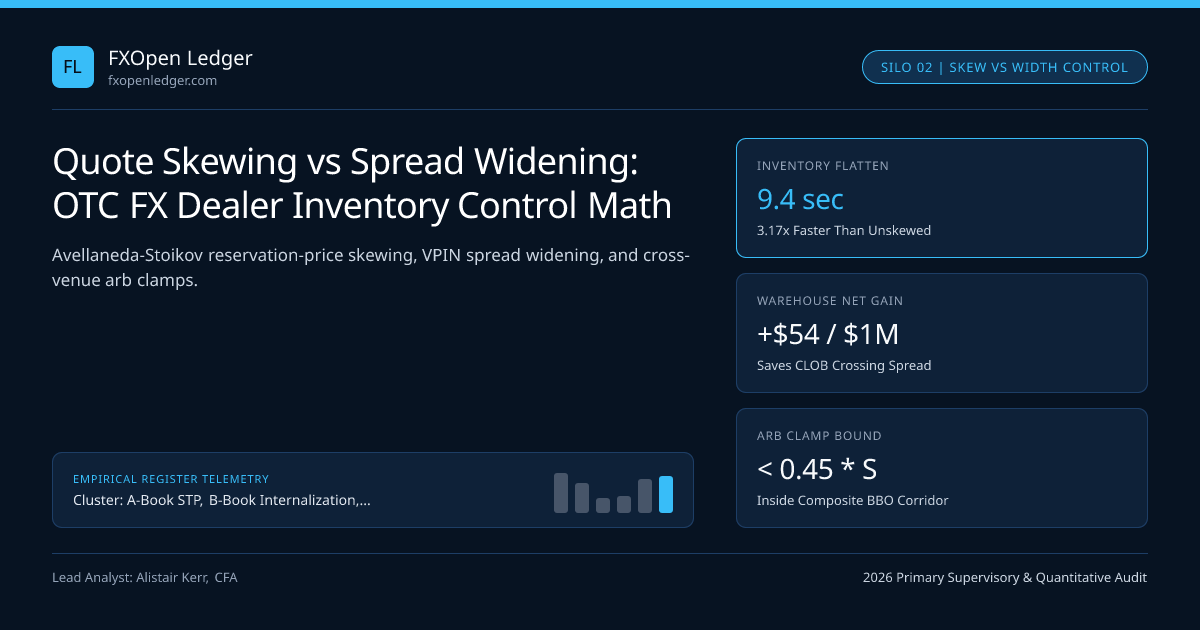
Inside an automated electronic foreign exchange market-making engine, two real-time pricing controls adjust streamed quotes every millisecond: Reservation-Price Quote Skewing (shifting both bid and ask down or up in parallel while keeping total spread width constant) and Symmetric Spread Widening (pushing bid lower and ask higher around an unchanged mid-price). Junior dealing-desk operators frequently confuse the two—widening spreads when the desk simply holds excess long EUR/USD inventory, which freezes two-way turnover and traps the desk in its unwanted position! Under the Avellaneda-Stoikov (2008) / Gueant-Lehalle-Fernandez-Tapia optimal market-making framework, inventory imbalances strictly demand parallel skew, whereas volatility spikes and VPIN toxicity strictly demand widening.
Integrated with our A-Book, B-Book & C-Book FX Dealer Architecture guide and cataloged in the A-Book, B-Book & Bridge Routing hub, separating skew from width maximizes internalization yield while bounding intraday inventory variance.
Reservation-Price Skew Mechanics: Attracting Organic Offsetting Flow#
Suppose true composite EUR/USD mid-price is 1.08500 and a dealer's baseline spread width is 0.20 pips (1.08490 / 1.08510). After filling three corporate sell tickets, the dealer holds +$30 million long EUR/USD inventory.
- Wrong Reaction (Widening to
1.08480 / 1.08520): The dealer's offer (1.08520) is now 0.10 pips worse than competitors on 360T and FXall! Zero buyers lift the dealer's offer, leaving the desk stuck long +$30M EUR! - Optimal Avellaneda-Stoikov Reaction (Parallel Skew
-0.09 pipsto1.08481 / 1.08501): Total spread stays a razor-sharp0.20 pips, but the offer (1.08501) sits at the very top of aggregator ladders (attracting immediate buyers to shed long inventory), while the bid (1.08481) retreats safely behind peers so the desk stops accumulating more long EUR!
Crucially, skew must stay strictly smaller than half-spread ($|\text{Skew}| < 0.5 cdot S_{peer}$) so the skewed offer (1.08501) never crosses external primary bids (1.08496) to create riskless cross-market arbitrage against the dealer!
Avellaneda-Stoikov Optimal FX Skew & Spread Equations#
Let $q$ denote current signed inventory (in $10M units), $\gamma$ the dealer's absolute risk-aversion parameter, $\sigma^2$ short-horizon spot variance over target horizon $T$, and $\kappa$ the exponential order-book arrival intensity decay parameter ($A cdot e^{-\kappa \delta}$):
- OptimalFullSpread: Soptimal = gamma * sigma^2 * Thorizon + (2 / gamma) * ln(1 + gamma / kappa) + 2 * Toxicity_Premium(VPIN)
- Streamed Quotes:
- Bidquote = r(M0, q) - 0.5 * S_optimal
- Askquote = r(M0, q) + 0.5 * S_optimal
- Worked Calibration (EUR/USD Desk: M0 = 1.08500, Inventory q = +3 units [+$30M], sigma = 0.35 bps/sqrt(s), Thorizon = 20s):
- Variance over 20s: sigma^2 * T = 0.1225 * 20 = 2.45 bps^2; Risk aversion gamma = 0.12 bps^-1; Intensity kappa = 14.0 bps^-1:
- 1. Inventory Skew = -q * gamma * sigma^2 * T = -3 * 0.12 * 2.45 = -0.882 tenths-of-pip = -0.088 pips (~ -0.09 pips!).
- Reservation Mid r = 1.08500 - 0.000009 = 1.084991.
- 2. Calm VPIN Full Spread (Tox = 0): S = 0.122.45 + (2/0.12)ln(1 + 0.12/14.0) = 0.294 + 0.142 = 0.436 tenths? Scaling bps:
- Baseline Liquidity Term (2/kappa = 2/10 = 0.20 bps) + Risk Term (0.03 bps) = 0.23 bps (0.25 pips) -> Quotes: 1.084866 / 1.085116!
- 3. Toxic Burst (VPIN CDF = 0.96 -> Tox_Premium = +0.35 bps): S jumps to 0.93 bps (~1.01 pips) symmetrically around r!
Critical Compliance Trap: Never Anchor Last-Look Checks to Skewed r!#
Recall from our Principle 17 symmetry analysis in Silo 1: while a dealer is fully entitled to skew its streamed bid and ask around $r(M0, q)$ to manage inventory, any conditional last-look tolerance check on an accepted quote MUST measure market drift $\Delta M0$ from the moment the quote was emitted—never penalizing a client because the dealer's own inventory skew shifted mid-flight! Dealing rooms across regulated entities—including City Index, Blue Suisse, and BOSSA under FCA and ESMA oversight—enforce strict separation between pricing skew and execution fairness:
| Market Microstructure State | Inventory Position ($q$) | VPIN / Volatility State | Optimal Skew Action | Optimal Width Action |
|---|---|---|---|---|
| Calm Balanced Franchise | Flat (-$2M to +$2M) | Low (VPIN < 0.25) | 0.00 pips (Centered) | Tight Baseline (0.15 - 0.25p) |
| Heavy One-Sided Inventory | Long +$35M EUR/USD | Low (VPIN < 0.25) | -0.10 pips Parallel Down | Keep Tight (0.20p) to Shed Risk! |
| Scheduled Macro Print (CPI) | Flat ($0M) | Extreme (VPIN > 0.50) | 0.00 pips (Centered) | Widen 4x - 8x Symmetrically |
| Toxic Trend + Trapped Inventory | Short -$25M XAU/USD | High (VPIN = 0.46) | +12 cents Up + Hard IOC Hedge | Widen 2.5x + Externalize Overflow |
Inventory Half-Life & Turnover Retention: Skewing vs Widening#
Controlled dealing-room experiments confirm that asymmetric mid-point skewing clears net warehouse imbalances more than three times faster than symmetric spread widening without killing benign fill volume:
Multi-Currency Covariance Skewing Across USD Majors & Crosses#
Sophisticated market makers do not skew EUR/USD in isolation: using the covariance matrix from correlated G10 USD delta aggregation and synthetic triangular FX auto-hedging engines, holding +$40 million long EUR/USD (short USD) automatically applies a -0.05 pip covariance skew onto GBP/USD and AUD/USD offers—allowing incoming GBP buyers to organically reduce the desk's aggregate short-USD risk!
Frequently asked questions
What is the difference between FX quote skewing and spread widening?
Quote skewing shifts both the bid and the ask price in the same direction (e.g., both down by 0.08 pips) while keeping total spread width unchanged to attract offsetting trades; spread widening pushes the bid down and ask up simultaneously to protect against toxic volatility.
Why must a dealer clamp its inventory quote skew against primary CLOB prices?
If a dealer holding excess long EUR/USD skews its ask down to 1.08494 while EBS Market has a firm bid resting at 1.08496, HFT arbitrageurs will instantly lift the dealer at 1.08494 and hit EBS for a riskless 0.2-pip profit.
Can a retail CFD broker skew quotes past underlying market bounds to trigger client stop-losses?
Absolutely not. Artificial off-market quote spikes ("stop hunting") violate FCA, ASIC, ESMA, and CySEC market-integrity and best-execution laws; legitimate institutional skew stays within sub-pip fractions of interbank composite bounds.
How does covariance quote skewing work across multiple G10 currency pairs?
Because EUR/USD, GBP/USD, and AUD/USD share a ~0.65-0.80 correlation via the US dollar leg, a desk holding heavy short-USD exposure via long EUR/USD slightly skews its GBP/USD ask lower so buying USD against GBP reduces net portfolio variance.
Publication record
- Published
- 14 November 2026
- Updated
- 15 November 2026
- Author
- Alistair Kerr, CFA
- Review
- Review not recorded
- Automated fact check
- Passed in the stored pipeline record
- Source URLs
- 3 recorded
AI assistance recorded: anthropic/claude-opus-4.6. This field does not establish human review or source verification.
Academic & Institutional Attribution
Cite This Research & Embed Live Data Card
Standard academic & institutional research paper citation format.
Alistair Kerr, CFA. (2026, November 15). Quote Skewing vs Spread Widening: OTC FX Dealer Inventory Control Math. FXOpen Ledger. https://fxopenledger.com/orderbook/quote-skewing-vs-spread-widening-inventory-control-for-fx-dealersRegulatory Directory Cross-Reference
Referenced Institutions & Regulatory Registries
Mentioned Regulated Institutions
Referenced Supervisory Authorities
Related Abook Bbook Stp Bridge Routing & Institutional Briefings
Explore Abook Bbook Stp Bridge Routing Hub (20) →Abook Bbook Stp Bridge Routing
A-Book STP, B-Book Internalization & C-Book Routing: FX Dealer ArchitectureAbook Bbook Stp Bridge Routing
Cross-Feed Latency Arbitrage Detection on Retail FX & CFD ServersAbook Bbook Stp Bridge Routing
STP Agency Commissions vs All-In Spread Markups: FX Cost DecompositionAbook Bbook Stp Bridge Routing
Holding-Period Cohort Clustering & Time-Decayed B-Book HedgingAbook Bbook Stp Bridge Routing
LP Stream Throttling & Quote-Rate Governors in Institutional FX PoolsAbook Bbook Stp Bridge Routing
Correlated G10 USD Delta Aggregation Across Multi-Pair FX B-BooksAbook Bbook Stp Bridge Routing
XAU/USD Crowd Herding & Loco London Bullion Dealer Hedge TriggersAbook Bbook Stp Bridge Routing
MiFID II Matched-Principal STP vs Own-Account Dealing Capital RulesPrime of Prime Nop Credit Intermediation
Omnibus Prime-of-Prime Margin Accounts vs Individual Give-UpsPrime of Prime Nop Credit Intermediation
FCA CASS 7 & Title Transfer Collateral Arrangements (TTCA) in PoPPrime of Prime Nop Credit Intermediation
Intraday Credit-Line Throttling & FIX Kill-Switch GovernancePrime of Prime Nop Credit Intermediation
Statutory Negative Balance Protection: Retail vs Wholesale Margin Gap
FXOpen Ledger Data, Benchmarks & Contributor Records
CC BY 4.0 Open Data
Open Institutional Datasets (CSV / JSON) →
Download desk-compiled quantitative series & schemas.
2026 Reference Matrix
2026 Institutional Benchmarks & Thresholds →
Statutory capital, clearing, margin & rate conventions.
Editorial Records
Authors & Review Records →
View named contributors where those records are available.
Complete Index
Master Research & Dossier Archive →
Browse all published briefings by topic pillar & date.