
Abook Bbook Stp Bridge Routing
Correlated G10 USD Delta Aggregation Across Multi-Pair FX B-Books
Monitoring B-Book exposure strictly pair-by-pair blinds foreign exchange risk desks to hidden US dollar concentration when retail accounts simultaneously short EUR/USD, GBP/USD, AUD/USD, and XAU/USD.
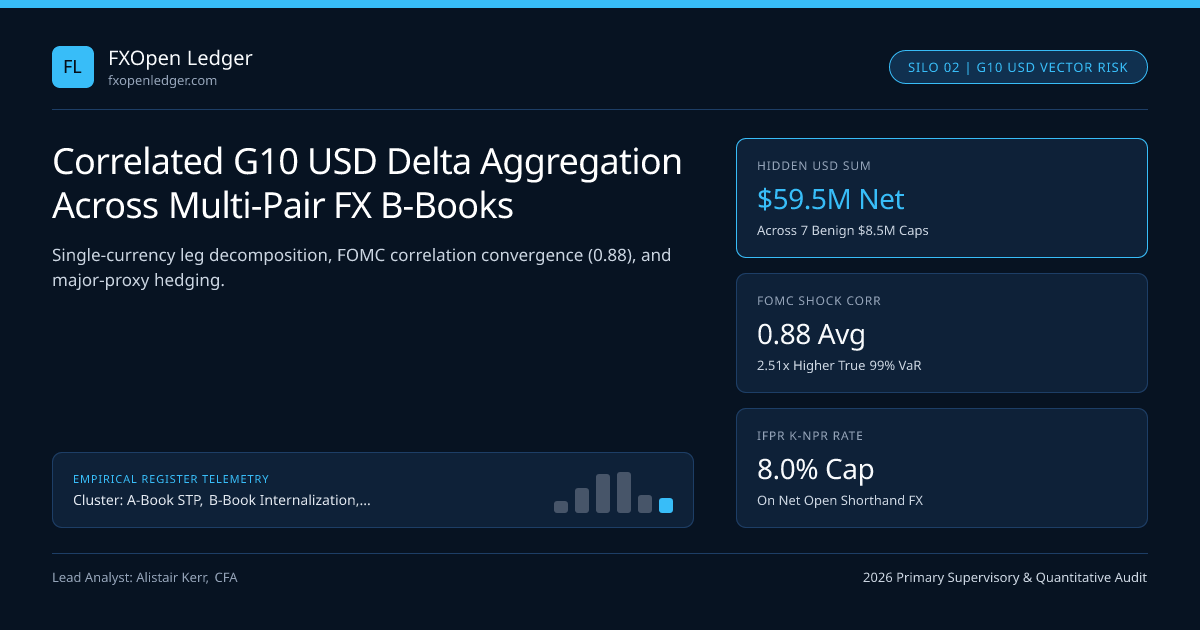
Setting isolated $10 million B-Book exposure caps on EUR/USD, GBP/USD, AUD/USD, NZD/USD, USD/CAD, USD/CHF, and USD/JPY creates one of the deadliest optical illusions in OTC foreign exchange risk management. Suppose every single pair sits comfortably at $8.5 million net exposure—85% below its individual symbol ceiling—yet every one of those seven positions represents Client Short USD / Dealer Long USD ahead of a Federal Reserve FOMC print or US CPI release! Instead of carrying seven independent $8.5M bets, the brokerage balance sheet actually holds $59.5 million of concentrated directional US Dollar exposure whose pairwise correlations jump above $\rho = +0.86$ the instant macro news hits the tape!
Connected to our A-Book, B-Book & C-Book FX Dealer Architecture guide and indexed inside the A-Book, B-Book & Bridge Routing hub, institutional risk engines decompose every currency pair and bullion contract into Single-Currency Leg Vectors before evaluating portfolio VaR.
Decomposing Multi-Pair Spot & CFD Positions Into Currency-Leg Vectors#
Inside a synthetic triangular FX risk engine, there is no such thing as an isolated EURGBP or AUDJPY position—every cross or dollar pair splits deterministically into two opposing single-currency legs converted to base reporting equity (USD or EUR) at live mid-rates:
- Dealer Short $10M
EUR/USDat 1.0800: Decomposes into-EUR 9,259,259(-$10.0MEUR leg) and+$10,000,000USD leg. - Dealer Long $8M
USD/JPYat 152.00: Decomposes into+$8,000,000USD leg and-JPY 1,216,000,000(-$8.0MJPY leg). - Dealer Short $12M
GBP/JPYCross: Decomposes into-$12.0MGBP leg and+$12.0MJPY leg—notice how the+$12.0MJPY leg fromGBP/JPYnaturally cancels-$8.0Mof the JPY leg fromUSD/JPY, leaving only+$4.0Mnet JPY!
Covariance Matrix Portfolio VaR Under Calm vs Macro-Shock Regimes#
Why does correlation breakdown destroy naive B-Book capital buffers modeled in B-Book risk warehouse VaR limits? Matrix portfolio variance $w^T \Sigma w$ scales linearly with average off-diagonal correlation $\bar{\rho}$ when $N$ currency legs align in the same dollar direction:
- Equal-Position Concentration Multiplier (N aligned legs of notional D and vol sigma):
- PortfolioSigma(rho) = D * sigma * sqrt( N + N * (N - 1) * rhoavg )
- Worked 7-Pair Dollar Alignment Audit (7 G10 USD Pairs each at D = $8.50M, Daily Vol sigma = 0.65%, 99% z = 2.33):
- 1. Naive Zero-Correlation Illusion (rho_avg = 0.00):
- Sigma_0 = $8.50M * 0.0065 * sqrt(7) = $55.25k * 2.646 = $146,192 -> 99% VaR = $340,627.
- 2. Calm Session G10 Dollar Correlation (rho_avg = 0.52):
- Sigma_calm = $55.25k * sqrt(7 + 42 * 0.52) = $55.25k * sqrt(28.84) = $296,704 -> 99% VaR = $691,320!
- 3. US CPI / FOMC Shock Regime Correlation (rho_avg = 0.88):
- Sigma_shock = $55.25k * sqrt(7 + 42 * 0.88) = $55.25k * sqrt(43.96) = $366,321 -> 99% VaR = $853,528 (+151% above zero-corr!).
Comparing Pair-Cap vs Currency-Vector Risk Engines Across Desks#
Supervisory capital audits under UK FCA IFPR (K-NPR currency netting), CySEC, ASIC, and FINMA inspect how dealing desks—ranging from institutional venues like City Index and Blue Suisse to multi-asset brokers like 4XC and BOSSA—aggregate cross-currency and bullion delta:
| Risk Engine Generation | Primary Limit Unit | Cross-Pair Offset Recognition | Macro-Shock Correlation Regime | Hedge Execution Efficiency |
|---|---|---|---|---|
| Legacy Symbol-Cap Plugin | Isolated MT4/MT5 Symbol Lots | None (Misses Cross Offsets) | Blind to 0.88 USD Convergence | Expensive Odd-Symbol Hedges |
| Static USD-Notional Cap | Gross Sum of USD Pairs Only | Partial (Misses EUR/JPY, GBP/JPY) | Fixed 60-Day Rolling Covariance | Moderate Major-Pair Offload |
| Currency-Leg Vector Engine | Net Exposure per ISO Currency | Full 28-Cross Triangular Netting | Stressed EWMA ($\lambda=0.94$) + Shock Floor | Optimal Lowest-Spread Major Proxy |
| Multi-Asset Factor Engine | USD + Real-Yield + Risk-Beta | Includes XAU/USD & US Indices | Live Jump-Diffusion Regime Switch | Sub-0.2p Major + Futures Overlay |
Portfolio VaR Escalation Across Calm vs FOMC Correlation Regimes#
Measuring 99% daily warehouse risk across seven aligned G10 dollar legs illustrates how synchronized macro repricing multiplies tail exposure relative to isolated symbol limits:
Proxy-Hedging Net USD Vector Excess via Ultra-Tight Majors#
Decomposing exposure into currency vectors unlocks a massive execution cost saving alongside risk reduction! Suppose the dealing desk exceeds its +$25M Net USD ceiling because retail traders bought AUD/USD, NZD/USD, and GBP/USD simultaneously. Instead of paying wide 0.6–0.9 pip wholesale spreads during pre-CPI illiquidity across three thinner Commonwealth pairs, the risk engine can immediately neutralize 80% of the excess aggregate USD beta in 2 milliseconds using deep 0.1 pip EUR/USD and USD/JPY institutional liquidity, then gradually rebalance residual AUD and NZD cross basis via synthetic cross-pair triangulation.
Frequently asked questions
Why are per-symbol B-Book limits insufficient for multi-pair forex risk management?
Because EUR/USD, GBP/USD, AUD/USD, NZD/USD, and USD/CHF all share the US Dollar leg; during Federal Reserve or US inflation releases, cross-pair correlations spike above 0.85, turning moderate per-pair exposures into one giant concentrated USD bet.
How does currency-leg vector decomposition reduce hedging spread costs?
Splitting minor crosses like GBP/NZD or EUR/AUD into single-currency legs often reveals offsetting USD, EUR, or JPY exposures across the book, allowing the desk to hedge only net residual delta using ultra-tight 0.1-pip major pairs.
Should Gold (XAU/USD) be included in an FX dealing desk net US Dollar risk bucket?
Yes. Spot gold exhibits a -0.65 to -0.80 negative correlation with the US Dollar Index and real Treasury yields during macro shocks, meaning retail long XAU/USD compounds retail short USD currency exposure.
How does MiFID II / FCA IFPR K-NPR treat offsetting currency legs?
Under IFR/IFPR K-NPR foreign-exchange capital rules, firms decompose positions into net open long or short totals per currency (plus gold), applying an 8% own-funds charge on the higher of aggregate net long or net short currency positions (4% for closely correlated pairs).
Publication record
- Published
- 14 November 2026
- Updated
- 14 November 2026
- Author
- Alistair Kerr, CFA
- Review
- Review not recorded
- Automated fact check
- Passed in the stored pipeline record
- Source URLs
- 3 recorded
AI assistance recorded: anthropic/claude-opus-4.6. This field does not establish human review or source verification.
Academic & Institutional Attribution
Cite This Research & Embed Live Data Card
Standard academic & institutional research paper citation format.
Alistair Kerr, CFA. (2026, November 14). Correlated G10 USD Delta Aggregation Across Multi-Pair FX B-Books. FXOpen Ledger. https://fxopenledger.com/orderbook/correlated-g10-usd-delta-aggregation-across-multi-pair-bbooksRegulatory Directory Cross-Reference
Referenced Institutions & Regulatory Registries
Mentioned Regulated Institutions
Referenced Supervisory Authorities
Related Abook Bbook Stp Bridge Routing & Institutional Briefings
Explore Abook Bbook Stp Bridge Routing Hub (20) →Abook Bbook Stp Bridge Routing
A-Book STP, B-Book Internalization & C-Book Routing: FX Dealer ArchitectureAbook Bbook Stp Bridge Routing
XAU/USD Crowd Herding & Loco London Bullion Dealer Hedge TriggersAbook Bbook Stp Bridge Routing
MiFID II Matched-Principal STP vs Own-Account Dealing Capital RulesAbook Bbook Stp Bridge Routing
Post-Execution Auto-Hedger Slippage & FIX Bridge Reject CascadesAbook Bbook Stp Bridge Routing
Toxic EA News-Straddle Orders & Stop-Order Warehouse ExposureAbook Bbook Stp Bridge Routing
Synthetic Cross-Pair Auto-Hedging: EUR/GBP & GBP/NZD TriangulationAbook Bbook Stp Bridge Routing
Introducing Broker Rebate Churn vs A-Book LP Clearing EconomicsAbook Bbook Stp Bridge Routing
FCA, ASIC & CySEC Execution-Venue Conflicts-of-Interest DisclosuresPrime of Prime Nop Credit Intermediation
Non-CLS Emerging-Market FX Settlement Cutoffs & Pre-FundingPrime of Prime Nop Credit Intermediation
Loco London Unallocated Bullion Credit Lines in Multi-Asset PoPPrime of Prime Nop Credit Intermediation
Cross-Margining Spot FX, NDFs & Index CFDs in PoP PortfoliosPrime of Prime Nop Credit Intermediation
FXPB Give-Up Ticket Surcharges & Small-Clip Aggregation Math
FXOpen Ledger Data, Benchmarks & Contributor Records
CC BY 4.0 Open Data
Open Institutional Datasets (CSV / JSON) →
Download desk-compiled quantitative series & schemas.
2026 Reference Matrix
2026 Institutional Benchmarks & Thresholds →
Statutory capital, clearing, margin & rate conventions.
Editorial Records
Authors & Review Records →
View named contributors where those records are available.
Complete Index
Master Research & Dossier Archive →
Browse all published briefings by topic pillar & date.