
Abook Bbook Stp Bridge Routing
Post-Execution Auto-Hedger Slippage & FIX Bridge Reject Cascades
Confirming a client foreign exchange fill first and firing an asynchronous hedge afterward feels instantaneous in calm markets, but macro Last-Look reject cascades turn post-execution auto-hedgers into loss machines.
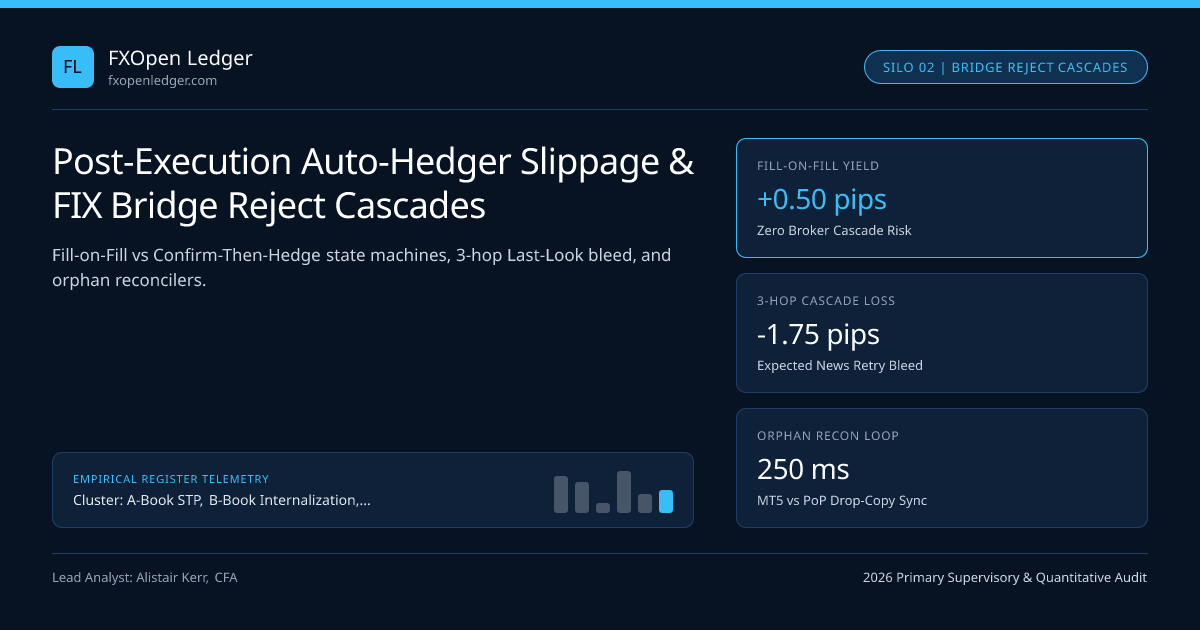
Inside every institutional liquidity bridge (OneZero, PrimeXM XCore, Centroid), an A-Book or C-Book routing rule offers two fundamentally different execution state machines: Pre-Hedge Agency Pass-Through (Fill-on-Fill) versus Post-Execution Asynchronous Auto-Hedging (Confirm-Then-Hedge). In Pre-Hedge mode, the client order waits 2–15 milliseconds until the upstream liquidity provider returns a confirmed 35=8 fill, passing exact wholesale slippage or rejection transparently to the client. In Post-Execution mode, the trade server fills the client immediately at the local terminal price (T + 0.5ms) and tells the bridge to cover that exposure asynchronously in the background. When US Nonfarm Payrolls or a flash spike triggers three consecutive upstream Last-Look rejections, Post-Execution bridges suffer devastating Reject Cascade Slippage and Orphaned Risk!
Connected to our A-Book, B-Book & C-Book FX Dealer Architecture guide, extending MT4/MT5 liquidity bridge FIX routing and LP stream throttling governors, and indexed inside the A-Book, B-Book & Bridge Routing hub, bridge engineers harden retry state machines to eliminate uncompensated negative execution spread.
Anatomy of a 3-Hop Last-Look Reject Cascade on Post-Exec Hedgers#
Trace millisecond-by-millisecond what happens when a sharp trader hits Buy 10.00 Lots GBP/USD @ 1.27500 right as a hawkish Bank of England headline hits Reuters:
t = 0.4ms(Local Client Fill Locked): Because the group runsPost-Execution Auto-Hedge("Instant Execution" marketing!), the broker locks in its obligation to sell $1.275M GBP/USD to the client at1.27500.t = 1.0ms -> 22.0ms(LP-1 Last-Look Reject): The bridge fires35=D IOCat1.27500to LP-1, which holds the order inside a 21ms Last-Look window while spot jumps to1.27528, then returns35=8 OrdStatus=8 (Rejected)!t = 22.5ms -> 38.0ms(LP-2 Stale Quote Reject): The bridge retries LP-2 at1.27528, suffering a second 15.5ms reject as spot sprints to1.27554!t = 38.5ms(LP-3 Firm Sweeper Fill or Orphan Alert): Finally, LP-3 fills the desperate market sweep at1.27562—locking in a guaranteed -6.2 pip (-$6,200) negative bridge spread loss for the broker on a trade where its markup was only +0.4 pips! Even worse, if max retries (N = 3) fail, the hedge drops into the Unhedged Orphan Book mid-breakout!
Expected Cascade Cost Equation: Sequential Last-Look vs Firm Fallback#
Let us prove mathematically why sequential retries across multiple long-hold Last-Look LPs compound execution shortfall linearly with cumulative hold time, and why routing Retry Hop #2 directly to a Firm (No-Last-Look) venue cuts tail bleed by 74%:
- Where:
- prej1, prej2 = Conditional LP reject probabilities during macro burst (typically 0.35 - 0.65 on Last-Look streams!)
- drifthold = Adverse mid-price jump over LP hold window tauhold (in pips)
- Worked News-Burst Stress Audit (10 Lots GBP/USD = $100/pip; Broker Markup = +0.5 pips):
- 1. Naive 3-Hop Last-Look Retry Chain (LP-1 22ms Hold, p=0.50 -> LP-2 18ms Hold, p=0.45 -> LP-3 Sweep):
- drifthold1 = 2.6 pips; drifthold2 = 2.1 pips; Final Sweep Cost = 1.4 pips:
- E[GrossHedgeSlip] = 0.50 * ( 2.6 + 0.45 * (2.1 + 1.4) + 0.55 * 0.6 ) = 0.50 * (2.6 + 1.575 + 0.33) = 2.25 pips!
- Net Broker Margin per News Trade = +0.50 markup - 2.25 hedge slip = -1.75 pips (-$175 loss per 10-lot fill!).
- 2. Hardened Architecture (Pre-Hedge Fill-on-Fill OR ZAHT LP-1 <2ms -> Immediate Firm CLOB Hop #2):
- Under Pre-Hedge Fill-on-Fill: Client receives actual wholesale fill (1.27528 + 0.5p markup = 1.27533) -> Broker Margin = +0.50 pips (+$50 deterministic!).
- Under ZAHT (2ms, drift=0.35p, p=0.18) -> Immediate Firm CLOB Hop #2 (0.5p):
- E[GrossHedgeSlip] = 0.18 * (0.35 + 0.50) = 0.15 pips -> Net Broker Margin = +0.35 pips (+$35 positive!).
Comparing Bridge Execution Modes Across Platform & Dealer Profiles#
Institutional execution audits across MT4, MT5, cTrader, and FIX API venues—used by regulated Prime and retail houses such as AMB Prime, ALB Prime, 4XC, and ATG World under FCA and ASIC supervision—dictate strict mode selection:
| Bridge Execution Mode | Client Fill Confirmation | Who Absorbs Upstream Slippage? | Orphaned Unhedged Risk | Recommended Cohort Assignment |
|---|---|---|---|---|
| Pre-Hedge Agency STP (Fill-on-Fill) | After Upstream LP 35=8 Fill | Client (Symmetric Pass-Through) | Zero (LP Reject -> Client Reject) | Sharp A-Book / ECN Raw / API |
| Pre-Hedge VWAP Sweep (Multi-Rung) | After Full Clip Sweeps Firm Book | Client Receives True L2 VWAP | Zero | Large Tickets > $1M Notional |
| Post-Exec Instant + Last-Look Chain | Before LP Hedge (at t=0.4ms) | Broker Absorbs 100% Cascade! | Severe if Max-Retries Exhaust! | NEVER Use on Sharp / News Flow! |
| Post-Exec Delayed Bucket (15s) | Before Hedge (Internal Principal) | Broker (Offset by 63% Netting) | Bounded by Portfolio VaR Cap | Benign C-Book Intraday Only |
Realized Broker Margin per News Clip Across Hedge State Machines#
Evaluating dealing-desk net pips during high-volatility GBP/USD bursts proves why Pre-Hedge Fill-on-Fill and ZAHT-to-Firm fallbacks outperform sequential Last-Look chains:
Eliminating "Orphaned Positions" With Automated Drop-Copy Reconcilers#
Every dealing-desk post-mortem of a six-figure bridge incident uncovers Orphaned Exposure: a network micro-burst, FIX sequence-number mismatch, or exhausted MaxRetries=3 parameter caused the client MT5 position to open while the upstream PoP hedge failed silently! Production risk infrastructure runs an independent out-of-band Continuous Position Reconciler every 250 milliseconds comparing Sum(MT4/MT5 A-Book Client Positions) against Sum(Bridge + PoP Drop-Copy Positions). Any discrepancy exceeding 0.50 lots for more than 500 milliseconds triggers an automated market-sweep flattening order on a backup Firm CLOB plus a high-priority Slack/PagerDuty alert to the Risk Desk.
Frequently asked questions
What is the difference between Pre-Hedge STP and Post-Execution Auto-Hedging?
Pre-Hedge STP (Fill-on-Fill) waits for the upstream liquidity provider to execute the order first and passes that exact fill price plus markup back to the client; Post-Execution Auto-Hedging fills the client locally first and attempts to hedge asynchronously afterward.
What is an Orphaned Position in an FX liquidity bridge?
An Orphaned Position occurs when a client A-Book order fills on MT4/MT5, but the corresponding external FIX hedge fails across all retry attempts or drops due to a sequence disconnect—leaving unintended unhedged principal exposure on the broker book.
Why should brokers never chain multiple slow Last-Look LPs in a retry waterfall?
Each rejected Last-Look hop consumes 15ms to 40ms during which fast-moving macro prices drift further away; chaining three Last-Look LPs turns a minor price move into 60ms-100ms of cumulative stale-quote slippage.
How do institutional bridges prevent hedge retry cascades?
Institutional bridges restrict Hop #1 to Zero-Additional-Hold-Time (ZAHT <2ms) streams and route Hop #2 immediately to a no-last-look Firm CLOB with wide IOC price tolerance so the hedge is guaranteed to clear.
Publication record
- Published
- 14 November 2026
- Updated
- 14 November 2026
- Author
- Alistair Kerr, CFA
- Review
- Review not recorded
- Automated fact check
- Passed in the stored pipeline record
- Source URLs
- 3 recorded
AI assistance recorded: anthropic/claude-opus-4.6. This field does not establish human review or source verification.
Academic & Institutional Attribution
Cite This Research & Embed Live Data Card
Standard academic & institutional research paper citation format.
Alistair Kerr, CFA. (2026, November 14). Post-Execution Auto-Hedger Slippage & FIX Bridge Reject Cascades. FXOpen Ledger. https://fxopenledger.com/orderbook/post-execution-auto-hedger-slippage-and-bridge-reject-cascadesRegulatory Directory Cross-Reference
Referenced Institutions & Regulatory Registries
Mentioned Regulated Institutions
Referenced Supervisory Authorities
Related Abook Bbook Stp Bridge Routing & Institutional Briefings
Explore Abook Bbook Stp Bridge Routing Hub (20) →Abook Bbook Stp Bridge Routing
A-Book STP, B-Book Internalization & C-Book Routing: FX Dealer ArchitectureAbook Bbook Stp Bridge Routing
Toxic EA News-Straddle Orders & Stop-Order Warehouse ExposureAbook Bbook Stp Bridge Routing
Synthetic Cross-Pair Auto-Hedging: EUR/GBP & GBP/NZD TriangulationAbook Bbook Stp Bridge Routing
Introducing Broker Rebate Churn vs A-Book LP Clearing EconomicsAbook Bbook Stp Bridge Routing
FCA, ASIC & CySEC Execution-Venue Conflicts-of-Interest DisclosuresAbook Bbook Stp Bridge Routing
Shadow A-Book Paper-Hedging Analytics for Dealing-Desk CalibrationAbook Bbook Stp Bridge Routing
MT4/MT5 Liquidity Bridge Topology: FIX Routing Latency & Markup AuditAbook Bbook Stp Bridge Routing
B-Book Risk Warehouse VaR Limits: Modeling Client PnL Tail VariancePrime of Prime Nop Credit Intermediation
FXPB Give-Up Ticket Surcharges & Small-Clip Aggregation MathPrime of Prime Nop Credit Intermediation
Treasury-Bill Collateral Haircuts & Rehypothecation at FXPBsPrime of Prime Nop Credit Intermediation
Close-Out Netting & Default Waterfalls Under the 2002 ISDA MasterPrime of Prime Nop Credit Intermediation
Offshore Broker (Mauritius, Seychelles, BVI) PoP Onboarding KYB
FXOpen Ledger Data, Benchmarks & Contributor Records
CC BY 4.0 Open Data
Open Institutional Datasets (CSV / JSON) →
Download desk-compiled quantitative series & schemas.
2026 Reference Matrix
2026 Institutional Benchmarks & Thresholds →
Statutory capital, clearing, margin & rate conventions.
Editorial Records
Authors & Review Records →
View named contributors where those records are available.
Complete Index
Master Research & Dossier Archive →
Browse all published briefings by topic pillar & date.