
Abook Bbook Stp Bridge Routing
MT4/MT5 Liquidity Bridge Topology: FIX Routing Latency & Markup Audit
Between a retail MT4 or MT5 trading server and wholesale ECN liquidity sits a high-speed C++ liquidity bridge that aggregates FIX 4.4 streams, injects bid-ask markups, and routes STP or B-Book fills in sub-millisecond hops.
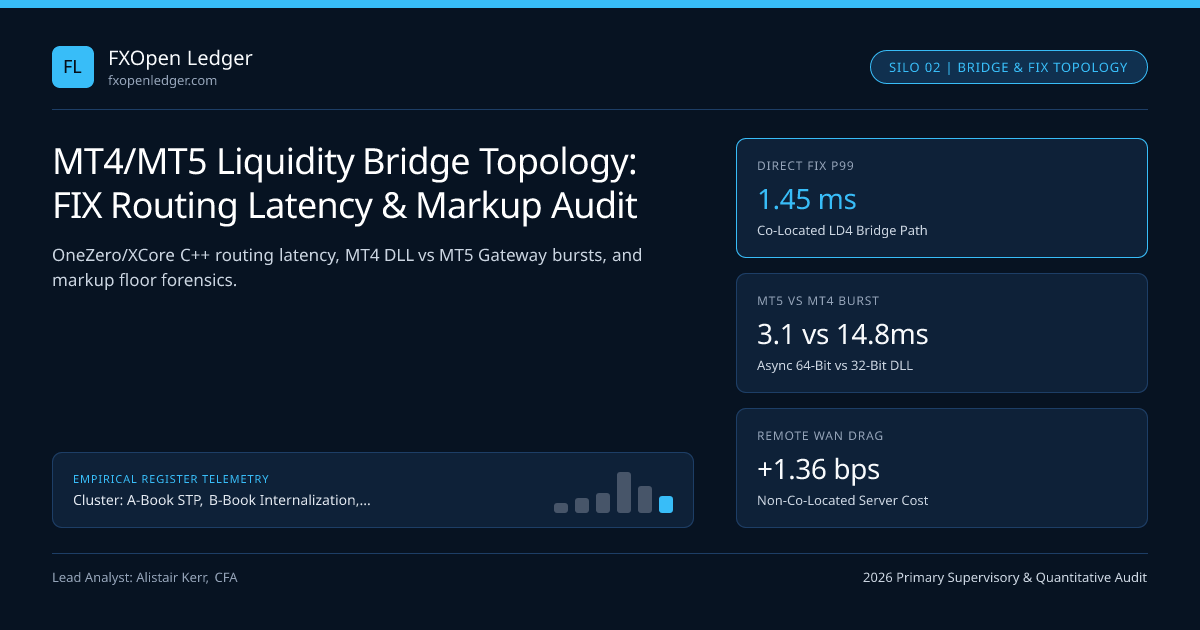
Neither MetaTrader 4 nor MetaTrader 5 speaks directly to Tier-1 interbank FX matching engines out of the box; every multi-asset brokerage relies on a dedicated Liquidity Bridge and Aggregation Engine—most commonly PrimeXM XCore, OneZero Liquidity Hub, Centroid Bridge, or TFB Trade Processor—co-located in Equinix LD4, NY4, or TY3. Understanding what happens inside that 400-to-1,500-microsecond bridge layer exposes how raw wholesale spreads transform into retail terminal quotes, why MT4 plugin architecture adds 3x more execution jitter than native MT5 or cTrader gateways, and where hidden markup or slippage configurations reside.
Connected to our A-Book, B-Book & C-Book FX Dealer Architecture guide and indexed inside the A-Book, B-Book & Bridge Routing hub, bridge telemetry forensics separates infrastructure bottlenecks from upstream LP rejections.
Inside the Bridge Stack: Quote Aggregation, Markup Profiles & Order Hops#
A production institutional bridge runs two asynchronous ultra-low-latency pipelines in parallel:
- Inbound Market-Data & Markup Pipeline: The bridge subscribes to 4–8 wholesale FIX API market-data sessions (
35=W/35=X), strips stale ticks, builds a consolidated synthetic order book, applies group-specific Spread Markup Profiles (e.g.,+0.0 pipson Raw ECN accounts vs+0.9 pipson Standard Rebate accounts), throttles tick updates (e.g., max 15 ticks/sec for legacy MT4 server stability), and pushes quotes to terminal trade servers. - Outbound Execution Routing Pipeline: When a client submits an order, the trade-server plugin hands the request via shared-memory IPC or local TCP loopback to the bridge core, which checks account cohort routing rules (
A-Book,B-Book, or hybrid C-Book), executes external FIX35=Dchild slices, and returns the VWAP fill price plus configured markup back to the client ledger.
Latency Decomposition & Geographic Misconfiguration Penalties#
The single worst architectural mistake among mid-sized brokerages—frequently uncovered when auditing execution across global dealer entities such as 305 Markets, 4XC, and ATG Markets—is hosting the MetaTrader trade server on public cloud VMs in Frankfurt or Dublin while the liquidity bridge sits in Equinix LD4 Slough! Every single A-Book STP order then pays a 12ms to 24ms WAN hop before touching the bridge, causing massive upstream post-execution auto-hedger reject cascades:
- All-InDisplayedAsk = Askbestlp + Markupaskpips + Max(0, MinSpreadFloor - RawLPSpread) / 2
- Worked Infrastructure Comparison (EUR/USD 3.00-Lot STP Market Order from London VPS):
- Config 1 (Optimal Equinix LD4 Co-Located MT5 + XCore):
- RTTlastmile = 0.8ms + taumt5gateway = 0.6ms + loopback = 0.1ms + tauxcore = 0.35ms + LPZAHT = 1.4ms = 3.25 ms Total!
- Config 2 (Misconfigured Cloud Frankfurt MT4 + LD4 Bridge):
- RTTlastmile = 11.5ms + taumt4dllburst = 5.4ms + WANFRALD4 = 14.2ms + taubridge = 0.5ms + LP_ZAHT = 1.4ms = 33.00 ms Total!
- At macro volatility 0.25 bps/sqrt(ms), 29.75ms of avoidable broker server/WAN bloat inflicts +1.36 bps of stale-quote slippage!
Comparing Terminal & Bridge Architectures Across Regulated Desks#
Supervisory technical reviews by CySEC, ASIC, and the UK FCA inspect whether bridge markup rules apply symmetrically on entry and exit (including stop-loss triggers) and whether B-Book execution artificially injects synthetic "virtual dealer" delays prohibited under fair-dealing statutes:
| Platform & Bridge Stack | Server-to-Bridge IPC | Burst Throughput (Orders/s) | Native Depth-of-Book (L2) | Audit & Slippage Risk Profile |
|---|---|---|---|---|
| FIX API Direct to XCore / OneZero | Direct TCP/Onload Kernel Bypass | 5,000+ orders/sec | Full 10-Rung VWAP Ladder | Institutional Gold Standard (<1.5ms) |
| cTrader Native ECN Server | Async Multi-Threaded Core | 2,500+ orders/sec | True L2 VWAP Sweep Built-In | Transparent Volume-Weighted Fills |
| MT5 Execution Gateway API | Async 64-Bit Multi-Threaded | 1,500+ orders/sec | Supported up to Market Depth | Clean Institutional Multi-Asset Standard |
| Legacy MT4 Server DLL Plugin | 32-Bit Serialized Hook Queue | 120 - 300 orders/sec | Top-of-Book Only (No True L2) | Severe Queue Spikes During NFP/CPI |
Empirical P99 Burst Latency Telemetry Across Platform Gateways#
Equinix LD4 packet-capture benchmarks during high-impact macro prints isolate exact serialization overhead between legacy 32-bit DLL hooks and native 64-bit asynchronous FIX routing engines:
Auditing "Minimum Spread Floors" and Asymmetric Markup Rules#
Inside bridge markup matrices, dealing desks can configure not only a linear +0.8 pip markup, but also a Minimum Spread Floor (e.g., forcing EUR/USD never to narrow below 1.0 pip even when wholesale ECN spreads tighten to -0.1 Choice/Inverted!) plus a Maximum Spread Cap during illiquid rollovers. Institutional auditors reconcile raw LP MarketDataSnapshot logs against terminal tick history to verify that spread floors match published product specifications and never widen asymmetrically against open stop-loss clusters.
Frequently asked questions
Why does MT5 execute faster than MT4 during high-impact forex news?
MT4 uses a legacy 32-bit single-process architecture where third-party C++ bridge plugins can bottleneck under concurrent stop/limit triggers, whereas MT5 uses a 64-bit distributed, multi-threaded Gateway API designed for asynchronous ECN routing.
What is a liquidity bridge in an OTC FX brokerage?
A liquidity bridge is specialized middleware co-located in Equinix LD4/NY4 that connects retail trading platforms (MT4, MT5, cTrader) to institutional FIX 4.4 liquidity providers, handling price aggregation, markups, and A/B/C-Book routing.
Are "Virtual Dealer" delay plugins legal on regulated FX dealing desks?
No. Plugins that inject artificial 500ms-2000ms delays on B-Book orders solely to re-quote or slip profitable trades violate FCA Consumer Duty, ESMA MiFID II Article 24/27, and ASIC RG 227 fair-execution rules.
How does an MT4 server handle multi-million orders without native Level-2 depth?
Although the MT4 client terminal displays only a single top-of-book bid/ask, the underlying liquidity bridge sweeps multiple Level-2 wholesale liquidity rungs via FIX and returns the exact Volume-Weighted Average Price (VWAP) fill back to MT4.
Publication record
- Published
- 14 November 2026
- Updated
- 14 November 2026
- Author
- Alistair Kerr, CFA
- Review
- Review not recorded
- Automated fact check
- Passed in the stored pipeline record
- Source URLs
- 3 recorded
AI assistance recorded: anthropic/claude-opus-4.6. This field does not establish human review or source verification.
Academic & Institutional Attribution
Cite This Research & Embed Live Data Card
Standard academic & institutional research paper citation format.
Alistair Kerr, CFA. (2026, November 14). MT4/MT5 Liquidity Bridge Topology: FIX Routing Latency & Markup Audit. FXOpen Ledger. https://fxopenledger.com/orderbook/mt4-mt5-liquidity-bridge-fix-routing-latency-and-markup-auditRegulatory Directory Cross-Reference
Referenced Institutions & Regulatory Registries
Mentioned Regulated Institutions
Referenced Supervisory Authorities
Related Abook Bbook Stp Bridge Routing & Institutional Briefings
Explore Abook Bbook Stp Bridge Routing Hub (20) →Abook Bbook Stp Bridge Routing
A-Book STP, B-Book Internalization & C-Book Routing: FX Dealer ArchitectureAbook Bbook Stp Bridge Routing
B-Book Risk Warehouse VaR Limits: Modeling Client PnL Tail VarianceAbook Bbook Stp Bridge Routing
Hybrid C-Book Alpha Profiling: Partial Delta Hedging & MultipliersAbook Bbook Stp Bridge Routing
VPIN Toxicity Scoring in Multi-Dealer FX Aggregators & Liquidity PoolsAbook Bbook Stp Bridge Routing
Five-Second Markout Profiling: Segmenting Sharp vs Benign FX FlowAbook Bbook Stp Bridge Routing
Quote Skewing vs Spread Widening: OTC FX Dealer Inventory Control MathAbook Bbook Stp Bridge Routing
Cross-Feed Latency Arbitrage Detection on Retail FX & CFD ServersAbook Bbook Stp Bridge Routing
STP Agency Commissions vs All-In Spread Markups: FX Cost DecompositionPrime of Prime Nop Credit Intermediation
Net Open Position (NOP) Utilization Formulas & Currency HaircutsPrime of Prime Nop Credit Intermediation
Four-Way FXPB Designation Notices & Traiana Harmony Give-UpsPrime of Prime Nop Credit Intermediation
CLS PvP Settlement vs Bilateral Netting & Herstatt Risk in OTC FXPrime of Prime Nop Credit Intermediation
SNB EUR/CHF Flash-Crash Contagion & Negative-Balance Controls
FXOpen Ledger Data, Benchmarks & Contributor Records
CC BY 4.0 Open Data
Open Institutional Datasets (CSV / JSON) →
Download desk-compiled quantitative series & schemas.
2026 Reference Matrix
2026 Institutional Benchmarks & Thresholds →
Statutory capital, clearing, margin & rate conventions.
Editorial Records
Authors & Review Records →
View named contributors where those records are available.
Complete Index
Master Research & Dossier Archive →
Browse all published briefings by topic pillar & date.