
Prime of Prime Nop Credit Intermediation
CLS PvP Settlement vs Bilateral Netting & Herstatt Risk in OTC FX
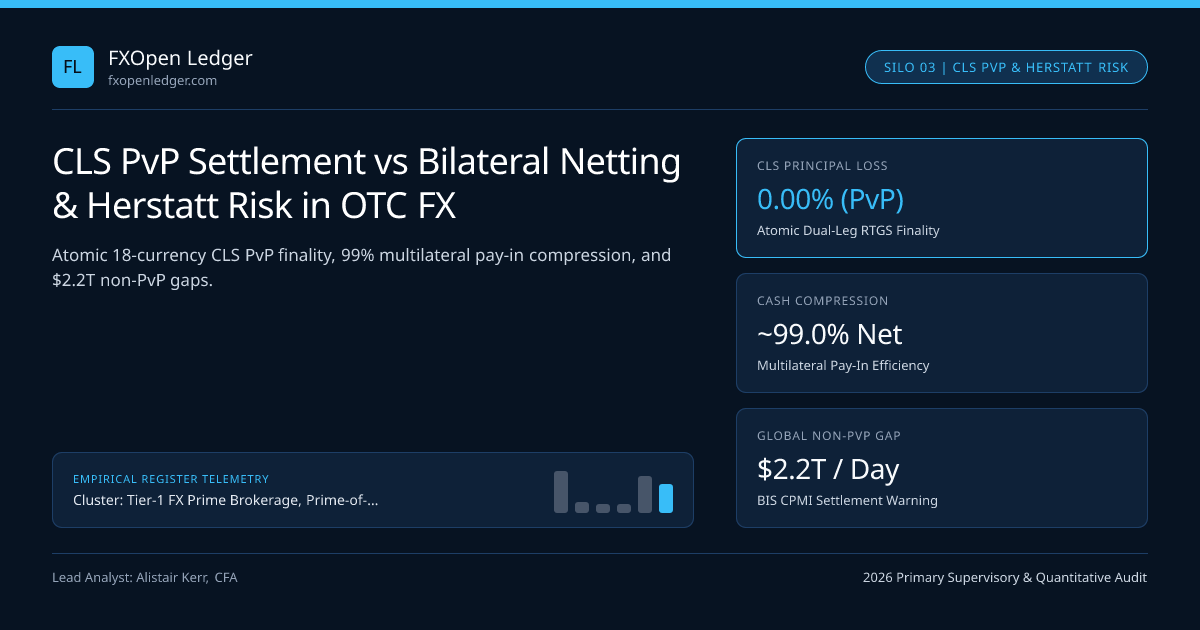
Roughly $2.2 trillion of daily global foreign exchange turnover still settles outside Payment-versus-Payment protection, exposing non-CLS bilateral settlement legs to 100% principal Herstatt loss.
At 15:30 CET on June 26, 1974, West German banking supervisors revoked the license of Cologne's Bankhaus Herstatt. Earlier that morning in Frankfurt, several international banks had irrevocably wired Deutsche Marks to Herstatt against spot USD/DEM trades—only to watch Herstatt's New York correspondent freeze outgoing US Dollar payments six time-zones later! Unlike margin trading risk (where you risk 2%–5% price movement), FX Settlement Risk (Herstatt Risk) exposes a counterparty to 100% loss of full principal notional! Despite the creation of CLS Bank International in 2002, the Bank for International Settlements reports that roughly $2.2 trillion of daily global FX turnover still settles without Payment-versus-Payment (PvP) protection!
Anchored in our Tier-1 FXPB & Prime-of-Prime Credit Intermediation guide and indexed inside the Prime-of-Prime & FXPB Credit hub, Global Foreign Exchange Committee Principle 35 & Principle 50 mandate PvP or automated bilateral netting wherever practicable.
How CLS Bank PvP & Multilateral Netting Compress 99% of Cashflows#
CLS Bank operates direct central-bank Real-Time Gross Settlement (RTGS) accounts across 18 eligible global currencies (USD, EUR, JPY, GBP, CHF, CAD, AUD, NZD, SEK, NOK, DKK, SGD, HKD, KRW, ZAR, ILS, MXN, HUF). Its operational magic combines two distinct mechanisms inside a tight 5-hour central European morning window (07:00 to 12:00 CET):
- 100% Atomic Payment-versus-Payment (PvP) on Gross Trades: CLS settles every matched FX instruction individually and simultaneously across central-bank books—either both sold and bought currencies transfer irrevocably, or neither transfers! Principal loss risk drops to 0.00%.
- Multilateral Pay-In Funding Compression (~96%–99% Liquidity Saving): Rather than wiring $5.0 Billion gross across 400 trades, a Settlement Member wires only its Net Short Currency Balances across five scheduled timed pay-in installments between
07:00and10:00 CET(or09:00 CETfor Asia-Pacific currencies)!
Quantifying Time-Zone Herstatt Exposure vs CLS Net Pay-In Math#
Consider an institutional desk settling $400 Million of JPY/USD bilaterally via SWIFT MT202 / pacs.009 wires without CLS versus settling inside a Tier-1 FXPB CLS account:
- Without CLS (Gross Bilateral Wire): Your Japanese correspondent bank wires
JPY 60.8 Billion ($400M)irrevocably via BOJ-NET before15:00 Tokyo (07:00 CET = 01:00 EST). You now hold $400,000,000 of unsecured Herstatt principal credit exposure for 8 to 15 hours until your counterparty's New York Fedwire finally arrives before18:00 EST! - With CLS PvP + Multilateral Netting: Look at the capital and intraday liquidity arithmetic:
- HerstattCreditEADBasel = 100% * GrossSoldCurrencyPrincipal_USD [If Unsettled Across Time Zones!]
- CLSNetPayInRatio = Sum{c in NetShortCurrencies} |NetShortBalanceUSDc| / Sum{all trades k} GrossNotionalUSDk
- Worked Settlement Treasury Audit ($850M Daily Gross Spot Volume across EUR, USD, JPY, GBP):
- 1. Un-Netted Non-PvP Bilateral SWIFT Wires:
- Required Intraday Treasury Cash / Daylight Overdraft = $850,000,000 gross liquidity!
- Peak Unsecured Principal Risk (Tokyo -> NY window) = Up to $320,000,000 (100% principal at risk for 11 hours!).
- 2. CLS Settlement (Directly via Tier-1 FXPB or CLS Third-Party Service):
- Multilateral Net Short Balances: -$4.2M EUR, -$3.1M JPY, +$7.3M USD -> Net Cash Pay-In = $7,300,000 (99.14% compression!).
- Unsecured Principal Herstatt Exposure = $0.00!
Comparing FX Settlement Rails Across Counterparty Tiers#
How do mid-sized brokerages and Prime-of-Prime clients interact with CLS when they are not direct $5B+ CLS Settlement Members? Let us compare the four institutional settlement tiers monitored by HKMA, UK FCA, NYDFS, and the BIS Committee on Payments and Market Infrastructures (CPMI):
| FX Settlement Rail | Principal Herstatt Risk | Liquidity Netting Efficiency | Eligible Currency Scope | Typical Institutional User |
|---|---|---|---|---|
| CLS Direct / CLS Third-Party | Zero (Atomic PvP) | 96% - 99%+ Multilateral | 18 CLS Currencies | Tier-1 Banks, Major Funds, Top PoPs |
| Omnibus PoP Margin Netting | Zero Gross Principal (VM Only) | 100% Continuous Rolling | All PoP Pairs (Via Tom-Next) | AMB Prime / ALB Prime Clients |
CLS Net (CLSNet Automated Bilateral) | Gross Principal Remains (Netted!) | 70% - 85% Payment Netting | 120+ Currencies (Incl. CNH, TRY!) | Non-CLS EM Desks |
Raw Gross SWIFT Bilateral (pacs.009) | 100% Gross Principal Risk! | 0% (Full Gross Wires) | Global Correspondent Rails | High-Risk Un-Netted Deliverable Corporate |
Why Prime-of-Prime Margin Rolling Bypasses Daily Physical Settlement#
Notice a vital distinction for non-deliverable CFD and margin spot FX brokerages!
Handling Non-CLS Currencies (CNH, TRY, BRL, AED) Safely#
Because major emerging-market currencies like Offshore Chinese Renminbi (CNH), Turkish Lira (TRY), Polish Zloty (PLN), and Brazilian Real (BRL) are not among CLS Bank's 18 PvP currencies, institutional desks rely on three alternatives recommended by GFXC Principle 35 and BCBS supervisory guidance: (1) local central-bank PvP links such as HKMA's USD/HKD and USD/CNH CHATS PvP clearing house in Hong Kong, (2) CLSNet automated bilateral payment netting across 120+ currencies to slash exposed principal by 80%+, or (3) settling strictly as cash-settled 1M Non-Deliverable Forwards (NDFs) or auto-rolled margin positions so full principal never crosses borders—backed by 2002 ISDA close-out netting.
Frequently asked questions
What is Herstatt Risk in institutional foreign exchange trading?
Named after the 1974 failure of German Bankhaus Herstatt, Herstatt Risk is the danger that one party to an FX trade irrevocably delivers the currency it sold in an earlier time zone (like JPY or EUR) while its counterparty defaults before delivering USD hours later.
How does CLS Bank achieve 99% liquidity compression while settling trades gross?
CLS settles individual trade instructions gross and atomically (PvP) inside its own books, but requires members to fund only their multilateral net short currency balances across five morning CET pay-in windows.
Which major traded currencies are NOT eligible for CLS Bank PvP settlement?
Offshore and onshore Chinese Renminbi (CNH/CNY), Turkish Lira (TRY), Polish Zloty (PLN), Indian Rupee (INR), and Brazilian Real (BRL) are currently outside CLS 18 PvP currencies, requiring HKMA CHATS PvP, CLSNet netting, or NDFs.
Do retail or mid-market CFD brokers need direct CLS membership?
No. CFD and margin spot brokers do not exchange physical currency principal on T+2; their Prime-of-Prime automatically rolls open positions daily at 17:00 NY via Tom-Next swaps while Tier-1 FXPBs handle underlying CLS settlement upstream.
Publication record
- Published
- 14 November 2026
- Updated
- 14 November 2026
- Author
- Alistair Kerr, CFA
- Review
- Review not recorded
- Automated fact check
- Passed in the stored pipeline record
- Source URLs
- 3 recorded
AI assistance recorded: anthropic/claude-opus-4.6. This field does not establish human review or source verification.
Academic & Institutional Attribution
Cite This Research & Embed Live Data Card
Standard academic & institutional research paper citation format.
Alistair Kerr, CFA. (2026, November 14). CLS PvP Settlement vs Bilateral Netting & Herstatt Risk in OTC FX. FXOpen Ledger. https://fxopenledger.com/orderbook/cls-pvp-settlement-vs-bilateral-netting-herstatt-credit-riskRegulatory Directory Cross-Reference
Referenced Institutions & Regulatory Registries
Top Regulated Institutions in This Coverage Slice
Referenced Supervisory Authorities
Related Prime of Prime Nop Credit Intermediation & Institutional Briefings
Explore Prime of Prime Nop Credit Intermediation Hub (20) →Prime of Prime Nop Credit Intermediation
Tier-1 FX Prime Brokerage, Prime-of-Prime NOP Limits & Give-Up Credit GuidePrime of Prime Nop Credit Intermediation
SNB EUR/CHF Flash-Crash Contagion & Negative-Balance ControlsPrime of Prime Nop Credit Intermediation
ISDA 2016 VM-CSA Daily Variation Margin Calls & MTA DisputesPrime of Prime Nop Credit Intermediation
Omnibus Prime-of-Prime Margin Accounts vs Individual Give-UpsPrime of Prime Nop Credit Intermediation
FCA CASS 7 & Title Transfer Collateral Arrangements (TTCA) in PoPPrime of Prime Nop Credit Intermediation
Intraday Credit-Line Throttling & FIX Kill-Switch GovernancePrime of Prime Nop Credit Intermediation
Statutory Negative Balance Protection: Retail vs Wholesale Margin GapPrime of Prime Nop Credit Intermediation
Multi-Prime PoP Redundancy & Single-PB Termination RiskTom Next Swap Rollover Triple Wednesday
USD/TRY & USD/MXN High-Yield Carry Rollover Widening TrapsTom Next Swap Rollover Triple Wednesday
Islamic Swap-Free FX Accounts: Storage Fees vs Carry ArbitrageTom Next Swap Rollover Triple Wednesday
Quarter-End & Year-End G-SIB "Turn" Spikes in USD FX SwapsTom Next Swap Rollover Triple Wednesday
17:00 NY Rollover Spread Widening & Phantom Stop-Loss Triggers
FXOpen Ledger Data, Benchmarks & Contributor Records
CC BY 4.0 Open Data
Open Institutional Datasets (CSV / JSON) →
Download desk-compiled quantitative series & schemas.
2026 Reference Matrix
2026 Institutional Benchmarks & Thresholds →
Statutory capital, clearing, margin & rate conventions.
Editorial Records
Authors & Review Records →
View named contributors where those records are available.
Complete Index
Master Research & Dossier Archive →
Browse all published briefings by topic pillar & date.