
Prime of Prime Nop Credit Intermediation
Intraday Credit-Line Throttling & FIX Kill-Switch Governance
A single runaway FIX client loop firing 2,000 market orders per second can exhaust a $50M Prime-of-Prime credit line in 40 milliseconds unless hardware pre-trade gates and FIX Tag 35=q MassCancel kill-switches intervene.
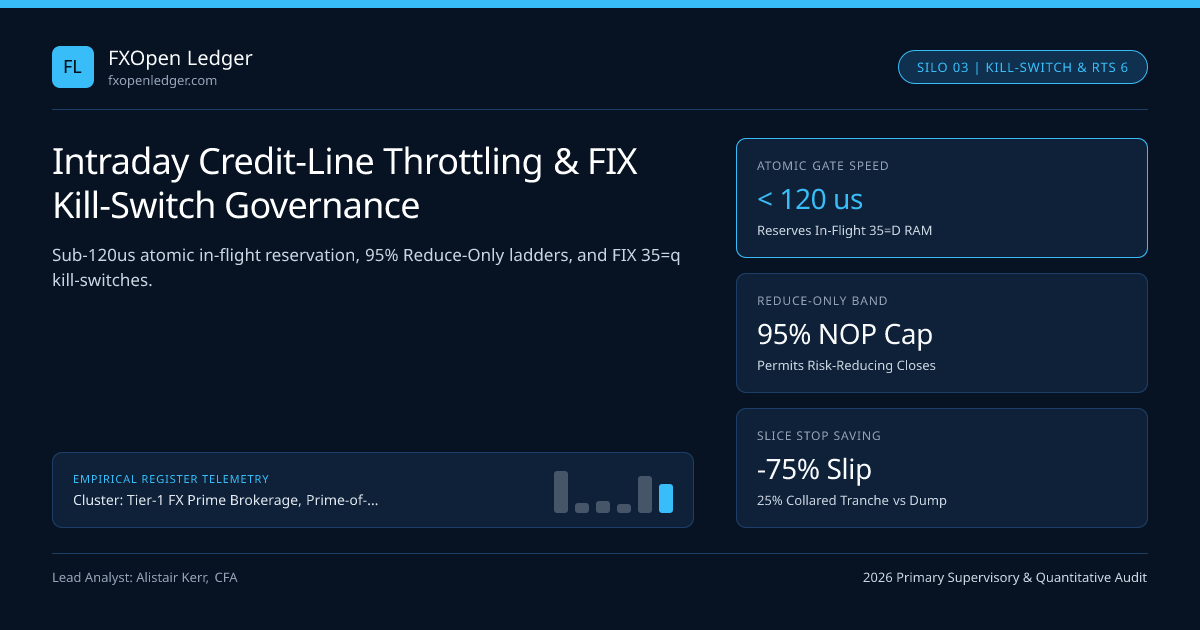
In August 2012, Knight Capital lost $440 Million in 45 minutes from an un-throttled deployment flag; in spot FX, where FIX 4.4 sessions co-located in Equinix LD4 transmit packets in 350 microseconds, an infinite while(true) order bug on an institutional API client can fire $250 Million of unintended USD/JPY sweeps in less than 80 milliseconds! Post-trade credit alerts that poll database tables every 5 seconds react 60 times too slowly to stop an algorithmic runaway. Modern Prime-of-Prime and ECN credit gateways enforce In-Memory Pre-Trade Atomic Reservation Gates paired with Multi-Tiered FIX 35=q (OrderMassCancelRequest) Kill-Switches mandated under MiFID II RTS 6 and GFXC Principle 18.
Connected to our Tier-1 FXPB & Prime-of-Prime Credit Intermediation guide and indexed inside the Prime-of-Prime & FXPB Credit hub, hardware-speed kill-switch governance protects both the client and the credit intermediary.
Four-Stage Progressive Credit & Runaway-Algo Throttling Ladder#
Shutting down an institutional brokerage's entire FIX bridge abruptly at 99.9% margin without intermediate warnings creates chaos for benign offsetting trades! Best-practice credit engines (OneZero, PrimeXM XCore, Traiana CreditLink) implement a Four-Stage Progressive Escalation Ladder:
75% Utilization(Warning & Treasury Webhook): Automated API/Slack/email alert fires to client treasury to initiate same-day collateral top-up; zero execution impact.88% Utilization(Clip-Size & Velocity Governor): Maximum single-order clip drops by 50% (e.g.,$10M -> $5M) and message rate throttles to20 orders/secto prevent sudden burst overshoot.95% Utilization(Reduce-Only Mode — Reject Risk-Increasing): Any new35=Dorder that increases haircut-weighted currency-vector NOP is immediately rejected (35=8 OrdRejReason=3 [Order Exceeds Limit]), while risk-reducing closing hedges execute freely!100% Breach / Runaway Loop(Hard Kill-Switch + MassCancel 35=q): Instantly cancels all restingGTC/GFDorders across all ECNs, drops inboundNewOrderSingleprivileges, and—if Margin Level breaches stop-out (e.g., 50%)—slices controlled TWAP liquidation.
Why "In-Flight Unconfirmed Reservation" Stops Parallel Burst Overruns#
A classic engineering flaw in amateur credit gateways is updating Used_Margin only after an ExecutionReport (35=8 Fill) returns from the upstream LP 8 milliseconds later! During those 8 milliseconds, a malfunctioning client thread can pump 40 parallel $5M orders ($200M total) past a $25M credit check before the first fill returns! Look at the exact Lock-Free Atomic Pre-Reservation Invariant:
- Pre-Trade Gate Condition on Arrival of Order m (Evaluated via CPU Compare-And-Swap CAS in < 0.05ms):
- ACCEPT Order m IFF:
- (1) ReservedMarginAtomic(t) + DeltaMargin(m) <= MaxCreditLineUSD, OR
- (2) Delta_Margin(m) < 0 [Order Strictly Reduces Portfolio Net Currency Vector Risk!]
- Release Rule: Decrement In-Flight Reservation ONLY upon terminal 35=8 (Rejected / Canceled / Expired) or convert to FilledOpenMargin!
- Worked Runaway-Algo Defence Audit ($1.00M Collateral; $30.0M Max G10 NOP @ 3.33% Haircut; Algo fires 50 x $5M Buy EUR/USD in 4ms):
- Naive Post-Fill Check (8ms LP RTT): All 50 packets pass at t=0..4ms before Fill #1 arrives at t=8ms -> $250M FILLED (833% Overrun!).
- Atomic CAS Pre-Reservation Gate:
- Packets #1..#6 ($30.0M cumulative) increment InFlightNOP atomically in 180 microseconds;
- Packets #7..#50 ($220.0M) hit InFlightNOP == $30.0M -> Rejected locally in 15 microseconds ($0.00 Overrun!) + Trips Algo Loop Breaker!
MiFID II RTS 6 Pre-Trade Controls Required on Institutional Gateways#
Under EU/UK MiFID II Regulatory Technical Standard 6 (RTS 6 Articles 12–18)—enforced by the UK FCA, ESMA, and CySEC across electronic venues and Prime-of-Prime gateways (AMB Prime, ALB Prime, Climax Prime)—every algorithmic FIX API access provider must operate six deterministic pre-trade safety gates:
| RTS 6 Pre-Trade Control | Parameter / FIX Tag Mechanism | Runaway Bug Prevented | Kill-Switch Recovery Protocol |
|---|---|---|---|
| Price Collar ("Fat-Finger Band") | Reject limit/market > 1.5% - 3.0% off mid | Off-market decimal typo (10.85 vs 1.085) | Immediate per-order 35=8 reject |
| Maximum Order Value / Volume | Hard cap per 35=D (e.g., $15M max clip) | Lot-vs-Notional unit multiplication bug (100M vs 100 lots!) | Rejects order; alerts desk |
| Repeated Automated Execution Throttle | Max N = 5 identical Sym+Side+Qty in 250ms | Infinite retry loop on rejected hedge! | Auto-Freezes Session; requires manual reset |
| Maximum Messages Per Second | 50 - 150 FIX msgs/sec token bucket | Quote-stuffing / modify storm | Drops excess; warns OTR breach |
Cancel-On-Disconnect (COD) | Session-level FIX Logon (Tag 35=A) flag | Orphaned resting limits during fiber cut | Auto-purges all GTC/GFD on TCP drop |
| Manual + API Emergency Kill-Switch | GUI Button + 35=q MassCancelRequest | Multi-pair strategy misfire | Dual-control Risk Officer unlock |
Why Instant "Market-Order Dump" Liquidation Is the Worst Stop-Out!#
Suppose a client's margin level legitimately falls below the 50% stop-out floor on a $40 Million GBP/JPY position at 21:30 UTC!
Partial Tranche De-Leveraging vs Total Portfolio Wipeout#
If a PoP bridge dumps a single $40 Million Market Order at 21:30 UTC, it sweeps 6 pips through thin liquidity—wiping out the client's remaining $600k equity AND potentially creating a negative deficit for the PoP! Institutional credit engines use Incremental 25% Tranche De-Leveraging with Price Collars: closing just enough of the largest margin-consuming position (e.g., $10M) via collared IOC slices over 3–10 seconds to lift Margin Utilization back into the safe 75% zone, preserving both client equity and market stability alongside 4-way Traiana CreditLink give-up limits.
Frequently asked questions
Why did my runaway EA breach my credit limit on a legacy bridge?
Legacy bridges check credit against filled positions rather than in-flight unconfirmed orders; during the 5-15ms round-trip before the first LP fill returns, a tight loop can transmit dozens of parallel orders past the gate.
What is "Reduce-Only Mode" on an institutional FX Prime-of-Prime account?
Activated around 90%-95% credit utilization, Reduce-Only Mode automatically rejects any new order that increases net currency-vector margin while permitting offsetting orders that shrink open exposure.
What does Cancel-On-Disconnect (COD) do on a FIX 4.4 trading session?
When enabled during FIX Logon (35=A), Cancel-On-Disconnect instructs the ECN or PoP gateway to immediately cancel all resting GTC and Day limit orders the instant TCP connectivity or FIX heartbeats drop.
Can an automated system immediately re-enable a tripped runaway-algo kill-switch?
No. Under MiFID II RTS 6 governance standards, once a repeated-execution loop trips a session kill-switch, reactivation requires manual four-eyes verification by designated risk officers confirming the underlying code bug is fixed.
Publication record
- Published
- 13 November 2026
- Updated
- 14 November 2026
- Author
- Alistair Kerr, CFA
- Review
- Review not recorded
- Automated fact check
- Passed in the stored pipeline record
- Source URLs
- 3 recorded
AI assistance recorded: anthropic/claude-opus-4.6. This field does not establish human review or source verification.
Academic & Institutional Attribution
Cite This Research & Embed Live Data Card
Standard academic & institutional research paper citation format.
Alistair Kerr, CFA. (2026, November 14). Intraday Credit-Line Throttling & FIX Kill-Switch Governance. FXOpen Ledger. https://fxopenledger.com/orderbook/intraday-credit-line-throttling-and-fix-kill-switch-governanceRegulatory Directory Cross-Reference
Referenced Institutions & Regulatory Registries
Top Regulated Institutions in This Coverage Slice
Referenced Supervisory Authorities
Related Prime of Prime Nop Credit Intermediation & Institutional Briefings
Explore Prime of Prime Nop Credit Intermediation Hub (20) →Prime of Prime Nop Credit Intermediation
Tier-1 FX Prime Brokerage, Prime-of-Prime NOP Limits & Give-Up Credit GuidePrime of Prime Nop Credit Intermediation
Statutory Negative Balance Protection: Retail vs Wholesale Margin GapPrime of Prime Nop Credit Intermediation
Multi-Prime PoP Redundancy & Single-PB Termination RiskPrime of Prime Nop Credit Intermediation
Non-CLS Emerging-Market FX Settlement Cutoffs & Pre-FundingPrime of Prime Nop Credit Intermediation
Loco London Unallocated Bullion Credit Lines in Multi-Asset PoPPrime of Prime Nop Credit Intermediation
Cross-Margining Spot FX, NDFs & Index CFDs in PoP PortfoliosPrime of Prime Nop Credit Intermediation
FXPB Give-Up Ticket Surcharges & Small-Clip Aggregation MathPrime of Prime Nop Credit Intermediation
Treasury-Bill Collateral Haircuts & Rehypothecation at FXPBsTom Next Swap Rollover Triple Wednesday
US Bank Holidays & Broken-Date Quadruple FX Swap RolloversTom Next Swap Rollover Triple Wednesday
XAU/USD Gold Lease Rates, SOFR & Loco London Tom-Next SwapsTom Next Swap Rollover Triple Wednesday
Offshore USD/CNH HIBOR Squeezes & Tom-Next Swap VolatilityTom Next Swap Rollover Triple Wednesday
NDF Monthly Roll Costs vs Deliverable Daily Tom-Next Swaps
FXOpen Ledger Data, Benchmarks & Contributor Records
CC BY 4.0 Open Data
Open Institutional Datasets (CSV / JSON) →
Download desk-compiled quantitative series & schemas.
2026 Reference Matrix
2026 Institutional Benchmarks & Thresholds →
Statutory capital, clearing, margin & rate conventions.
Editorial Records
Authors & Review Records →
View named contributors where those records are available.
Complete Index
Master Research & Dossier Archive →
Browse all published briefings by topic pillar & date.