
Prime of Prime Nop Credit Intermediation
Four-Way FXPB Designation Notices & Traiana Harmony Give-Ups
Institutional FX Prime Brokerage relies on New York Fed FMLG Master Give-Up Agreements, Prime Broker Designation Notices, and sub-second Traiana Harmony post-trade novation to turn bilateral trades into centrally cleared credit.
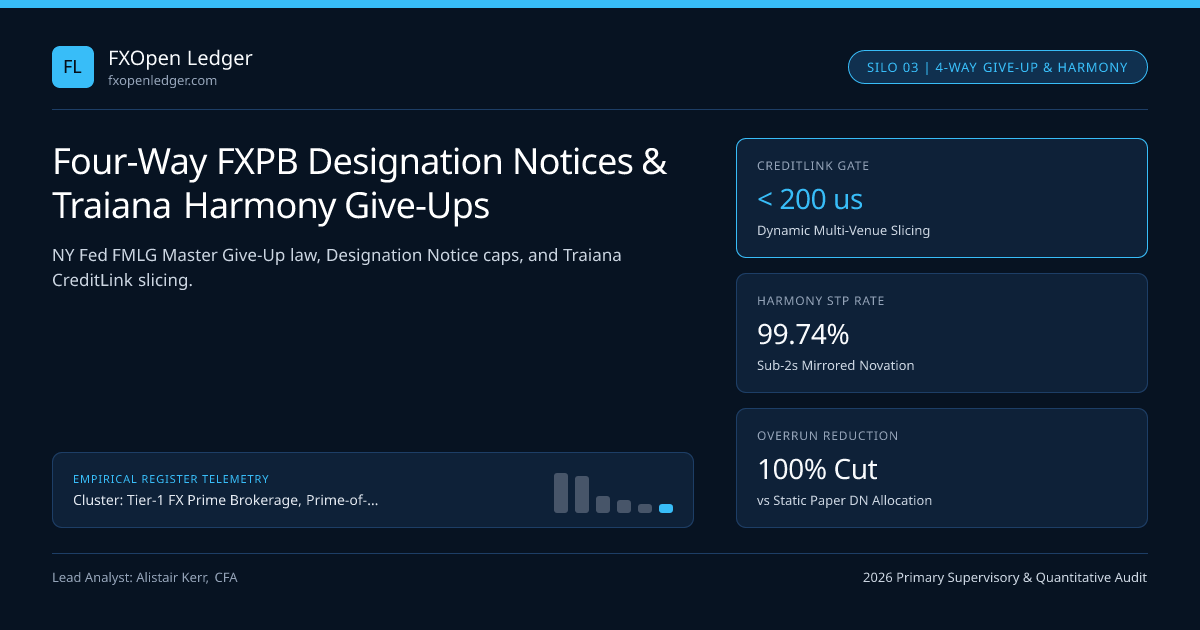
How can an institutional trading desk execute $25 million USD/JPY in 800 microseconds against a bank liquidity provider with whom that trading desk has zero ISDA agreement, zero margin account, and zero bilateral credit line? The legal and technological machinery making anonymous ECN and disclosed multi-dealer FX streaming possible is the Four-Party FX Prime Brokerage Give-Up Architecture—standardized legally by the New York Fed Financial Markets Lawyers Group (FMLG 2005 Master FX Give-Up Agreement) and orchestrated electronically in milliseconds by OSTTRA Traiana Harmony and CreditLink.
Anchored in our Tier-1 FXPB & Prime-of-Prime Credit Intermediation guide and indexed inside the Prime-of-Prime & FXPB Credit hub, auditing FXPB Designation Notice limits prevents catastrophic "Rejected Give-Up" tear-up disputes.
The Legal Triangle: Master Give-Up Agreement + Designation Notice#
Every prime-brokered spot, forward, or NDF execution involves three active parties (or four parties when a Prime-of-Prime or ECN venue sits in the middle) governed by two paired legal contracts:
- Master FX Give-Up Agreement (FXPB <-> Executing Dealer): Signed once between Tier-1 Bank PB (e.g., Citi or UBS) and Executing Dealer LP (e.g., XTX, Jump, or Barclays), establishing automatic legal novation rules whenever an authorized client trades within designated limits.
- Designation Notice (
DN/Reverse DN): The specific schedule attached by the FXPB naming the Designated Party (the Prime Client or PoP), permitted product scope (Spot, Forward <= 3M, NDF), Maximum Daily Settlement Limit (DSL), Maximum Net Open Position (NOP), and Maximum Single Ticket Clip (e.g.,$20M per order).
Crucially, as long as the trade falls strictly inside the quantitative parameters of an active Designation Notice, the FXPB is unconditionally obligated to accept the give-up—even if the client's overall portfolio went bankrupt 50 milliseconds earlier before the PB sent a formal Revocation Notice!
CreditLink Dynamic Headroom Allocation & Revocation Exposure Math#
Before real-time pre-trade credit hubs (Traiana CreditLink / EBS Prime Credit), a Prime Broker granting a client $50M total NOP across 10 Executing Dealers faced a terrifying multiplication bug: if the PB wrote $50M static limits onto 10 separate paper Designation Notices, a rogue algorithm could simultaneously fire $50M x 10 = $500M in 10 milliseconds before paper revocation notices took effect! Let us model Dynamic CreditLink Allocation vs Static Paper DN Over-Allocation:
- DynamicCreditLinkSlicej(t) = MIN( MaxClipj, (ClientGlobalNOPCeiling - GlobalUsedNOP(t)) * VenueWeightj )
- Worked 8-Dealer Multi-Venue Credit Audit (Client Global NOP Limit = $40.0M; Posted PoP/PB Margin = $1.60M):
- 1. Legacy Static Paper Designation Notices ($15.0M static cap written to each of 8 Executing Dealers):
- Simultaneous Burst Capacity = 8 * $15.0M = $120.0M!
- Worst-Case Unmargined Overrun = $120.0M - $40.0M = $80.0M ($3.20M margin deficit during a 4% shock!).
- 2. Active Traiana CreditLink Dynamic Slicing (Global Pool = $40.0M; Current Used NOP = $31.0M -> Remaining = $9.0M):
- CreditLink pushes real-time FIX credit updates to all 8 ECN/LP gateways in < 5 milliseconds:
- Available_Headroom across ALL 8 venues combined caps at $9.0M (e.g., $3.0M active slice x 3 primary venues, auto-replenished!).
- Maximum Burst Overrun = $0.00!
Comparing Direct 3-Party FXPB vs 4-Way Prime-of-Prime Give-Ups#
When a mid-market broker accesses Tier-1 bank liquidity through a regulated Prime-of-Prime—such as AMB Prime, ALB Prime, or Climax Prime under UK FCA or CySEC oversight—two architectural flavors of 4-way intermediation exist:
| Intermediation Architecture | Named Designated Party on Bank DN | Executing Dealer Visibility | Traiana Harmony Matching Flow | Settlement Rail |
|---|---|---|---|---|
| Direct 3-Party Bank FXPB | End Hedge Fund / Major Broker | Sees Client Code + PB Name | Client + Dealer -> Bank PB | Direct Client ISDA / CLS |
| 4-Way Sponsored Sub-Account PoP | PoP Entity (Sub-Tag ID per Client) | Sees Segregated Sub-Tag (POP_C14) | Dealer + PoP XCore -> Bank PB | Bank PB <-> PoP <-> Client TTCA |
| Omnibus Aggregated PoP Bridge | PoP Entity (Single Clean Pool Tag) | Sees Omnibus Tier-A Tag Only | EOD Compressed Block Give-Up | Bank CLS <-> PoP <-> Client Ledger |
| Anonymous ECN Prime (EBS/LSEG) | Central Venue PB Sponsor Code | 100% Post-Trade Anonymous | Venue Auto-Give-Up to Both PBs | CLS PvP Central Settlement |
What Happens When a Give-Up Breaches a Designation Notice?#
In institutional FX law, an Out-of-Scope / Rejected Give-Up (e.g., a client accidentally executes a 6-Month Forward when the Designation Notice only authorizes Spot and <= 1-Month Forwards, or fires $25M against a $20M single-ticket cap) creates immediate bilateral credit jeopardy!

Enforcing Pre-Trade Designation-Notice Mirrors Inside Liquidity Bridges#
Under Section 5 of the FMLG Master FX Give-Up Agreement (Compensation on Rejection), if a Prime Broker validly rejects an out-of-scope trade, the Executing Dealer immediately unwinds the trade in the spot market and bills any close-out loss directly to the unauthorized client (or enters bilateral dispute arbitration)! To guarantee 0.00% out-of-scope give-ups, institutional FIX API bridges hard-code an exact local mirror of every active Designation Notice parameter—blocking unauthorized tenors, non-approved EM pairs, and oversize child clips before the 35=D packet ever leaves Equinix LD4—paired with intraday FIX kill-switch governance and Harmony ticket-aggregation pipelines.
Frequently asked questions
What is an FX Prime Brokerage Designation Notice (DN)?
A Designation Notice is the legal schedule issued by an FX Prime Broker to an Executing Dealer authorizing a specific client (or Prime-of-Prime) to trade in the PB name up to defined single-clip, daily settlement, tenor, and Net Open Position limits.
How does legal novation work in a Traiana Harmony give-up?
Immediately after execution, both the Executing Dealer and Prime Client submit trade details to Traiana Harmony; upon matching within DN limits, the original trade extinguishes and is replaced by two mirrored trades: PB-vs-Dealer and PB-vs-Client.
What happens if a client executes a trade disallowed by its Designation Notice?
If a trade breaches explicit Designation Notice boundaries (such as trading an unauthorized 6-month forward or exceeding max ticket size), the Prime Broker can validly reject the give-up, forcing an immediate close-out unwind.
How fast does a Prime Broker Revocation Notice take effect?
On electronic platforms integrated with Traiana CreditLink, kill-switch limit revocation takes effect in milliseconds; under legacy paper/email FMLG Master Give-Up notices, revocation typically takes effect 15 to 30 minutes after receipt.
Publication record
- Published
- 14 November 2026
- Updated
- 15 November 2026
- Author
- Alistair Kerr, CFA
- Review
- Review not recorded
- Automated fact check
- Passed in the stored pipeline record
- Source URLs
- 3 recorded
AI assistance recorded: anthropic/claude-opus-4.6. This field does not establish human review or source verification.
Academic & Institutional Attribution
Cite This Research & Embed Live Data Card
Standard academic & institutional research paper citation format.
Alistair Kerr, CFA. (2026, November 15). Four-Way FXPB Designation Notices & Traiana Harmony Give-Ups. FXOpen Ledger. https://fxopenledger.com/orderbook/four-way-fxpb-designation-notice-and-traiana-harmony-give-upRegulatory Directory Cross-Reference
Referenced Institutions & Regulatory Registries
Top Regulated Institutions in This Coverage Slice
Referenced Supervisory Authorities
Related Prime of Prime Nop Credit Intermediation & Institutional Briefings
Explore Prime of Prime Nop Credit Intermediation Hub (20) →Prime of Prime Nop Credit Intermediation
Tier-1 FX Prime Brokerage, Prime-of-Prime NOP Limits & Give-Up Credit GuidePrime of Prime Nop Credit Intermediation
CLS PvP Settlement vs Bilateral Netting & Herstatt Risk in OTC FXPrime of Prime Nop Credit Intermediation
SNB EUR/CHF Flash-Crash Contagion & Negative-Balance ControlsPrime of Prime Nop Credit Intermediation
ISDA 2016 VM-CSA Daily Variation Margin Calls & MTA DisputesPrime of Prime Nop Credit Intermediation
Omnibus Prime-of-Prime Margin Accounts vs Individual Give-UpsPrime of Prime Nop Credit Intermediation
FCA CASS 7 & Title Transfer Collateral Arrangements (TTCA) in PoPPrime of Prime Nop Credit Intermediation
Intraday Credit-Line Throttling & FIX Kill-Switch GovernancePrime of Prime Nop Credit Intermediation
Statutory Negative Balance Protection: Retail vs Wholesale Margin GapTom Next Swap Rollover Triple Wednesday
Retail FX Dealer Long/Short Swap Markup Asymmetry BenchmarkTom Next Swap Rollover Triple Wednesday
USD/TRY & USD/MXN High-Yield Carry Rollover Widening TrapsTom Next Swap Rollover Triple Wednesday
Islamic Swap-Free FX Accounts: Storage Fees vs Carry ArbitrageTom Next Swap Rollover Triple Wednesday
Quarter-End & Year-End G-SIB "Turn" Spikes in USD FX Swaps
FXOpen Ledger Data, Benchmarks & Contributor Records
CC BY 4.0 Open Data
Open Institutional Datasets (CSV / JSON) →
Download desk-compiled quantitative series & schemas.
2026 Reference Matrix
2026 Institutional Benchmarks & Thresholds →
Statutory capital, clearing, margin & rate conventions.
Editorial Records
Authors & Review Records →
View named contributors where those records are available.
Complete Index
Master Research & Dossier Archive →
Browse all published briefings by topic pillar & date.