
Prime of Prime Nop Credit Intermediation
Tier-1 FX Prime Brokerage, Prime-of-Prime NOP Limits & Give-Up Credit Guide
Basel III SA-CCR leverage charges forced Tier-1 FX Prime Brokers to raise minimum client balance sheets above $50M-$100M, making regulated Prime-of-Prime credit intermediation and Net Open Position governance essential.
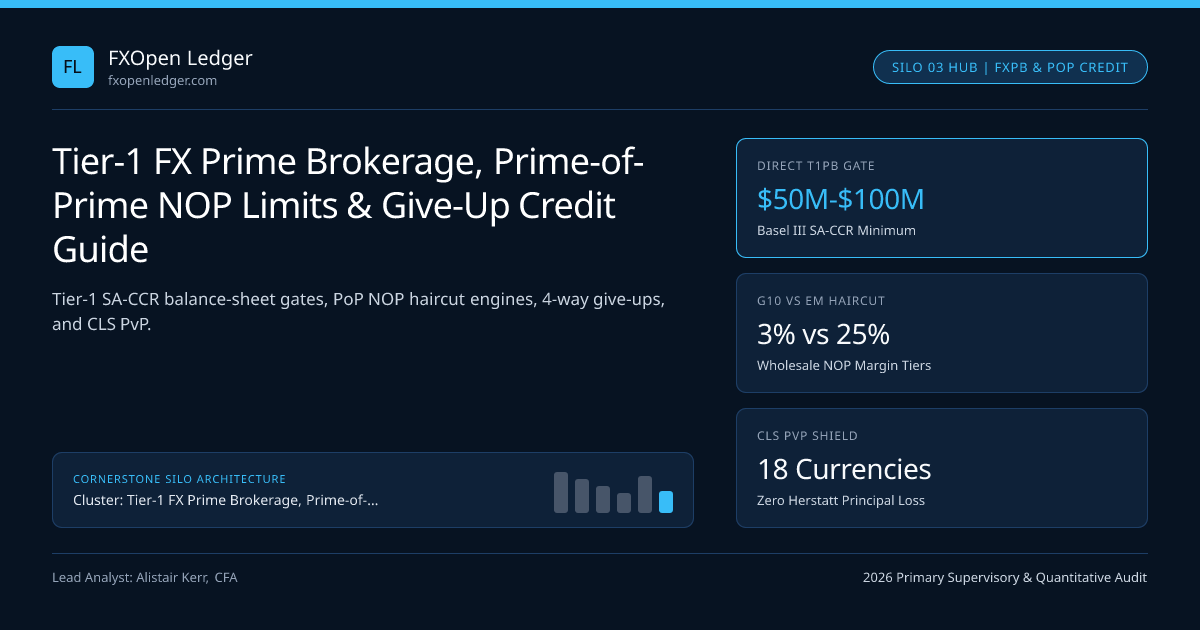
Global OTC foreign exchange operates without a central clearinghouse for spot currency transactions; access to anonymous primary interbank venues (EBS Market, LSEG Matching) and bespoke Tier-1 bank streams depends entirely on Bilateral Credit Intermediation anchored by Tier-1 FX Prime Brokers (FXPBs)—led by Citi, J.P. Morgan, UBS, Deutsche Bank, Morgan Stanley, BNP Paribas, Barclays, Goldman Sachs, NatWest Markets, and Standard Chartered. Following the 2015 Swiss National Bank (EUR/CHF) flash crash, the 2021 Archegos prime-brokerage failure, and full implementation of Basel III Standardized Approach for Counterparty Credit Risk (SA-CCR), Tier-1 banks raised direct FXPB balance-sheet minimums to $50M–$100M+ in audited Tangible Net Worth, locking out 92% of mid-market brokerages, hedge funds, and proprietary trading desks.
This cornerstone credit-architecture guide anchors the Prime-of-Prime & FXPB Credit hub, mapping how regulated Prime-of-Prime (PoP) intermediaries bridge wholesale Tier-1 credit down to mid-tier institutional desks via omnibus margin accounts, real-time Net Open Position (NOP) engines, and CLS Payment-versus-Payment settlement.
Why Basel III SA-CCR Reshaped Direct Tier-1 FXPB Access#
Under legacy Current Exposure Method (CEM), G-SIB banks held relatively modest capital against short-dated spot and tom-next FX prime brokerage lines. Basel III SA-CCR introduced explicit supervisory factors (SF = 4.0% on currency notional) plus severe leverage-ratio exposures on unsettled give-up portfolios—analyzed in Tier-1 bank FXPB balance-sheet and SA-CCR onboarding. Simultaneously, fixed per-ticket post-trade messaging charges analyzed in PB give-up ticket surcharges and small-clip aggregation fees made sub-$500k retail hedge tickets economically unviable on direct bank PB lines.
Regulated Prime-of-Prime houses—such as institutional entities tracked in our dealers directory including AMB Prime, ALB Prime, and Climax Prime—solve both constraints by posting eight-figure collateral with two or three Tier-1 FXPBs, aggregating downstream micro-lots into wholesale blocks, and extending leveraged margin lines down to $250k–$10M institutional clients, compared in omnibus Prime-of-Prime margin vs individual give-up.
The Four-Way Give-Up & Net Open Position (NOP) Governance Stack#
Inside a classic wholesale prime relationship, legal novation operates through a Four-Way FXPB Designation Notice and Traiana Harmony workflow: the client executes anonymously in the Prime Broker's name against Executing Dealer X, and within milliseconds Traiana CreditLink / Harmony matches both sides and novates two mirrored principal trades against the central FXPB. To prevent a rogue algorithm from exceeding credit lines across 12 simultaneous venues, every intermediary enforces Net Open Position (NOP) utilization formulas and currency haircuts paired with intraday credit-line throttling and FIX kill-switches.
| Credit Access Tier | Minimum Counterparty Equity | Legal Documentation Stack | Typical G10 Leverage / NOP | Settlement Rail | Primary Counterparty Risk |
|---|---|---|---|---|---|
| Direct Tier-1 Bank FXPB | $50M - $100M+ Audited | 2002 ISDA + 2016 VM-CSA + Master Give-Up | 15:1 - 35:1 Dynamic VaR | Direct CLS PvP / Netting | SA-CCR Fee & Single-PB Termination |
| FCA / FINMA / ASIC Tier-1 PoP | $250k - $5M Institutional | ISDA/CSA or FCA CASS 7 TTCA | 20:1 - 50:1 Tiered NOP | Omnibus PoP Margin Ledger | PoP Balance-Sheet Solvency |
| Non-Bank ECN / Bilateral PoP | $100k - $1M Wholesale | Institutional Terms (TTCA) | 25:1 - 100:1 Intraday | Bilateral Wire Netting | Commingled Omnibus Contagion |
| Unregulated Offshore "Fake PoP" | $10k - $50k | Unaudited Terms of Business | 100:1 - 500:1 (B-Booked!) | Crypto / Third-Party PSP | Internalized Fraud / Withdrawal Freeze |
Exact Prime-of-Prime NOP & SA-CCR Credit Utilization Formula#
Institutional credit officers size a downstream client's maximum gross and net exposure using Haircut-Weighted Net Open Position ($NOP_{weighted}$) bounded by posted Title Transfer collateral $C{posted}$ and currency-specific volatility haircuts $hc$:
- MarginUtilizedUSD = Sum{all currencies c} ( |NetPosUSDc| * Haircutc ) + Max(0, -UnrealizedVMPnLUSD)
- NOPHeadroomRatio = (PostedCollateralUSD - MarginUtilizedUSD) / PostedCollateralUSD
- Worked Institutional PoP Credit Audit ($2.00M Posted Cash/T-Bill Collateral; Kill-Switch Hard Stop-Out at 85% Utilization):
- Portfolio: Long $18.0M EUR/USD (G10 Haircut 3.0%), Short $6.0M USD/TRY (EM Tier-4 Haircut 15.0%), Unrealized PnL = -$140,000:
- EUR/USD Margin ($18.0M * 3.0%) = $540,000
- USD/TRY Margin ($6.0M * 15.0%) = $900,000
- Unrealized Floating Loss Deduction = $140,000 -> Total Margin_Utilized = $1,580,000 (79.0% Utilization!).
- Remaining Free Margin before 85% ($1,700,000) Pre-Trade Throttle = $120,000 ($4.0M G10 or $800k TRY capacity).
Settlement Risk, Flash-Crash Contagion & Collateral Architecture#
Credit intermediation extends far beyond intraday margin math into settlement cutoffs and insolvency law. When trades settle outside CLS Bank's 18 eligible currencies, treasuries confront Herstatt principal risk detailed in CLS PvP vs bilateral netting credit risk and non-CLS emerging-market settlement cutoffs. Moreover, structural mismatches between retail statutory Negative Balance Protection and wholesale non-NBP margin fueled the 2015 broker insolvencies analyzed in SNB EUR/CHF flash-crash contagion controls.
Due Diligence Across Collateral, Multi-Asset Lines & PoP Solvency#
Before signing a Title Transfer Collateral Arrangement under UK FCA, FINMA, ASIC, or CySEC rules, institutional treasurers audit every link of the PoP legal and operational chain: ISDA 2016 VM-CSA daily variation margin disputes, Loco London unallocated bullion credit lines, cross-margining spot FX, NDFs, and index CFDs, Treasury-bill collateral haircuts and rehypothecation, 2002 ISDA Master close-out netting waterfalls, offshore Mauritius/Seychelles PoP AML onboarding, and evaluating PoP counterparty solvency via audited ICAAP filings.
Frequently asked questions
What is the difference between a Tier-1 FX Prime Broker and a Prime-of-Prime (PoP)?
A Tier-1 FXPB is a G-SIB global bank (like Citi, J.P. Morgan, or UBS) providing direct interbank credit intermediation to $50M-$100M+ institutions; a regulated Prime-of-Prime holds Tier-1 FXPB accounts and subdivides wholesale credit and ECN access to $250k-$10M brokers and funds.
How can a broker tell a genuine Prime-of-Prime apart from a disguised B-Book dealer?
Demand three proofs: (1) live Tier-1 bank FXPB confirmation or Naming Notice disclosure, (2) audited FCA MIFIDPRU 8 / IFR Pillar 3 accounts showing agency fee focus and strong CET1 capital, and (3) transparent L2 market-impact pass-through on large clips.
What does Net Open Position (NOP) mean in wholesale FX credit agreements?
Net Open Position measures the aggregate unhedged directional currency and bullion exposure open across all trading sessions and value dates, determining real-time pre-trade credit utilization against posted collateral.
Why do institutional wholesale PoP accounts lack retail Negative Balance Protection?
Wholesale PoP relationships are governed by ISDA/CSA or FCA CASS 7 Title Transfer Collateral Arrangements between professional/eligible counterparties, meaning both parties remain legally liable for full mark-to-market deficits beyond initial margin.
Publication record
- Published
- 14 November 2026
- Updated
- 15 November 2026
- Author
- Alistair Kerr, CFA
- Review
- Review not recorded
- Automated fact check
- Passed in the stored pipeline record
- Source URLs
- 4 recorded
AI assistance recorded: anthropic/claude-opus-4.6. This field does not establish human review or source verification.
Academic & Institutional Attribution
Cite This Research & Embed Live Data Card
Standard academic & institutional research paper citation format.
Alistair Kerr, CFA. (2026, November 15). Tier-1 FX Prime Brokerage, Prime-of-Prime NOP Limits & Give-Up Credit Guide. FXOpen Ledger. https://fxopenledger.com/orderbook/tier-1-fx-prime-brokerage-pop-nop-credit-intermediation-guideRegulatory Directory Cross-Reference
Referenced Institutions & Regulatory Registries
Top Regulated Institutions in This Coverage Slice
Related Prime of Prime Nop Credit Intermediation & Institutional Briefings
Explore Prime of Prime Nop Credit Intermediation Hub (20) →Prime of Prime Nop Credit Intermediation
Tier-1 Bank FXPB Balance-Sheet Floors & Basel III SA-CCR MathPrime of Prime Nop Credit Intermediation
Net Open Position (NOP) Utilization Formulas & Currency HaircutsPrime of Prime Nop Credit Intermediation
Four-Way FXPB Designation Notices & Traiana Harmony Give-UpsPrime of Prime Nop Credit Intermediation
CLS PvP Settlement vs Bilateral Netting & Herstatt Risk in OTC FXPrime of Prime Nop Credit Intermediation
SNB EUR/CHF Flash-Crash Contagion & Negative-Balance ControlsPrime of Prime Nop Credit Intermediation
ISDA 2016 VM-CSA Daily Variation Margin Calls & MTA DisputesPrime of Prime Nop Credit Intermediation
Omnibus Prime-of-Prime Margin Accounts vs Individual Give-UpsPrime of Prime Nop Credit Intermediation
FCA CASS 7 & Title Transfer Collateral Arrangements (TTCA) in PoPTom Next Swap Rollover Triple Wednesday
Tom-Next Swap Points, Triple-Swap Wednesday & FX Dealer Rollover GuideLmax Ebs Ecn Spread Slippage Audit
CLOB vs Disclosed FX Streams, Effective Spread & News Slippage GuideFX Global Code Last Look Execution
Auditing GFXC Liquidity Provider Cover Sheets: Last-Look & Hold-Time MetricsFX Global Code Last Look Execution
Firm vs Last-Look OTC FX Liquidity Streams: Spread vs Reject Cost Math
FXOpen Ledger Data, Benchmarks & Contributor Records
CC BY 4.0 Open Data
Open Institutional Datasets (CSV / JSON) →
Download desk-compiled quantitative series & schemas.
2026 Reference Matrix
2026 Institutional Benchmarks & Thresholds →
Statutory capital, clearing, margin & rate conventions.
Editorial Records
Authors & Review Records →
View named contributors where those records are available.
Complete Index
Master Research & Dossier Archive →
Browse all published briefings by topic pillar & date.