
FX Global Code Last Look Execution
Firm vs Last-Look OTC FX Liquidity Streams: Spread vs Reject Cost Math
Tighter headline bid-ask spreads on conditional OTC foreign exchange streams frequently mask 0.45 to 1.15 bps of secondary replacement slippage when simultaneous multi-venue sweeps trigger last-look rejections.
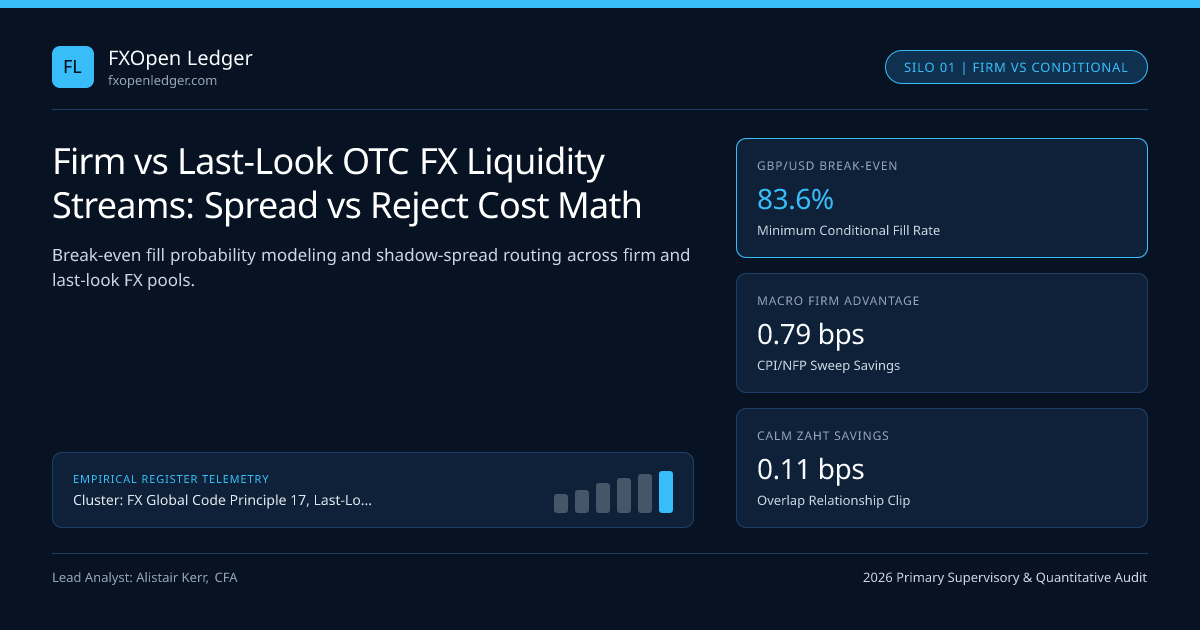
Institutional smart order routers aggregating both firm Central Limit Order Book quotes and conditional bilateral streams confront a deceptive optical illusion: conditional last-look feeds routinely display EUR/USD spreads 0.12 to 0.22 pips tighter than firm no-last-look order books, yet empirical post-trade audits across $5 million to $20 million Urgent-Fill sweeps frequently show lower total implementation shortfall on firm liquidity. In conditional OTC foreign exchange streams, the market maker retains a free millisecond validity check to decline trades that breach price-tolerance bands; on firm venues governed by Minimum Quote Life (MQL) rules, a resting limit quote is unconditionally binding the instant a matching market or IOC order arrives at the engine.
As established in our FX Global Code Principle 17 & Execution TCA cornerstone and categorized under the Principle 17 & Execution TCA hub, institutional execution desks must calculate the exact break-even fill ratio below which a tight conditional quote becomes mathematically inferior to a wider firm stream.
Why Market Makers Price Firm Liquidity Wider Than Conditional Feeds#
A liquidity provider quoting $5 million firm EUR/USD on four independent ECNs exposes itself to $20 million of instantaneous directional inventory if a macro headline triggers a synchronized cross-market sweep before cancel packets traverse fiber links between London LD4 and New York NY4. Because the dealer cannot invoke last-look to reject the second, third, and fourth simultaneous hits, the pricing algorithm embeds an adverse-selection risk premium directly into the quoted bid-ask spread—widening a 0.12-pip conditional quote to roughly 0.28–0.35 pips on a firm book.
By contrast, a conditional LP streaming to curated relationship books can quote ultra-tight spreads to benign corporate or real-money accounts while relying on symmetric tolerance checks—audited via GFXC liquidity provider cover sheet metrics—to reject stale-quote collisions. Consequently, passive single-clip orders sent during calm London-New York overlap hours often capture genuine savings on conditional streams, whereas multi-leg sweep orders sent during fast markets pay severe replacement penalties.
Break-Even Fill Ratio Mathematics for Smart Order Routers#
To configure venue priority weights inside institutional FIX API execution engines, quantitative analysts solve for the critical fill probability $p^*$ at which a conditional stream's expected execution cost equals a firm order book's deterministic half-spread plus clearing fee. Crucially, the replacement penalty $\Delta_{chase}$ must incorporate both the hold duration of the rejecting LP and the inter-venue routing hop to the secondary pool, as analyzed in spot FX hold-time latency distributions.
- Solving for Break-Even Conditional Fill Probability (p*):
- p* = Deltachase / (0.5 * (Sfirm - Scond) + (Ffirm - Fcond) + Deltachase)
- Where:
- S_firm = Full bid-ask spread on firm no-last-look venue (bps)
- S_cond = Full bid-ask spread on conditional last-look stream (bps)
- F_firm = Exchange / CLOB clearing fee per million (bps)
- F_cond = Bilateral / aggregator fee on conditional stream (bps)
- Delta_chase = Average adverse mid-price movement between order inception and post-reject fallback fill (bps)
- Worked Calibration (GBP/USD $5M Institutional Ticket):
- Sfirm = 0.42 bps, Ffirm = 0.12 bps -> Deterministic Firm Cost = 0.21 + 0.12 = 0.33 bps
- Scond = 0.18 bps, Fcond = 0.06 bps -> Filled Conditional Cost = 0.09 + 0.06 = 0.15 bps (0.18 bps cheaper when filled)
- Measured post-reject mid drift Delta_chase = 0.92 bps during European macro hours.
- p* = 0.92 / (0.18 + 0.92) = 0.92 / 1.10 = 0.8364 (83.64%)
- Decision Rule: Any conditional GBP/USD stream whose empirical rolling fill rate drops below 83.6% must be demoted behind firm liquidity.
Regime-Dependent Routing Across Calm, Fixing, and Macro Windows#
Static routing tables that rank LPs solely by raw price destroy execution alpha because fill ratios and $\Delta_{chase}$ are sharply non-stationary across intraday volatility regimes. Multi-asset brokerage books—such as Climax Prime, BYFX Global, and CGFX—operating under best-execution mandates from the UK FCA and Swiss FINMA segment execution routing into three distinct intraday regimes:
Intraday Volatility Regime Routing Matrix#
| Intraday Market Regime | Conditional Stream Avg Half-Spread | Observed Conditional Fill Ratio | Post-Reject Mid Drift ($\Delta_{chase}$) | Optimal SOR Routing Priority |
|---|---|---|---|---|
| London-NY Calm Overlap (13:00-15:30 LDN) | 0.07 bps (EUR/USD) | 94.8% | +0.24 bps | Priority 1: ZAHT Conditional Streams |
| WMR 16:00 Fixing Window (+/- 2.5 mins) | 0.11 bps (EUR/USD) | 84.2% | +0.68 bps | Hybrid Split: Firm CLOB + Top 2 ZAHT LPs |
| High-Impact Macro Print (CPI / NFP +/- 60s) | 0.45 bps (EUR/USD) | 58.2% | +2.35 bps | 100% Firm No-Last-Look CLOBs Only |
| Asian Rollover Thin Book (21:55-22:15 LDN) | 0.38 bps (EUR/USD) | 71.5% | +1.15 bps | Firm Limit Pegs / Throttle Conditional Sweeps |
Shadow-Cost Accounting in Execution Management Systems#
Advanced EMS routers implement Shadow-Spread Adjustment: rather than sorting order-book ladders by raw streamed bid/ask, the router adds $(1 - \hat{p}i) \cdot \hat{\Delta}{chase}$ directly onto every conditional LP's displayed quote in real time. If Conditional LP Alpha quotes 1.08501 with an 80% rolling 5-minute fill ratio and a 0.80-pip expected reject drift, its shadow ask is penalised by $0.20 \times 0.80 = 0.16$ pips to 1.085026, automatically elevating a firm venue offering 1.085020 at 99% certainty to top-of-book execution priority.
Frequently asked questions
What defines firm liquidity in institutional OTC foreign exchange?
Firm liquidity means every resting limit order displayed on the venue is unconditionally executable upon matching; the liquidity provider has zero post-match last-look window to reject the fill due to subsequent price movement.
When do conditional last-look streams outperform firm FX venues?
During normal intraday liquidity hours for non-toxic, single-clip real-money or corporate orders where fill ratios exceed 93% and ZAHT checks add under 2ms of processing delay, conditional relationship streams capture 0.08 to 0.15 bps in spread savings.
How does sweeping multiple conditional streams at once amplify reject costs?
Sending simultaneous child clips across several last-look streams alerts multiple market makers or hits correlated upstream liquidity simultaneously; any rejected leg forces a delayed retry after surviving fills have already moved the composite mid-price.
How do smart order routers automate switching between firm and last-look feeds?
Modern FX routers compute rolling EWMA fill probabilities and post-reject drift per LP tag, penalizing each conditional quote with a shadow reject cost in sub-pip increments before constructing the consolidated execution ladder.
Publication record
- Published
- 14 November 2026
- Updated
- 15 November 2026
- Author
- Alistair Kerr, CFA
- Review
- Review not recorded
- Automated fact check
- Passed in the stored pipeline record
- Source URLs
- 3 recorded
AI assistance recorded: anthropic/claude-opus-4.6. This field does not establish human review or source verification.
Academic & Institutional Attribution
Cite This Research & Embed Live Data Card
Standard academic & institutional research paper citation format.
Alistair Kerr, CFA. (2026, November 15). Firm vs Last-Look OTC FX Liquidity Streams: Spread vs Reject Cost Math. FXOpen Ledger. https://fxopenledger.com/orderbook/firm-liquidity-vs-last-look-otc-fx-stream-reject-economicsRegulatory Directory Cross-Reference
Referenced Institutions & Regulatory Registries
Mentioned Regulated Institutions
Referenced Supervisory Authorities
Related FX Global Code Last Look Execution & Institutional Briefings
Explore FX Global Code Last Look Execution Hub (20) →FX Global Code Last Look Execution
FX Global Code Principle 17, Last-Look Hold Windows & OTC Execution TCA GuideFX Global Code Last Look Execution
Symmetric vs Asymmetric Last-Look Price-Tolerance Checks in Spot FXFX Global Code Last Look Execution
Spot FX Hold-Time Latency Distributions (0ms-50ms) & Tail Reject SpikesFX Global Code Last Look Execution
FX Global Code Principle 11: Pre-Hedging Rules & Client Consent BoundariesFX Global Code Last Look Execution
Post-Trade FX Markout Curves (+5ms to +60s): Adverse Selection DiagnosticsFX Global Code Last Look Execution
Zero Additional Hold Time (ZAHT) in FX Streams: Engineering & Audit GuideFX Global Code Last Look Execution
Rejected FIX Order Information Leakage: Auditing Last-Look Quote DriftFX Global Code Last Look Execution
Implementation Shortfall TCA Against Arrival Mid for OTC FX AlgosAbook Bbook Stp Bridge Routing
Hybrid C-Book Alpha Profiling: Partial Delta Hedging & MultipliersAbook Bbook Stp Bridge Routing
VPIN Toxicity Scoring in Multi-Dealer FX Aggregators & Liquidity PoolsAbook Bbook Stp Bridge Routing
Five-Second Markout Profiling: Segmenting Sharp vs Benign FX FlowAbook Bbook Stp Bridge Routing
Quote Skewing vs Spread Widening: OTC FX Dealer Inventory Control Math
FXOpen Ledger Data, Benchmarks & Contributor Records
CC BY 4.0 Open Data
Open Institutional Datasets (CSV / JSON) →
Download desk-compiled quantitative series & schemas.
2026 Reference Matrix
2026 Institutional Benchmarks & Thresholds →
Statutory capital, clearing, margin & rate conventions.
Editorial Records
Authors & Review Records →
View named contributors where those records are available.
Complete Index
Master Research & Dossier Archive →
Browse all published briefings by topic pillar & date.