
FX Global Code Last Look Execution
FX Global Code Principle 17, Last-Look Hold Windows & OTC Execution TCA Guide
Under FX Global Code Principle 17, wholesale foreign exchange market makers applying last-look checks must enforce disclosed price-tolerance symmetry, eliminate discretionary hold delays, and isolate rejected order data from dealing desk algorithms.
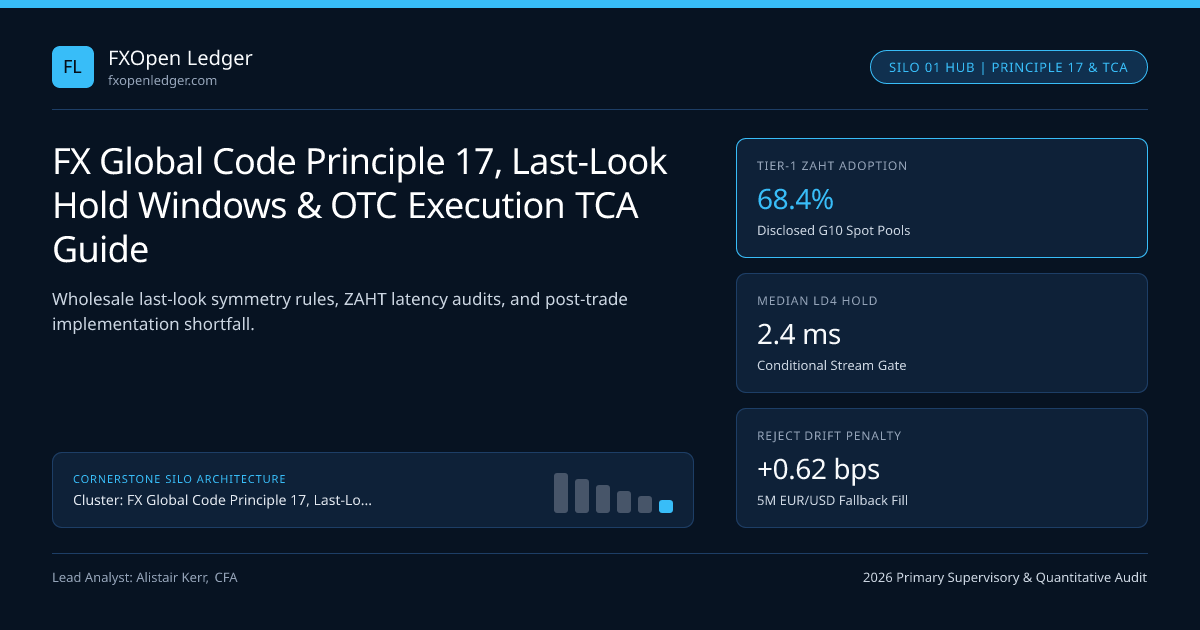
Principle 17 of the FX Global Code restricts wholesale foreign exchange market makers to deterministic credit and price-validity checks during the last-look window, prohibiting trading activity that exploits client trade requests before acceptance or rejection. Across disclosed bilateral streams surveyed alongside the Bank for International Settlements Triennial FX turnover data ($7.5 trillion daily OTC volume), median last-look processing times compressed from 35 milliseconds in 2018 to sub-5 milliseconds on co-located LD4 and NY4 institutional feeds, while Zero Additional Hold Time (ZAHT) configurations now account for over 68% of Tier-1 bank spot G10 liquidity pools. Despite tighter operational latency, execution desks routing sweep orders across multi-dealer aggregators still encounter effective spread slippage of 0.35 to 1.40 bps when asymmetric reject thresholds or uncalibrated quote-to-trade filters silently discard in-the-money fills.
This cornerstone execution manual synthesizes the regulatory and microstructural governance framework spanning Global Foreign Exchange Committee cover sheets, firm versus conditional liquidity pricing, Principle 11 pre-hedging demarcations, and millisecond post-trade markout forensics tracked inside the Principle 17 & Execution TCA hub.
Anatomy of Last-Look Checks Under GFXC Principle 17#
When a liquidity provider broadcasts conditional quotes across twelve aggregators simultaneously, $10M top-of-book depth exposes the desk to $120M in concurrent sweep risk. Principle 17 therefore permits only two deterministic checks upon NewOrderSingle (35=D) arrival: counterparty credit headroom and symmetric price validity against a pre-defined tolerance band.
The 2021 and 2024 revisions coordinated by the Global Foreign Exchange Committee closed three historical loopholes that previously generated nine-figure regulatory penalties from the UK Financial Conduct Authority and the New York State Department of Financial Services. First, LPs must never apply asymmetric price tolerances that reject trades moving in the client's favor while filling trades moving in the dealer's favor—a structural distortion examined in symmetric vs asymmetric last-look price-tolerance thresholds. Second, dealers cannot stretch hold timers beyond actual technical validation to observe subsequent tick direction, a metric scrutinized in spot FX hold-time latency distributions from 0ms to 50ms. Third, order telemetry from an unaccepted last-look request must never trigger hedging or quote skewing prior to fill confirmation, directly addressing rejected FIX order information leakage.
Standardizing Transparency via GFXC Liquidity Provider Cover Sheets#
Adoption of the GFXC Standardized Liquidity Provider Disclosure Cover Sheet converted ambiguous Terms of Business PDFs into structured disclosures covering maximum hold duration, symmetry, ZAHT status, and reference price construction. Execution committees auditing broker and dealer books—ranging from multi-asset venues such as City Index and AMB Prime to regional institutional desks like Blue Suisse—can now cross-examine declared parameters directly against empirical FIX Tag 39 OrdStatus reject code forensics.
Our dedicated breakdown of GFXC liquidity provider cover sheet audit metrics demonstrates that two streams advertising identical 0.2-pip EUR/USD raw spreads can diverge by 0.85 bps in realized execution cost once reject re-routing latency is priced in. Furthermore, when desks evaluate zero additional hold time (ZAHT) implementations, they must verify whether the LP computes validity at the exact microsecond of gateway ingress or after internal message-bus queuing.
| Execution Governance Dimension | Firm CLOB / No-Last-Look Stream | ZAHT Disclosed Bilateral Stream | Legacy Hold-Window Stream (10-30ms) | Supervisory & GFXC Benchmark |
|---|---|---|---|---|
| Quoted Top-of-Book EUR/USD Spread | 0.25 - 0.45 pips | 0.10 - 0.22 pips | 0.05 - 0.15 pips | Audited against FCA UK & CFTC rules |
| Additional Discretionary Hold Delay | 0 ms (Deterministic Match) | 0 ms (Gateway Ingress Check) | 10 ms - 30 ms Configurable | GFXC Principle 17 Cover Sheet Q4 |
| Price-Tolerance Symmetry Rule | Not Applicable (Firm Limit) | Strict Symmetric (+/- Band) | Symmetric Mandatory Since 2021 | GFXC Last-Look Guidance (2021) |
| Typical 5M Sweep Fill Ratio | 96.5% - 99.4% | 89.0% - 94.5% | 74.0% - 85.0% | Institutional FIX API Drop-Copy |
| Rejected Ticket Signaling Footprint | Zero LP Leakage (Anonymous) | Isolated Compliance Log Only | Elevated Re-Quote Drift (+0.48 bps) | Principle 17 Information Barrier |
Firm Liquidity Economics vs Conditional Stream Reject Costs#
Conditional feeds quote tighter optical spreads because last-look shields dealers from cross-venue arbitrage, whereas firm CLOBs price adverse-selection risk directly into quoted width. In firm liquidity vs last-look OTC FX stream reject economics, we prove that urgent market-sweep algorithms suffer severe secondary slippage whenever a conditional LP holds an order for 15 milliseconds during a directional breakout and returns 39=8 (Rejected), forcing the smart order router to chase an already repriced market.
To unify quoted spread, fill probability, and reject replacement drift into a single institutional metric, execution desks rely on FX TCA Implementation Shortfall adjusted for conditional reject drag:
- Where:
- E[ECallin] = Expected all-in execution cost in basis points relative to arrival mid-price
- pfill = Empirical fill ratio on the primary liquidity stream (0 < pfill <= 1)
- S_quoted = Quoted full bid-ask spread on the primary stream (bps)
- S_backup = Quoted full bid-ask spread on the secondary fallback venue (bps)
- DeltaM(t) = Expected adverse mid-price drift over hold duration tauhold plus router latency tau_reroute (bps)
- C_comm = Brokerage / ECN clearing fee in basis points
- Worked Institutional Audit ($10M EUR/USD Sweep):
- Stream A (Conditional 20ms Hold): Squoted = 0.16 bps, pfill = 0.78, Sbackup = 0.36 bps, DeltaM(24ms) = 0.74 bps, C_comm = 0.10 bps
- E[EC_A] = 0.78 * (0.08 + 0.10) + 0.22 * (0.18 + 0.74 + 0.10) = 0.1404 + 0.2244 = 0.3648 bps ($364.80 per $10M)
- Stream B (Firm No-Last-Look): Squoted = 0.32 bps, pfill = 0.98, Sbackup = 0.38 bps, DeltaM(2ms) = 0.09 bps, C_comm = 0.12 bps
- E[EC_B] = 0.98 * (0.16 + 0.12) + 0.02 * (0.19 + 0.09 + 0.12) = 0.2744 + 0.0080 = 0.2824 bps ($282.40 per $10M)
- Result: Despite a 2x wider headline spread, Firm Stream B saves 0.0824 bps ($82.40 per $10M clip) in realized shortfall.
Principle 11 Pre-Hedging Boundaries and Benchmark Fixing Controls#
While Principle 17 governs electronic last-look streams, Principle 11 regulates pre-hedging—the management of anticipated inventory risk associated with a communicated but not-yet-executed client order. Pre-hedging is strictly unlawful during a last-look window because the dealer already possesses a binding executable request and has not assumed market risk. However, in voice/electronic Request-for-Quote (RFQ) workflows or benchmark orders targeting the 16:00 London fix, a dealer may pre-hedge only if three conditions hold: the client has granted prior informed consent, the transaction genuinely intends to benefit client execution quality, and market impact does not disadvantage the customer's fill price.
Buy-side treasury teams examine these rules closely across FX Global Code Principle 11 pre-hedging disclosure boundaries, WMR 4pm London benchmark pre-hedging and window impact TCA, and RFQ panel-size signaling cost in disclosed OTC FX swaps. Supervisory enforcement by ESMA and the US CFTC treats undisclosed front-running of competitive multi-dealer RFQs—where a dealer knows the client is polling four banks simultaneously—as abusive market conduct.
Post-Trade Markout Curves, Algo Routing & LP Scorecard Governance#
Modern Transaction Cost Analysis extends far beyond comparing fill price to daily VWAP. Quantitative execution desks construct high-resolution markout trajectories from +1 millisecond out to +60 seconds—detailed in post-trade FX markout curves from 5ms to 60s—to separate benign spread capture from premature market impact. When parent orders exceed top-of-book depth, execution traders deploy TWAP, POV, or passive peg strategies benchmarked via implementation shortfall arrival-mid TCA for OTC FX algos and passive peg vs aggressive sweep child execution TCA.
Equally critical is auditing how bank algos route child clips internally before touching lit venues. Using GFXC algorithmic due diligence templates alongside single-dealer platform internalization disclosures, fiduciaries satisfy MiFID II best-execution governance while monitoring fill-ratio decay by ticket clip size and cross-Atlantic stale-quote protection. Every quarter, investment committees consolidate these diagnostics into buy-side quarterly LP scorecards cross-checked against our institutional execution benchmarks and regulatory verification register to prune high-reject feeds and concentrate flow with transparent market makers.
Frequently asked questions
Does FX Global Code Principle 17 ban last-look execution in wholesale spot FX?
No. Principle 17 permits conditional last-look liquidity streams provided the liquidity provider discloses its maximum hold window, applies symmetric price-tolerance thresholds, adds zero discretionary hold delay beyond technical validity checks, and enforces strict information barriers on rejected trade requests.
What is Zero Additional Hold Time (ZAHT) on an FX liquidity provider cover sheet?
ZAHT means the market maker evaluates credit and symmetric price tolerance immediately upon order ingress without pausing a timer to observe subsequent tick movements. Total processing latency reflects pure hardware and software validation—typically 0.4ms to 2.5ms—rather than an artificial 15ms to 50ms waiting window.
Why can a tighter last-look spread cost more than a wider firm CLOB quote?
When a conditional stream rejects 15% to 25% of directional sweep orders after a 15ms hold delay, the smart order router must re-send unfilled notional into a market that has already moved adversely by 0.50 to 0.90 bps, making expected all-in implementation shortfall higher than an immediate firm fill.
Can an FX dealer pre-hedge an incoming client order during the last-look window?
Never. Both Principle 11 and Principle 17 explicitly prohibit pre-hedging or altering market quotes using information from a client trade request while a last-look acceptance decision is pending, as the dealer has assumed zero principal risk until the order is confirmed.
Publication record
- Published
- 14 November 2026
- Updated
- 14 November 2026
- Author
- Alistair Kerr, CFA
- Review
- Review not recorded
- Automated fact check
- Passed in the stored pipeline record
- Source URLs
- 4 recorded
AI assistance recorded: anthropic/claude-opus-4.6. This field does not establish human review or source verification.
Academic & Institutional Attribution
Cite This Research & Embed Live Data Card
Standard academic & institutional research paper citation format.
Alistair Kerr, CFA. (2026, November 14). FX Global Code Principle 17, Last-Look Hold Windows & OTC Execution TCA Guide. FXOpen Ledger. https://fxopenledger.com/orderbook/fx-global-code-principle-17-last-look-tca-institutional-guideRegulatory Directory Cross-Reference
Referenced Institutions & Regulatory Registries
Mentioned Regulated Institutions
Referenced Supervisory Authorities
Related FX Global Code Last Look Execution & Institutional Briefings
Explore FX Global Code Last Look Execution Hub (20) →FX Global Code Last Look Execution
Auditing GFXC Liquidity Provider Cover Sheets: Last-Look & Hold-Time MetricsFX Global Code Last Look Execution
Firm vs Last-Look OTC FX Liquidity Streams: Spread vs Reject Cost MathFX Global Code Last Look Execution
Symmetric vs Asymmetric Last-Look Price-Tolerance Checks in Spot FXFX Global Code Last Look Execution
Spot FX Hold-Time Latency Distributions (0ms-50ms) & Tail Reject SpikesFX Global Code Last Look Execution
FX Global Code Principle 11: Pre-Hedging Rules & Client Consent BoundariesFX Global Code Last Look Execution
Post-Trade FX Markout Curves (+5ms to +60s): Adverse Selection DiagnosticsFX Global Code Last Look Execution
Zero Additional Hold Time (ZAHT) in FX Streams: Engineering & Audit GuideFX Global Code Last Look Execution
Rejected FIX Order Information Leakage: Auditing Last-Look Quote DriftAbook Bbook Stp Bridge Routing
A-Book STP, B-Book Internalization & C-Book Routing: FX Dealer ArchitecturePrime of Prime Nop Credit Intermediation
Tier-1 FX Prime Brokerage, Prime-of-Prime NOP Limits & Give-Up Credit GuideTom Next Swap Rollover Triple Wednesday
Tom-Next Swap Points, Triple-Swap Wednesday & FX Dealer Rollover GuideLmax Ebs Ecn Spread Slippage Audit
CLOB vs Disclosed FX Streams, Effective Spread & News Slippage Guide
FXOpen Ledger Data, Benchmarks & Contributor Records
CC BY 4.0 Open Data
Open Institutional Datasets (CSV / JSON) →
Download desk-compiled quantitative series & schemas.
2026 Reference Matrix
2026 Institutional Benchmarks & Thresholds →
Statutory capital, clearing, margin & rate conventions.
Editorial Records
Authors & Review Records →
View named contributors where those records are available.
Complete Index
Master Research & Dossier Archive →
Browse all published briefings by topic pillar & date.