
FX Global Code Last Look Execution
Quarterly FX LP Scorecard Design: Weighting Spread, Hold Time & Markouts
Institutional foreign exchange execution committees govern counterparty panels through quantitative quarterly LP scorecards that penalize reject chasing, +500ms hedge dumping, and P99 hold-time breaches alongside raw quoted spread.
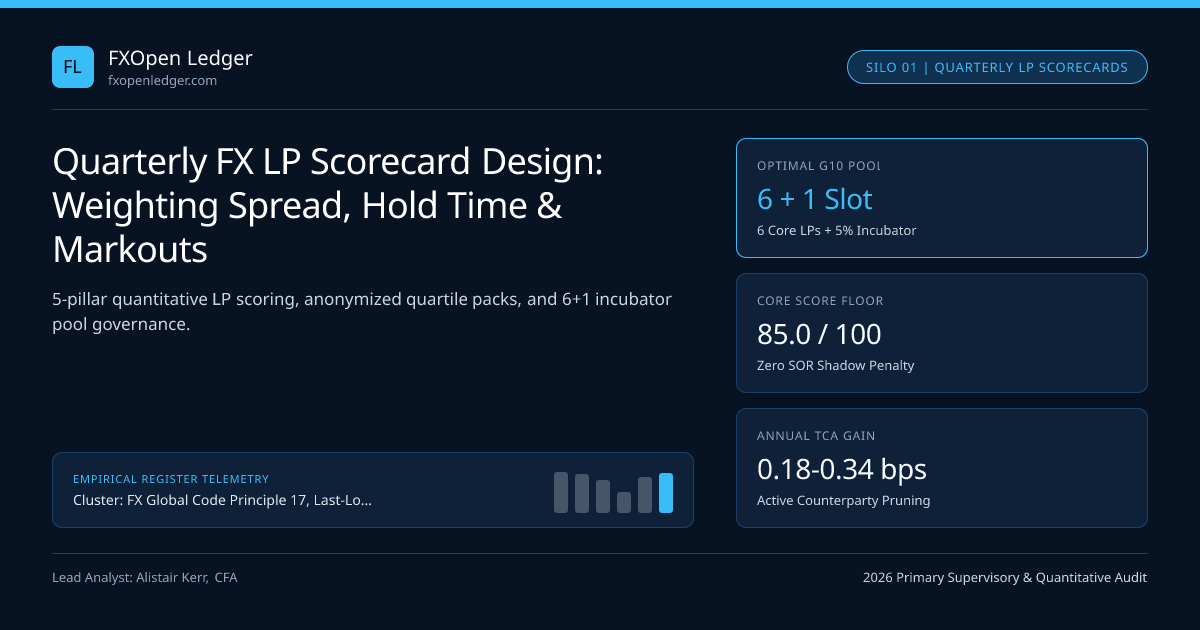
Curating an institutional foreign exchange liquidity pool is a dynamic feedback game: add too many liquidity providers (12–15 LPs) and your smart order router suffers phantom-liquidity sweeps and diluted relationship hit ratios; prune down to 3 captive LPs without rigorous quarterly competition and spreads quietly drift wider by 0.15 bps. High-performing buy-side asset managers, corporate treasury centers, and Prime-of-Prime aggregators solve this trade-off through Quantitative Quarterly LP Scorecards—combining five orthogonal execution metrics into a composite Pool Allocation Weight reviewed formally by the firm's Best Execution Committee.
Synthesizing every analytical pillar from our FX Global Code Principle 17 & Last-Look TCA cornerstone inside the Principle 17 & Execution TCA hub, a bulletproof scorecard turns raw FIX drop-copy logs into actionable counterparty promotions, stream probation notices, and pool terminations.
Five Orthogonal Pillars of a Manipulation-Proof LP Scorecard#
Ranking LPs solely on "Average Quoted Top-of-Book Spread" invites immediate gaming: any conditional dealer can stream a 0.05-pip mirage spread while rejecting 28% of directional sweeps and dumping accepted fills onto primary CLOBs in 150 milliseconds! To close every gaming vector, institutional scorecards normalize five metrics across matched currency and clip-size buckets:
- Expected All-In Execution Cost ($35%$ Weight): Combines effective half-spread on filled tickets with
(1 - p_clean) * Delta_chasereplacement cost on rejected tickets, using clean FIX Tag 39 fill ratios. - +500ms & +5s Post-Trade Warehouse Markout ($25%$ Weight): Rewards genuine internalizers (flat
< +0.10 bpsdrift) and penalizes "hot-potato" externalizers, applying post-trade FX markout curve diagnostics. - P99 Hold-Time Latency & Cover Sheet Compliance ($15%$ Weight): Penalizes any stream whose empirical P99 reject RTT violates its GFXC Disclosure Cover Sheet or exhibits bimodal hold tails.
- DiD Rejected-Order Information Barrier Score ($15%$ Weight): Verifies zero abnormal own-quote skew (
|Z_leak| < 1.96) after single-LP rejections. - Depth-of-Book Stability During Top-Decile Volatility ($10%$ Weight): Measures top-of-book spread retention and $5M rung availability during macro releases.
Five-Factor Composite LP Score & Z-Penalty Equation#
- Where each penalty term Zm(i) = clip( (Metricm(i) - BestBenchmarkm) / Scale_m, 0, 2.5 )
- Worked Q4 2026 EUR/USD Tier-1 Pool Review ($5M Clip Bucket):
- LP Alpha (ZAHT Bank Warehouse):
- All-In Cost = 0.16 bps (Z=0.10); +500ms Drift = +0.07 bps (Z=0.05); P99 RTT = 2.1ms (Z=0.08); Z_leak = 0.01 (Z=0.00); Vol Widen = 1.8x (Z=0.15)
- Score_Alpha = 100 - [3.5 + 1.25 + 1.20 + 0.0 + 1.5] = 92.55 / 100 -> Tier-1 Core Allocation (28% Routing Share).
- LP Omega (Tight Optical Conditional Feed):
- All-In Cost = 0.38 bps due to 21% rejects (Z=1.20); +500ms Drift = +0.49 bps hot-potato (Z=1.68); P99 RTT = 19.4ms vs 5ms Cover Sheet (Z=2.00!); Z_leak = 0.24 bps (Z=1.40); Vol Widen = 4.9x (Z=1.30)
- Score_Omega = 100 - [42.0 + 42.0 + 30.0 + 21.0 + 13.0] = 0.0 (Floored; 48.0 raw deficit) -> Immediate Stream Suspension!
Sharing Anonymized Peer-Quartile Scorecards With Liquidity Providers#
One of the highest-ROI practices in institutional FX relationship management is delivering a quarterly Anonymized Bilateral Scorecard Pack to each liquidity provider—showing LP Gamma its exact rank (e.g., "#5 of 7 in GBP/USD $5M clips due to +0.34 bps +500ms markout and 11.2% tolerance rejects") without revealing competitor names! Because bank e-FX distribution heads compete fiercely for real-money wallet share across regulated brokerage and fund ecosystems—supervised by the UK FCA, ESMA, ASIC, and benchmarked across our dealer directory and execution benchmarks—presenting empirical data routinely prompts an LP to move the client onto a tighter ZAHT relationship stream within 48 hours!
Pool Tier Routing Rules & Escalation Governance#
| Scorecard Score Band | Pool Tier Classification | Smart Order Router Action | Bilateral Counterparty Action | Governance Sign-Off |
|---|---|---|---|---|
85.0 - 100.0 | Tier-1 Core Franchise | Zero Shadow Penalty; Algo Whitelisted | Eligible for Block Swap & Algo Mandates | Best-Ex Committee Approved |
70.0 - 84.9 | Tier-2 Secondary Liquidity | +0.04 to +0.10 bps Shadow Cost Offset | Quarterly Review; Request ZAHT Upgrade | Head of FX Trading Sign-Off |
55.0 - 69.9 | Probationary Watchlist | Demoted to Calm Overlap Passive Only | Formal 30-Day Cover Sheet & Tag 39 Audit | Chief Compliance Officer Alert |
< 55.0 (or Principle 17 Breach) | Suspended / Terminated | Hard FIX Kill-Switch Disabled | Immediate Stream Removal & Breach Log | Documented for Regulatory Inspection |
Maintaining a "6 Active + 1 Incubator" Pool Topology#
Rather than freezing an LP roster permanently, leading institutional FX desks operate a 6 Active + 1 Incubator G10 spot topology: six proven high-score market makers carry 95% of flow (maintaining healthy >15% hit ratios per LP), while one rotating "Incubator Slot" receives a controlled 5% canary allocation for 60 days. To graduate into the core six, the challenger LP must outscore the lowest incumbent across at least two consecutive monthly reviews—institutionalizing Darwinian execution discipline year-round.
Frequently asked questions
How many liquidity providers should an institutional spot FX aggregator pool include?
Empirical TCA shows 5 to 7 active liquidity providers per G10 pair is optimal; fewer than 4 reduces top-of-book spread competition, while pooling 12+ LPs dilutes per-dealer hit ratios and multiplies multi-sweep market footprint.
Why must LP scorecards normalize comparisons by currency pair and ticket size?
Comparing LP A (which receives easy $1M EUR/USD overlap clips) against LP B (which receives $15M USD/ZAR macro sweeps) creates severe Simpson Paradox distortion; all metrics must be evaluated inside matched pair/clip/regime cells.
How do buy-side desks test a new FX liquidity provider without risking large slippage?
Desks allocate a 3% to 5% Incubator Canary quota of non-urgent single-LP 1M-3M clips with fallback disabled for 250ms, gathering 1,500+ clean observations over 60 days before granting full smart-order-router eligibility.
Do regulatory examiners inspect quarterly FX LP scorecards during best-execution audits?
Yes. Following the repeal of RTS 28 tables, FCA, ESMA, and CySEC examiners treat documented quarterly LP scorecard minutes—specifically evidence that underperforming LPs were demoted or removed—as primary proof of MiFID II Article 27 compliance.
Publication record
- Published
- 14 November 2026
- Updated
- 15 November 2026
- Author
- Alistair Kerr, CFA
- Review
- Review not recorded
- Automated fact check
- Passed in the stored pipeline record
- Source URLs
- 3 recorded
AI assistance recorded: anthropic/claude-opus-4.6. This field does not establish human review or source verification.
Academic & Institutional Attribution
Cite This Research & Embed Live Data Card
Standard academic & institutional research paper citation format.
Alistair Kerr, CFA. (2026, November 15). Quarterly FX LP Scorecard Design: Weighting Spread, Hold Time & Markouts. FXOpen Ledger. https://fxopenledger.com/orderbook/quarterly-lp-scorecard-governance-for-buy-side-fx-desksRegulatory Directory Cross-Reference
Referenced Institutions & Regulatory Registries
Top Regulated Institutions in This Coverage Slice
Referenced Supervisory Authorities
Related FX Global Code Last Look Execution & Institutional Briefings
Explore FX Global Code Last Look Execution Hub (20) →FX Global Code Last Look Execution
FX Global Code Principle 17, Last-Look Hold Windows & OTC Execution TCA GuideFX Global Code Last Look Execution
Auditing GFXC Liquidity Provider Cover Sheets: Last-Look & Hold-Time MetricsFX Global Code Last Look Execution
Firm vs Last-Look OTC FX Liquidity Streams: Spread vs Reject Cost MathFX Global Code Last Look Execution
Symmetric vs Asymmetric Last-Look Price-Tolerance Checks in Spot FXFX Global Code Last Look Execution
Spot FX Hold-Time Latency Distributions (0ms-50ms) & Tail Reject SpikesFX Global Code Last Look Execution
FX Global Code Principle 11: Pre-Hedging Rules & Client Consent BoundariesFX Global Code Last Look Execution
Post-Trade FX Markout Curves (+5ms to +60s): Adverse Selection DiagnosticsFX Global Code Last Look Execution
Zero Additional Hold Time (ZAHT) in FX Streams: Engineering & Audit GuidePrime of Prime Nop Credit Intermediation
Tier-1 Bank FXPB Balance-Sheet Floors & Basel III SA-CCR MathPrime of Prime Nop Credit Intermediation
Net Open Position (NOP) Utilization Formulas & Currency HaircutsPrime of Prime Nop Credit Intermediation
Four-Way FXPB Designation Notices & Traiana Harmony Give-UpsPrime of Prime Nop Credit Intermediation
CLS PvP Settlement vs Bilateral Netting & Herstatt Risk in OTC FX
FXOpen Ledger Data, Benchmarks & Contributor Records
CC BY 4.0 Open Data
Open Institutional Datasets (CSV / JSON) →
Download desk-compiled quantitative series & schemas.
2026 Reference Matrix
2026 Institutional Benchmarks & Thresholds →
Statutory capital, clearing, margin & rate conventions.
Editorial Records
Authors & Review Records →
View named contributors where those records are available.
Complete Index
Master Research & Dossier Archive →
Browse all published briefings by topic pillar & date.