
FX Global Code Last Look Execution
Auditing GFXC Liquidity Provider Cover Sheets: Last-Look & Hold-Time Metrics
Standardized GFXC Liquidity Provider Disclosure Cover Sheets expose critical execution disparities across OTC foreign exchange market makers, including reference mid-price sources, maximum hold-time caps, and internal order-routing firewalls.
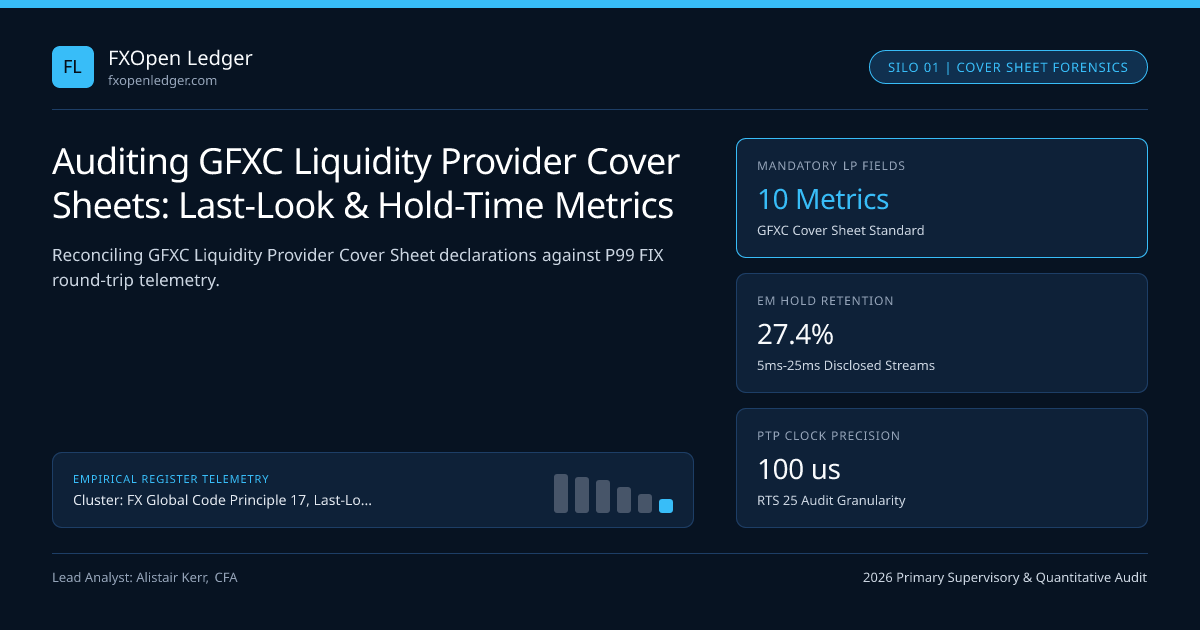
Introduced by the Global Foreign Exchange Committee in 2022 and expanded across institutional onboarding portals through 2026, the GFXC Standardized Liquidity Provider Disclosure Cover Sheet compels wholesale foreign exchange dealers to quantify ten specific execution behaviors in a uniform tabular format. Prior to mandatory cover sheet standardization, buy-side execution committees reviewing 25-page Terms of Business PDFs encountered vague clauses stating that orders were "subject to automated validity screening" without revealing whether hold windows lasted 2 milliseconds or 100 milliseconds. Across 62 active Statement of Commitment signatories today, 100% disclose explicit symmetry settings, yet 27% still reserve non-zero hold windows on bespoke emerging-market or large-clip bilateral streams.
Within our FX Global Code Principle 17 & TCA guide, cover sheet verification serves as the primary pre-trade compliance filter before enabling any new FIX liquidity session inside the execution governance topic hub.
Decoding the Seven Core Fields of the GFXC LP Cover Sheet#
A rigorous counterparty onboarding review does not stop at confirming whether an LP signed the FX Global Code public register; desk analysts dissect seven technical fields on the cover sheet that govern realized fill quality:
- Application of Last Look (Yes / No by Channel): LPs frequently operate hybrid infrastructures—streaming firm quotes onto primary CLOBs while applying last-look on disclosed API feeds, GUI single-dealer portals, and multi-dealer aggregators.
- Symmetry of Price Tolerance: Signatories must confirm that upward and downward price-deviation thresholds around the reference rate are identical. If spot moves +0.3 pips beyond tolerance in the dealer's favor, the engine must reject the client trade or pass price improvement rather than pocketing windfall slippage.
- Zero Additional Hold Time (ZAHT) Declaration: Separates instantaneous ingress checks from timer-paused hold windows, a distinction verified empirically in zero additional hold time (ZAHT) implementation audits.
- Minimum and Maximum Hold Times (ms): Requires exact millisecond bounds per liquidity stream rather than open-ended prose.
- Reference Price Construction: Reveals whether the LP validates incoming client prices against its own internal BBO mid, a composite primary-market feed (EBS/LSEG), or a volume-weighted futures/spot synthetic curve.
- Pre-Hedging Policy Across E-Commerce vs Voice: Cross-references Principle 11 consent triggers.
- Timestamp Granularity on Execution Reports: Identifies whether FIX Tag 60 (
TransactTime) logs microsecond PTP-synchronized clocks or coarse 1-millisecond system ticks.
Reference Price Pitfalls: Internal Mid vs Primary CLOB Composite#
Even when an LP attests to strict symmetry and ZAHT on its cover sheet, choice of Reference Price can manufacture systematic reject spikes during volatility bursts. Suppose an LP streams EUR/USD at 1.08500 / 1.08502 (0.2 pips wide) on an ECN aggregator while validating last-look checks against an internal synthetic mid-price Incorporating CME 6E futures ticks. During a US macro release, CME futures frequently reprice 1 to 3 milliseconds ahead of European spot venues. If a buy-side router lifts 1.08502 on London spot while the LP's internal futures-weighted reference mid has already jumped to 1.08505, an aggressive +/-0.20 pip tolerance band triggers an instant reject—even though spot CLOBs have not yet traded at 1.08505.
Compliance officers cross-examining institutional brokers and prime conduits—such as ALB Prime, 4XC, and ATG Markets—compare cover sheet reference-price disclosures against supervisory conduct standards enforced by ASIC and CySEC.
Cross-Stream Cover Sheet Comparison Matrix#
| Cover Sheet Disclosure Item | Tier-1 Bank SDP (Stream Alpha) | Non-Bank HFT Maker (Stream Beta) | Regional PoP Aggregator (Stream Gamma) | Audit Red Flag Threshold |
|---|---|---|---|---|
| ZAHT Attestation Status | Yes (0ms Additional Delay) | Yes (FPGA Ingress Check) | No (Up to 15ms Upstream Hold) | Mismatch vs P99 FIX RTT |
| Declared Max Hold Window | 3.0 ms (System Processing Cap) | 0.8 ms (Hardware Gate) | 20.0 ms (Pass-Through Composite) | > 10 ms on G10 Major Pairs |
| Last-Look Reference Price | Internal Franchise Mid-Book | CME + Primary CLOB Micro-Price | Upstream Tier-1 LP Pass-Through | Undisclosed Lead-Lag Futures Weight |
| Symmetry Handling on Out-of-Band | Reject Both Sides Equally | Fill Positive Improvement / Reject Loss | Reject Client Gain / Fill Loss (Breach) | Any Asymmetric Fill Bias > 1.5% |
| FIX Timestamp Precision | 1 Microsecond (PTP Grandmaster) | 100 Nanoseconds (FPGA NIC) | 1 Millisecond (NTP Server) | Coarser than MiFID II RTS 25 |
Reconciling Cover Sheet Claims Against Live Round-Trip Telemetry#
Legal declarations require continuous statistical verification. Because a client's Order Management System measures total Round-Trip Time ($RTT_{total}$) from outbound NewOrderSingle wire departure to inbound ExecutionReport arrival, analysts isolate the LP's internal processing/hold time by subtracting baseline fiber propagation and ECN switch overhead measured on immediate credit-check acks or heartbeat messages (TestRequest 35=1 / Heartbeat 35=0).
- BreachRatio = Count(Tickets where tauimpliedhold > Tcoversheetmax) / Ntotaltickets
- Where:
- RTTexecp99 = 99th percentile round-trip latency on rejected and filled orders (ms)
- RTTwirebaseline = Minimum observed FIX heartbeat round-trip across the same cross-connect (ms)
- tauecnhop = Aggregator matching/routing overhead (typically 0.25 ms to 0.60 ms)
- Tcoversheet_max = Maximum hold window declared on the LP's GFXC Cover Sheet (ms)
- Worked Reconciliation (Equinix LD4 Cross-Connect):
- LP Cover Sheet declares ZAHT = Yes, Tcoversheet_max = 2.50 ms.
- Measured RTTwirebaseline = 0.35 ms; tauecnhop = 0.45 ms.
- Observed Filled P99 RTT = 2.10 ms -> tauimpliedhold = 2.10 - 0.80 = 1.30 ms (Compliant).
- Observed Rejected P99 RTT = 14.80 ms -> tauimpliedhold = 14.80 - 0.80 = 14.00 ms (11.50 ms Breach!).
- Conclusion: Rejected tickets exhibit a bimodal 14ms hold tail, proving an undisclosed secondary timer on toxic-flagged clips.
Operational Governance for Annual Cover Sheet Re-Attestation#
Liquidity providers update pricing engines, tolerance algorithms, and sub-stream tags far more frequently than legal teams amend master brokerage agreements. Institutional FX desks therefore mandate automated quarterly checks pairing cover sheet JSON repositories with quarterly buy-side LP scorecards. Whenever bimodal reject latency or asymmetric fill drift appears, execution heads demand Tag-by-Tag server logs from the LP before restoring tier-1 routing priority.
Frequently asked questions
Where do institutional FX desks obtain a dealer GFXC Disclosure Cover Sheet?
Signatory liquidity providers publish standardized PDF and machine-readable cover sheets directly via the Global Foreign Exchange Committee public register and institutional single-dealer onboarding portals alongside their Statement of Commitment.
Why do rejected FX orders sometimes show higher latency than filled orders on ZAHT streams?
If rejected orders systematically return 10ms to 20ms slower than filled orders on the same cross-connect, the LP may be routing borderline tickets into a secondary risk queue or upstream aggregator pass-through, violating a pure gateway ZAHT declaration.
Does a GFXC Cover Sheet apply identically to every liquidity stream from the same bank?
Not necessarily. A Tier-1 bank often operates separate stream profiles—such as a firm CLOB stream, a ZAHT relationship stream, and a wider-tolerance emerging-market stream—each carrying distinct parameters that must be verified by stream ID.
How does MiFID II RTS 25 clock synchronization support cover sheet audits?
RTS 25 requires high-frequency trading venues and investment firms to synchronize business clocks to UTC within 100 microseconds and record microsecond granularity, enabling forensic reconciliation of outbound FIX 35=D and inbound 35=8 timestamps.
Publication record
- Published
- 14 November 2026
- Updated
- 14 November 2026
- Author
- Alistair Kerr, CFA
- Review
- Review not recorded
- Automated fact check
- Passed in the stored pipeline record
- Source URLs
- 3 recorded
AI assistance recorded: anthropic/claude-opus-4.6. This field does not establish human review or source verification.
Academic & Institutional Attribution
Cite This Research & Embed Live Data Card
Standard academic & institutional research paper citation format.
Alistair Kerr, CFA. (2026, November 14). Auditing GFXC Liquidity Provider Cover Sheets: Last-Look & Hold-Time Metrics. FXOpen Ledger. https://fxopenledger.com/orderbook/gfxc-liquidity-provider-cover-sheet-last-look-audit-metricsRegulatory Directory Cross-Reference
Referenced Institutions & Regulatory Registries
Mentioned Regulated Institutions
Related FX Global Code Last Look Execution & Institutional Briefings
Explore FX Global Code Last Look Execution Hub (20) →FX Global Code Last Look Execution
FX Global Code Principle 17, Last-Look Hold Windows & OTC Execution TCA GuideFX Global Code Last Look Execution
Firm vs Last-Look OTC FX Liquidity Streams: Spread vs Reject Cost MathFX Global Code Last Look Execution
Symmetric vs Asymmetric Last-Look Price-Tolerance Checks in Spot FXFX Global Code Last Look Execution
Spot FX Hold-Time Latency Distributions (0ms-50ms) & Tail Reject SpikesFX Global Code Last Look Execution
FX Global Code Principle 11: Pre-Hedging Rules & Client Consent BoundariesFX Global Code Last Look Execution
Post-Trade FX Markout Curves (+5ms to +60s): Adverse Selection DiagnosticsFX Global Code Last Look Execution
Zero Additional Hold Time (ZAHT) in FX Streams: Engineering & Audit GuideFX Global Code Last Look Execution
Rejected FIX Order Information Leakage: Auditing Last-Look Quote DriftAbook Bbook Stp Bridge Routing
B-Book Risk Warehouse VaR Limits: Modeling Client PnL Tail VarianceAbook Bbook Stp Bridge Routing
Hybrid C-Book Alpha Profiling: Partial Delta Hedging & MultipliersAbook Bbook Stp Bridge Routing
VPIN Toxicity Scoring in Multi-Dealer FX Aggregators & Liquidity PoolsAbook Bbook Stp Bridge Routing
Five-Second Markout Profiling: Segmenting Sharp vs Benign FX Flow
FXOpen Ledger Data, Benchmarks & Contributor Records
CC BY 4.0 Open Data
Open Institutional Datasets (CSV / JSON) →
Download desk-compiled quantitative series & schemas.
2026 Reference Matrix
2026 Institutional Benchmarks & Thresholds →
Statutory capital, clearing, margin & rate conventions.
Editorial Records
Authors & Review Records →
View named contributors where those records are available.
Complete Index
Master Research & Dossier Archive →
Browse all published briefings by topic pillar & date.