
FX Global Code Last Look Execution
Rejected FIX Order Information Leakage: Auditing Last-Look Quote Drift
Information leakage from rejected OTC foreign exchange orders occurs when an unaccepted FIX trade request triggers automated quote skewing or algorithmic hedging—violating FX Global Code Principle 17 confidential handling mandates.
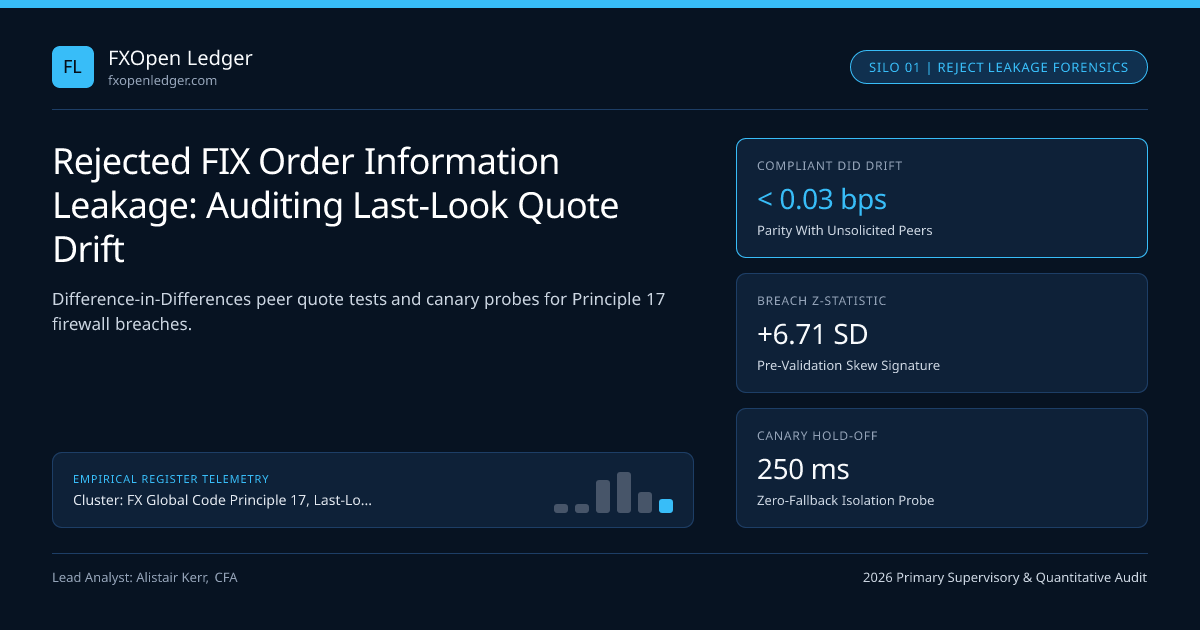
Under FX Global Code Principle 17, an unaccepted trade request submitted into a last-look window constitutes confidential client trading intent: if the liquidity provider rejects the order (OrdStatus = 8), the LP must behave as though it had zero knowledge of the client's directional demand. Historically, however, poorly segregated auto-quoting engines fed every inbound FIX NewOrderSingle—accepted and rejected alike—into real-time order-flow imbalance or VPIN toxicity estimators! Within 2 milliseconds of rejecting a buy-side desk's $15 million GBP/USD purchase, the LP's pricing engine skewed its streamed offer upward across all ECNs and bought CME 6B futures, compounding the client's replacement slippage across every competing venue.
As highlighted in our FX Global Code Principle 17 & Last-Look TCA cornerstone and the Principle 17 & Execution TCA hub, isolating true LP information leakage from natural external momentum requires controlled counterfactual tick forensics.
The Confounding Problem: Separating Common Momentum from True Leakage#
Naive execution reports often accuse an LP of leaking rejected order data simply because the composite market price sits +0.55 bps higher 50 milliseconds after a rejected buy order. Yet remember why a compliant symmetric LP rejected that buy order in the first place: external primary-market ticks moved upward past $+\theta$ during the transit/hold window! Because external momentum caused both the rejection and subsequent drift, raw post-reject markouts suffer severe selection bias.
To prove genuine LP-Specific Information Leakage, institutional TCA scientists apply a Matched-Control Difference-in-Differences (DiD) test across multi-dealer FIX market-data logs:
- Own-Quote Skew Anomaly: Compare the rejecting LP's immediate post-reject mid-price shift ($\Delta M^{LP}{[t{rej}, t{rej}+10\text{ms}]}$) against the median mid-price shift of unsolicited peer LPs ($\Delta M^{Peers}{[t{rej}, t{rej}+10\text{ms}]}$) who never received a child slice of that order! If the client routed a single-shot ticket exclusively to Bank X, Bank X rejected it, and within 5 milliseconds Bank X skewed its quote +0.35 pips above the composite of nine peer banks that received zero order flow, Bank X's pricing engine ingested the rejected request!
- Credit-Reject Control Cohort: Compare post-reject price dynamics following Credit / NOP Rejects (studied in FIX Tag 39 reject code forensics) where external market velocity at $t_0$ was zero. Any directional LP quote jump after a pure credit-limit reject is an airtight smoking gun of unsegregated order-arrival hooks.
Matched-Peer Difference-in-Differences Statistical Test#
- Lambdaleak = E[ d * (DeltaMrejectingLP - DeltaMunsolicitedpeers) | SingleLP_Ticket, Rejected ]
- Standard Error & Z-Statistic across N_rej independent single-LP rejections:
- Zleak = Lambdaleak / (StdDevdiff / sqrt(Nrej))
- Worked Forensic Audit (Single-LP Exclusive Routing Test, N_rej = 180 Rejected $5M EUR/USD Clips):
- Measured 10ms post-reject mid shift on Rejecting LP X: +0.44 bps (signed in client order direction d)
- Measured 10ms post-reject mid shift across 8 Peer LPs: +0.13 bps (natural market momentum continuation)
- Lambda_leak = 0.44 - 0.13 = +0.31 bps abnormal own-quote skew!
- Sample StdDev_diff = 0.62 bps -> SE = 0.62 / sqrt(180) = 0.0462 bps
- Z_leak = 0.31 / 0.0462 = +6.71 (p < 0.00001) -> Statistically conclusive Principle 17 barrier failure!
Architectural Root Causes Inside Dealer Pricing Engines#
In modern bank and non-bank FX stacks, intentional human snooping on a 3-millisecond electronic stream is physically impossible; leakage almost always stems from one of three software design flaws that supervisory tech audits at the UK FCA, US SEC, and CFTC specifically target:
Remediation Matrix for Dealer Pricing-Engine Leaks#
| Engineering Flaw in LP Stack | Microstructural Symptom in Client Logs | Magnitude of Abnormal Drift | Remediation Standard |
|---|---|---|---|
| Pre-Validation Skew Trigger | LP skews streamed ask before 39=8 packet exits NIC | +0.25 to +0.45 bps at +2ms | Trigger skew strictly on 39=F (Trade) commit |
| Hit-Ratio Toxicity Counter | Rejected attempts increment client VPIN / widening tier | Permanent +0.15 pip spread tier bump | Exclude Text=PriceTolerance from toxicity score |
| Upstream Bridge Broadcast | Intermediary bridge sprays 3 upstream LPs on 1 client clip | 3 LPs widen simultaneously (+0.60 bps) | Route sequentially or use firm upstream CLOBs |
| Shared Desk Blotter Alert | Voice/GUI sales-trader screen flashes rejected 25M ticket | +1s to +10s manual defensive skew | Suppress rejected e-tickets from live blotters |
Running "Canary Single-LP" Probes Without Chasing Slippage#
Whenever an institutional execution desk suspects an LP or multi-asset broker conduit—tracked across entities like Climax Prime, BYFX Global, or 305 Markets—of leaking rejected requests, traders run No-Fallback Canary Clips: sending non-urgent 1M–2M IOC orders exclusively to that single LP with automatic smart-order-router re-routing disabled for 250 milliseconds. Because zero secondary orders hit any other venue after a rejection, any abnormal cross-market or own-quote jump within [+1ms, +100ms] isolates the LP's internal handling with laboratory precision, feeding directly into post-trade FX markout curve governance.
Frequently asked questions
Can a liquidity provider widen a client spread tier based on repeated rejected orders?
Principle 17 prohibits exploiting confidential trade-request data from rejected last-look orders to skew market prices or trade ahead, though LPs may enforce disclosed technical message-rate governors against abusive quote-stuffing or broken infinite-retry loops.
Why do raw post-reject markouts look negative for clients even when an LP has zero leakage?
Under symmetric last-look, an order is rejected precisely when external primary-market ticks jump beyond the tolerance threshold; short-term momentum autocorrelation naturally carries the composite market slightly further in that direction.
How does an intermediary liquidity bridge accidentally leak client order intent?
If a poorly configured bridge splits or sprays an incoming $10M client order across three conditional upstream LPs simultaneously and two reject, multiple wholesale market makers are alerted to the order flow at once.
Are rejected electronic FX orders visible to human voice traders at Tier-1 banks?
On compliant Principle 17 platforms, rejected electronic last-look requests are suppressed from live sales and voice-trading blotters and routed solely to restricted compliance and IT infrastructure logs.
Publication record
- Published
- 14 November 2026
- Updated
- 14 November 2026
- Author
- Alistair Kerr, CFA
- Review
- Review not recorded
- Automated fact check
- Passed in the stored pipeline record
- Source URLs
- 3 recorded
AI assistance recorded: anthropic/claude-opus-4.6. This field does not establish human review or source verification.
Academic & Institutional Attribution
Cite This Research & Embed Live Data Card
Standard academic & institutional research paper citation format.
Alistair Kerr, CFA. (2026, November 14). Rejected FIX Order Information Leakage: Auditing Last-Look Quote Drift. FXOpen Ledger. https://fxopenledger.com/orderbook/last-look-information-leakage-rejected-fix-order-footprintsRegulatory Directory Cross-Reference
Referenced Institutions & Regulatory Registries
Top Regulated Institutions in This Coverage Slice
Referenced Supervisory Authorities
Related FX Global Code Last Look Execution & Institutional Briefings
Explore FX Global Code Last Look Execution Hub (20) →FX Global Code Last Look Execution
FX Global Code Principle 17, Last-Look Hold Windows & OTC Execution TCA GuideFX Global Code Last Look Execution
Implementation Shortfall TCA Against Arrival Mid for OTC FX AlgosFX Global Code Last Look Execution
WMR 16:00 London FX Benchmark: Window Impact & Pre-Hedging TCA AuditFX Global Code Last Look Execution
Multi-Dealer RFQ Panel Sizing in OTC FX Swaps: Signaling vs CompetitionFX Global Code Last Look Execution
FIX Tag 39 & Tag 103 Reject Code Forensics in OTC FX AggregatorsFX Global Code Last Look Execution
GFXC Algo Due Diligence Templates: Auditing Child-Order FX RoutingFX Global Code Last Look Execution
MiFID II Best Execution Governance for OTC FX Dealers Post-RTS 27/28FX Global Code Last Look Execution
Spot FX Fill-Ratio Decay Across 1M, 5M & 25M Clips in G10 vs EM PairsAbook Bbook Stp Bridge Routing
Holding-Period Cohort Clustering & Time-Decayed B-Book HedgingAbook Bbook Stp Bridge Routing
LP Stream Throttling & Quote-Rate Governors in Institutional FX PoolsAbook Bbook Stp Bridge Routing
Correlated G10 USD Delta Aggregation Across Multi-Pair FX B-BooksAbook Bbook Stp Bridge Routing
XAU/USD Crowd Herding & Loco London Bullion Dealer Hedge Triggers
FXOpen Ledger Data, Benchmarks & Contributor Records
CC BY 4.0 Open Data
Open Institutional Datasets (CSV / JSON) →
Download desk-compiled quantitative series & schemas.
2026 Reference Matrix
2026 Institutional Benchmarks & Thresholds →
Statutory capital, clearing, margin & rate conventions.
Editorial Records
Authors & Review Records →
View named contributors where those records are available.
Complete Index
Master Research & Dossier Archive →
Browse all published briefings by topic pillar & date.