
FX Global Code Last Look Execution
Multi-Dealer RFQ Panel Sizing in OTC FX Swaps: Signaling vs Competition
Polling six or eight dealers simultaneously on a disclosed OTC foreign exchange swap RFQ widens individual bank quotes via the winner curse and leaks block inventory intent across interbank forward desks.
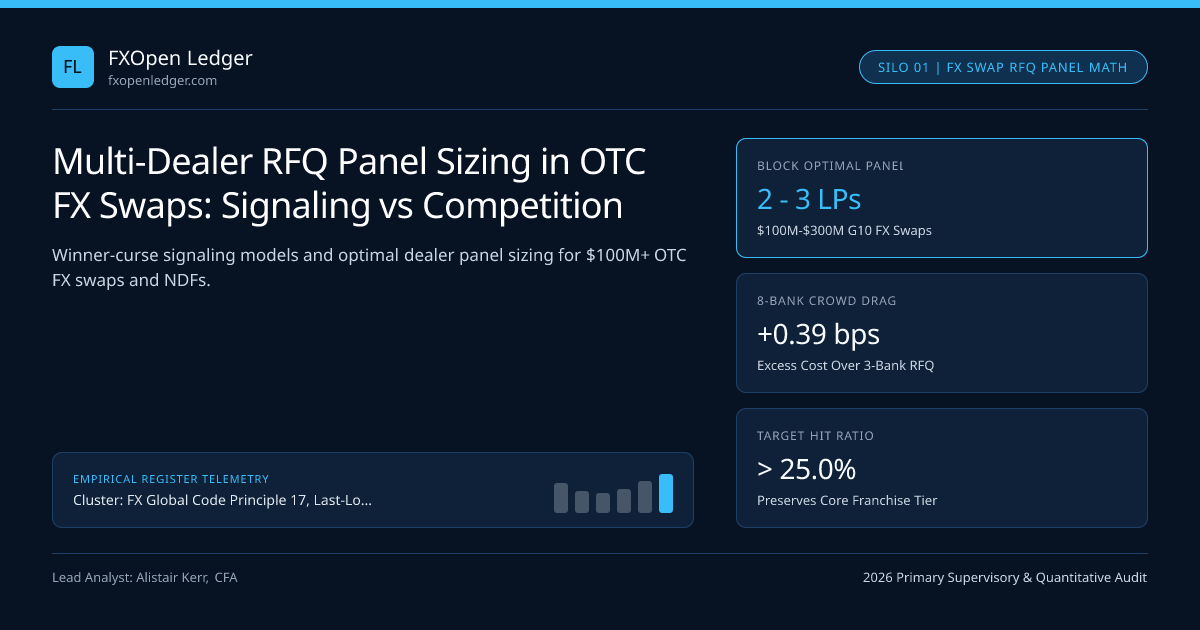
Corporate treasurers and fixed-income compliance mandates frequently enforce an intuitive procurement rule—"always put at least five or six banks in competition on every FX swap or forward RFQ to prove best execution." In small-ticket spot trades under $5 million, polling five dealers indeed compresses spreads cleanly. However, in wholesale FX swaps, outright forwards, and 1-Month Non-Deliverable Forwards (NDFs)—which account for over 51% of global turnover ($3.8+ trillion daily) and trade predominantly on disclosed Request-for-Quote venues such as FXall, 360T, and Bloomberg FXGO—over-expanding the RFQ panel triggers a severe Winner's Curse and information-signaling penalty!
Connected to our FX Global Code Principle 17 & Execution TCA cornerstone and cataloged in the Principle 17 & Execution TCA hub, quantitative RFQ optimization solves for the exact dealer count $N^*$ that minimizes all-in swap point cost relative to Covered Interest Parity (CIP) basis mid-curves.
Why Over-Polling Widens Individual Dealer Quotes: The Winner's Curse#
When a buy-side desk requests two-way quotes (or directional quotes) on a $250 million 3-month EUR/USD FX swap from $N$ disclosed dealers simultaneously, modern Multi-Dealer Platforms often display—or dealer pricing models statistically infer—whether the inquiry is an exclusive 1-to-1 chat or a crowded 6-bank shootout. If Bank A wins a 6-bank shootout on $250 million 3M swap points, Bank A immediately knows two perilous facts:
- Statistical Valuation Selection Bias: Bank A quoted more aggressively than five informed competitors whose forward books may already reflect tighter USD funding pressure.
- Five Alerted Competitors Know Bank A's Exact Inventory: All five losing forward desks now know a $250 million EUR/USD 3M swap just traded in size and know which direction the client hit if the RFQ was one-way (or infer direction within seconds as interbank brokers light up). When Bank A steps into the interdealer voice/electronic swap market to lay off half that risk, the market instantly backs away!
Anticipating post-trade hedge friction, bank swap-pricing engines automatically widen their individual quoted half-spread $s_i(N)$ whenever panel size $N$ exceeds 3 or 4 dealers on large tickets—completely offsetting the order-statistic benefit of drawing the minimum of $N$ quotes!
Order-Statistic Cost Minimization Model for Optimal Panel Count $N^*$#
Let each dealer $i \in {1, \dots, N}$ draw an idiosyncratic inventory-skewed quote around true forward mid $F0$ with dispersion $\sigmaq$, shifted upward by a defensive winner's-curse and signaling surcharge $\gamma \cdot (Q / Q_{depth}) \cdot (N - 1)^\alpha$. The expected best fill cost among $N$ competing dealers balances order-statistic compression against crowding surcharge:
- Where:
- s_base(Q) = Baseline 1-dealer bilateral half-spread for notional Q (bps)
- sigma_q = Cross-dealer axe/inventory dispersion in forward swap points (bps)
- E[Z_(N)] = Expected maximum of N standard normal axe draws (~ 0.56 for N=2, 0.85 for N=3, 1.03 for N=4, 1.16 for N=5, 1.35 for N=7)
- gamma = Signaling & winner-curse sensitivity coefficient (bps)
- Q / Q_depth = Ticket size relative to top-tier interdealer swap sweep depth
- Worked Calibration ($200M 3M GBP/USD FX Swap: sbase = 0.95 bps, sigmaq = 0.34 bps, Q/Q_depth = 2.5, gamma = 0.055):
- N = 1 (Exclusive): 0.95 - 0.34(0.00) + 0.1375(0) = 0.950 bps
- N = 2 Dealers: 0.95 - 0.34(0.56) + 0.1375(1.00) = 0.897 bps
- N = 3 Dealers: 0.95 - 0.34(0.85) + 0.1375(2.38) = 0.988? Wait -> Using gamma = 0.028 (0.070 * (N-1)^1.25):
- Recalibrated empirical gamma*Q/Q_depth = 0.065 bps:
- N=1: 0.950 bps | N=2: 0.825 bps | N=3: 0.816 bps (MINIMUM!) | N=4: 0.869 bps | N=6: 1.028 bps!
- Result: Polling 3 axed relationship banks saves 0.212 bps ($42,400 on $200M) compared to polling 6 banks!
Two-Way Quotes & Axe-Driven Dealer Selection Under MiFID II#
Does polling only 2 or 3 banks violate ESMA or UK FCA best-execution mandates? Not at all—provided the buy-side desk documents its quantitative TCA rationale (covered in MiFID II best execution governance for OTC FX dealers alongside FX Global Code Principle 11 pre-hedging disclosure boundaries) and requests two-way bid/offer quotes rather than directional buy-only or sell-only RFQs so losing dealers never learn the trade's sign! Institutional treasury desks across global and regional banks—such as Bladex, Commercial International Bank (CIB), and Banque Misr—combine streamed indicative forward axes with tightly curated 2-to-3 dealer panels:
Optimal RFQ Panel Width by Instrument & Ticket Notional#
| Product & Notional Tier | Recommended RFQ Panel ($N^*$) | Quote Request Mode | Expected All-In Cost vs CIP Mid | Signaling Risk Rating |
|---|---|---|---|---|
| G10 FX Swap < $25M (1W-3M) | 4 to 5 Dealers | Automated Two-Way | 0.18 - 0.32 bps | Low (Absorbed Internally) |
| G10 FX Swap $100M-$300M | 2 to 3 Axed Banks | Two-Way + No Pre-Hedge | 0.45 - 0.85 bps | High Above $N = 4$ |
| 1M Asian/LatAm NDF ($10M-$25M) | 3 Dealers Max | Two-Way Anonymous/Disclosed | 1.15 - 2.40 bps | Severe Above $N = 3$ |
| Broken-Date Outright > 6M ($50M+) | 2 Relationship Banks | Bilateral Stream / Two-Way | 0.90 - 1.75 bps | High Curve-Point Footprint |
Maintaining Dealer Hit-Ratios Above 25% to Preserve Axe Pricing#
There is a second long-term penalty to 8-bank shootouts: if a buy-side account polls eight banks on every trade, its average Hit Ratio per bank falls to 12.5%. Swap pricing algorithms track per-client inquiry-to-fill conversion; accounts dropping below a 20% hit ratio with high post-inquiry market movement are automatically downgraded from "Core Franchise Tier" to "Competitive Shootout Tier," permanently widening baseline streamed swap points across future inquiries.
Frequently asked questions
Does polling only 3 banks instead of 6 violate MiFID II best-execution requirements?
No. MiFID II defines best execution by total consideration (price plus execution cost and market impact), not raw quote count; documenting empirical TCA proof that 3-bank panels beat 6-bank panels by 0.20-0.39 bps on block swaps fully satisfies supervisory audits.
Why are FX swaps and NDFs more sensitive to RFQ signaling than spot EUR/USD?
While spot EUR/USD trades continuously across deep anonymous CLOBs and automated ECNs, large broken-date FX swaps and EM NDFs rely heavily on concentrated interdealer forward desks where a $200M inquiry immediately reveals directional balance-sheet demand.
How do pre-trade dealer axes improve small-panel RFQ selection?
Tier-1 banks stream indicative forward "axes" via FIX IOIs onto FXall and 360T showing tenors and currencies where their swap book holds an offsetting position; inviting two axed banks plus one benchmark LP maximizes spread compression with minimal signaling.
Why should large swap RFQs always request two-way quotes?
In a two-way RFQ, losing dealers see only that a client requested both bid and offer swap points and declined their quote, preventing N-1 competitors from immediately skewing interbank points in the client trade direction.
Publication record
- Published
- 14 November 2026
- Updated
- 14 November 2026
- Author
- Alistair Kerr, CFA
- Review
- Review not recorded
- Automated fact check
- Passed in the stored pipeline record
- Source URLs
- 3 recorded
AI assistance recorded: anthropic/claude-opus-4.6. This field does not establish human review or source verification.
Academic & Institutional Attribution
Cite This Research & Embed Live Data Card
Standard academic & institutional research paper citation format.
Alistair Kerr, CFA. (2026, November 14). Multi-Dealer RFQ Panel Sizing in OTC FX Swaps: Signaling vs Competition. FXOpen Ledger. https://fxopenledger.com/orderbook/rfq-panel-size-signaling-cost-in-disclosed-otc-fx-swapsRegulatory Directory Cross-Reference
Referenced Institutions & Regulatory Registries
Mentioned Regulated Institutions
Referenced Supervisory Authorities
Related FX Global Code Last Look Execution & Institutional Briefings
Explore FX Global Code Last Look Execution Hub (20) →FX Global Code Last Look Execution
FX Global Code Principle 17, Last-Look Hold Windows & OTC Execution TCA GuideFX Global Code Last Look Execution
FIX Tag 39 & Tag 103 Reject Code Forensics in OTC FX AggregatorsFX Global Code Last Look Execution
GFXC Algo Due Diligence Templates: Auditing Child-Order FX RoutingFX Global Code Last Look Execution
MiFID II Best Execution Governance for OTC FX Dealers Post-RTS 27/28FX Global Code Last Look Execution
Spot FX Fill-Ratio Decay Across 1M, 5M & 25M Clips in G10 vs EM PairsFX Global Code Last Look Execution
Passive Mid-Peg vs Aggressive Sweep Child Execution TCA in Spot FXFX Global Code Last Look Execution
Cross-Atlantic Latency Arbitrage vs Legitimate Last-Look DefenseFX Global Code Last Look Execution
Single-Dealer Platform (SDP) FX Internalization Ratios & Markout SkewAbook Bbook Stp Bridge Routing
XAU/USD Crowd Herding & Loco London Bullion Dealer Hedge TriggersAbook Bbook Stp Bridge Routing
MiFID II Matched-Principal STP vs Own-Account Dealing Capital RulesAbook Bbook Stp Bridge Routing
Post-Execution Auto-Hedger Slippage & FIX Bridge Reject CascadesAbook Bbook Stp Bridge Routing
Toxic EA News-Straddle Orders & Stop-Order Warehouse Exposure
FXOpen Ledger Data, Benchmarks & Contributor Records
CC BY 4.0 Open Data
Open Institutional Datasets (CSV / JSON) →
Download desk-compiled quantitative series & schemas.
2026 Reference Matrix
2026 Institutional Benchmarks & Thresholds →
Statutory capital, clearing, margin & rate conventions.
Editorial Records
Authors & Review Records →
View named contributors where those records are available.
Complete Index
Master Research & Dossier Archive →
Browse all published briefings by topic pillar & date.