
FX Global Code Last Look Execution
Cross-Atlantic Latency Arbitrage vs Legitimate Last-Look Defense
Hollow-core fiber and millimeter-wave links carry CME Aurora and NY4 price shocks to London LD4 14 milliseconds ahead of standard subsea cables—defining the exact microstructural boundary of legitimate Principle 17 stale-quote defense.
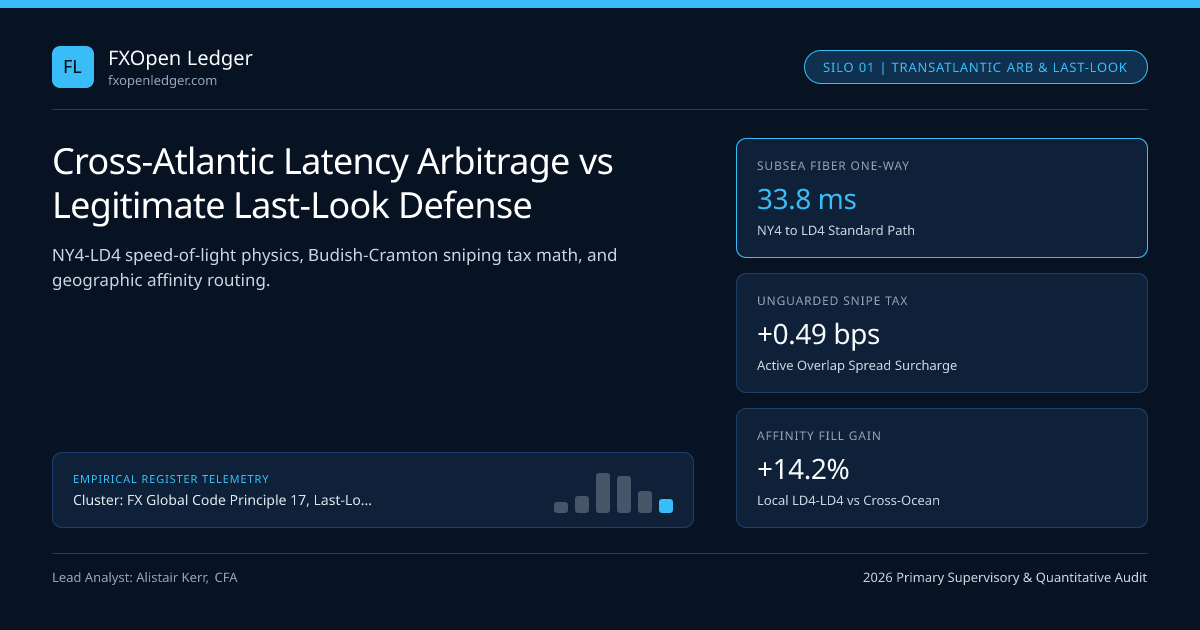
Why hasn't the Global Foreign Exchange Committee banned conditional last-look outright across wholesale foreign exchange? The answer lies in relativistic telecommunications physics between Chicago (CME Aurora), New York (Equinix NY4), London (Equinix LD4), and Tokyo (Equinix TY3). Standard commercial transatlantic submarine optical fiber transmits packets across the ~5,500 km New York-to-London corridor in roughly 33.2 to 34.0 milliseconds one-way ($c / 1.468$ refractive index in silica glass). Meanwhile, ultra-low-latency HFT arbitrageurs subscribing to hybrid microwave + short-path low-earth/subsea links receive Chicago 6E Euro FX futures ticks in London up to 4 to 14 milliseconds faster than regional banks relying on standard enterprise market-data distribution!
Positioned inside our FX Global Code Principle 17 & Last-Look TCA cornerstone and the Principle 17 & Execution TCA hub, understanding cross-data-center propagation physics clarifies when a conditional reject represents legitimate stale-quote defense versus an unlawful discretionary hold.
Anatomy of a Cross-Data-Center Stale-Quote Snipe#
Trace what occurs at 08:30:00.000 EST (13:30:00.000 UTC) when US Core CPI prints 0.2% above consensus in Washington, D.C. / New Jersey:
- T + 2.1 ms: NY4 spot ECNs and CME Aurora 6E futures jump +38 pips (
EUR/USDdrops from1.0850to1.0812). - T + 19.5 ms: An HFT cross-venue arbitrageur using premium hybrid microwave/HIBERNIA Express low-latency transport receives the NY4 crash signal inside its Equinix LD4 Slough co-location cage and instantly fires
35=Dsell orders against every London regional bank still streaming1.0849! - T + 34.2 ms: Standard enterprise market-data fiber finally delivers the NY4
1.0812update to the regional London bank's pricing server—14.7 milliseconds AFTER the arbitrageur hit its London bid!
Without either (a) low-latency NY4 reference feeds, (b) venue-level speed bumps / Minimum Quote Life randomized batching, or (c) a conditional last-look gate, regional and mid-tier banks would be bled dry on every US data print and forced to widen G10 spreads by 3x for corporate treasurers!
Modeling Stale-Quote Adverse Selection Tax Without Last-Look#
Using the Budish-Cramton-Shim continuous-limit-order-book sniping equilibrium, a market maker suffering a one-way information lag $\Delta \tau{lag}$ against $M$ fast arbitrageurs faces an unavoidable Latency Sniping Tax proportional to jump arrival rate $lambda{jump}$ and jump magnitude $J$, forcing firm spread $S{firm}$ to widen above conditional spread $S{cond}$:
Budish-Cramton Stale-Quote Sniping Equilibrium Formula#
- 0.5 * Sfirm >= (lambdajump * Deltataulag * E[J]) / (Lambdabenignvolume + lambdajump * Deltatau_lag)
- Where:
- lambda_jump = Frequency of cross-center macro/order-flow jumps exceeding half-spread (events / sec)
- Deltataulag = Transport latency disadvantage of LP vs fastest HFT taker (sec)
- E[J] = Mean jump size beyond top-of-book spread (bps)
- Lambdabenignvolume = Arrival rate of uninformed corporate/institutional liquidity-seeking trades (events / sec)
- Worked Comparison (Regional London Bank on USD/JPY):
- E[J] = 2.40 bps; Lambdabenign = 0.80 trades/sec; lambdajump = 0.45 jumps/sec.
- Case A (Slow Enterprise Fiber, Deltataulag = 0.015 sec = 15 ms, No Last-Look):
- Snipe_Rate = 0.45 * 0.015 = 0.00675 snipes/sec (only 0.84% of trades, YET 100% toxic at 2.40 bps!)
- Required Spread Surcharge = (0.00675 * 2.40) / (0.80 + 0.00675) = 0.0162 / 0.80675 = +0.020 bps calm,
- AND during active NY overlap (lambda_jump = 6.0/sec): (0.09 * 2.40) / 0.89 = +0.243 bps (+0.49 bps full-spread widening!).
- Case B (Upgraded Express Feed, Deltataulag = 0.001 sec + Symmetric ZAHT): Sniping surcharge drops by 93% to +0.017 bps!
Comparing Four Wholesale Anti-Sniping Architectures#
| Venue / LP Defense Mechanism | How It Stops Cross-Center Sniping | Impact on Benign Real-Money Takers | GFXC / Regulatory Assessment |
|---|---|---|---|
| Upgraded Express Reference + ZAHT | LP sees NY4 shock simultaneously; rejects in <2ms | Zero Hold Delay; Tight Spreads | Gold-Standard ZAHT Audit |
| Venue Speed Bump / Batch Auction | 3ms-5ms randomized taker delay lets makers cancel | Slight 4ms Fill Delay; Firm Execution | Approved by CFTC & FCA on Primary CLOBs |
| Regional Session Co-Location Match | Match NY takers ONLY on NY4 engine, LDN on LD4 | Eliminates Cross-Ocean Stale Quotes | Institutional ECN Best Practice |
| Legacy 35ms Discretionary Hold | Stalls ALL clients 35ms waiting for slow fiber | Penalizes Benign Sweeps (+0.62 bps) | Discouraged; Must Disclose on Cover Sheet |
The Golden Routing Rule: Match Geographic Engine to Taker Co-Location#
Buy-side execution engineers and multi-asset dealing desks—comparing infrastructure across City Index, Blue Suisse, and institutional FIX API aggregators—enforce strict Regional Affinity Routing: a New York NY4 algo server must hit ONLY NY4 LP matching engines, and a London LD4 server must hit ONLY LD4 engines, pairing geographic parity with 0ms-50ms hold-time percentile monitoring.
Frequently asked questions
Why is cross-center latency arbitrage particularly severe in OTC spot FX?
Unlike US equities governed by Reg NMS consolidated routing in New Jersey, spot FX trades simultaneously across fragmented matching centers in London (LD4), New York (NY4), Tokyo (TY3), and Singapore (SG1), creating constant speed-of-light price discrepancies.
How do primary FX CLOB speed bumps protect makers without using last-look?
A 3ms to 5ms asymmetric or batch speed bump delays incoming aggressive market/IOC orders just long enough for co-located market makers to cancel stale resting quotes when CME or cross-venue prices jump, preserving firm execution.
Why should an NY4 client never route spot FX sweeps to a London LD4 LP session?
Your FIX order travels 33.8ms across the Atlantic while the London LP already receives faster NY4 price updates; during any market tick, your order arrives 34ms stale and suffers massive symmetric tolerance rejections.
Does GFXC Principle 17 accept slow market-data feeds as an excuse for 50ms holds?
While Principle 17 allows disclosed hold windows if strictly symmetric and documented on the LP Cover Sheet, institutional buy-side scorecards heavily penalize >10ms holds because modern co-located LPs validate risk in under 2.5ms.
Publication record
- Published
- 14 November 2026
- Updated
- 14 November 2026
- Author
- Alistair Kerr, CFA
- Review
- Review not recorded
- Automated fact check
- Passed in the stored pipeline record
- Source URLs
- 3 recorded
AI assistance recorded: anthropic/claude-opus-4.6. This field does not establish human review or source verification.
Academic & Institutional Attribution
Cite This Research & Embed Live Data Card
Standard academic & institutional research paper citation format.
Alistair Kerr, CFA. (2026, November 14). Cross-Atlantic Latency Arbitrage vs Legitimate Last-Look Defense. FXOpen Ledger. https://fxopenledger.com/orderbook/latency-floor-arbitrage-and-stale-quote-protection-in-last-lookRegulatory Directory Cross-Reference
Referenced Institutions & Regulatory Registries
Mentioned Regulated Institutions
Referenced Supervisory Authorities
Related FX Global Code Last Look Execution & Institutional Briefings
Explore FX Global Code Last Look Execution Hub (20) →FX Global Code Last Look Execution
FX Global Code Principle 17, Last-Look Hold Windows & OTC Execution TCA GuideFX Global Code Last Look Execution
Single-Dealer Platform (SDP) FX Internalization Ratios & Markout SkewFX Global Code Last Look Execution
Quarterly FX LP Scorecard Design: Weighting Spread, Hold Time & MarkoutsFX Global Code Last Look Execution
Auditing GFXC Liquidity Provider Cover Sheets: Last-Look & Hold-Time MetricsFX Global Code Last Look Execution
Firm vs Last-Look OTC FX Liquidity Streams: Spread vs Reject Cost MathFX Global Code Last Look Execution
Symmetric vs Asymmetric Last-Look Price-Tolerance Checks in Spot FXFX Global Code Last Look Execution
Spot FX Hold-Time Latency Distributions (0ms-50ms) & Tail Reject SpikesFX Global Code Last Look Execution
FX Global Code Principle 11: Pre-Hedging Rules & Client Consent BoundariesAbook Bbook Stp Bridge Routing
FCA, ASIC & CySEC Execution-Venue Conflicts-of-Interest DisclosuresAbook Bbook Stp Bridge Routing
Shadow A-Book Paper-Hedging Analytics for Dealing-Desk CalibrationPrime of Prime Nop Credit Intermediation
Tier-1 Bank FXPB Balance-Sheet Floors & Basel III SA-CCR MathPrime of Prime Nop Credit Intermediation
Net Open Position (NOP) Utilization Formulas & Currency Haircuts
FXOpen Ledger Data, Benchmarks & Contributor Records
CC BY 4.0 Open Data
Open Institutional Datasets (CSV / JSON) →
Download desk-compiled quantitative series & schemas.
2026 Reference Matrix
2026 Institutional Benchmarks & Thresholds →
Statutory capital, clearing, margin & rate conventions.
Editorial Records
Authors & Review Records →
View named contributors where those records are available.
Complete Index
Master Research & Dossier Archive →
Browse all published briefings by topic pillar & date.