
FX Global Code Last Look Execution
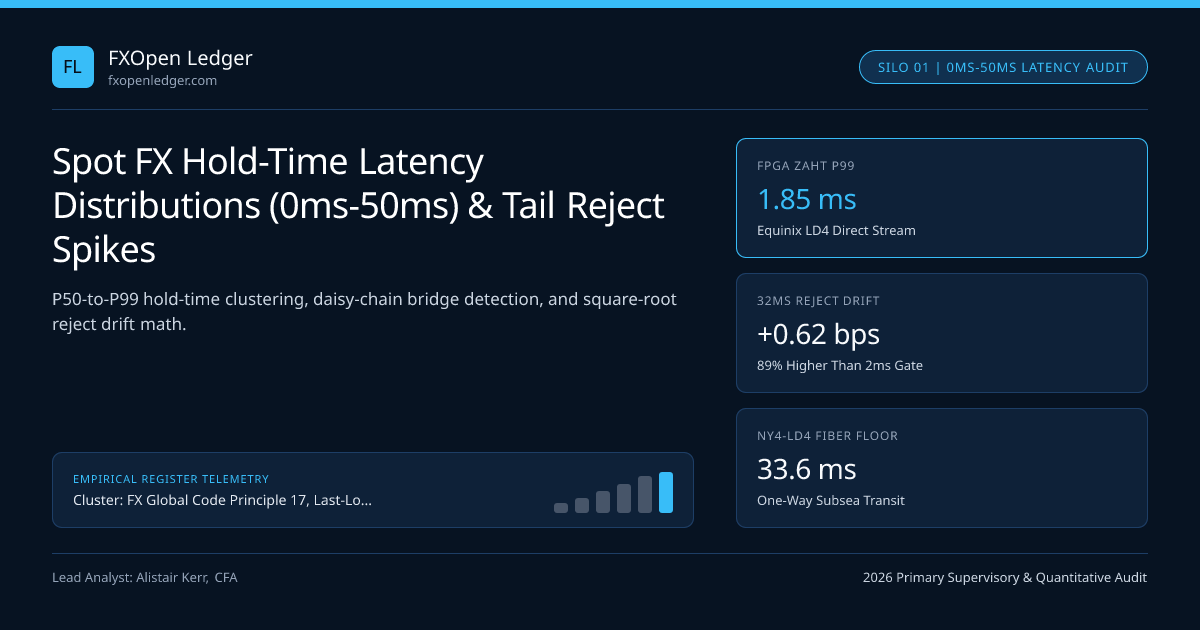
Spot FX Hold-Time Latency Distributions (0ms-50ms) & Tail Reject Spikes
Empirical round-trip telemetry across institutional spot foreign exchange feeds reveals distinct latency clusters—sub-2ms ZAHT gates, 5ms-15ms aggregator pass-throughs, and 25ms-50ms legacy hold timers—that govern adverse mid-price drift.
Average execution latency is one of the most misleading statistics in wholesale foreign exchange reporting. A liquidity stream posting a 3.8-millisecond mean acknowledgement time can easily harbor a bimodal latency distribution in which 91% of routine fills clear in 1.4 milliseconds while the 9% of tickets arriving during cross-venue volatility spikes sit inside a 35-millisecond hold buffer—suffering massive reject rates right as Order-Book Depth Resiliency deteriorates. Measuring full percentile distributions (P50, P90, P99, and P99.9) across 0ms to 50ms hold windows is therefore essential for institutional desks operating co-located sessions in Equinix LD4 (Slough), NY4 (Secaucus), and TY3 (Tokyo).
Within our FX Global Code Principle 17 & Last-Look TCA cornerstone and the broader execution TCA topic cluster, latency distribution profiling bridges network infrastructure engineering and post-trade implementation shortfall.
Four Distinct Microstructural Regimes Between 0ms and 50ms#
When execution engineers strip out fiber propagation—approximately 0.35ms intra-data-center cross-connect, 67ms round-trip London-New York submarine fiber, and 145ms London-Tokyo—internal LP hold-time distributions segregate into four unmistakable operational clusters:
- Sub-1.5ms Hardware / Kernel-Bypass ZAHT (0.2ms – 1.5ms): Operated by non-bank electronic market makers and top-5 quantitative G10 banks running solarflare/FPGA NICs. Credit and symmetric tolerance checks execute in memory at ingress, matching zero additional hold time (ZAHT) audit benchmarks.
- 2ms – 8ms Standard JVM / Multi-Asset Engine Processing: Common across regional institutional banks and multi-asset Prime-of-Prime hubs—such as AMB Prime and ALB Prime—where spot FX shares an enterprise credit limit bus with metals and NDFs.
- 10ms – 25ms Daisy-Chained Liquidity Bridge Pass-Through: Occurs when an intermediary aggregator or regional broker streams composite liquidity without warehousing principal risk, forwarding incoming client
35=Dtickets upstream to a Tier-1 LP that runs its own check before returning confirmation downstream. - 25ms – 50ms Legacy Discretionary Timer Windows: Explicit countdown delays historically deployed to outlast cross-Atlantic NY4-to-LD4 fiber latency (~33.5ms one-way) so London engines could observe New York CME futures price action before accepting a London spot trade.
Quantifying Reject Drift Scaling Under Square-Root-of-Time Volatility#
Why does extending a hold timer from 2 milliseconds to 32 milliseconds quadruple post-reject replacement slippage? Under high-frequency jump-diffusion price dynamics, standard deviation of mid-price displacement grows proportionally to $\sqrt{\tau}$ during diffusive ticks and linearly with arrival intensity $lambda \tau$ during macro Poisson jumps. Whenever a conditional stream rejects an order at the upper tolerance boundary $+\theta$, expected price overshoot scales directly with hold window duration:
- Where:
- tau = Total hold duration from order arrival to reject transmission (ms)
- theta = Symmetric price-tolerance threshold (bps)
- sigma_1ms = 1-millisecond diffusive mid-price volatility (bps / sqrt(ms))
- z = Standardized threshold theta / (sigma_1ms * sqrt(tau))
- phi / Phi = Standard normal PDF and CDF (Inverse Mills Ratio tail expectation)
- lambdajump = Probability per millisecond of a discrete macro order-book sweep jump of size Jmean (bps)
- Worked Comparison (USD/JPY Active Overlap: theta = 0.25 bps, sigma1ms = 0.08 bps, lambdajump = 0.003/ms, J_mean = 0.90 bps):
- Case 1 (ZAHT tau = 2 ms):
- sigma_tau = 0.08 * 1.414 = 0.113 bps; z = 2.21; Inverse Mills = 0.0389 / 0.0136 = 2.86
- E[Drift_reject(2ms)] = 0.25 + (0.113 * 2.86 - 0.25) + 0.006 * 0.90 = 0.323 + 0.005 = 0.328 bps
- Case 2 (Legacy Timer tau = 32 ms):
- sigma_tau = 0.08 * 5.657 = 0.453 bps; z = 0.55; Inverse Mills = 0.3429 / 0.2912 = 1.18
- E[Drift_reject(32ms)] = 0.25 + (0.453 * 1.18 - 0.25) + 0.096 * 0.90 = 0.535 + 0.086 = 0.621 bps (+89% worse per reject, at 3.8x higher reject frequency!)
Percentile Latency Benchmarks Across LP Infrastructure Tiers#
| LP Infrastructure Cohort | P50 RTT (LD4) | P90 RTT (LD4) | P99 RTT (LD4) | Observed Sweep Reject Rate | Supervisory / Venue Benchmark |
|---|---|---|---|---|---|
| Tier-1 Non-Bank FPGA ZAHT | 0.65 ms | 0.95 ms | 1.85 ms | 6.4% | FIX API Direct Co-Location |
| Global G-SIB Bank ZAHT | 1.40 ms | 2.30 ms | 4.10 ms | 8.9% | FCA UK Senior Managers Regime |
| Multi-Hop Retail/PoP Bridge | 6.80 ms | 11.90 ms | 19.40 ms | 16.7% | Audited on CySEC & ASIC Desks |
| Legacy 30ms Hold Stream | 30.80 ms | 32.10 ms | 39.50 ms | 26.8% | Flagged in Firm vs Last-Look TCA |
Tail-Latency Anomaly Detection on Equinix Sessions#
Continuous P99 monitoring flags upstream bridge congestion before sweep reject rates cascade across child slices.
Configuring Smart Order Router Timeout Kill-Switches#
Institutional execution desks never allow an unanswered NewOrderSingle packet to hang indefinitely on a degraded LP session. Smart order routers enforce hard per-stream SLA monitors: if an LP's rolling 100-ticket P95 latency exceeds 12 milliseconds on a supposed ZAHT feed—or if a TCP micro-burst stalls responses past 50 milliseconds—the router trips a temporary circuit breaker, isolates the session, and logs an automated governance exception for review in the desk's quarterly counterparty audit.
Frequently asked questions
Why did legacy FX dealers frequently set last-look hold timers around 30 to 35 milliseconds?
One-way optical fiber propagation between New York (NY4/CME Aurora) and London (LD4) takes roughly 33.5 to 38 milliseconds. A 35ms London hold timer allowed a dealer to verify whether cross-Atlantic futures arbitrageurs had already repriced New York before accepting a London spot quote.
How can an execution desk distinguish a daisy-chained PoP bridge from a true principal LP?
A true principal LP co-located in the same Equinix facility returns ZAHT fills in 0.6ms to 3.0ms P90, whereas an intermediary bridge forwarding orders upstream exhibits a step-function jump to 8ms-18ms plus compound upstream reject codes.
What happens if an FX liquidity provider fails to reply within 50 milliseconds?
Institutional smart order routers transmit an automated FIX OrderCancelRequest (35=F) and suspend routing to that stream, though in OTC streams the taker must wait for CancelReject (35=9) or ExecutionReport confirmation to avoid double-execution risk.
Does geographic mismatch inflate apparent last-look hold time?
Yes. Sending orders from a Tokyo TY3 server to a London LD4 LP adds ~145ms of deterministic fiber transit; analysts always subtract baseline FIX Heartbeat RTT on the identical session before estimating internal LP hold time.
Publication record
- Published
- 14 November 2026
- Updated
- 14 November 2026
- Author
- Alistair Kerr, CFA
- Review
- Review not recorded
- Automated fact check
- Passed in the stored pipeline record
- Source URLs
- 3 recorded
AI assistance recorded: anthropic/claude-opus-4.6. This field does not establish human review or source verification.
Academic & Institutional Attribution
Cite This Research & Embed Live Data Card
Standard academic & institutional research paper citation format.
Alistair Kerr, CFA. (2026, November 14). Spot FX Hold-Time Latency Distributions (0ms-50ms) & Tail Reject Spikes. FXOpen Ledger. https://fxopenledger.com/orderbook/spot-fx-hold-time-latency-distributions-zero-to-fifty-msRegulatory Directory Cross-Reference
Referenced Institutions & Regulatory Registries
Top Regulated Institutions in This Coverage Slice
Referenced Supervisory Authorities
Related FX Global Code Last Look Execution & Institutional Briefings
Explore FX Global Code Last Look Execution Hub (20) →FX Global Code Last Look Execution
FX Global Code Principle 17, Last-Look Hold Windows & OTC Execution TCA GuideFX Global Code Last Look Execution
FX Global Code Principle 11: Pre-Hedging Rules & Client Consent BoundariesFX Global Code Last Look Execution
Post-Trade FX Markout Curves (+5ms to +60s): Adverse Selection DiagnosticsFX Global Code Last Look Execution
Zero Additional Hold Time (ZAHT) in FX Streams: Engineering & Audit GuideFX Global Code Last Look Execution
Rejected FIX Order Information Leakage: Auditing Last-Look Quote DriftFX Global Code Last Look Execution
Implementation Shortfall TCA Against Arrival Mid for OTC FX AlgosFX Global Code Last Look Execution
WMR 16:00 London FX Benchmark: Window Impact & Pre-Hedging TCA AuditFX Global Code Last Look Execution
Multi-Dealer RFQ Panel Sizing in OTC FX Swaps: Signaling vs CompetitionAbook Bbook Stp Bridge Routing
Five-Second Markout Profiling: Segmenting Sharp vs Benign FX FlowAbook Bbook Stp Bridge Routing
Quote Skewing vs Spread Widening: OTC FX Dealer Inventory Control MathAbook Bbook Stp Bridge Routing
Cross-Feed Latency Arbitrage Detection on Retail FX & CFD ServersAbook Bbook Stp Bridge Routing
STP Agency Commissions vs All-In Spread Markups: FX Cost Decomposition
FXOpen Ledger Data, Benchmarks & Contributor Records
CC BY 4.0 Open Data
Open Institutional Datasets (CSV / JSON) →
Download desk-compiled quantitative series & schemas.
2026 Reference Matrix
2026 Institutional Benchmarks & Thresholds →
Statutory capital, clearing, margin & rate conventions.
Editorial Records
Authors & Review Records →
View named contributors where those records are available.
Complete Index
Master Research & Dossier Archive →
Browse all published briefings by topic pillar & date.