
Abook Bbook Stp Bridge Routing
Cross-Feed Latency Arbitrage Detection on Retail FX & CFD Servers
Cross-feed latency arbitrage exploits 5ms to 40ms quote-ingestion lags between CME futures or fast ECN feeds and retail MT4/MT5 trade servers—extracting riskless profits from B-Books or poisoning upstream PoP tags.
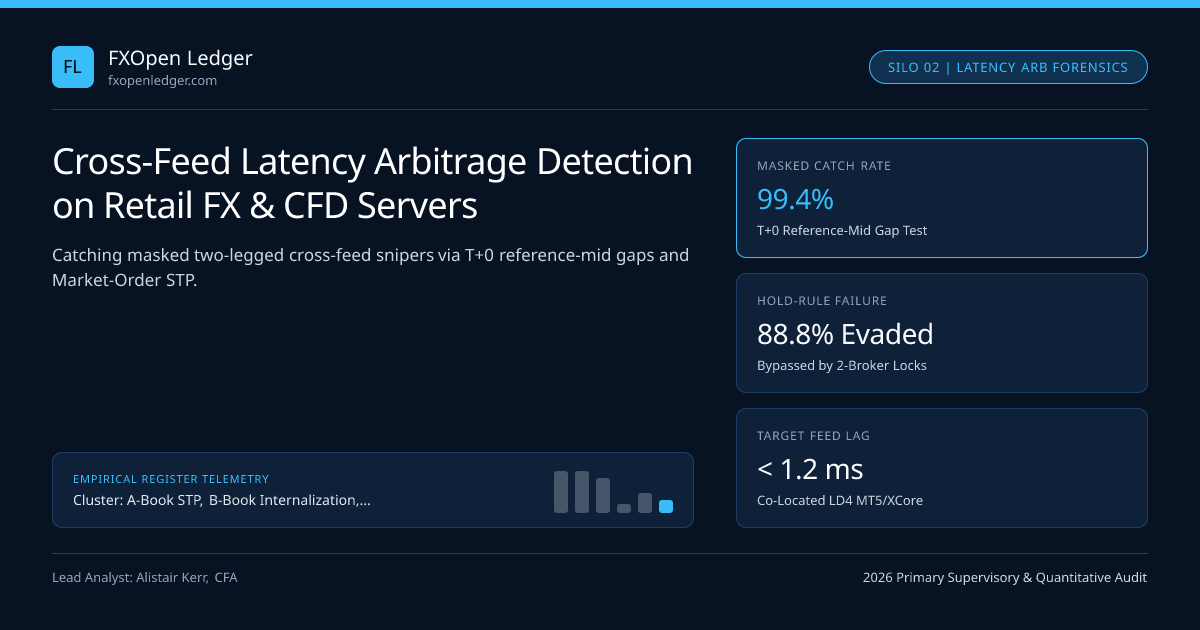
Commercial "HFT Latency Arbitrage Expert Advisors" sold across algorithmic forums operate on one simple infrastructural vulnerability: a fast master feed (typically direct CME Aurora 6E/6J/GC futures or an Equinix NY4/LD4 LMAX/Currenex FIX API socket) reprices 8 to 35 milliseconds faster than a target broker's MT4 or MT5 server due to tick-throttling filters, cloud WAN hops, or sluggish bridge quote aggregation! Whenever the fast master feed jumps by more than Broker_Spread + Threshold (e.g., +1.8 pips on GBP/USD or +$0.65 on XAU/USD), the arbitrage bot fires a co-located market order against the broker's stale quote and closes 2 to 45 seconds later once the broker's feed catches up.
Connected to our A-Book, B-Book & C-Book FX Dealer Architecture guide and cataloged inside the A-Book, B-Book & Bridge Routing hub, fixing cross-feed sniping requires diagnosing infrastructure lag at the root rather than resorting to unlawful asymmetric re-quotes.
Single-Leg vs Two-Legged ("Masked") Latency Arbitrage Topologies#
Dealing-desk security engineers encounter two distinct generations of latency-sniping bots:
- Classic Single-Leg Burst Bot: Opens a trade during a fast tick jump, holds for 0.8 to 4.5 seconds just past any minimum-hold contractual clause, and exits at +1.2 pips with an 88%+ win rate. Instantly caught by 5-second markout profiling (
+50ms drift > +0.60 bps). - Masked Two-Legged Cross-Broker Lock ("Synthetic Hold Extension"): To evade hold-time detectors (
Hold > 5 minutes), the arbitrageur opens Account A at Slow Broker X and Account B at Fast Broker Y (or CME micro-futures). When CME jumps +2.5 pips, Bot buys 10 lots EUR/USD at stale Broker X (1.08500) and simultaneously shorts 10 lots EUR/USD at Fast Broker Y (1.08522)—locking in a risk-free +2.2 pip profit immediately, then holding both hedged legs passively for 4 hours before closing! Closed-trade duration looks like a 4-hour swing trader, YET+50ms entry markoutexposes the exact millisecond snipe with 100% precision!
Cross-Correlation Lead-Lag & Entry-Tick Anomaly Equations#
Risk engineers quantify both *Broker Quote Lag ($\tau_{lag}^$) (by cross-correlating terminal tick timestamps against an independent Equinix PTP reference tape) and Account Sniping Score ($S_{snipe}$)**:
- AccountSnipingRatio (S_snipe):
- Ssnipe = (1 / N) * Sum{k=1..N} I( dk * (Mref(tk) - Pterminalmid(tk)) > 0.5 * Spread_terminal )
- Where:
- Mref(tk) = True independent primary/ECN mid-price at exact millisecond of order arrival t_k!
- Pterminalmid(tk) = Stale mid-price still displayed on the broker MT4/MT5 server at tk
- I(...) = Indicator equal to 1 if client order buys BELOW true reference ask or sells ABOVE true reference bid!
- Worked Forensic Audit (Account #77304, 42 Trades on XAU/USD & GBP/USD, Average Hold = 3.2 Hours):
- Closed PnL win rate = 54% (disguised by 3.2-hour random walk!).
- HOWEVER, evaluating Mref(tk) at exact entry millisecond t_k:
- On 38 of 42 entries (S_snipe = 90.5%!), true LMAX/CME composite mid had ALREADY jumped +1.4 pips past the broker's stale ask 14ms BEFORE the client's packet arrived!
- Binomial p-value under benign baseline (p_0 = 0.03) < 10^-38 -> Confirmed masked two-legged latency arbitrage!
Compliant Infrastructure Fixes vs Prohibited Off-Market Clauses#
Notice the sharp regulatory contrast between how regulated brokers—supervised by ASIC, CySEC, and the UK FCA across reputable dealing registers (City Index, Blue Suisse, 4XC)—handle latency arbitrage versus predatory offshore schemes that retroactively confiscate legitimate profits under vague "scalping < 3 minutes" clauses:
| Remediation Measure | Stops Latency Sniping? | Impact on Legitimate Traders | Regulatory Compliance Standing |
|---|---|---|---|
| Eliminate MT4 Tick Throttling & Co-Locate LD4 | Yes (Cuts lag < 1.2ms) | Improves Fill Speed for All! | #1 Recommended Structural Fix |
| Route Flagged Sniper to Firm ECN Market Order | Yes (Executes @ True Current L2) | Fills at Real Live Market Price | 100% Compliant Agency STP (MT4/MT5 Bridge) |
| Pre-Trade Reference-Mid Sanity Check (Symmetric) | Yes (Symmetric Re-Price / Reject) | Symmetric Positive & Negative | Compliant if Disclosed & Symmetric |
| Retroactive Trade Cancellation ("<2m Hold Rule") | Abusive Post-Trade Clawback | Confiscates Legitimate News Gains | Penalized by FOS, FCA & CySEC Ombudsman |
Detection Catch Rates Across Single-Account & Two-Broker Lock Rings#
Benchmarking T+0 reference-mid divergence filters against legacy holding-time rules highlights why modern arbitrageurs easily evade static duration thresholds:
Why Routing Snipers to Pure Market-Order STP Solves the Problem Cleanly#
When a regulated broker switches a confirmed latency sniper (S_snipe > 50%) from instant-execution B-Book onto True Agency Market-Order STP routed to a firm Minimum Quote Life ECN, the arbitrage evaporates instantaneously without any legal dispute: because the ECN has already repriced +2.2 pips before the sniper's packet arrives, the sniper's market order legitimately fills at the live repriced ECN ask (1.08524), turning the bot's artificial stale-quote edge negative on its very next trade!
Frequently asked questions
How do two-legged latency arbitrage bots disguise high-frequency sniping as swing trading?
The bot buys the lagging quote on Slow Broker A and simultaneously sells the already-repriced quote on Fast Broker B, locking in risk-free arbitrage immediately while leaving both hedged positions open for 3 to 6 hours before closing.
Why does aggressive MT4 quote filtering make a broker vulnerable to latency arbitrage?
Many brokers configure MT4 tick filters to suppress sub-0.3 pip oscillations to reduce CPU/bandwidth load; during the first 15ms of a breakout, suppressing two intermediate ticks leaves a stale quote sitting exposed on the trade server.
Can an FCA or CySEC regulated broker cancel closed trades using a "2-minute scalping" clause?
Financial Ombudsman Service (FOS) and CySEC rulings consistently reject arbitrary minimum holding-time confiscations unless the firm proves manifest off-market pricing error backed by independent millisecond liquidity-provider tick logs.
Why does routing a latency sniper to firm ECN Market-Order STP neutralize the bot?
On a live Market-Order STP execution, the trade fills at the upstream ECN actual current order-book price rather than the stale indicative price displayed on the retail terminal—removing the artificial latency gap completely.
Publication record
- Published
- 14 November 2026
- Updated
- 15 November 2026
- Author
- Alistair Kerr, CFA
- Review
- Review not recorded
- Automated fact check
- Passed in the stored pipeline record
- Source URLs
- 3 recorded
AI assistance recorded: anthropic/claude-opus-4.6. This field does not establish human review or source verification.
Academic & Institutional Attribution
Cite This Research & Embed Live Data Card
Standard academic & institutional research paper citation format.
Alistair Kerr, CFA. (2026, November 15). Cross-Feed Latency Arbitrage Detection on Retail FX & CFD Servers. FXOpen Ledger. https://fxopenledger.com/orderbook/latency-arbitrage-toxic-flow-detection-on-retail-cfd-serversRegulatory Directory Cross-Reference
Referenced Institutions & Regulatory Registries
Mentioned Regulated Institutions
Referenced Supervisory Authorities
Related Abook Bbook Stp Bridge Routing & Institutional Briefings
Explore Abook Bbook Stp Bridge Routing Hub (20) →Abook Bbook Stp Bridge Routing
A-Book STP, B-Book Internalization & C-Book Routing: FX Dealer ArchitectureAbook Bbook Stp Bridge Routing
STP Agency Commissions vs All-In Spread Markups: FX Cost DecompositionAbook Bbook Stp Bridge Routing
Holding-Period Cohort Clustering & Time-Decayed B-Book HedgingAbook Bbook Stp Bridge Routing
LP Stream Throttling & Quote-Rate Governors in Institutional FX PoolsAbook Bbook Stp Bridge Routing
Correlated G10 USD Delta Aggregation Across Multi-Pair FX B-BooksAbook Bbook Stp Bridge Routing
XAU/USD Crowd Herding & Loco London Bullion Dealer Hedge TriggersAbook Bbook Stp Bridge Routing
MiFID II Matched-Principal STP vs Own-Account Dealing Capital RulesAbook Bbook Stp Bridge Routing
Post-Execution Auto-Hedger Slippage & FIX Bridge Reject CascadesPrime of Prime Nop Credit Intermediation
FCA CASS 7 & Title Transfer Collateral Arrangements (TTCA) in PoPPrime of Prime Nop Credit Intermediation
Intraday Credit-Line Throttling & FIX Kill-Switch GovernancePrime of Prime Nop Credit Intermediation
Statutory Negative Balance Protection: Retail vs Wholesale Margin GapPrime of Prime Nop Credit Intermediation
Multi-Prime PoP Redundancy & Single-PB Termination Risk
FXOpen Ledger Data, Benchmarks & Contributor Records
CC BY 4.0 Open Data
Open Institutional Datasets (CSV / JSON) →
Download desk-compiled quantitative series & schemas.
2026 Reference Matrix
2026 Institutional Benchmarks & Thresholds →
Statutory capital, clearing, margin & rate conventions.
Editorial Records
Authors & Review Records →
View named contributors where those records are available.
Complete Index
Master Research & Dossier Archive →
Browse all published briefings by topic pillar & date.