
Abook Bbook Stp Bridge Routing
Holding-Period Cohort Clustering & Time-Decayed B-Book Hedging
Order toxicity in margin foreign exchange decays sharply as median trade holding duration lengthens from 10 seconds to 48 hours—powering time-delayed C-Book algorithms that defer external hedging unless short-term price action confirms risk.
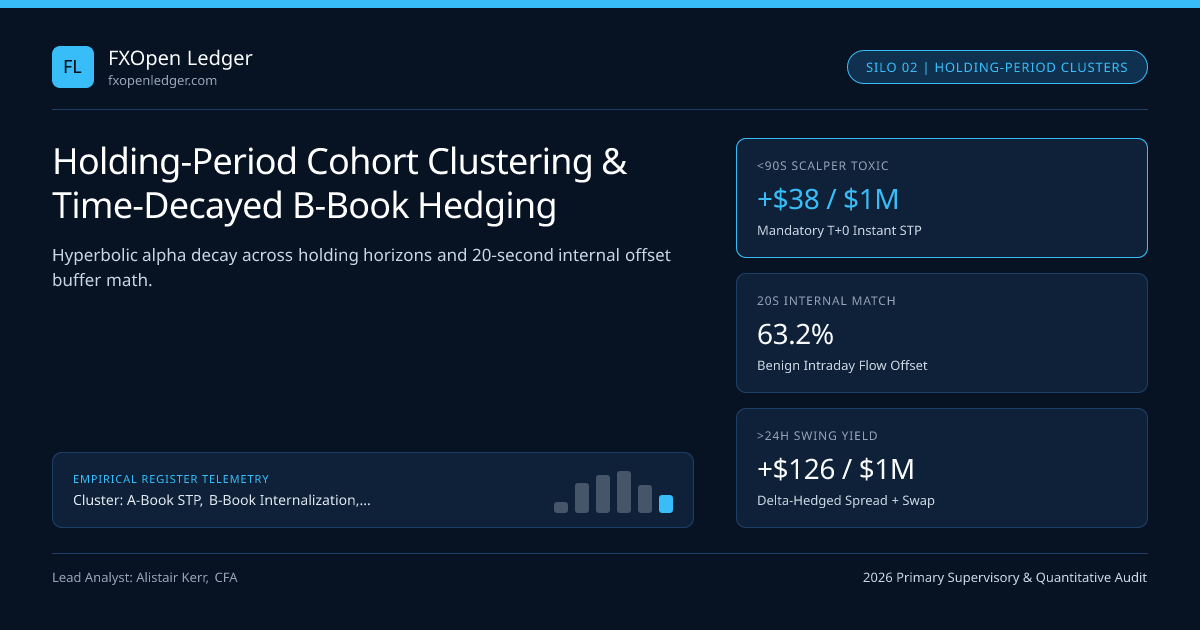
Plot realized trader Sharpe ratio across 50,000 margin foreign exchange accounts against Median Trade Holding Duration ($\tau_{hold}$) on a logarithmic scale—from 1 second out to 10 days—and an extraordinary microstructural regularity emerges: signal-to-noise ratio collapses hyperbolically with holding horizon! An account closing trades in 8 seconds needs only a 0.4-pip price edge to overcome spread, exploiting high-autocorrelation order-book imbalances; an account holding leveraged positions across three nights (>72 hours) faces 180 pips of macro random-walk volatility PLUS cumulative Tom-Next interbank rollover markups that compound against over-leveraged margin accounts!
Connected to our A-Book, B-Book & C-Book FX Dealer Architecture guide, paired with five-second markout profiling and hybrid C-Book partial delta externalization, and housed inside the A-Book, B-Book & Bridge Routing hub, holding-period cohort clustering underpins Time-Decayed / Delayed-Hedge C-Book execution.
Empirical Profitability & Swap-Drag Decay Across Four Holding Cohorts#
Why does dealer gross retention rise monotonically with client holding duration (provided portfolio VaR caps guard against multi-week macro trends)? Three compounding forces govern the curve:
- Microstructural Alpha Evaporation (
> 60 seconds): Order-book imbalance (OBI) and cross-venue lead-lag predictive power decay to near zero within 15 to 60 seconds. - Disposition Effect Asymmetry (
15 mins – 24 hours): Intraday discretionary traders take quick +15-pip profits while widening stop-losses on losing trades until margin stop-out (50% margin close-outunder ESMA/FCA rules). - Cumulative Rollover Financing Bleed (
> 24 hours): Every 17:00 New York rollover deducts dealer swap markups—turning negative-carry swing trades into steady yield streams for hedged or internalized dealing books!
Optimal Delayed-Hedge ("Wait-and-See") C-Book Valuation Model#
Beyond static cohort assignment, quantitative dealing rooms evaluate Time-Delayed Hedging: instead of paying upstream LP spread ($C{lp}$) immediately at $t = 0$ on an ambiguous intraday trader, what happens if the desk warehouses the order for $\Delta t = 15\text{ seconds}$? Watch carefully—unconditional delayed hedging is a mathematical fallacy if prices follow a martingale, unless the trader exhibits negative short-term markouts (`T5s < 0` from 5-second markout profiling), in which case waiting 15 seconds captures mean-reversion alpha before externalizing large-size VaR!
- Where Pinternaloffset(Deltat) = 1 - exp( -Lambdaoppositeflow * Deltat / Q_clip )
- Worked 20-Second Warehouse Buffer Calculation ($500k EUR/USD Intraday Retail Ticket):
- Upstream PoP STP Cost C_lp = $24/M ($12 on $500k clip).
- 1. Benign Contrarian Cohort (Mean 20s client drift = -0.18 bps = -$18/M; Opposing arrival Lambda = $1.5M/min = $0.025M/s):
- Pinternaloffset(20s) = 1 - exp(-0.025 * 20 / 0.50) = 1 - exp(-1.00) = 63.21% matched internally!
- Advantage over Instant t=0 STP = +$18/M (favorable 20s reversion) + 0.6321 * $24/M (saved LP cost) = +$33.17 per $1M!
- 2. Sharp Momentum Cohort (Mean 20s client drift = +0.55 bps = +$55/M):
- Advantage = -$55/M + 0.6321 * $24/M = -$39.83 per $1M LOSS! -> Never delay hedging on positive-markout cohorts!
Cohort Risk Governance Across Regulated Multi-Asset Brokerages#
Risk committees at regulated investment firms—such as City Index, BOSSA, Blue Suisse, and 4XC operating under UK FCA, ESMA, and ASIC supervision—never alter client execution speed based on holding cohort; client fills remain instantaneous (<2ms) while post-fill house hedging cadence adapts strictly in the background:
| Holding-Period Cluster | Share of Broker Volume | Median +5s Client Drift | Dominant Broker Revenue Driver | Post-Fill House Hedging Cadence |
|---|---|---|---|---|
Ultra-Short (< 90 Seconds) | 14% Notional | +0.38 bps (Toxic) | Agency Commission / Raw Markup | T + 0ms Instant Firm ECN STP |
Intraday Scalper (90s - 30m) | 31% Notional | -0.06 bps (Neutral) | Spread Turnover ($65-$90/M) | T + 15s Bucket Flush ($100k Cap) |
Day Trader (30m - 24h) | 36% Notional | -0.19 bps (Benign) | Spread + Disposition Skew | Portfolio VaR Ceiling Overflow Only |
Multi-Day Swing (> 24 Hours) | 19% Notional | -0.12 bps (Benign) | Spread + Tom-Next Swap Markup | Daily EOD Delta + Swap Hedge |
Realized Desk Yield Across Four Holding-Duration Clusters#
Segmenting historical trade ledgers by median holding horizon demonstrates why 15-to-20-second internal crossing buffers thrive on benign intraday noise yet fail on sub-minute scalpers:
Guarding the >24h Swing Cohort Against Macro Regime Shifts#
Notice the vital caveat on the >24h Swing Cohort: although individual swing entries have benign -0.12 bps 5-second markouts, three weeks of one-way USD/JPY rally can accumulate $45 million of correlated unrealized profit among trend-following swing accounts! Dealing desks therefore hedge net EOD currency delta via cheap institutional wholesale Tom-Next swaps—earning the retail-versus-interbank swap differential risk-free without carrying unhedged directional spot exposure!
Frequently asked questions
Why are sub-minute FX scalpers much harder to internalize than day traders?
Sub-minute scalpers enter almost exclusively during strong order-book imbalances, news spikes, or feed lags where 5-second price continuation exceeds the bid-ask spread, leaving a B-Book with immediate uncompensated adverse selection.
Does a 15-second delayed B-Book hedge slow down the client trade confirmation?
Never on a compliant platform. The broker confirms the client trade in ~1-2 milliseconds as principal, and the 15-second timer governs only when the broker own risk engine decides to lay off residual net inventory externally.
Why does delaying a hedge lose money if applied to sharp momentum traders?
If a trader possesses genuine 10-to-30-second breakout alpha, waiting 20 seconds means the wholesale market moves +0.55 bps against the broker before the delayed hedge fires—costing more than double the saved LP spread.
How do brokers earn swap margin safely on multi-day swing positions without directional risk?
When net client swing positioning is +$20M long EUR/USD, the broker shorts $20M EUR/USD in the wholesale spot/tom-next market, paying interbank tom-next points while charging retail swap rates and pocketing the net financing spread.
Publication record
- Published
- 14 November 2026
- Updated
- 15 November 2026
- Author
- Alistair Kerr, CFA
- Review
- Review not recorded
- Automated fact check
- Passed in the stored pipeline record
- Source URLs
- 3 recorded
AI assistance recorded: anthropic/claude-opus-4.6. This field does not establish human review or source verification.
Academic & Institutional Attribution
Cite This Research & Embed Live Data Card
Standard academic & institutional research paper citation format.
Alistair Kerr, CFA. (2026, November 15). Holding-Period Cohort Clustering & Time-Decayed B-Book Hedging. FXOpen Ledger. https://fxopenledger.com/orderbook/time-decayed-bbook-hedging-and-holding-period-cohort-clusteringRegulatory Directory Cross-Reference
Referenced Institutions & Regulatory Registries
Mentioned Regulated Institutions
Referenced Supervisory Authorities
Related Abook Bbook Stp Bridge Routing & Institutional Briefings
Explore Abook Bbook Stp Bridge Routing Hub (20) →Abook Bbook Stp Bridge Routing
A-Book STP, B-Book Internalization & C-Book Routing: FX Dealer ArchitectureAbook Bbook Stp Bridge Routing
LP Stream Throttling & Quote-Rate Governors in Institutional FX PoolsAbook Bbook Stp Bridge Routing
Correlated G10 USD Delta Aggregation Across Multi-Pair FX B-BooksAbook Bbook Stp Bridge Routing
XAU/USD Crowd Herding & Loco London Bullion Dealer Hedge TriggersAbook Bbook Stp Bridge Routing
MiFID II Matched-Principal STP vs Own-Account Dealing Capital RulesAbook Bbook Stp Bridge Routing
Post-Execution Auto-Hedger Slippage & FIX Bridge Reject CascadesAbook Bbook Stp Bridge Routing
Toxic EA News-Straddle Orders & Stop-Order Warehouse ExposureAbook Bbook Stp Bridge Routing
Synthetic Cross-Pair Auto-Hedging: EUR/GBP & GBP/NZD TriangulationPrime of Prime Nop Credit Intermediation
Statutory Negative Balance Protection: Retail vs Wholesale Margin GapPrime of Prime Nop Credit Intermediation
Multi-Prime PoP Redundancy & Single-PB Termination RiskPrime of Prime Nop Credit Intermediation
Non-CLS Emerging-Market FX Settlement Cutoffs & Pre-FundingPrime of Prime Nop Credit Intermediation
Loco London Unallocated Bullion Credit Lines in Multi-Asset PoP
FXOpen Ledger Data, Benchmarks & Contributor Records
CC BY 4.0 Open Data
Open Institutional Datasets (CSV / JSON) →
Download desk-compiled quantitative series & schemas.
2026 Reference Matrix
2026 Institutional Benchmarks & Thresholds →
Statutory capital, clearing, margin & rate conventions.
Editorial Records
Authors & Review Records →
View named contributors where those records are available.
Complete Index
Master Research & Dossier Archive →
Browse all published briefings by topic pillar & date.