
Abook Bbook Stp Bridge Routing
Synthetic Cross-Pair Auto-Hedging: EUR/GBP & GBP/NZD Triangulation
Hedging minor currency crosses like GBP/NZD, EUR/CAD, or CHF/JPY directly on thin cross order books wastes 0.8 to 2.2 pips in wholesale spread; triangular USD-leg synthesis cuts hedge costs by over 55%.
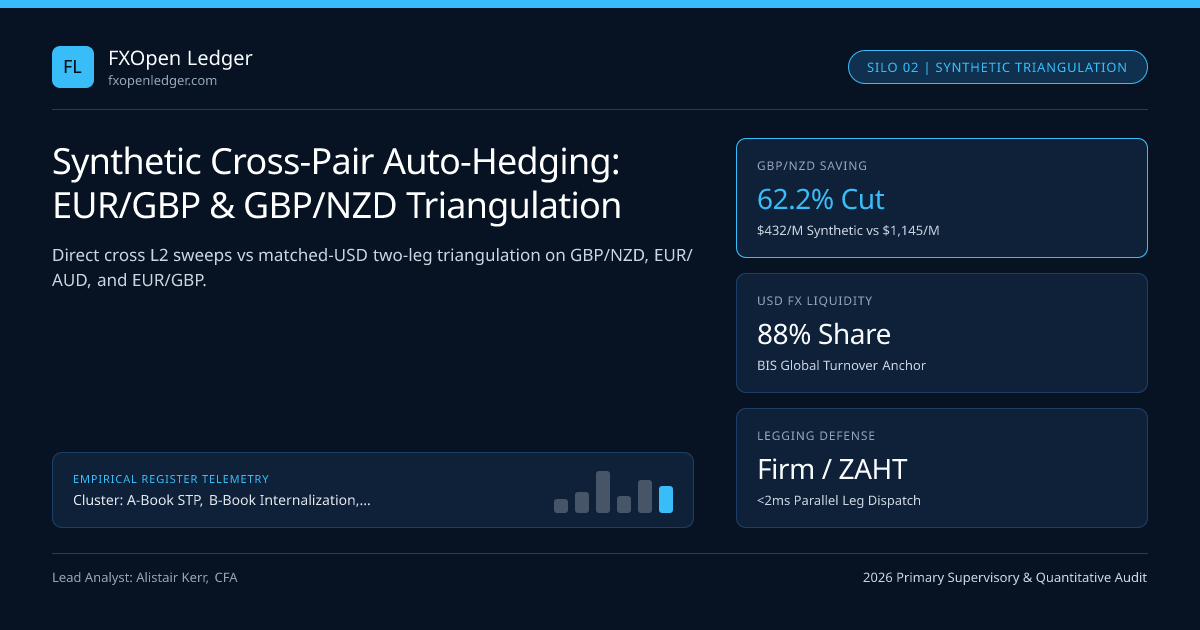
Suppose an institutional or high-net-worth client hits Buy 15.00 Lots (£1.50M) GBP/NZD at 21:45 UTC during the thin Wellington/Sydney transition! If a broker's liquidity bridge naively routes a single direct 15-Lot GBPNZD market order to an upstream aggregator, it collides with a desolate direct cross book quoting a 2.4-pip spread with only £250k at top-of-book—suffering 3.8 pips of VWAP sweep cost! Yet at that exact millisecond, wholesale GBP/USD and NZD/USD primary dollar legs hold 6x deeper liquidity and tighter combined spreads! Synthetic Triangular Auto-Hedging Engines decompose illiquid cross exposures into two synchronized USD-major legs (Buy GBP/USD + Sell NZD/USD), slashing wholesale cross-hedging execution costs by 45% to 68%.
Connected to our A-Book, B-Book & C-Book FX Dealer Architecture guide and indexed within the A-Book, B-Book & Bridge Routing hub, synthetic triangular FX engines power modern Prime-of-Prime cross liquidity.
Direct Cross Books vs Synthetic USD-Leg Triangulation#
In global interbank FX microstructure—confirmed every three years by the BIS Triennial Central Bank Survey—roughly 88% of all FX transactions involve the US Dollar on one side! Outside of three liquid non-USD crosses (EUR/GBP, EUR/JPY, and EUR/CHF, which maintain genuine primary order books on EBS and LSEG Matching), almost all remaining 25+ G10 crosses (GBP/NZD, EUR/AUD, AUD/CAD, CAD/JPY, GBP/CAD) are synthetically derived by bank pricing engines from their underlying USD legs anyway!
- When Direct Cross Wins: On
EUR/GBPduring London hours (07:00–16:00 UTC), directEUR/GBPquotes0.2–0.3 pips, beating the sum ofEUR/USD(0.1p) +GBP/USD(0.25p) plus double brokerage! - When Synthetic Triangulation Wins: On secondary crosses (
GBP/NZD,EUR/NZD,CHF/JPY,AUD/CHF)—especially for clips $\ge $1\text{M}$ or outside London peak—executing two deep USD legs simultaneously beats direct cross VWAP sweeps dramatically.
Exact Triangular No-Arbitrage Sizing & Legging-Risk Formula#
Getting the notional math wrong by confusing base and quote currencies leaves residual USD exposure! To synthetically hedge a Long $Q_{gbp}$ GBP/NZD client trade at spot rates $S{GBPUSD}$ and $S{NZDUSD}$ (where $S{GBPNZD} = S{GBPUSD} / S_{NZDUSD}$), the bridge must match the exact USD intermediate cashflow on both legs:
- Synthetic_Bid(GBP/NZD) = Bid(GBP/USD) / Ask(NZD/USD)
- Exact Zero-USD-Residual Hedge Notionals for Long Q_gbp (£1,500,000) GBP/NZD:
- 1. Leg A (Buy GBP / Sell USD): Buy Notional_GBP = £1,500,000 GBP/USD @ Ask(GBP/USD) = 1.2720
- > USD Cashflow Paid = -£1,500,000 * 1.2720 = -$1,908,000.00 USD.
- 2. Leg B (Buy USD / Sell NZD): Sell Notional_NZD = $1,908,000 / Bid(NZD/USD 0.6000) = NZ$3,180,000 NZD/USD!
- > USD Cashflow Received = +NZ$3,180,000 * 0.6000 = +$1,908,000.00 USD -> Net USD Residual = $0.00!
- Worked Execution Cost Comparison (£1.50M = $1.908M Notional at 21:45 UTC):
- Option 1 (Direct GBP/NZD Sweep): Half-spread + L2 sweep = 1.90 NZD pips/GBP = $2,184 execution cost ($1,145/M)!
- Option 2 (Synthetic Parallel Triangulation + 2x $8/M Brokerage):
- Leg A (£1.5M GBP/USD half-spread 0.25p = $375) + Leg B (NZ$3.18M NZD/USD half-spread 0.22p = $420) + Clearing ($30) = $825 ($432/M)!
- > Net Broker Execution Saving = $1,359 on a single 15-lot clip (-62.2% cost reduction)!
Direct vs Synthetic Routing Matrix Across Major Cross Categories#
Institutional bridges operated by liquidity specialists like AMB Prime, ALB Prime, Climax Prime, and 4XC—audited under FCA and CySEC best-execution standards—configure dynamic pair-routing tables by session and clip size:
| Cross-Pair Category | Representative Symbols | London Peak (<$1M Clip) | Asian / Rollover or >$2M Clip | Double Clearing Fee Impact |
|---|---|---|---|---|
| Primary European Cross | EUR/GBP, EUR/CHF | Direct Cross Book (0.2p) | Hybrid (Compare L2 VWAP Live) | Direct Saves 2nd Ticket Fee |
| Primary Yen Carry Cross | EUR/JPY, GBP/JPY | Direct Cross Book (0.3-0.6p) | Synthetic USD Legs (> $3M) | Synthetic Wins on Deep Sweeps |
| Commonwealth Secondary | GBP/NZD, EUR/AUD, GBP/CAD | Synthetic USD Legs | Synthetic USD Legs (Saves 60%+) | Spread Saving Dwarfs 2x Fee |
| Nordic & EM Crosses | EUR/TRY, GBP/ZAR, NOK/SEK | Direct EUR/TRY or USD Legs | Synthetic USD/EUR Primary Legs | Essential for CLS/PoP Netting |
Wholesale Execution Cost Benchmarks: Direct Cross vs USD Legs#
Comparing empirical Level-2 sweep costs across primary European crosses and secondary Commonwealth pairs establishes clear session-by-session smart-routing cutoffs:
Controlling Legging Risk and Unifying With Currency-Vector Netting#
What if Leg A (GBP/USD) fills 100% while Leg B (NZD/USD) rejects on a Last-Look stream—leaving an unintended $1.908M USD leg? Institutional synthetic engines obey two iron rules:
- Route Synthetic Legs Exclusively to Firm or ZAHT (<2ms) Streams: Never triangulate across slow 25ms Last-Look LPs where reject cascades leave one leg naked!
- Integrate With Correlated G10 USD Vector Netting: Even better, before firing both legs externally, check whether the house B-Book already holds an offsetting
+$1.9MNZD/USD position—often the desk only needs to execute one external leg (GBP/USD) to flatten both cross and dollar risk simultaneously!
Frequently asked questions
What is synthetic triangular auto-hedging in an FX liquidity bridge?
Synthetic triangular hedging splits a cross-currency client trade (such as Buy GBP/NZD) into two simultaneous US Dollar major trades (Buy GBP/USD and Sell NZD/USD) matched in exact USD notional to access deeper interbank liquidity.
When is a direct cross order book cheaper than synthetic USD triangulation?
On primary interbank crosses—specifically EUR/GBP, EUR/JPY, and EUR/CHF during active London trading for clips under $2M—dedicated primary CLOB depth is tight enough to beat paying two separate USD-leg spreads and two ticket fees.
What is "legging risk" when executing synthetic cross FX hedges?
Legging risk occurs when Leg 1 (e.g., GBP/USD) fills immediately while Leg 2 (e.g., NZD/USD) is rejected by a Last-Look LP, leaving temporary unhedged USD exposure until the retry completes.
How do you size the second leg of a synthetic cross hedge so zero USD exposure remains?
First compute the exact USD notional generated by Leg 1 (Base Quantity multiplied by Leg-1 execution price), then divide or multiply that exact USD cashflow by Leg-2 execution price to determine Leg-2 quantity.
Publication record
- Published
- 14 November 2026
- Updated
- 15 November 2026
- Author
- Alistair Kerr, CFA
- Review
- Review not recorded
- Automated fact check
- Passed in the stored pipeline record
- Source URLs
- 3 recorded
AI assistance recorded: anthropic/claude-opus-4.6. This field does not establish human review or source verification.
Academic & Institutional Attribution
Cite This Research & Embed Live Data Card
Standard academic & institutional research paper citation format.
Alistair Kerr, CFA. (2026, November 15). Synthetic Cross-Pair Auto-Hedging: EUR/GBP & GBP/NZD Triangulation. FXOpen Ledger. https://fxopenledger.com/orderbook/synthetic-cross-pair-auto-hedging-eurgbp-audnzd-triangulationRegulatory Directory Cross-Reference
Referenced Institutions & Regulatory Registries
Mentioned Regulated Institutions
Referenced Supervisory Authorities
Related Abook Bbook Stp Bridge Routing & Institutional Briefings
Explore Abook Bbook Stp Bridge Routing Hub (20) →Abook Bbook Stp Bridge Routing
A-Book STP, B-Book Internalization & C-Book Routing: FX Dealer ArchitectureAbook Bbook Stp Bridge Routing
Introducing Broker Rebate Churn vs A-Book LP Clearing EconomicsAbook Bbook Stp Bridge Routing
FCA, ASIC & CySEC Execution-Venue Conflicts-of-Interest DisclosuresAbook Bbook Stp Bridge Routing
Shadow A-Book Paper-Hedging Analytics for Dealing-Desk CalibrationAbook Bbook Stp Bridge Routing
MT4/MT5 Liquidity Bridge Topology: FIX Routing Latency & Markup AuditAbook Bbook Stp Bridge Routing
B-Book Risk Warehouse VaR Limits: Modeling Client PnL Tail VarianceAbook Bbook Stp Bridge Routing
Hybrid C-Book Alpha Profiling: Partial Delta Hedging & MultipliersAbook Bbook Stp Bridge Routing
VPIN Toxicity Scoring in Multi-Dealer FX Aggregators & Liquidity PoolsPrime of Prime Nop Credit Intermediation
Close-Out Netting & Default Waterfalls Under the 2002 ISDA MasterPrime of Prime Nop Credit Intermediation
Offshore Broker (Mauritius, Seychelles, BVI) PoP Onboarding KYBPrime of Prime Nop Credit Intermediation
Evaluating PoP Counterparty Solvency: ICARA, MIFIDPRU & AuditsTom Next Swap Rollover Triple Wednesday
Spot FX T+2 Settlement Calendar & Wednesday Triple-Rollover Mechanics
FXOpen Ledger Data, Benchmarks & Contributor Records
CC BY 4.0 Open Data
Open Institutional Datasets (CSV / JSON) →
Download desk-compiled quantitative series & schemas.
2026 Reference Matrix
2026 Institutional Benchmarks & Thresholds →
Statutory capital, clearing, margin & rate conventions.
Editorial Records
Authors & Review Records →
View named contributors where those records are available.
Complete Index
Master Research & Dossier Archive →
Browse all published briefings by topic pillar & date.