
Prime of Prime Nop Credit Intermediation
Close-Out Netting & Default Waterfalls Under the 2002 ISDA Master
Without enforceable close-out netting under a 2002 ISDA Master Agreement, a bankrupt counterparty liquidator could cherry-pick profitable FX trades while repudiating losing hedges—turning a flat $1.5M net book into $39.6M ruin.
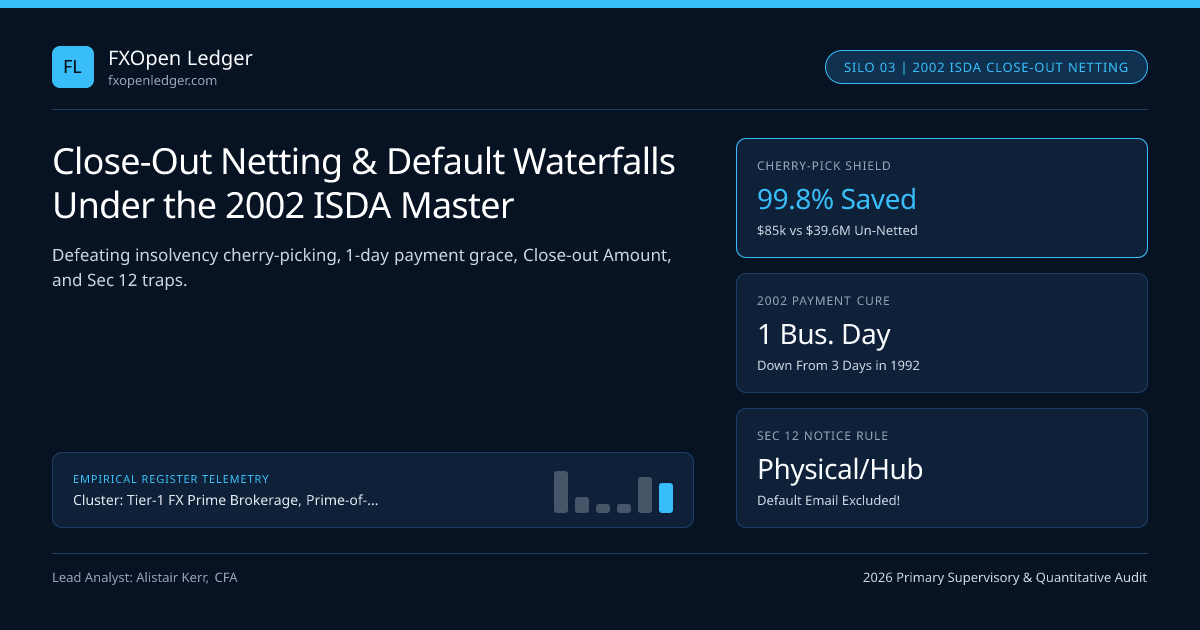
Why do Tier-1 banks and institutional Prime-of-Prime houses refuse to trade $100 Million of FX swaps and forwards with corporate entities incorporated in jurisdictions lacking Clean ISDA Netting Legal Opinions? Because of the nightmare of Bankruptcy "Cherry-Picking"! Suppose your brokerage holds 200 open FX forward and spot hedges with Counterparty X: 100 trades are in-the-money to you by +$48.0 Million, and 100 offsetting trades are out-of-the-money to you by -$46.5 Million (Net Exposure = +$1.5M, covered by $1.4M Variation Margin). If Counterparty X goes bankrupt in a jurisdiction without statutory close-out netting, the insolvency liquidator demands you pay $46.5M in full cash immediately on your losing trades while paying you 15 cents on the dollar on your winning trades—inflicting a catastrophic -$39.61 Million loss on a hedged book!
Connected to our Tier-1 FXPB & Prime-of-Prime Credit Intermediation guide and indexed inside the Prime-of-Prime & FXPB Credit hub, Sections 5 and 6 of the 2002 ISDA Master Agreement fuse thousands of FX trades into a Single Indivisible Netting Contract.
The Three Pillars of ISDA Close-Out Netting (Single Agreement + Termination + Set-Off)#
Enforceable close-out netting across over 80 ISDA-opinion jurisdictions (UK, US, EU, Switzerland, Australia, Singapore, Hong Kong, Japan, Cayman, BVI) operates through three sequential legal steps upon a Section 5(a) Event of Default (Failure to Pay after 1 Local Business Day grace in 2002 ISDA, vs 3 days in 1992 ISDA!, or Bankruptcy):
- Section 1(c) Single Agreement: All Transactions entered under the Master Agreement plus the ISDA 2016 VM-CSA form one single integrated contract—barring a liquidator from affirming winners and rejecting losers.
- Section 6(a) Early Termination: The Non-Defaulting Party designates an
Early Termination Date(orAutomatic Early Termination [AET]fires instantly in specific insolvency regimes like Germany/Switzerland!). - Section 6(e) Single Net
Close-out Amount: Every terminated FX spot, forward, swap, and NDF values at replacement mid-plus-spread cost (Close-out Amount), sums algebraically against posted collateral (Unpaid Amounts), and collapses into one single net Termination Currency payment!
Quantifying Gross Cherry-Picking Ruin vs 2002 ISDA Section 6(e) Netting#
Let us write out the exact mathematical difference between Enforceable Section 6(e) Close-Out Netting and Unenforceable Gross Insolvency Exposure (which also dictates why Basel III SA-CCR prohibits netting RWA without a clean annual legal opinion!):
- CherryPickLossvsFairVal = (1 - RecoveryRateR) * MAX( 0, Sum{i: MTMi > 0} MTMi - CollateralHeldVMIM )
- Worked Insolvency Waterfall Audit (200 Open FX Trades: +$48.0M Winning Legs, -$46.5M Losing Legs -> True Net MTM = +$1.50M; Posted VM Held = $1.40M; Estate Recovery R = 15%):
- 1. With Clean 2002 ISDA Close-Out Netting (UK / NY / Swiss / Cayman Opinion):
- Single Section 6(e) Early Termination Amount = +$48.0M - $46.5M - $1.40M (VM set-off) = +$0.10M unsecured residual.
- Realized Credit Loss (@ 15% recovery) = $0.10M * 0.85 = $85,000 ($0.085M — 99.82% protected!).
- 2. Without Enforceable Netting ("Cherry-Picking" Jurisdiction or Missing Master Agreement):
- Liquidator collects full $46.50M cash from you on losing legs; you claim $48.0M - $1.40M = $46.60M in estate (@ 15% = $6.99M)!
- Realized Credit Loss vs Fair Value = $46.60M * 0.85 = $39,610,000 (-$39.61M CATASTROPHIC WIPEOUT!).
Key Upgrades in the 2002 ISDA Master Over the Legacy 1992 ISDA#
Institutional legal counsel reviewing Prime-of-Prime and bank FX documentation—across supervised hubs (UK FCA, NYDFS, FINMA, CIMA Cayman, BVIFSC)—strongly favor the 2002 ISDA Master Agreement over legacy 1992 templates for four FX-critical reasons:
| Contractual Provision | Legacy 1992 ISDA Master | Modern 2002 ISDA Master | Why It Matters During an FX Flash Crash |
|---|---|---|---|
| Failure-to-Pay Grace Period | 3 Local Business Days | 1 Local Business Day | Cuts uncollateralized market drift by 67%! |
| Valuation Methodology | Rigid Market Quotation (4 Dealers) / Loss | Flexible Close-out Amount | Works when dealer quotes evaporate in crashes! |
| Force Majeure Termination | Not Built-In (Required Illegality Annex) | Built-In Sec 5(b)(ii) (8 Bus. Days) | Clean exit during sovereign FX freezes / wars! |
| Cross-Agreement Set-Off | Optional Rider Required | Built-In Section 6(f) Set-Off | Offsets surplus across other mature obligations |
Why 1992 Market Quotation Failed During Volatile Crashes#
During the 1998 LTCM/Russian ruble crisis and 2008 Lehman collapse, the 1992 ISDA's rigid Market Quotation rule—requiring the Non-Defaulting Party to obtain at least 3 out of 4 binding executable dealer replacement quotes at the exact same timestamp for complex or illiquid FX books—broke down or produced wildly distorted bid-ask midpoints!
Operational Trap: Section 12 Default Notices Usually Cannot Be Sent by Email!#
Ask any derivatives litigation partner for the #1 operational blunder made when terminating a defaulting FX counterparty at 16:00 Friday: sending the Section 6(a) Early Termination Notice solely by email! Under standard Section 12(a) of both the 1992 and 2002 ISDA Master Agreements, notices under Section 5 or Section 6 (Events of Default & Early Termination) may NOT be given by electronic messaging system or email (unless modified via the ISDA Notices Hub or explicit Schedule amendment)—requiring physical courier delivery or certified mail to the counterparty's Schedule address! Every institutional risk room keeps pre-drafted physical courier templates and ISDA Notices Hub enrollment verified annually alongside T-Bill Tri-Party IM pledges.
Frequently asked questions
What is "bankruptcy cherry-picking" in OTC foreign exchange?
In jurisdictions lacking statutory close-out netting, an insolvent counterparty administrator can enforce only the FX contracts profitable to the bankrupt estate while treating all losing contracts as unpaid general creditor claims.
Why did the 2002 ISDA Master replace "Market Quotation" with "Close-out Amount"?
During market crises, obtaining three firm third-party dealer quotes simultaneously for dozens of broken-date FX swaps often failed; Close-out Amount permits commercially reasonable internal models alongside market data and executable spreads.
What is Automatic Early Termination (AET) in an ISDA Schedule?
AET is an election in the ISDA Schedule causing all transactions to terminate automatically the split-second immediately preceding specific insolvency filings—used primarily in jurisdictions like Germany or Switzerland to preserve netting priority.
Can I send an ISDA Early Termination Notice by email during a margin default?
Not under an unamended 1992 or 2002 ISDA Master Agreement! Section 12(a) explicitly excludes email/electronic messaging for Section 5 and Section 6 default notices, requiring physical delivery unless amended or enrolled on ISDA Notices Hub.
Publication record
- Published
- 13 November 2026
- Updated
- 15 November 2026
- Author
- Alistair Kerr, CFA
- Review
- Review not recorded
- Automated fact check
- Passed in the stored pipeline record
- Source URLs
- 3 recorded
AI assistance recorded: anthropic/claude-opus-4.6. This field does not establish human review or source verification.
Academic & Institutional Attribution
Cite This Research & Embed Live Data Card
Standard academic & institutional research paper citation format.
Alistair Kerr, CFA. (2026, November 15). Close-Out Netting & Default Waterfalls Under the 2002 ISDA Master. FXOpen Ledger. https://fxopenledger.com/orderbook/default-waterfall-close-out-netting-under-2002-isda-masterRegulatory Directory Cross-Reference
Referenced Institutions & Regulatory Registries
Top Regulated Institutions in This Coverage Slice
Related Prime of Prime Nop Credit Intermediation & Institutional Briefings
Explore Prime of Prime Nop Credit Intermediation Hub (20) →Prime of Prime Nop Credit Intermediation
Tier-1 FX Prime Brokerage, Prime-of-Prime NOP Limits & Give-Up Credit GuidePrime of Prime Nop Credit Intermediation
Offshore Broker (Mauritius, Seychelles, BVI) PoP Onboarding KYBPrime of Prime Nop Credit Intermediation
Evaluating PoP Counterparty Solvency: ICARA, MIFIDPRU & AuditsPrime of Prime Nop Credit Intermediation
Tier-1 Bank FXPB Balance-Sheet Floors & Basel III SA-CCR MathPrime of Prime Nop Credit Intermediation
Net Open Position (NOP) Utilization Formulas & Currency HaircutsPrime of Prime Nop Credit Intermediation
Four-Way FXPB Designation Notices & Traiana Harmony Give-UpsPrime of Prime Nop Credit Intermediation
CLS PvP Settlement vs Bilateral Netting & Herstatt Risk in OTC FXPrime of Prime Nop Credit Intermediation
SNB EUR/CHF Flash-Crash Contagion & Negative-Balance ControlsTom Next Swap Rollover Triple Wednesday
Central-Bank Decision-Eve Overnight FX Swap Pricing JumpsTom Next Swap Rollover Triple Wednesday
MiFID II Ex-Ante Cost Disclosure: Auditing Annualized FX Swap DragLmax Ebs Ecn Spread Slippage Audit
Primary FX CLOBs: EBS Market, LSEG Matching & Minimum Quote LifeLmax Ebs Ecn Spread Slippage Audit
Firm No-Last-Look FX CLOBs: LMAX Exchange Matching Mechanics
FXOpen Ledger Data, Benchmarks & Contributor Records
CC BY 4.0 Open Data
Open Institutional Datasets (CSV / JSON) →
Download desk-compiled quantitative series & schemas.
2026 Reference Matrix
2026 Institutional Benchmarks & Thresholds →
Statutory capital, clearing, margin & rate conventions.
Editorial Records
Authors & Review Records →
View named contributors where those records are available.
Complete Index
Master Research & Dossier Archive →
Browse all published briefings by topic pillar & date.