
Lmax Ebs Ecn Spread Slippage Audit
Firm No-Last-Look FX CLOBs: LMAX Exchange Matching Mechanics
Regulated Multilateral Trading Facility (MTF) Central Limit Order Books operating exclusively on 100% firm limit orders eliminate Last-Look hold delays and asymmetric rejections—delivering deterministic sub-millisecond FIFO execution.
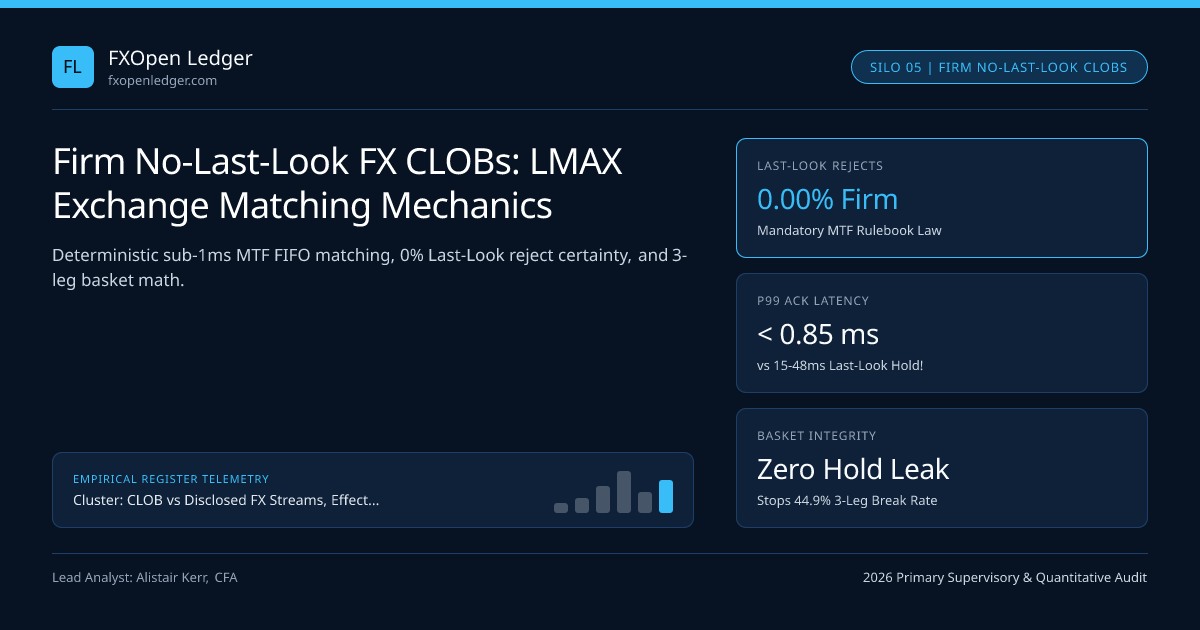
Ask a high-frequency quantitative FX desk what frustrates its execution algorithms most on legacy OTC aggregators, and the answer is immediate: Indeterminate Execution State During Last-Look Windows! When you send an Immediate-or-Cancel (IOC) order to a Last-Look dealer stream and wait 15 to 45 milliseconds only to receive a 35=8 ExecType=8 (Rejected) message after the market has already ticked 0.8 pips away, your algorithm suffers unhedged leg risk, stale signal alpha decay, and hidden adverse selection. Firm No-Last-Look Central Limit Order Books—pioneered in institutional spot FX by LMAX Exchange (operating FCA/CySEC-regulated Multilateral Trading Facilities and institutional matching engines in Equinix LD4, NY4, TY3, and SG1, alongside firm-only books on Cboe FX Firm and Euronext FX Firm)—eliminate Last-Look by architectural rule: every resting order in the matching engine is a legally binding, 100% firm limit order!
Connected to our CLOB vs Disclosed FX Streams & Slippage Guide, contrasted with primary interbank MQL CLOBs, and indexed inside the CLOB vs Disclosed Streams & Slippage Audit hub, auditing Firm-Only CLOB Mechanics reveals why deterministic fill certainty frequently beats tighter mirage quotes.
Architectural Rules of a Regulated Firm No-Last-Look FX MTF#
How does a regulated FX Multilateral Trading Facility (MTF) or institutional Firm CLOB guarantee zero Last-Look rejections without subjecting its bank and non-bank market makers (XTX, Citadel Securities, Jump, HC Tech, Virtu, Tier-1 Banks) to toxic ruin? Four deterministic exchange primitives govern the matching loop:
- Strict Pre-Trade Credit Gate (
< 50 Microseconds): Every limit and market order passes an in-memory Net Open Position (NOP) credit check before entering the central order-book ring buffer (Disruptorarchitecture)—so once matched, zero post-match credit or Last-Look veto exists! - Pure Price/Time FIFO Priority (
Zero Dealer Discretion): Makers cannot inspect takerClientIDbefore deciding whether to honor a fill; resting limit orders match strictly by best price, then microsecond arrival timestamp. - Sub-Millisecond Cancel/Replace Speed (
< 350–800 us): Because makers are never allowed a post-hit Last-Look hold window, the exchange gives makers ultra-low-jitter deterministic UDP multicast market data (ITCH) and binary/FIX order entry (OUCH / FIX 4.4) so makers update quotes proactively before stale hits arrive! - Symmetric Limit Price Improvement: Any marketable limit order crossing a better resting price fills immediately at the resting maker's better price, guaranteeing symmetric positive slippage!
Exact Triangular & Multi-Leg Execution Risk Formula: Firm CLOB vs Last-Look#
To appreciate why quantitative multi-leg strategies (Triangular FX Arbitrage, Cross-Venue Hedging, Portfolio Basket Rebalancing) pay explicit exchange fees to trade on Firm No-Last-Look CLOBs, compute the Expected Legging Slippage Loss on a 3-leg synthetic basket (EUR/USD + USD/JPY -> EUR/JPY) when each Last-Look leg carries rejection probability $p_{rej} = 18%$:
- ProbAtLeastOneOrphanedLeg = 1 - ( 1 - prej )^N
- ExpectedMultiLegRejectCostbps = Sum{i=1..N} [ preji * ( HoldTimeDriftbpsi + EmergencyUnwindHalfSpreadbps ) ]
- Worked 3-Leg Basket Execution Audit ($3,000,000 per leg across EUR/USD, USD/JPY, EUR/JPY):
- 1. Executing Across 3 Last-Look Streams (p_rej = 18% per leg, 25ms hold drift = 0.75 bps, emergency market unwind = 0.45 bps):
- Prob(All 3 Legs Fill Together) = (0.82)^3 = ONLY 55.14%!
- Prob(Broken / Orphaned Basket!) = 1 - 0.5514 = 44.86% (Nearly HALF of all 3-leg baskets break mid-flight!).
- Expected Broken-Leg Penalty = 3 * 0.18 * (0.75 + 0.45) = 0.648 bps ($194.40 deadweight loss per basket!).
- 2. Executing on Firm No-Last-Look CLOB (prejlast_look = 0.00%; IOC Limit with 0.3p protection against book movement):
- Zero 25ms hold-time information leakage; deterministic sub-1ms confirmation lets Leg 2/3 react in <1.2ms -> Saves ~0.52 bps/basket!
Comparing Firm CLOBs vs Last-Look Streams Across Strategy Profiles#
Does Firm No-Last-Look beat Disclosed Last-Look for every single trader? Not necessarily! Honest institutional GFXC Cover Sheet analysis across regulated venues (UK FCA, CySEC, ASIC) and institutional liquidity hubs (AMB Prime, ALB Prime, Climax Prime) highlights an exact specialization split:
| Client Flow Profile | Firm No-Last-Look CLOB (LMAX / Cboe Firm) | Disclosed Relationship Stream (Tailored ESP) | Winner & Microstructural Reason |
|---|---|---|---|
| Latency-Sensitive / Event Algo | 0% LL Reject, ~0.25p raw + comm | 35% - 65% LL Reject + stream widening! | Firm CLOB Wins Decisively (Certainty!) |
| Passive Resting Limit Maker | Earns Half-Spread directly inside book! | Cannot post passive bids on pure taker ESP! | Firm CLOB Wins (True two-way limit book!) |
| Multi-Leg Basket / Cross Hedger | Sub-1ms atomic IOC response; zero hold leak | High broken-leg risk during 20ms holds | Firm CLOB Wins (Eliminates leg hang) |
| Slow Corporate / Benign Asset Mgr | Pays public anonymous adverse-selection spread | Bank quotes 0.08p ultra-tight relationship skew! | Disclosed Stream Wins (Rewarded for low toxicity!) |
Why Anonymous Firm CLOBs Must Guard Order-to-Trade Ratios (OTR)#
Notice row 4 of our table above: because an anonymous Firm CLOB cannot discriminate against sharp takers after an order hits, its makers must price a modest adverse-selection cushion (~0.2–0.3 pips on Majors vs 0.08 pips on a curated benign corporate stream). To keep spreads razor-tight, MiFID II RTS 9 Order-to-Trade Ratio (OTR) governance penalizes excessive quote messaging spam while rewarding makers who maintain continuous top-of-book size and fast order-book depth resiliency.
Unlocking Passive Limit-Order Alpha on Institutional CLOBs#
Perhaps the biggest overlooked advantage of routing via FIX 4.4 to a true Firm CLOB over a taker-only retail bridge is Passive Liquidity Provision (Posting on the Bid or Offer): instead of crossing the spread and paying 0.25 pips as an aggressive taker, mean-reverting and execution-slicing (TWAP / Pegged) algorithms post resting Post-Only limit orders inside the CLOB—earning +0.12 to +0.20 pips of spread capture instead of paying it!
Frequently asked questions
Can an order ever fail to fill on a Firm No-Last-Look CLOB like LMAX Exchange?
A limit or IOC order only goes unfilled (or partially filled) if another participant genuinely beat your packet in strict microsecond FIFO order and consumed the resting liquidity first—never because a dealer held your order and vetoed the trade!
How is an FCA or EU Multilateral Trading Facility (MTF) different from a standard FX ECN?
An MTF is a statutory regulated trading venue under MiFID II / UK MiFIR with a transparent public rulebook, non-discretionary FIFO matching rules, mandatory MiFID RTS 9 order-to-trade ratios, and regulatory market-abuse surveillance.
Why are top-of-book spreads sometimes 0.1-0.2 pips wider on an anonymous Firm CLOB than on a disclosed Last-Look feed?
On a disclosed Last-Look feed, the dealer sees your identity and retains a millisecond option to reject toxic hits; on an anonymous Firm CLOB, makers stand 100% firm against all takers and price that certainty honestly upfront.
Where are Firm FX CLOB matching engines physically hosted?
Institutional Firm FX CLOBs run regional matching engines inside Equinix LD4 (Slough/London for European pairs), Equinix NY4 (Secaucus/New York for Americas), Equinix TY3 (Tokyo for JPY/Asian), and Equinix SG1 (Singapore).
Publication record
- Published
- 13 November 2026
- Updated
- 14 November 2026
- Author
- Alistair Kerr, CFA
- Review
- Review not recorded
- Automated fact check
- Passed in the stored pipeline record
- Source URLs
- 3 recorded
AI assistance recorded: anthropic/claude-opus-4.6. This field does not establish human review or source verification.
Academic & Institutional Attribution
Cite This Research & Embed Live Data Card
Standard academic & institutional research paper citation format.
Alistair Kerr, CFA. (2026, November 14). Firm No-Last-Look FX CLOBs: LMAX Exchange Matching Mechanics. FXOpen Ledger. https://fxopenledger.com/orderbook/firm-no-last-look-clob-venues-lmax-exchange-execution-mechanicsRegulatory Directory Cross-Reference
Referenced Institutions & Regulatory Registries
Top Regulated Institutions in This Coverage Slice
Referenced Supervisory Authorities
Related Lmax Ebs Ecn Spread Slippage Audit & Institutional Briefings
Explore Lmax Ebs Ecn Spread Slippage Audit Hub (20) →Lmax Ebs Ecn Spread Slippage Audit
CLOB vs Disclosed FX Streams, Effective Spread & News Slippage GuideLmax Ebs Ecn Spread Slippage Audit
Top-of-Book Zero-Spread Illusion vs $10M Sweep VWAP DepthLmax Ebs Ecn Spread Slippage Audit
Symmetric Positive Slippage vs Asymmetric Dealer Limit FillsLmax Ebs Ecn Spread Slippage Audit
US Nonfarm Payrolls & CPI Liquidity Withdrawal: FX Spread AuditLmax Ebs Ecn Spread Slippage Audit
Order-Book Depth Resiliency Half-Life After FX Rate ShocksLmax Ebs Ecn Spread Slippage Audit
Stop-Loss Cascade Slippage Through Thin Air Pockets in GBP/JPYLmax Ebs Ecn Spread Slippage Audit
Randomized Latency Floors & Batching on Primary FX CLOBsLmax Ebs Ecn Spread Slippage Audit
Hidden Iceberg Orders vs Displayed Limit Liquidity on FX ECNsPrivate Equity
TLG Capital launches Ghana's first local-currency private credit fund - DealroomInvestment Strategies
Nomura, Aventus launch JV to offer investors access to opportunities across securitized products and private credit - FX News GroupMarket Insights
Goldman Sachs: Private credit GPs expect liquidity relief in 2027–28 - Alternatives WatchMonetary Policy
Bank of England’s inflation response ‘risks higher interest rates for longer’ - Forex Factory
FXOpen Ledger Data, Benchmarks & Contributor Records
CC BY 4.0 Open Data
Open Institutional Datasets (CSV / JSON) →
Download desk-compiled quantitative series & schemas.
2026 Reference Matrix
2026 Institutional Benchmarks & Thresholds →
Statutory capital, clearing, margin & rate conventions.
Editorial Records
Authors & Review Records →
View named contributors where those records are available.
Complete Index
Master Research & Dossier Archive →
Browse all published briefings by topic pillar & date.