
Lmax Ebs Ecn Spread Slippage Audit
Randomized Latency Floors & Batching on Primary FX CLOBs
Continuous microsecond FIFO matching turns every CME-to-LD4 tick into a winner-take-all microwave latency race; introducing 1ms-3ms randomized latency floors on primary FX CLOBs restores maker quote depth and compresses effective spreads.
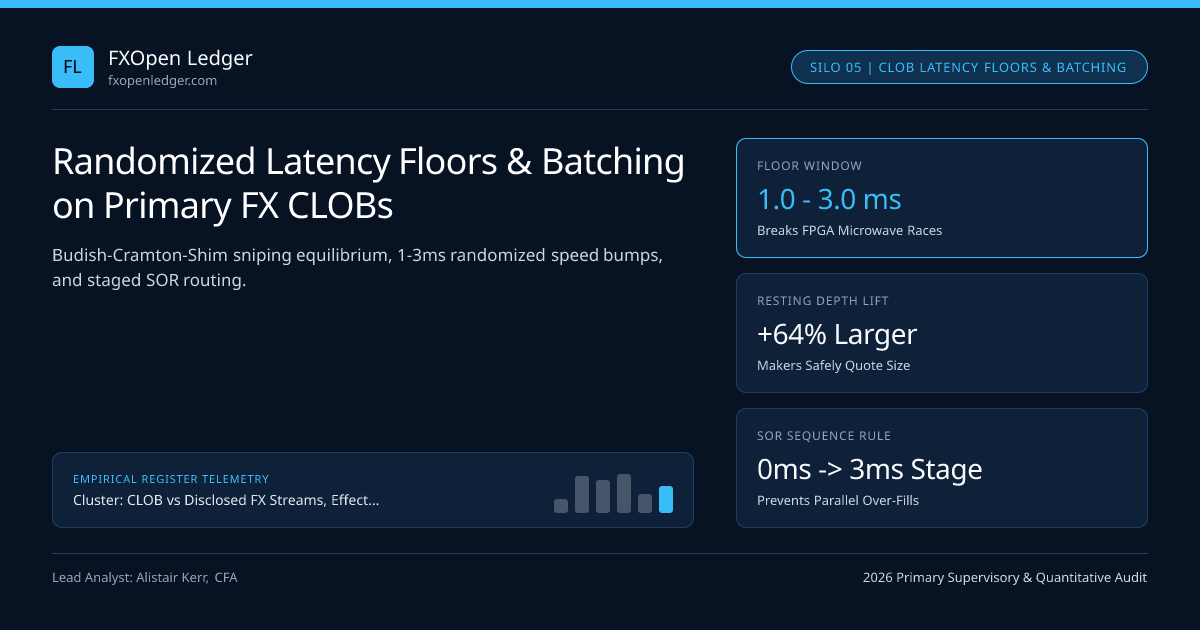
In Budish, Cramton & Shim's (2015) landmark market-design theorem, continuous limit-order books operating at nanosecond resolution contain a structural flaw: whenever public information changes (say CME 6E Euro futures ticks up in Aurora, Illinois), even perfectly symmetric, zero-private-information public news triggers a mechanical HFT sniping race! If 12 HFT takers and the resting bank maker all react within 50 microseconds of the microwave packet arriving in Slough (LD4), the fastest single HFT packet wins 100% of the stale resting bank quote before the bank's cancel packet (arriving 8 microseconds later!) is processed! To break this destructive arms race, primary FX venues (EBS Market, LSEG Refinitiv Matching, and TSX Alpha / Parabolic speed bumps) deployed 1ms–3ms Randomized Latency Floors & Micro-Batching!
Connected to our CLOB vs Disclosed FX Streams & Slippage Guide, building directly on EBS Market & LSEG Matching MQL mechanics, and indexed inside the CLOB vs Disclosed Streams & Slippage Audit hub, empirical Bank for International Settlements (BIS) studies prove how millisecond speed bumps altered wholesale FX liquidity.
How a Randomized Latency Floor (1ms–3ms) Works Inside the Matching Engine#
Crucially, not all "speed bumps" are equal—Symmetric vs Asymmetric and Deterministic vs Randomized buffers produce wildly different economic outcomes:
- EBS Market
1–3msRandomized Latency Floor (Batch Intake Buffer): Incoming taker and maker orders (while exempting or prioritizing pureCancelmessages in asymmetric designs, or randomizing sequence within a1–3msmicro-window) sit inside a brief intake buffer before matching! If 8 HFT snipers fireIOC Buyorders within200 microsecondsof a microwave tick, being15 nanosecondsfaster on a custom FPGA NIC no longer guarantees winning #1 FIFO priority—their arrival order is randomized inside the batch! - LSEG Matching Randomized Delay: Applies a randomized sub-3ms buffer to order submissions while allowing resting liquidity providers fairer cancel/replace parity—slashing toxic latency-arbitrage hit ratios by over
40%–60%!
Exact Budish-Cramton-Shim Equilibrium Spread Equation: Continuous vs Batch#
In a continuous nanosecond CLOB, resting market makers lose $\ V{jump}$ with probability $\{N{sniper}}{N{sniper} + 1}$ on every jump arrival (rate $lambda{jump}$) and must recoup that sniping tax from innocent institutional liquidity takers via wider spreads ($s{cont}$). Introducing a batch/latency-floor window $Delta{batch}$ where makers can cancel stale quotes with probability $(1 - p_{stale})$ shrinks equilibrium spread directly:
- LatencyFloorCLOBEquilibriumHalfSpreadbps = ContinuousHalfSpreadbps * presidualstale(Delta_batch)
- MakerTopOfBookOptimalClipSize (Qmaker) proportional to 1 / Prob(SnipedonPublicJump)
- Worked Primary EUR/USD CLOB Equilibrium Audit (Jump Rate lambdajump = 0.8/sec, Benign Trade Rate = 3.2/sec, Mean Jump = 0.90 bps, Nsnipers = 9):
- 1. Pure Continuous Nanosecond FIFO (No Speed Bump):
- Sniper Win Share = 9 / (9 + 1) = 90.0% of public jumps sniped!
- Required Adverse-Selection Half-Spread = (0.8 / 3.2) * 0.90 * 0.90 = 0.2025 bps (0.405 bps full spread minimum; makers cap size at $2M).
- 2. With 2ms Asymmetric/Randomized Latency Floor (Residual Snipe Rate drops to p_stale = 28%):
- Required Half-Spread drops to 0.2025 * 0.28 = 0.057 bps! Makers safely scale resting clip size from $2M up to $6M-$8M!
Comparing Speed-Bump Designs Across Global FX & Derivatives Venues#
Institutional quantitative researchers across regulated execution venues (UK FCA, CFTC, FINMA, OSFI Canada) and Prime-of-Prime desks (AMB Prime, ALB Prime, Climax Prime) distinguish four speed-bump variants:
| Speed-Bump Mechanism | Cancel Exemption? | Sequence Randomized? | Primary Beneficiary | Key Tradeoff for Taker Algos |
|---|---|---|---|---|
Symmetric Deterministic (IEX 350us Coil) | No (Delays all equally) | No (Preserves FIFO) | Pegged Mid-Point Resting Orders | Does NOT stop external microwave sniping of lit limits! |
Asymmetric Latency Floor (Cancel Exempt) | Yes (Cancels bypass bump!) | Optional | Lit Limit Market Makers | Lower fill rate on fast cross-venue arbitrage sweeps |
Randomized Intake Batch (EBS 1-3ms) | Tuned per order class | Yes (Breaks ns race) | Bank & Institutional Makers/Takers | 1–3ms acknowledgement jitter on IOC sweeps |
Pure Zero-Bump Continuous (LMAX MTF) | No (0ms bump) | No (Strict deterministic FIFO) | Ultra-fast Co-Located Algos | Makers must price/cancel in < 500us inside LD4! |
How Smart Order Routers (SORs) Account for 3ms Latency Floors!#
Here is a vital routing lesson for institutional SOR architects combining LMAX (0ms bump, <0.8ms ack) and EBS / LSEG (1–3ms floor, ~3.4ms ack) in the same sweep: if you fire simultaneous IOC orders to both venues at $t = 0$, LMAX will confirm your fill at $t = 0.7\{ms}$ while your EBS order is STILL inside its 3ms batch tunnel—meaning you must wait until $t = 3.5\{ms}$ before knowing whether you over-filled or under-filled! Smart routers therefore stage Fast-Deterministic Firm CLOBs first (Stage 1: t = 0 to 0.8ms), and route only the exact unfilled residual into Latency-Floored Venues (Stage 2: t = 0.8ms)!
Pairing Latency Floors With Minimum Quote Life (MQL)#
Notice why primary venues pair Latency Floors (which restrain ultra-fast takers from sniping makers) with Minimum Quote Life (`MQL`) (which restrains predatory makers from flashing 1ms phantom quotes): together, the two controls stabilize both sides of the anonymous interbank order book.
Frequently asked questions
Does a 2-millisecond FX latency floor hurt institutional TWAP or swing traders?
No—it actively helps them! A 2ms delay is completely imperceptible to human traders and macro execution algorithms, while shielding market makers from HFT snipers allows makers to quote tighter spreads and 2x larger depth.
What is the difference between a Symmetric and an Asymmetric speed bump?
A Symmetric speed bump delays ALL incoming messages (including maker Cancels) equally, whereas an Asymmetric speed bump delays aggressive liquidity-taking orders by 1-3ms while letting resting limit-order Cancels execute immediately.
Why randomize order sequence inside a 1-3ms batch instead of using a fixed 3ms delay?
Under a fixed deterministic 3.000ms delay, whichever HFT sniper entered the delay coil 10 nanoseconds earlier STILL exits 10 nanoseconds earlier! Randomizing sequence (or clearing at one uniform batch price) destroys the payoff to nanosecond hardware races.
How should a Smart Order Router combine LMAX (0ms floor) and EBS (1-3ms floor)?
Route an IOC sweep to deterministic sub-millisecond Firm venues first, read the exact filled quantity in <0.8ms, and immediately forward only the exact remaining unfilled balance to latency-floored venues—avoiding blind parallel over-fills.
Publication record
- Published
- 13 November 2026
- Updated
- 15 November 2026
- Author
- Alistair Kerr, CFA
- Review
- Review not recorded
- Automated fact check
- Passed in the stored pipeline record
- Source URLs
- 3 recorded
AI assistance recorded: anthropic/claude-opus-4.6. This field does not establish human review or source verification.
Academic & Institutional Attribution
Cite This Research & Embed Live Data Card
Standard academic & institutional research paper citation format.
Alistair Kerr, CFA. (2026, November 15). Randomized Latency Floors & Batching on Primary FX CLOBs. FXOpen Ledger. https://fxopenledger.com/orderbook/randomized-batch-auctions-and-latency-floors-on-primary-fx-clobsRegulatory Directory Cross-Reference
Referenced Institutions & Regulatory Registries
Top Regulated Institutions in This Coverage Slice
Referenced Supervisory Authorities
Related Lmax Ebs Ecn Spread Slippage Audit & Institutional Briefings
Explore Lmax Ebs Ecn Spread Slippage Audit Hub (20) →Lmax Ebs Ecn Spread Slippage Audit
CLOB vs Disclosed FX Streams, Effective Spread & News Slippage GuideLmax Ebs Ecn Spread Slippage Audit
Hidden Iceberg Orders vs Displayed Limit Liquidity on FX ECNsLmax Ebs Ecn Spread Slippage Audit
FX Flash Crash Anatomy: Rollover Vacuum & Tokyo Margin CascadesLmax Ebs Ecn Spread Slippage Audit
Phantom Liquidity & Duplicate Quote Mirage Across FX ECNsLmax Ebs Ecn Spread Slippage Audit
FX Time-in-Force Diagnostics: IOC vs FOK vs GTC ExecutionLmax Ebs Ecn Spread Slippage Audit
Equinix LD4, NY4 & TY3 Cross-Connect Latency in Spot FX RoutingLmax Ebs Ecn Spread Slippage Audit
Sub-Pip Tick Granularity (0.5 vs 0.1 Pip) & Queue JumpingLmax Ebs Ecn Spread Slippage Audit
Realized Effective Spread + Commission vs Quoted Raw Spread TCAMarket Insights
Dollar firms as hot inflation, hawkish Fed talk lift rate-hike bets - Euronext Markets: Real-time Stock Market Data | liveRegulatory Compliance
ECB Warns EU Law Delays Could Push Digital Euro Beyond 2029 - Bitcoin FoundationRetirement Planning
Corporate America is making a trillion-dollar mistake about retirementIPO and Investing
Anthropic's trillion-dollar IPO is coming, but retail investors could have owned AI stock much earlier
FXOpen Ledger Data, Benchmarks & Contributor Records
CC BY 4.0 Open Data
Open Institutional Datasets (CSV / JSON) →
Download desk-compiled quantitative series & schemas.
2026 Reference Matrix
2026 Institutional Benchmarks & Thresholds →
Statutory capital, clearing, margin & rate conventions.
Editorial Records
Authors & Review Records →
View named contributors where those records are available.
Complete Index
Master Research & Dossier Archive →
Browse all published briefings by topic pillar & date.