
Lmax Ebs Ecn Spread Slippage Audit
Sub-Pip Tick Granularity (0.5 vs 0.1 Pip) & Queue Jumping
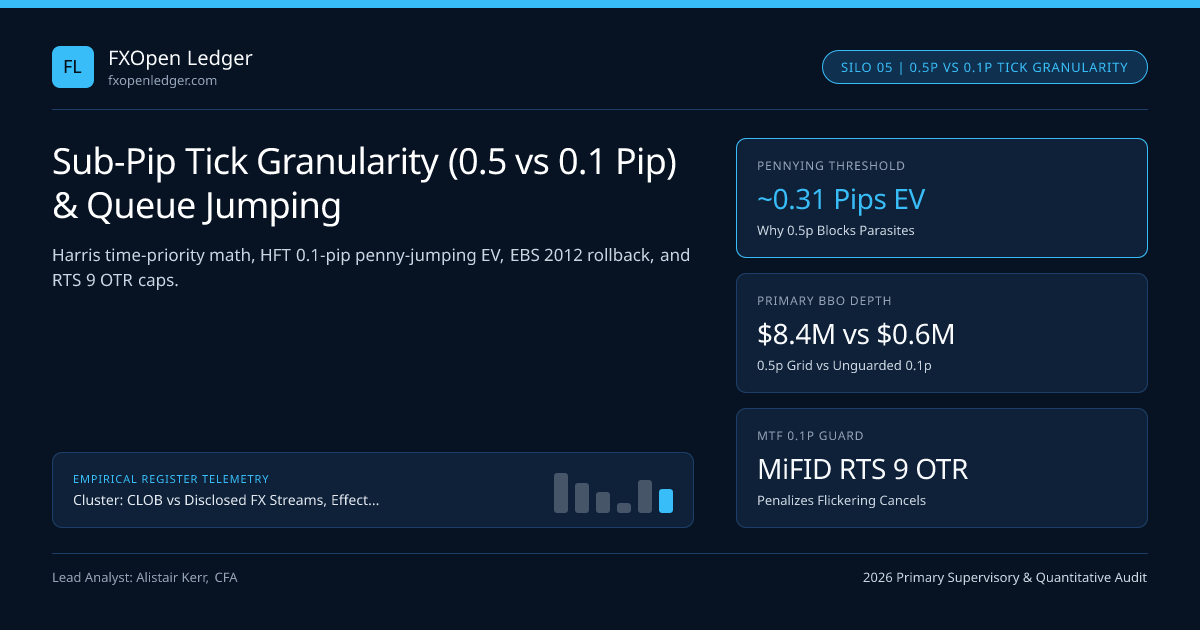
Shrinking minimum FX tick increments from 0.5 pips to 0.1 pips slashes the cost of stepping ahead of a resting $10M institutional bid by 80%—eroding FIFO time priority unless paired with disclosed relationship filtering or MiFID RTS 9 OTR caps.
At first glance, finer price granularity always sounds better for investors: shouldn't quoting EUR/USD to the fifth decimal place (0.00001 = 0.1 pips = $1.00 per lot) always produce tighter spreads than quoting in half-pip (0.00005 = 0.5 pips) increments? Yet when EBS Market cut EUR/USD and USD/JPY tick sizes from 0.5 pips down to 0.1 pips in March 2011, displayed interbank liquidity deteriorated so severely that EBS reversed decimalization back to 0.5 pips eighteen months later—and CME Group's flagship 6E Euro FX Futures likewise preserve a 0.5-pip ($6.25/contract) outright tick size! Understanding Larry Harris's Time-Priority Insurance Theorem explains why 0.1-pip fractional ticks work brilliantly on curated bilateral streams yet unleash Predatory Queue-Jumping ("Pennying") on unguarded anonymous CLOBs.
Anchored in our CLOB vs Disclosed FX Streams & Slippage Guide, extending EBS Market & LSEG Matching primary CLOB rules, and indexed inside the CLOB vs Disclosed Streams & Slippage Audit hub, tick-grid design dictates resting limit-order profitability.
Mechanics of Predatory 0.1-Pip Queue Jumping ("Sub-Pip Pennying")#
Watch what happens to a Tier-1 bank or institutional buy-side desk posting a patient $10,000,000 Buy Limit @ 1.08500 on an anonymous 0.1-pip CLOB:
- The Resting Institutional Anchor (
1.08500): By displaying$10Mfirm at1.08500, the bank provides a massive Free Downside Put Option to any HFT parasite! - The Parasitic
$1MStep-Ahead (1.08501— Costing Just0.1 Pips = $100!): Seeing$10Mof solid buy support directly underneath at1.08500, an HFT algorithm immediately posts$1Mat1.08501(stealing #1 price priority across the entire market for just 1 tenth of a pip!).
- If Spot Rallies: The HFT captures the incoming seller at
1.08501and profits+1.2 pipswhile the patient$10Mbank bid at1.08500gets zero fill! - If Seller Aggresses Size: As soon as
$7Mof the$10Mcushion at1.08500starts getting eaten, the HFT dumps its$1Minventory straight into the remaining$3Mbank bid at1.08500—capping its maximum loss at-0.1 pips (-$100)!
Exact Parasitic Queue-Jumping Expected-Value (EV) Threshold Formula#
Let $Delta{tick}$ denote the venue's minimum price increment, $alpha{up}$ the conditional expected upside gain when passive fill mean-reverts favorably, and $p{win}$ the probability that incoming flow bounces off the $10M wall rather than breaking through it. Parasitic pennying is profitable whenever $Delta{tick}$ falls below the *Critical Anti-Pennying Tick Floor ($Delta_{tick}^$)**!
- CriticalMinimumTickSizeToBlockPennying (Deltatickstar):
- Deltatickstar > pwin * UpsideMeanReversionPips - ( 1 - pwin ) * VenueFeesPips
- Worked Tick-Grid Stability Audit on Anonymous EUR/USD CLOB (p_win = 0.42 leaning on >= $8M wall; Upside = 0.85 pips; Round-Turn Venue Fee = 0.08 pips):
- 1. Critical Tick Threshold (Delta_tick*):
- Delta_tick* = 0.42 * 0.85 - 0.58 * 0.08 = 0.357 - 0.046 = 0.311 PIPS!
- 2. Testing 0.1-Pip Grid vs 0.5-Pip Grid:
- Under 0.1-Pip Tick (0.10p < 0.311p!): Parasite EV = +0.211 pips/trade (HIGHLY PROFITABLE -> HFTs relentlessly penny every visible >= $5M order!).
- Under 0.5-Pip Tick (0.50p > 0.311p!): Parasite EV = -0.189 pips/trade (STRICTLY UNPROFITABLE -> Parasites vanish; banks display $10M+ openly!).
Where 0.1-Pip Ticks Succeed vs Where 0.5-Pip / 0.25-Pip Grids Prevail#
Why can disclosed ECN streams, Prime-of-Prime bridges (AMB Prime, ALB Prime, Climax Prime), and MTF CLOBs regulated under UK FCA and ESMA MiFID II RTS 9 quote 0.1-pip fractional pricing cleanly without collapsing? Compare how each venue prevents parasitic leaning:
| Venue / Stream Type | Standard Tick Grid | How It Defends Against Pennying | Optimal Strategy Fit |
|---|---|---|---|
CME EBS Market / 6E Outright | 0.5 pip (0.25p select) | Coarse tick grid + Minimum Quote Life + Latency Floor | $5M–$50M anonymous resting bank liquidity |
CME 6E Calendar Roll Spreads | 0.1 pip (0.00001)! | Low directional volatility on M1-M2 interest differential | Quarterly FX futures roll execution |
Firm MTF CLOB (LMAX Exchange) | 0.1 pip | Strict MiFID RTS 9 OTR penalties + curated maker governance | Sub-millisecond $100k–$5M institutional clips |
Disclosed Stream (FXSpotStream / PoP) | 0.1 pip (or 0.01p VWAP) | Bilateral (1-to-1): No public order book for parasites to read! | Tailored relationship & retail bridge feeds |
Beware "5-Digit Pipette Confusion" in Retail Expert Advisors (Point vs Pip)!#
On a practical coding level across MT4, MT5, and cTrader accounts at regulated dealers (City Index, 4XC, Blue Suisse), 99% of modern retail feeds stream 5-decimal (EUR/USD 1.08504) / 3-decimal (USD/JPY 152.345) fractional quotes ("pipettes"). Hardcoding Slippage = 3 in legacy MQL4/MQL5 Point units sets your maximum deviation to 0.3 pips instead of 3.0 pips—causing silent rejection spikes until multiplied by 10!
Tactical Defense on 0.1-Pip CLOBs: Never Expose Your Full Anchor!#
Whenever you post passive liquidity on a 0.1-pip anonymous ECN, never expose a static $10M bid for parasites to lean against—combine randomized synthetic Iceberg slicing (displaying $800k–$1.4M) with an automated Anti-Pennying Cancel Trigger that pulls your resting bid immediately if top-of-book volume ahead of you swells without filling!
Frequently asked questions
What is "Penny-Jumping" (or Queue-Jumping) in electronic FX order books?
Penny-jumping occurs when a fast trader detects a large resting limit order (e.g. $10M Bid at 1.08500) and posts a small Bid 0.1 pips higher at 1.08501—stealing first execution priority on rebounds while using the $10M bid below as a cheap -0.1-pip stop-loss cushion.
Why did EBS Market switch EUR/USD back from 0.1-pip ticks to 0.5-pip ticks in 2012?
After decimalizing to 0.1-pip ticks in March 2011, predatory HFT penny-jumping caused traditional bank market makers to pull displayed size; restoring 0.5-pip ticks made queue-jumping 5x costlier and rebuilt multi-million-dollar resting depth.
Why can disclosed FX streams quote 0.1-pip spreads safely without penny-jumping?
On a disclosed 1-to-1 relationship stream, the Liquidity Provider streams private executable prices directly to one specific client—no third-party HFT sees a public limit queue to step ahead of.
What is the difference between a Pip and a Fractional Pipette on 5-digit trading platforms?
On EUR/USD, 1 standard Pip is the 4th decimal place (0.0001 = $10 per standard lot), whereas 1 Fractional Pipette (Point) is the 5th decimal place (0.00001 = 0.1 pips = $1 per standard lot).
Publication record
- Published
- 13 November 2026
- Updated
- 15 November 2026
- Author
- Alistair Kerr, CFA
- Review
- Review not recorded
- Automated fact check
- Passed in the stored pipeline record
- Source URLs
- 3 recorded
AI assistance recorded: anthropic/claude-opus-4.6. This field does not establish human review or source verification.
Academic & Institutional Attribution
Cite This Research & Embed Live Data Card
Standard academic & institutional research paper citation format.
Alistair Kerr, CFA. (2026, November 15). Sub-Pip Tick Granularity (0.5 vs 0.1 Pip) & Queue Jumping. FXOpen Ledger. https://fxopenledger.com/orderbook/fractional-pip-tenth-pip-tick-granularity-and-queue-jumpingRegulatory Directory Cross-Reference
Referenced Institutions & Regulatory Registries
Mentioned Regulated Institutions
Referenced Supervisory Authorities
Related Lmax Ebs Ecn Spread Slippage Audit & Institutional Briefings
Explore Lmax Ebs Ecn Spread Slippage Audit Hub (20) →Lmax Ebs Ecn Spread Slippage Audit
CLOB vs Disclosed FX Streams, Effective Spread & News Slippage GuideLmax Ebs Ecn Spread Slippage Audit
Realized Effective Spread + Commission vs Quoted Raw Spread TCALmax Ebs Ecn Spread Slippage Audit
Sunday 17:00 NY Open Gap Slippage & Stop-Out Execution RulesLmax Ebs Ecn Spread Slippage Audit
Dark Mid-Point FX Matching Pools: Fill Rates vs Adverse SelectionLmax Ebs Ecn Spread Slippage Audit
FIX 4.4 & cTrader API vs MetaTrader Tick Throttling Under LoadLmax Ebs Ecn Spread Slippage Audit
Independent Post-Trade FX Slippage Forensics Using Tick FeedsLmax Ebs Ecn Spread Slippage Audit
Primary FX CLOBs: EBS Market, LSEG Matching & Minimum Quote LifeLmax Ebs Ecn Spread Slippage Audit
Firm No-Last-Look FX CLOBs: LMAX Exchange Matching MechanicsMarket Insights
Asian stocks steady as AI, Mideast jitters recede; dollar firm on Fed betsMarket Insights
US dollar holds onto payrolls gains, NZ dollar rises after electionMarket Insights
WSJ Dollar Index Rises 0.23% to 97.22Market Insights
WSJ Dollar Index Falls 0.30% to 96.94
FXOpen Ledger Data, Benchmarks & Contributor Records
CC BY 4.0 Open Data
Open Institutional Datasets (CSV / JSON) →
Download desk-compiled quantitative series & schemas.
2026 Reference Matrix
2026 Institutional Benchmarks & Thresholds →
Statutory capital, clearing, margin & rate conventions.
Editorial Records
Authors & Review Records →
View named contributors where those records are available.
Complete Index
Master Research & Dossier Archive →
Browse all published briefings by topic pillar & date.