
Lmax Ebs Ecn Spread Slippage Audit
Hidden Iceberg Orders vs Displayed Limit Liquidity on FX ECNs
Posting a visible $25M EUR/USD bid on a lit CLOB telegraphs buying pressure and pushes spot away; Iceberg reserve orders mask parent size via FIX Tag 111 (MaxFloor), but naive fixed-size reloads leak clear HFT footprints.
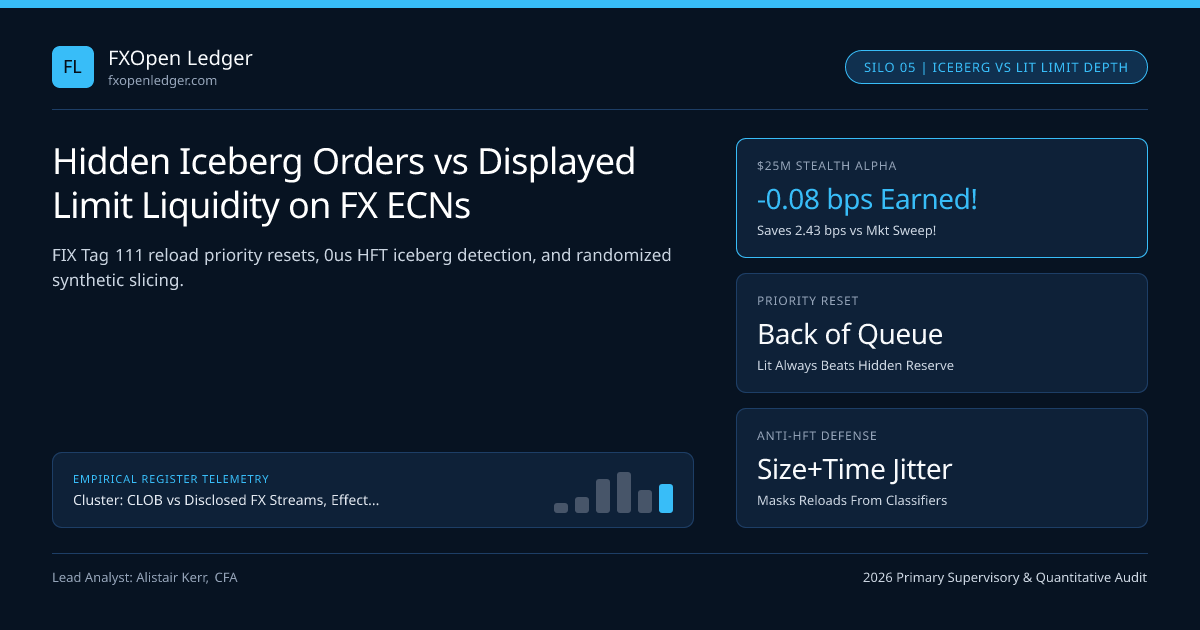
Suppose a sovereign wealth fund or corporate treasury needs to buy EUR 50,000,000 passively at 1.08400 on a lit FX Central Limit Order Book (EBS Market, LSEG Matching, or LMAX Exchange). If the trader posts a fully displayed EUR 50M Bid at 1.08400, every HFT order-book-imbalance (OBI) model across Equinix LD4 and NY4 instantly sees a 10:1 buy-side wall—jumping 0.1 or 0.5 pips ahead to 1.08405 so the EUR 50M bid never gets filled until spot rallies 15 pips without them! Conversely, using a Native ECN Iceberg Order (FIX Tag 111 MaxFloor = 1,000,000) displays only EUR 1M publicly while holding EUR 49M hidden in reserve—yet naive fixed-1M Icebergs get unmasked within 3 reloads by HFT Iceberg Detectors!
Anchored in our CLOB vs Disclosed FX Streams & Slippage Guide, paired with dark mid-point matching pools, and indexed inside the CLOB vs Disclosed Streams & Slippage Audit hub, mastering Queue-Priority Reload Rules & Randomized Iceberg Synthetic Slicing protects block alpha.
Two Microstructural Rules Every ECN Iceberg User Must Know#
How does an exchange matching engine treat the EUR 49M hidden reserve relative to other traders' displayed orders at the exact same 1.08400 price level?
- Displayed-Before-Hidden Queue Priority (
Time-Priority Reset on Every Reload!): Across every regulated MTF and interbank CLOB, displayed liquidity ALWAYS outranks hidden reserve liquidity at the same price! When your visibleEUR 1Mtip (#1 in FIFO) is completely filled, your nextEUR 1Mreload slice is stamped with a brand-new timestamp and placed at the BACK of the1.08400displayed queue behind all existing lit bidders! - The
0.000msReload Footprint (How HFTs Spot Native Exchange Icebergs!): When a native exchange Iceberg (FIX Tag 111) reloads, the matching engine emits the Trade Fill message AND the new1.0MBid Add message inside the EXACT SAME atomic UDP multicast packet (delta_t = 0 microseconds)! HFT parsers flag any0usidentical-size reload atp = 99.9%certainty as a native Iceberg—and immediately step ahead of it!
Exact Optimal Iceberg Peak-Size ($q_{tip}^*$) Optimization Formula#
Choosing your displayed tip size $q_{tip}$ involves a classic Queue-Capture vs Information-Leakage tradeoff:
- Make $q_{tip}$ too small (
e.g. $100kon a$20Morder =200 reloads): every reload drops to the back of a$6Mlit queue—causing Queue Starvation (you capture < 2% of incoming sell volume and miss the move!). - Make $q{tip}$ too large (
e.g. $10Mvisible): **Order-Book Imbalance ($\{OBI} = \{V{bid} - V{ask}}{V{bid} + V_{ask}}$)** spikes above+0.65, pushing micro-price upward by $\ \ \{OBI}$ before sellers hit you!
- ExpectedQueueFillSharePerCycle = qtip / ( qtip + VLitCompetitorsAt_Price )
- OptimalDisplayedPeakSize (qtipstar) = sqrt( ( VLitCompetitors * AdverseDriftIfUnfilledbps ) / OBISignalingSensitivitybpsperM )
- Worked EUR 25,000,000 Passive Execution Audit on EUR/USD (Average Competing Lit Bid Queue V_Lit = EUR 3.5M; Drift Risk = 1.4 bps; OBI Sensitivity = 0.28 bps/M):
- 1. Optimal Mean Tip Size (q_tip*):
- Unconstrained q_tip* = sqrt( (3.5 * 1.4) / 0.28 ) = EUR 4.18M, which against a EUR 3.5M Ask would push OBI above +0.38.
- Capping OBI impact at <= +0.20 sets practical institutional tip band at EUR 1.0M - 1.8M (Randomized Uniform[0.9M, 1.7M] per slice!), capturing ~27% of queue turnover while keeping OBI inconspicuous!
- 2. Result vs Fully Displayed EUR 25M Wall:
- Lit 25M Wall: OBI spikes to +0.78 -> Spot jumps +2.1 pips away; only 14% filled before breakout -> Implementation Shortfall = -1.85 bps.
- Jittered Synthetic Iceberg (0.9M-1.7M tips, 120-450ms reload jitter): 92% filled passively @ 1.08400 -> Implementation Shortfall = +0.08 bps (EARNS spread!).
Comparing Native Exchange Icebergs, Synthetic Slicers & Hidden Orders#
Institutional execution desks connecting via FIX 4.4 across Prime-of-Prime venues (AMB Prime, ALB Prime, Climax Prime) regulated by ESMA (MiFID II Article 4 pre-trade transparency waivers) and the UK FCA choose between four passive block tools:
| Order Mechanism | Pre-Trade Visibility | Queue Priority at Rung | HFT Detection Vulnerability | Best Institutional Use Case |
|---|---|---|---|---|
| 100% Displayed Limit | 100% Visible | #1 Full Size Priority! | Zero ambiguity—moves OBI immediately! | Clips <= $2M in deep Majors |
Native ECN Iceberg (Tag 111) | Tip Visible (>= EUR 10k MiFID) | Tip FIFO; Reserve goes to back | High (0us deterministic reload!) | Fast breakouts needing instant reload |
| Synthetic Client-Side Iceberg | Jittered Tip Visible | Each child enters fresh FIFO | Very Low (Random size + 150ms jitter) | $10M–$100M Institutional Accumulation |
| 100% Hidden / Mid-Pegged | 0% Visible (Dark) | Lowest (Behind all lit quotes) | Zero book footprint (Watch post-trade!) | Crossing quietly at Mid-Point (0.0p) |
MiFID II Minimum Iceberg Peak Size (>= EUR 10,000) & OTR Rules#
Under MiFID II RTS 1 / RTS 2 (Order Management Facility Waiver) across EU and UK Multilateral Trading Facilities, reserve/iceberg orders are legally required to maintain a minimum initial order threshold (>= EUR 10,000 equivalent) so micro-lot HFTs cannot abuse hidden order books with EUR 100 dust tips!
Engineering Checklist for Client-Side Synthetic Iceberg Slicers#
To upgrade from a naive exchange Tag 111 Iceberg to an institutional Stealth Synthetic Iceberg inside your execution EMS: (1) sample each displayed child size from a continuous truncated log-normal distribution (e.g. $0.83M, $1.41M, $1.07M—never round $1.00M integers!), (2) inject a randomized 80ms–450ms reload pause calibrated to venue depth resiliency, and (3) rest 30% of parent notional simultaneously inside a dark mid-point matching pool to harvest zero-spread blocks opportunistically.
Frequently asked questions
Does the hidden portion of an Iceberg order keep my original time priority in the order book?
No! Only the currently visible tip holds its FIFO timestamp. The moment that visible tip fills completely and a new tip reloads from your hidden reserve, the new tip goes to the back of the displayed queue at that price level.
How do high-frequency trading algorithms detect native exchange Iceberg orders?
When a seller hits a $1M displayed bid and a new $1M bid reappears at the exact same price inside the exact same 0-microsecond exchange multicast packet three times in a row, HFT tape readers mathematically confirm a native Tag 111 Iceberg.
What happens if I set my Iceberg visible tip size way too small (e.g., 1% of the book)?
You suffer Queue Starvation: because every tiny reload drops to the back of a multi-million-dollar lit queue, competing full-size limit orders absorb 98% of incoming flow while your parent order sits largely unfilled.
Why does MiFID II require a minimum EUR 10,000 size on Iceberg orders on European MTFs?
Under MiFID II Order Management Facility pre-trade transparency rules, regulators require reserve orders to exceed EUR 10,000 so algorithmic traders cannot obscure ordinary small orders from public price discovery.
Publication record
- Published
- 13 November 2026
- Updated
- 15 November 2026
- Author
- Alistair Kerr, CFA
- Review
- Review not recorded
- Automated fact check
- Passed in the stored pipeline record
- Source URLs
- 3 recorded
AI assistance recorded: anthropic/claude-opus-4.6. This field does not establish human review or source verification.
Academic & Institutional Attribution
Cite This Research & Embed Live Data Card
Standard academic & institutional research paper citation format.
Alistair Kerr, CFA. (2026, November 15). Hidden Iceberg Orders vs Displayed Limit Liquidity on FX ECNs. FXOpen Ledger. https://fxopenledger.com/orderbook/hidden-iceberg-orders-vs-displayed-limit-liquidity-on-fx-ecnsRegulatory Directory Cross-Reference
Referenced Institutions & Regulatory Registries
Top Regulated Institutions in This Coverage Slice
Referenced Supervisory Authorities
Related Lmax Ebs Ecn Spread Slippage Audit & Institutional Briefings
Explore Lmax Ebs Ecn Spread Slippage Audit Hub (20) →Lmax Ebs Ecn Spread Slippage Audit
CLOB vs Disclosed FX Streams, Effective Spread & News Slippage GuideLmax Ebs Ecn Spread Slippage Audit
FX Flash Crash Anatomy: Rollover Vacuum & Tokyo Margin CascadesLmax Ebs Ecn Spread Slippage Audit
Phantom Liquidity & Duplicate Quote Mirage Across FX ECNsLmax Ebs Ecn Spread Slippage Audit
FX Time-in-Force Diagnostics: IOC vs FOK vs GTC ExecutionLmax Ebs Ecn Spread Slippage Audit
Equinix LD4, NY4 & TY3 Cross-Connect Latency in Spot FX RoutingLmax Ebs Ecn Spread Slippage Audit
Sub-Pip Tick Granularity (0.5 vs 0.1 Pip) & Queue JumpingLmax Ebs Ecn Spread Slippage Audit
Realized Effective Spread + Commission vs Quoted Raw Spread TCALmax Ebs Ecn Spread Slippage Audit
Sunday 17:00 NY Open Gap Slippage & Stop-Out Execution RulesRegulatory Compliance
ECB Warns EU Law Delays Could Push Digital Euro Beyond 2029 - Bitcoin FoundationRetirement Planning
Corporate America is making a trillion-dollar mistake about retirementIPO and Investing
Anthropic's trillion-dollar IPO is coming, but retail investors could have owned AI stock much earlierCredit Cards
Amex Goes After a Sports-Mad Crowd With Fanatics Credit Card
FXOpen Ledger Data, Benchmarks & Contributor Records
CC BY 4.0 Open Data
Open Institutional Datasets (CSV / JSON) →
Download desk-compiled quantitative series & schemas.
2026 Reference Matrix
2026 Institutional Benchmarks & Thresholds →
Statutory capital, clearing, margin & rate conventions.
Editorial Records
Authors & Review Records →
View named contributors where those records are available.
Complete Index
Master Research & Dossier Archive →
Browse all published briefings by topic pillar & date.