
Lmax Ebs Ecn Spread Slippage Audit
FX Flash Crash Anatomy: Rollover Vacuum & Tokyo Margin Cascades
Major modern FX flash crashes repeatedly strike inside the exact same 90-minute twilight window between 17:00 NY rollover and Tokyo bank open—where thin synthetic order books collide with automated Japanese retail 25:1 margin liquidations.
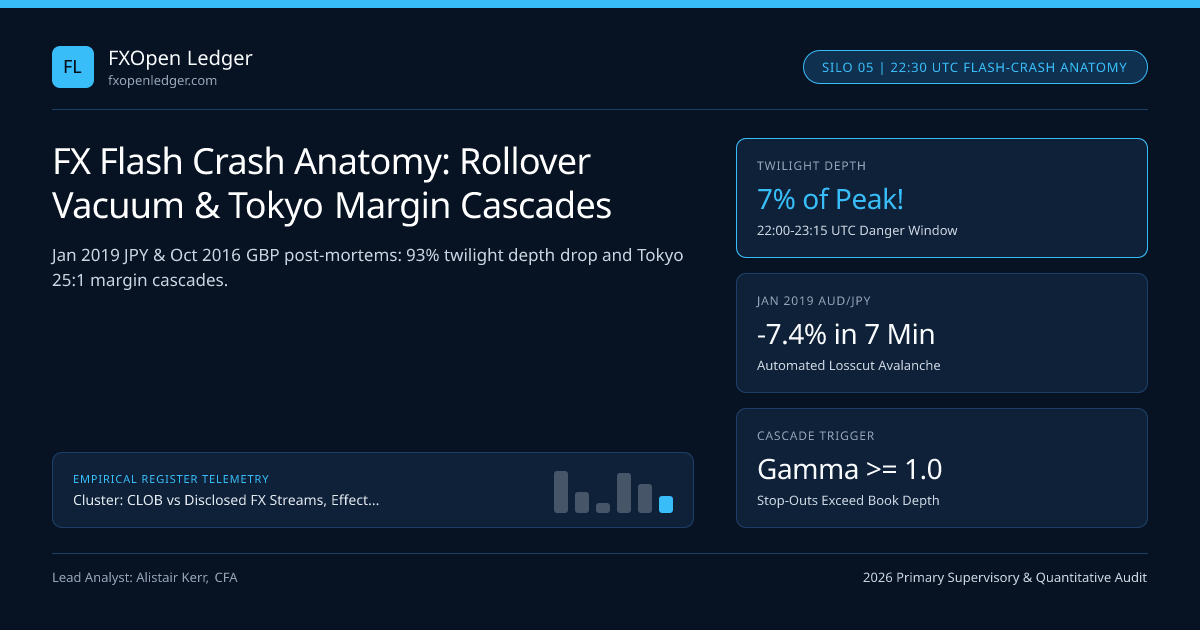
Why did October 7, 2016 (GBP/USD -9% in 2 minutes), January 2–3, 2019 (JPY flash crash: AUD/JPY -7.4%, TRY/JPY -9.8%, USD/JPY -400 pips in 7 minutes), and multiple ZAR/JPY spikes ALL detonate inside the exact same diurnal clock window (21:30 to 23:50 UTC / 06:30 to 08:50 Tokyo JST)? A landmark investigation by the Bank for International Settlements (BIS Markets Committee) and the Reserve Bank of Australia proved that FX flash crashes are rarely "fat-finger" accidents—they are Structural Microstructure Collisions between the Daily 17:00–18:30 NY Liquidity Desert (when New York desks have gone home and Tokyo banks have not yet sat down at 09:00 JST) and Automated Margin Close-Outs across $10B+ of Carry-Long Japanese Retail (Mrs. Watanabe) Margin Accounts supervised by FFAJ Japan!
Connected to our CLOB vs Disclosed FX Streams & Slippage Guide, paired with GBP/JPY synthetic cross stop air pockets and post-shock depth resiliency half-life, and indexed inside the CLOB vs Disclosed Streams & Slippage Audit hub, dissecting the January 2019 Yen Flash Crash reveals every mechanical link in systemic OTC liquidity failure.
Minute-by-Minute Post-Mortem of the January 2–3, 2019 Yen Flash Crash#
Reconstruct the exact BIS-documented sequence at 22:30–22:38 UTC (17:30 NY / 07:30 Tokyo) during Japanese New Year bank holidays:
- The Macro Spark (
16:32 EST / 21:32 UTC): Apple Inc. issued a rare post-close revenue warning citing China slowdown—nudgingAUD/USDandUSD/JPYmodestly lower into the17:00 NY(22:00 UTC) daily rollover cutoff, when global CLOB depth sits at less than8%of London-overlap normal! - The Mechanical Accelerant (
22:31 UTC / 07:31 JST: Automated Tokyo Margin Calls!): Japanese retail FX accounts (representing ~30% of global retail spot FX volume!) held massive crowded carry longs inAUD/JPY,TRY/JPY,ZAR/JPY, andUSD/JPYat25:1FFAJ leverage. AsAUD/JPYslipped past multi-year support during thin rollover hours, Tokyo retail brokers' automated Loss-Cut (Losscut) Engines fired billions of Yen in unconstrainedMarket Sellliquidations! - Cross-Pair Contagion via Triangular Engines (
22:35 UTC): BecauseAUD/JPYandTRY/JPYbooks were empty, Tokyo brokers' bridges hedged synthetically by dumpingAUD/USDANDUSD/JPYsimultaneously on EBS Market—pullingUSD/JPYdown-410 pips(108.90 -> 104.80) in 420 seconds before recovering60%within 20 minutes!
Diurnal Depth Ratio & Forced-Liquidation Cascade Threshold Formula#
Why does a $400,000,000 forced margin liquidation barely move USD/JPY -18 pips at 14:00 UTC (London-NY Overlap), yet crash USD/JPY -410 pips (22.8x larger move!) at 22:35 UTC? Because market impact is inversely proportional to Instantaneous Resting Book Depth $D(t)$, AND once price drop $\ P$ exceeds margin buffer $B{margin}$, forced liquidation volume $V{liq}(\ P)$ becomes endogenous and super-critical ($Gamma_{cascade} \ 1$)!
- SuperCriticalLiquidationCascadeCondition (Branching Ratio Gamma >= 1.0):
- Gammacascade(t) = ( MarginalRetailMarginCallVolumeperPip ) / ( RestingCLOBBidDepthper_Pip(t) ) >= 1.0
- Worked Diurnal Cascade Comparison on AUD/JPY ($350M Crowded Carry Stop-Out Cluster across 75.00 -> 74.00):
- 1. At 14:00 UTC (London-NY Peak: Resting Synthetic Depth = $18.0M per pip; Marginal Stop-Out Density = $4.5M/pip):
- Branching Ratio Gamma = 4.5 / 18.0 = 0.25 (< 1.0 Sub-Critical!) -> Absorbed smoothly over -24 pips; zero flash crash!
- 2. At 22:35 UTC (Post-Rollover Twilight: Resting Depth = $1.4M per pip; HFTs pull 65% on VPIN alarm -> $0.49M/pip!):
- Branching Ratio Gamma = 4.5 / 0.49 = 9.18 (>> 1.0 SUPER-CRITICAL AVALANCHE!) -> Self-accelerates -560 pips until 100% of leveraged cluster is wiped out!
Historical FX Flash Crashes & Structural Vulnerability Matrix#
Supervisors including FFAJ Japan, ASIC, the UK FCA, and HKMA—alongside institutional risk teams at AMB Prime, ALB Prime, and Japanese-market comparables tracked on our Gaitame.com comparison page—study four canonical FX flash-crash blueprints:
| Flash Crash Event | Exact UTC Time | Peak 10-Min Plunge | Primary Microstructural Catalyst | Post-Crash Regulatory / Venue Reform |
|---|---|---|---|---|
SNB EUR/CHF Un-Peg (Jan 15, 2015) | 09:30 UTC | -29% (1.20 -> 0.85) | Policy floor removal + complete bid evacuation | Mandatory retail Negative Balance Protection |
Sterling GBP/USD Crash (Oct 7, 2016) | 23:07 UTC (07:07 SGT) | -9.0% (1.26 -> 1.149) | Asian-open thinness + algo option-barrier hedges + CME velocity logic | BIS GFXC algorithmic execution controls |
Yen Carry Crash (Jan 2-3, 2019) | 22:35 UTC (07:35 JST) | -7.4% AUD/JPY (-4.0% JPY) | Japan holiday + 17:30 NY desert + FFAJ 25:1 retail Losscut | Tokyo broker dynamic Losscut pacing |
March 2020 COVID NOK/GBP Vacuum | 21:00 - 23:00 UTC | -6% to -11% swings | Dealer work-from-home transition + VaR limit locks | Automated kill-switch & collar upgrades |
Three Engineering Safeguards Against 22:00–23:59 UTC Twilight Crashes#
How do institutional execution engines and brokerage risk rooms survive the 90-minute twilight window (17:00 to 18:30 NY) without getting liquidated on a transient -500-pip liquidity vacuum wick?
- Never Trigger Margin Stop-Outs on Single-LP Asymmetric Ask Spikes: Validate margin close-outs against a 3-source median composite Mid-Price (
filtering out single-venue flash ticks)! - Liquidate Distressed Books via Collared
IOCSlices (Never BlindOrdType=1Market Dumps!): Dumping$50Mas an uncollaredMarketorder at22:35 UTCguarantees negative-balance deficits! - Suspend Automated TWAP / Rebalancing Between
16:55 NYand18:15 NY(21:55–23:15 UTC): Wait 75 minutes until Sydney/Tokyo interbank desks open!
Crucial Difference: OTC Spot FX Has NO Central Market-Wide Circuit Breaker!#
Unlike US equities (LULD Halts) or CME 6J / 6E FX Futures (CME Velocity Logic, which pauses futures matching for 100ms–1,000ms if price moves more than $X$ ticks in under 1 second!), decentralized OTC Spot FX has ZERO central market-wide trading halt—meaning each participant must enforce its own pre-trade price-collar (Max Slippage) protection!
Frequently asked questions
Why do so many forex flash crashes happen around 17:30 New York time (07:30 Tokyo)?
Between 17:00 NY (daily settlement rollover) and 09:00 Tokyo (when Japanese banks sit down), New York and London liquidity providers are offline—leaving global FX order-book depth >90% thinner than peak hours and vulnerable to stop-out avalanches.
Who is "Mrs. Watanabe" and why do Japanese retail accounts move global JPY exchange rates?
Japanese household margin traders ("Mrs. Watanabe") account for roughly 30% of global retail spot FX volume and hold heavily directional positive-carry longs (AUD/JPY, ZAR/JPY, TRY/JPY, USD/JPY); synchronized FFAJ 25:1 margin liquidations dump billions of Yen at once.
Does the global OTC spot FX market have an automatic circuit breaker like the stock market?
No! While CME currency futures run automated Velocity Logic pauses and individual ECNs apply fat-finger collars, decentralized OTC spot FX has no central exchange capable of halting global trading—so prices can gap hundreds of pips in seconds.
How can a brokerage avoid bankrupting itself on Negative Balance Protection during a flash crash?
Brokers trigger margin close-outs off median-filtered composite Mid-Prices (preventing fake single-LP Ask-spike liquidations), apply tiered leverage caps on Yen crosses, and execute upstream liquidations via collared IOC slices rather than blind Market dumps.
Publication record
- Published
- 13 November 2026
- Updated
- 15 November 2026
- Author
- Alistair Kerr, CFA
- Review
- Review not recorded
- Automated fact check
- Passed in the stored pipeline record
- Source URLs
- 3 recorded
AI assistance recorded: anthropic/claude-opus-4.6. This field does not establish human review or source verification.
Academic & Institutional Attribution
Cite This Research & Embed Live Data Card
Standard academic & institutional research paper citation format.
Alistair Kerr, CFA. (2026, November 15). FX Flash Crash Anatomy: Rollover Vacuum & Tokyo Margin Cascades. FXOpen Ledger. https://fxopenledger.com/orderbook/flash-crash-anatomy-japanese-retail-margin-liquidation-at-0030-utcRegulatory Directory Cross-Reference
Referenced Institutions & Regulatory Registries
Mentioned Regulated Institutions
Referenced Supervisory Authorities
Related Lmax Ebs Ecn Spread Slippage Audit & Institutional Briefings
Explore Lmax Ebs Ecn Spread Slippage Audit Hub (20) →Lmax Ebs Ecn Spread Slippage Audit
CLOB vs Disclosed FX Streams, Effective Spread & News Slippage GuideLmax Ebs Ecn Spread Slippage Audit
Phantom Liquidity & Duplicate Quote Mirage Across FX ECNsLmax Ebs Ecn Spread Slippage Audit
FX Time-in-Force Diagnostics: IOC vs FOK vs GTC ExecutionLmax Ebs Ecn Spread Slippage Audit
Equinix LD4, NY4 & TY3 Cross-Connect Latency in Spot FX RoutingLmax Ebs Ecn Spread Slippage Audit
Sub-Pip Tick Granularity (0.5 vs 0.1 Pip) & Queue JumpingLmax Ebs Ecn Spread Slippage Audit
Realized Effective Spread + Commission vs Quoted Raw Spread TCALmax Ebs Ecn Spread Slippage Audit
Sunday 17:00 NY Open Gap Slippage & Stop-Out Execution RulesLmax Ebs Ecn Spread Slippage Audit
Dark Mid-Point FX Matching Pools: Fill Rates vs Adverse SelectionRetirement Planning
Corporate America is making a trillion-dollar mistake about retirementIPO and Investing
Anthropic's trillion-dollar IPO is coming, but retail investors could have owned AI stock much earlierCredit Cards
Amex Goes After a Sports-Mad Crowd With Fanatics Credit CardMarket Insights
New Zealand Dollar Climbs as Traders Await Election Result
FXOpen Ledger Data, Benchmarks & Contributor Records
CC BY 4.0 Open Data
Open Institutional Datasets (CSV / JSON) →
Download desk-compiled quantitative series & schemas.
2026 Reference Matrix
2026 Institutional Benchmarks & Thresholds →
Statutory capital, clearing, margin & rate conventions.
Editorial Records
Authors & Review Records →
View named contributors where those records are available.
Complete Index
Master Research & Dossier Archive →
Browse all published briefings by topic pillar & date.