
Lmax Ebs Ecn Spread Slippage Audit
Equinix LD4, NY4 & TY3 Cross-Connect Latency in Spot FX Routing
Global electronic foreign exchange executes inside three physical Equinix campuses—LD4 in Slough, NY4 in Secaucus, and TY3 in Tokyo—where sub-millisecond single-mode fiber cross-connects beat public internet routing by 65+ milliseconds.
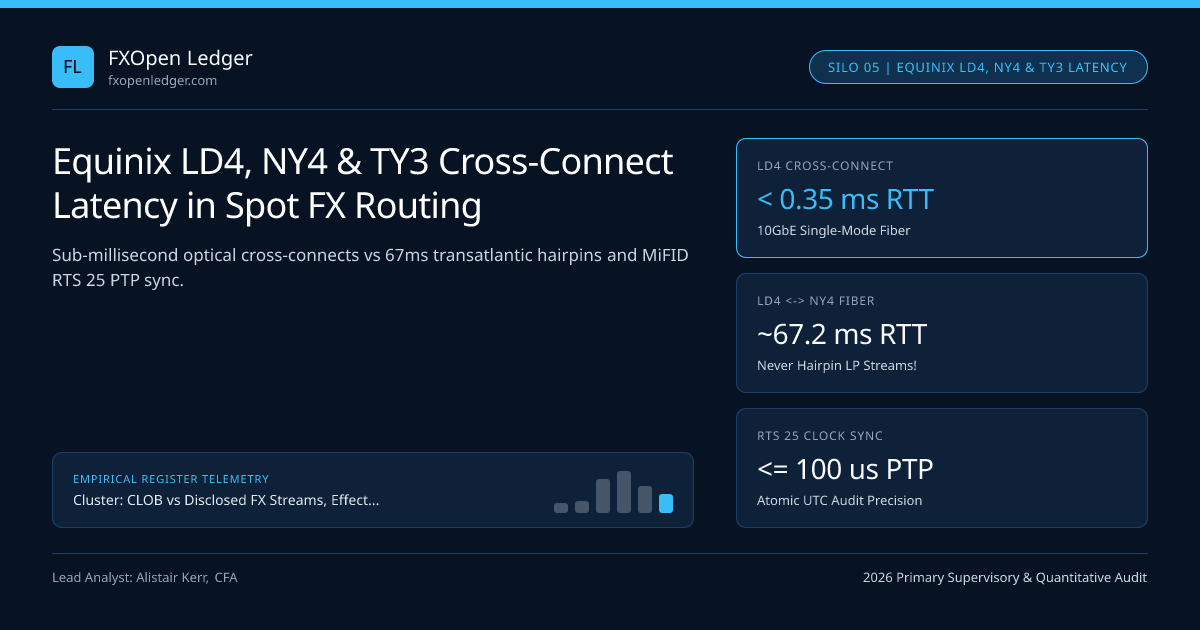
"Decentralized OTC FX" does not float in an abstract cloud—over 88% of global institutional spot foreign exchange matches inside three physical brick-and-steel buildings: Equinix LD4 (Slough, 30km west of London — ~42% of global e-FX), Equinix NY4 / NY5 (Secaucus, New Jersey — ~31%), and Equinix TY3 (Koto-ku, Tokyo — ~15%, supplemented by SG1 in Singapore)! Inside LD4 alone, a single 10GbE single-mode optical fiber Cross-Connect between your execution server rack and an LP or Firm CLOB matching engine traverses 80 meters of glass in ~0.4 microseconds (< 250 microseconds full TCP/FIX application round-trip)! Contrast that against a retail trader or misconfigured broker routing an LD4 LP stream through a Frankfurt or Virginia public-cloud VPS (68 to 115 milliseconds round-trip): you are trading on prices from the geological past!
Anchored in our CLOB vs Disclosed FX Streams & Slippage Guide, paired with cTrader/FIX API vs MetaTrader tick throttling, and indexed inside the CLOB vs Disclosed Streams & Slippage Audit hub, aligning Server Geography to LP Matching Hub eliminates cross-ocean Last-Look rejections and latency arbitrage.
Physical Speed-of-Light Matrix Across LD4, NY4, TY3 & Aurora#
In silica optical fiber (refractive index n ≈ 1.468), light travels at $204,190\{ km/s}$ (~4.90 microseconds per kilometer), adding switch serialization and subsea cable slack:
- Intra-Campus Optical Cross-Connect (
LD4 <-> LD4):0.05 – 0.35 ms(50–350 microsecondsapplication-to-application!). - Chicago (
CME Aurora DC3) <-> Secaucus (NY4):~14.1 msfiber RTT (~7.95 msultra-low-latency microwave towers!). - London (
LD4Slough) <-> New York (NY4Secaucus):~66.8 – 68.5 mssubsea fiber RTT (Hibernia Express / EXA), or~31.5 – 38 msHF shortwave/LEO for tiny signal packets! - New York (
NY4) <-> Tokyo (TY3Trans-Pacific):~146 – 152 msfiber RTT; London (LD4) <-> Tokyo (TY3):~212 – 228 msfiber RTT!
Exact "Transatlantic Hairpin" Stale-Quote Reject & Latency-Arb Math#
Watch the fatal architectural mistake committed when a broker hosts its trade server in NY4 (New York) while subscribing to an LP's LD4 (London) pricing engine (67.2 ms RTT away!):
- 33.6 ms Stale Quote On Arrival: Every
LD4tick displayed inNY4is already33.6 msold! - Another 33.6 ms Order Flight Back to
LD4: By the time anNY4client order flies back across the Atlantic toLD4,67.2 millisecondshave elapsed—exceeding the LP's Last-Look price-tolerance threshold on volatile ticks and inviting Latency Arbitrageurs (who read fresh NY4 CME futures and hit the broker's 33.6ms-lagged LD4-derived quote!)!
- ProbabilityPriceBreachesToleranceTau(Stalenesst) = 2 * ( 1 - NormalCDF( TolerancePips / ( sigmapipspersec * sqrt(Stalenesstsec) ) ) )
- Worked EUR/USD Hairpin Audit (LPSymmetric Price Tolerance = 0.25 pips; London Overlap Volatility sigma = 1.60 pips/sec):
- 1. Co-Located LD4 Algo -> LD4 LP Cross-Connect (Total Staleness = 0.2ms + 0.3ms + 0.2ms = 0.7 ms = 0.0007s):
- Diffusion SD over 0.7ms = 1.60 * sqrt(0.0007) = 0.042 pips -> Z-score = 0.25 / 0.042 = 5.91 sigma -> Reject Rate = ~0.0001% (99.99%+ FILL!).
- 2. Misconfigured NY4 Server -> LD4 LP Hairpin (Total Staleness = 33.6ms + 1.4ms + 33.6ms = 68.6 ms = 0.0686s):
- Diffusion SD over 68.6ms = 1.60 * sqrt(0.0686) = 0.419 pips -> Z-score = 0.25 / 0.419 = 0.60 sigma -> Reject Rate = 55.1% REJECTED ON FAST TICKS!
Global Equinix e-FX Hub Specialization & Co-Location Table#
Institutional Prime-of-Prime aggregators (AMB Prime, ALB Prime, Climax Prime) and multi-region brokers (City Index, BYFX Global, 4XC) regulated across the UK FCA, CFTC, FFAJ, and HKMA deploy Regional Liquidity Meshes so clients always hit local liquidity:
| Equinix Campus | Location | Primary Venue Engines Hosted | Optimal Currency Pairs | Recommended Client VPS / Bare-Metal |
|---|---|---|---|---|
LD4 (Slough) | West London, UK | EBS (EUR/CHF), LSEG Matching, LMAX LD4, XTX, Citi, JPM, OneZero/PrimeXM | EUR/USD, GBP/USD, EUR/GBP, USD/CHF, XAU/USD | Equinix LD4 / LD5 Financial Cross-Connect |
NY4 / NY5 | Secaucus, NJ, USA | Cboe FX, Euronext FX, EBS (USD/NDF), LMAX NY4, FXSpotStream, Currenex | EUR/USD, USD/CAD, USD/MXN, 1M LatAm NDFs | Equinix NY4 Bare-Metal (<0.5ms) |
TY3 | Tokyo, Japan | EBS (JPY), LMAX TY3, Tokyo Mega-Banks (MUFG/Mizuho/SMBC), PrimeXM TY3 | USD/JPY, EUR/JPY, AUD/JPY | Equinix TY3 (00:00–08:00 UTC edge) |
SG1 | Singapore | SGX CurrencyNode, Asian NDF Engines, Tier-1 APAC Regional Hubs | USD/CNH, USD/SGD, 1M KRW/INR/TWD/IDR NDFs | Equinix SG1 APAC Gateway |
Clock Synchronization Discipline: MiFID II RTS 25 (PTP < 100 Microseconds)#
When auditing cross-connect execution latencies across LD4 and NY4, ordinary internet NTP (which drifts +/- 5 to 25 milliseconds!) produces nonsensical negative apparent latencies (where the fill timestamp appears earlier than the order send timestamp!). Under MiFID II RTS 25, institutional HFT and venue servers synchronize hardware NIC clocks via IEEE 1588 Precision Time Protocol (PTP) locked to GPS/Galileo atomic grandmasters within <= 100 microseconds maximum divergence—essential for independent post-trade millisecond tick slippage forensics!
Quick Diagnostic: Find Where Your Broker's Trade Server ACTUALLY Lives!#
Before purchasing a co-located VPS in NY4 or LD4, run a simple ping / mtr trace against your broker's FIX 4.4 or MT5/cTrader endpoint IP: if RTT from Slough is 0.6 ms and RTT from New York is 68 ms, your broker's core matching bridge sits inside Equinix LD4—meaning deploying your algo inside NY4 actually adds 68 ms of unnecessary Atlantic latency!
Frequently asked questions
What is Equinix LD4 and why is it the center of global forex trading?
Equinix LD4 is a carrier-neutral financial data center in Slough (west of London) housing the matching engines and pricing servers of EBS, LSEG, LMAX, PrimeXM, OneZero, Tier-1 banks, and top non-bank market makers—handling ~42% of global e-FX.
What is the fastest possible latency between London (LD4) and New York (NY4)?
Over low-latency transatlantic subsea optical fiber (such as Hibernia Express), round-trip time between LD4 and NY4 is ~66.8 to 68.5 milliseconds (~33.5ms one-way); specialized HF shortwave/satellite links shave small-packet signals closer to ~32-38ms RTT.
Should I put my FX trading server on AWS/Google Cloud or inside Equinix LD4/NY4?
For holding horizons under 5 minutes or news/scalping execution, bare-metal or financial VPS racks inside the EXACT same Equinix hall (LD4 or NY4) as your broker FIX engine achieve 0.3-0.8ms RTT with minimal jitter, beating public clouds (2-8ms + hypervisor spikes).
Why does MiFID II RTS 25 ban standard NTP clock sync for high-frequency trading logs?
Standard internet NTP drifts by 5 to 25+ milliseconds—far slower than 0.4ms Equinix execution! RTS 25 mandates GPS-disciplined PTP synchronization accurate to <= 100 microseconds so regulators can reconstruct exact cross-venue event order.
Publication record
- Published
- 13 November 2026
- Updated
- 14 November 2026
- Author
- Alistair Kerr, CFA
- Review
- Review not recorded
- Automated fact check
- Passed in the stored pipeline record
- Source URLs
- 3 recorded
AI assistance recorded: anthropic/claude-opus-4.6. This field does not establish human review or source verification.
Academic & Institutional Attribution
Cite This Research & Embed Live Data Card
Standard academic & institutional research paper citation format.
Alistair Kerr, CFA. (2026, November 14). Equinix LD4, NY4 & TY3 Cross-Connect Latency in Spot FX Routing. FXOpen Ledger. https://fxopenledger.com/orderbook/equinix-ld4-ny4-ty3-cross-connect-latency-in-spot-fx-routingRegulatory Directory Cross-Reference
Referenced Institutions & Regulatory Registries
Mentioned Regulated Institutions
Referenced Supervisory Authorities
Related Lmax Ebs Ecn Spread Slippage Audit & Institutional Briefings
Explore Lmax Ebs Ecn Spread Slippage Audit Hub (20) →Lmax Ebs Ecn Spread Slippage Audit
CLOB vs Disclosed FX Streams, Effective Spread & News Slippage GuideLmax Ebs Ecn Spread Slippage Audit
Sub-Pip Tick Granularity (0.5 vs 0.1 Pip) & Queue JumpingLmax Ebs Ecn Spread Slippage Audit
Realized Effective Spread + Commission vs Quoted Raw Spread TCALmax Ebs Ecn Spread Slippage Audit
Sunday 17:00 NY Open Gap Slippage & Stop-Out Execution RulesLmax Ebs Ecn Spread Slippage Audit
Dark Mid-Point FX Matching Pools: Fill Rates vs Adverse SelectionLmax Ebs Ecn Spread Slippage Audit
FIX 4.4 & cTrader API vs MetaTrader Tick Throttling Under LoadLmax Ebs Ecn Spread Slippage Audit
Independent Post-Trade FX Slippage Forensics Using Tick FeedsLmax Ebs Ecn Spread Slippage Audit
Primary FX CLOBs: EBS Market, LSEG Matching & Minimum Quote LifeMarket Insights
New Zealand Dollar Climbs as Traders Await Election ResultMarket Insights
Asian stocks steady as AI, Mideast jitters recede; dollar firm on Fed betsMarket Insights
US dollar holds onto payrolls gains, NZ dollar rises after electionMarket Insights
WSJ Dollar Index Rises 0.23% to 97.22
FXOpen Ledger Data, Benchmarks & Contributor Records
CC BY 4.0 Open Data
Open Institutional Datasets (CSV / JSON) →
Download desk-compiled quantitative series & schemas.
2026 Reference Matrix
2026 Institutional Benchmarks & Thresholds →
Statutory capital, clearing, margin & rate conventions.
Editorial Records
Authors & Review Records →
View named contributors where those records are available.
Complete Index
Master Research & Dossier Archive →
Browse all published briefings by topic pillar & date.