
Lmax Ebs Ecn Spread Slippage Audit
CLOB vs Disclosed FX Streams, Effective Spread & News Slippage Guide
Modern OTC foreign exchange splits price discovery across anonymous Central Limit Order Books (EBS Market, LSEG Matching, LMAX Exchange) and disclosed relationship streams—creating wide divergences between quoted 0.0-pip top-of-book spreads and realized all-in execution costs.
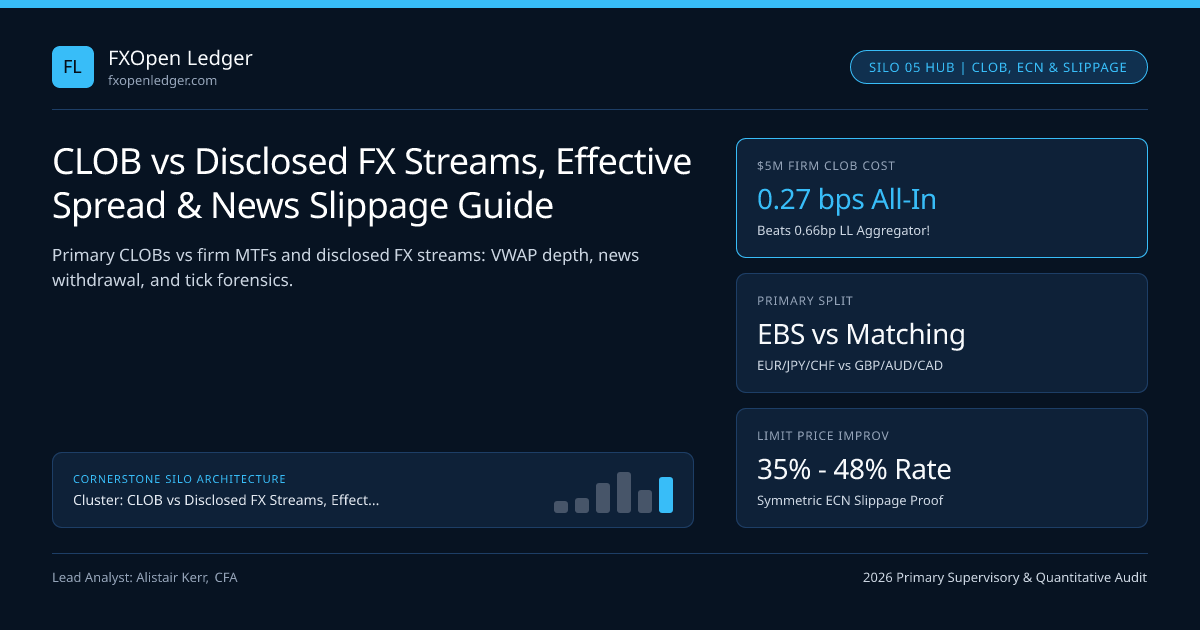
Where is the "true" global exchange rate of EUR/USD or USD/JPY actually discovered at any millisecond? Unlike US equities (which consolidate onto SIP national best bid/offer feeds) or CME futures (which clear inside one single Aurora, Illinois matching engine), the $7.5 trillion/day OTC foreign exchange market fragments liquidity across three competing execution architectures: (1) Interbank Primary Central Limit Order Books (CLOBs)—historically EBS Market (for EUR, JPY, CHF, CNH) and LSEG Refinitiv Matching (for GBP, AUD, CAD, NZD, Scandies), protected by Minimum Quote Life (`MQL`) and randomized latency floors; (2) Firm No-Last-Look Institutional MTF/ECN CLOBs such as LMAX Exchange in Equinix LD4 / NY4 / TY3; and (3) Bilateral Disclosed Relationship Streams (ESP / RFS) aggregated over platforms like FXSpotStream, 360T, Cboe FX, and Euronext FX!
This cornerstone venue-microstructure guide anchors the CLOB vs Disclosed Streams & Slippage Audit hub, giving institutional execution quants, brokerage bridge architects, and systematic traders a complete quantitative framework for auditing Realized Effective Spread, Full-Book VWAP Depth, Positive vs Negative Slippage Symmetry, and Macro News Liquidity Withdrawal.
Comparing the Four Dominant Spot FX Execution Venues#
Why does a screen showing 0.0 pips on a retail or institutional aggregator frequently fill a $5,000,000 sweep at 0.68 pips effective cost—while a 0.3-pip firm CLOB fills 100% on the first try with zero Last-Look delay? Every venue solves the fundamental tradeoff between Quote Tightness and Adverse-Selection Protection differently:
- Primary Interbank CLOBs: Enforce coarse tick increments (
0.5 pipson EBS/Matching majors) and Minimum Quote Life plus latency floors combined with randomized batching mechanics to neutralize sub-millisecond latency snipers. - Firm No-Last-Look CLOBs (
LMAX MTFModel): Enforce strict price/time FIFO matching on 100% firm limit orders with zero Last-Look rejections—analyzed in firm no-last-look CLOB execution mechanics. - Disclosed / Semi-Disclosed ECN Aggregators: Stream ultra-fine
0.1-pipquotes tailored by client toxicity tier, but carry phantom duplicate liquidity mirages when a single bank quotes the same$2Minventory across five ECNs simultaneously!
Exact All-In Effective Spread & Full-Depth Sweep Cost Decomposition#
Headline "Raw Top-of-Book Spread" is the single easiest metric to game in foreign exchange: stream $100,000 (1 standard lot) at 0.0 pips with a 25ms Last-Look reject gate, charge $35/million commission, and reject 30% of fast sweeps so retries fill 0.9 pips worse! Institutional FX TCA Implementation Shortfall measures All-In Realized Execution Cost across both filled and rejected attempts—detailed in realized effective spread plus commission TCA and top-of-book zero-spread vs $10M VWAP depth:
- FillRatio * ( EffectiveHalfSpreadVWAPbps(Q) + SignedSlippagebps + RoundTurnCommissionHalf_bps )
- + (1 - FillRatio) * RejectRetryDriftPenalty_bps
- Where Level-2 Sweep VWAP Half-Spread for Order Size Q across Book Rungs k = 1..K:
- EffectiveHalfSpreadVWAP(Q) = ( Sum{k=1..K} [ qk * | Prungk - Mid_Arrival | ] ) / Q
- Worked $5,000,000 EUR/USD Sweep Audit: "0.0-Pip Last-Look Stream" vs "0.25-Pip Firm No-Last-Look CLOB":
- 1. Venue A ("0.0-Pip Top-of-Book Last-Look Stream", $25/M RT Comm = 0.125 bps/side, 78% Fill Ratio, 1.10 bps Reject Penalty):
- Level-2 Book: $500k @ 0.0p, $1.5M @ 0.3p, $3.0M @ 0.7p -> Sweep VWAP Half-Spread = 0.255 pips (0.236 bps) + 0.18 bps asymmetric slip.
- Realized Cost = 0.78 * (0.236 + 0.180 + 0.125) + 0.22 * (1.100) = 0.422 + 0.242 = 0.664 bps ($332.00 per $5M!).
- 2. Venue B ("0.25-Pip Firm No-Last-Look CLOB", $20/M RT Comm = 0.100 bps/side, 100% Firm Fill Ratio, Symmetric Slippage = 0.00 bps):
- Level-2 Book: $2.0M @ 0.25p (0.125p half), $3.0M @ 0.45p (0.225p half) -> Sweep VWAP Half-Spread = 0.185 pips (0.171 bps).
- Realized Cost = 1.00 * (0.171 + 0.000 + 0.100) + 0 = 0.271 bps ($135.50 per $5M -> 59.2% CHEAPER than the "0.0-pip" stream!).
Microstructural Comparison Matrix Across Venue Archetypes#
Execution desks across institutional Prime-of-Prime houses (AMB Prime, ALB Prime, Climax Prime) and regulated multi-asset dealers (City Index, 4XC, Blue Suisse) supervised by the UK FCA, CFTC, ASIC, and FFAJ match execution algorithms to venue rules:
| Venue Class | Quote Firmness | Tick Increment | Latency / Batching | Primary Strength | Core Execution Hazard |
|---|---|---|---|---|---|
Primary Interbank CLOB (EBS / LSEG) | 100% Firm | 0.5 pip (0.1p select) | MQL + Latency Floor | True benchmark crisis discovery | Coarse tick; high PB credit floor |
Firm Institutional MTF (LMAX) | 100% Firm (No-LL) | 0.1 pip | Deterministic <1ms FIFO | Zero Last-Look; clean limit fills | Explicit exchange fee per $1M |
Disclosed Relationship (FSS / 360T) | Firm or Last-Look | 0.1 pip | Sub-ms Direct Cross-Connect | Tight tailored skew for benign flow | Reject cascades if flow turns toxic |
Dark Mid-Point Pool (Bilateral Mid) | Firm Pegged to Mid | Mid-Point (0.0p) | Continuous / Periodic | Zero spread crossing on block fills | Low fill rate during fast trends |
Auditing News Withdrawal, Flash Crashes & Asymmetric Slippage#
During calm London-New York overlap hours (13:00–16:00 UTC), nearly every FX feed looks liquid. True venue quality reveals itself under acute order-book stress—when US Nonfarm Payrolls and CPI liquidity withdrawal drains 85% of top-of-book depth in 400 milliseconds, when order-book depth resiliency half-life separates genuine market makers from fair-weather quote recyclers, and when 00:30 JST / 22:30 UTC Tokyo retail margin liquidations trigger 400-pip AUD/JPY flash crashes!
Complete Silo Navigation Across Order-Book & Slippage Forensics#
Explore all nineteen specialized microstructure studies in this silo: symmetric positive slippage vs asymmetric dealer limit fills, GBP/JPY stop-loss cascade air pockets, hidden iceberg vs displayed ECN limit orders, IOC vs FOK vs GTC time-in-force diagnostics, Equinix LD4, NY4 & TY3 cross-connect latency, fractional tenth-pip tick granularity & queue jumping, Sunday open weekend gap execution rules, dark mid-point FX matching pools, cTrader/FIX API vs MetaTrader tick throttling, and independent post-trade millisecond tick slippage forensics.
Frequently asked questions
What is the difference between a Central Limit Order Book (CLOB) and a Disclosed FX Stream?
A CLOB (like EBS Market, LSEG Matching, or LMAX Exchange) matches anonymous firm limit and market orders centrally by price/time or batch priority. A Disclosed Stream (like FXSpotStream or 360T) delivers bilateral relationship quotes tailored specifically to the known client identity.
Why did my $5 million market order slip 0.7 pips when the screen showed a 0.0-pip spread?
Top-of-book displays show only Rung 1 volume (often just $100k-$500k) and frequently aggregate duplicate quotes from the same underlying LP across multiple ECNs; sweeping $5M walks down deeper rungs and triggers Last-Look cancellations.
Should limit orders ever receive positive slippage (price improvement) in spot FX?
Yes! On genuine ECNs and firm CLOBs, whenever market liquidity gaps favorably past your limit price—or an aggressive counterparty crosses inside your resting price—your limit order fills at the better prevailing price.
Which primary CLOB dominates EUR/USD and USD/JPY versus GBP/USD and AUD/USD?
Historically and structurally in interbank spot FX, CME EBS Market serves as the primary interbank CLOB for EUR/USD, USD/JPY, USD/CHF, and USD/CNH, whereas LSEG (Refinitiv) Matching anchors Commonwealth pairs (GBP/USD, AUD/USD, USD/CAD, NZD/USD) and Scandinavian crosses.
Publication record
- Published
- 14 November 2026
- Updated
- 14 November 2026
- Author
- Alistair Kerr, CFA
- Review
- Review not recorded
- Automated fact check
- Passed in the stored pipeline record
- Source URLs
- 4 recorded
AI assistance recorded: anthropic/claude-opus-4.6. This field does not establish human review or source verification.
Academic & Institutional Attribution
Cite This Research & Embed Live Data Card
Standard academic & institutional research paper citation format.
Alistair Kerr, CFA. (2026, November 14). CLOB vs Disclosed FX Streams, Effective Spread & News Slippage Guide. FXOpen Ledger. https://fxopenledger.com/orderbook/clob-vs-disclosed-fx-streams-effective-spread-slippage-guideRegulatory Directory Cross-Reference
Referenced Institutions & Regulatory Registries
Mentioned Regulated Institutions
Related Lmax Ebs Ecn Spread Slippage Audit & Institutional Briefings
Explore Lmax Ebs Ecn Spread Slippage Audit Hub (20) →Lmax Ebs Ecn Spread Slippage Audit
Primary FX CLOBs: EBS Market, LSEG Matching & Minimum Quote LifeLmax Ebs Ecn Spread Slippage Audit
Firm No-Last-Look FX CLOBs: LMAX Exchange Matching MechanicsLmax Ebs Ecn Spread Slippage Audit
Top-of-Book Zero-Spread Illusion vs $10M Sweep VWAP DepthLmax Ebs Ecn Spread Slippage Audit
Symmetric Positive Slippage vs Asymmetric Dealer Limit FillsLmax Ebs Ecn Spread Slippage Audit
US Nonfarm Payrolls & CPI Liquidity Withdrawal: FX Spread AuditLmax Ebs Ecn Spread Slippage Audit
Order-Book Depth Resiliency Half-Life After FX Rate ShocksLmax Ebs Ecn Spread Slippage Audit
Stop-Loss Cascade Slippage Through Thin Air Pockets in GBP/JPYLmax Ebs Ecn Spread Slippage Audit
Randomized Latency Floors & Batching on Primary FX CLOBsFX Global Code Last Look Execution
Auditing GFXC Liquidity Provider Cover Sheets: Last-Look & Hold-Time MetricsFX Global Code Last Look Execution
Firm vs Last-Look OTC FX Liquidity Streams: Spread vs Reject Cost MathFX Global Code Last Look Execution
Symmetric vs Asymmetric Last-Look Price-Tolerance Checks in Spot FXFX Global Code Last Look Execution
Spot FX Hold-Time Latency Distributions (0ms-50ms) & Tail Reject Spikes
FXOpen Ledger Data, Benchmarks & Contributor Records
CC BY 4.0 Open Data
Open Institutional Datasets (CSV / JSON) →
Download desk-compiled quantitative series & schemas.
2026 Reference Matrix
2026 Institutional Benchmarks & Thresholds →
Statutory capital, clearing, margin & rate conventions.
Editorial Records
Authors & Review Records →
View named contributors where those records are available.
Complete Index
Master Research & Dossier Archive →
Browse all published briefings by topic pillar & date.