
Lmax Ebs Ecn Spread Slippage Audit
Primary FX CLOBs: EBS Market, LSEG Matching & Minimum Quote Life
CME EBS Market and LSEG Refinitiv Matching remain the wholesale anchor of spot FX reference pricing during macro shocks, defending maker liquidity via Minimum Quote Life (MQL) rules and calibrated half-pip tick increments.
Even though bilateral bank internalizers and disclosed multi-dealer aggregators now capture over 70% of routine calm-market spot FX volume, the instant an unexpected Federal Reserve leak, Bank of Japan intervention, or geopolitical shock hits the wires, global bank market-making engines immediately widen bilateral skews and snap their eyes back to the Two Primary Interbank Central Limit Order Books: CME EBS Market and LSEG (formerly Reuters / Refinitiv) Matching! Understanding why interbank spot FX bifurcated between EBS and Reuters in the 1990s—and how Minimum Quote Life (`MQL`) rescued primary makers from predatory HFT latency arbitrage—explains how every downstream ECN derives its core mid-price.
Anchored in our CLOB vs Disclosed FX Streams & Slippage Guide, paired with randomized batching & latency floors, and indexed inside the CLOB vs Disclosed Streams & Slippage Audit hub, primary CLOB microstructure governs the wholesale heartbeat of spot currency discovery.
Why Global Primary CLOB Liquidity Split Between EBS and LSEG Matching#
Network externalities in limit order books are winner-take-most per currency pair: liquidity attracts liquidity! In 1992–1993, Reuters launched Dealing 2000-2 (Matching) first across Sterling and Commonwealth desks in London, prompting a consortium of 13 major Continental European, US, and Japanese banks to launch Electronic Broking Services (EBS) in 1993—permanently splitting primary G10 discovery along currency-bloc lines:
- CME
EBS MarketPrimary Strongholds:EUR/USD,USD/JPY,EUR/JPY,USD/CHF,EUR/CHF, Offshore Renminbi (USD/CNH), and1M Asian/LatAm NDFs(KRW, INR, TWD, BRL). Matching hubs sit in London (LD4— EUR/CHF), New York (NY4/Aurora— USD/NDFs), and Tokyo (TY3— JPY/CNH)! - LSEG
MatchingPrimary Strongholds:GBP/USD(Cable),AUD/USD,USD/CAD,NZD/USD, Scandinavian pairs (EUR/NOK, EUR/SEK), and Commonwealth/CEEMEA emerging markets (USD/ZAR, USD/MXN, EUR/PLN).
Exact Minimum Quote Life (MQL) Tradeoff: Stopping Spoofers vs Maker Option Value#
What happens mechanically when a venue enforces a Minimum Quote Life ($T_{MQL}$, e.g. 25ms or 100ms) on resting limit orders?
- Anti-Spoofing Benefit: A predatory HFT algorithm can no longer flash a fake
$20Mbid for2 millisecondsto trick bank pricing engines into skewing upward and then cancel before anyone can hit it—any submitted quote is legally committed to stand firm and tradable in the book for at least $T_{MQL}$ milliseconds! - Adverse-Selection Cost Formula: Conversely, if an unexpected macro headline breaks
4 millisecondsafter a bank posts a resting bid, MQL forbids the bank from canceling its quote until $t = T_{MQL}$—embedding a shortMQL Straddle Optionproportional to $\{T_{MQL}}$!
- MinimumViableCLOBHalfSpreadbps >= MakerMQLEmbeddedOptionCostbps + VenueBrokerageFeebps + InventoryHoldingCost
- Worked MQL Calibration Audit on USD/JPY (Normal Volatility sigma1sec = 0.65 bps vs BoJ Event Volatility sigma1sec = 8.50 bps):
- 1. Calm Session with T_MQL = 25 ms (0.025s), Event Arrival Intensity = 0.15:
- Embedded MQL Option Cost = 0.7979 * 0.65 * sqrt(0.025) * 0.15 = 0.012 bps (Negligible -> Makers comfortably quote 0.5-pip [0.33 bps] tight spreads!).
- 2. High-Alert BoJ Window with T_MQL = 100 ms (0.100s), Shock Intensity = 1.00:
- Embedded MQL Option Cost = 0.7979 * 8.50 * sqrt(0.100) * 1.00 = 2.145 bps (~3.26 JPY pips half-spread -> 6.5 pips full spread required to break even!).
- Insight: Why EBS paired shorter/targeted MQL with 1-3ms Latency Floors—protecting makers from speed snipers WITHOUT trapping makers for 100ms!
Primary Interbank CLOBs vs Secondary Institutional Venues#
Institutional desks accessing primary venues via Tier-1 FX Prime Brokers or Prime-of-Prime conduits (AMB Prime, ALB Prime, Climax Prime) regulated by the UK FCA, CFTC, and FINMA compare primary CLOB rules against secondary ECNs:
| Microstructure Feature | CME EBS Market | LSEG Matching | LMAX Exchange (MTF) | Secondary ECN (Cboe / Euronext) |
|---|---|---|---|---|
| Dominant Spot Liquidity | EUR/USD, USD/JPY, CHF, CNH | GBP/USD, AUD, CAD, NZD, NOK | G10 Majors & Crosses + Metals | Broad G10 across Firm & LL books |
| Quote Firmness | 100% Firm Anonymous | 100% Firm Anonymous | 100% Firm Anonymous | Configurable Firm or Last-Look |
| Standard Tick Granularity | 0.5 pip (0.25p select) | 0.5 pip (0.1p select) | 0.1 pip | 0.1 pip |
| Anti-HFT Mechanism | Latency Floor + MQL rules | Randomized Latency Floor | Strict Deterministic FIFO | Maker/Taker Ratio & Toxicity Tiers |
Why EBS Rolled EUR/USD Back From 0.1-Pip Ticks to 0.5-Pip Ticks!#
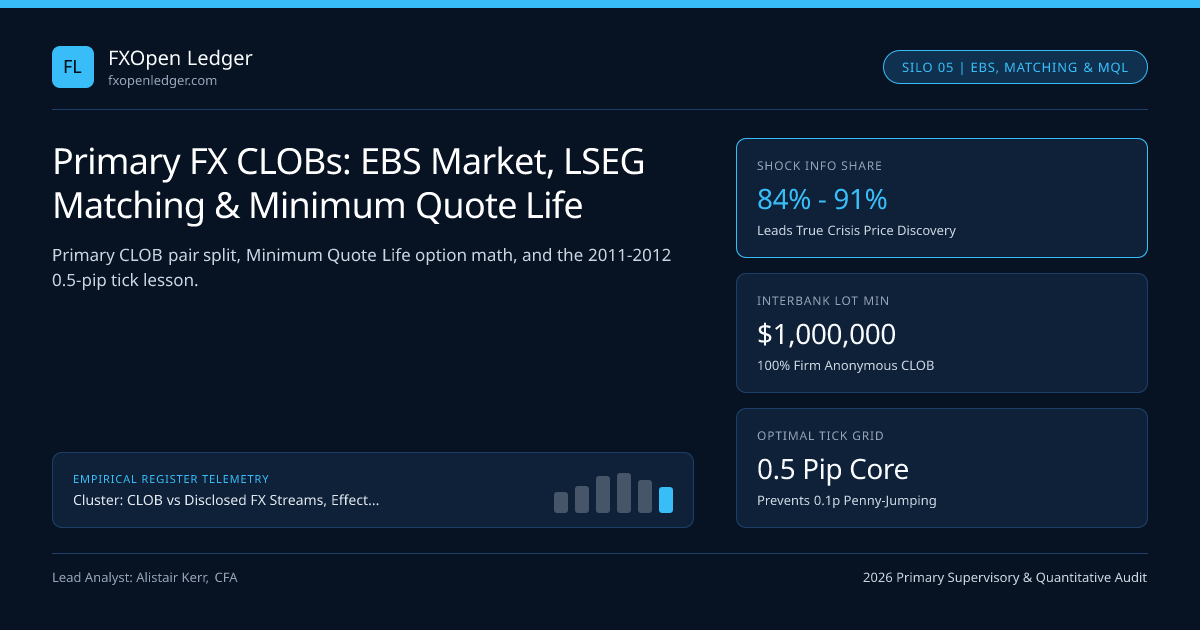
One of the greatest empirical natural experiments in financial market design occurred in March 2011, when EBS cut EUR/USD and USD/JPY minimum tick sizes from 0.5 pips down to 0.1 pips ("decimalization")—expecting tighter spreads! Instead, manual and bank liquidity collapsed: HFT algorithms stepped 0.1 pips ahead of resting $10M bank bids for practically zero cost (fractional tenth-pip queue jumping), destroying time-priority value! In September 2012, EBS rolled ticks back to 0.5 pips (half-pip), immediately restoring multi-million-dollar top-of-book depth!
Operational Takeaway: Subscribing to Primary CLOB Feeds as Your "Truth Reference"#
Even if a mid-tier brokerage or hedge fund executes 90% of its daily clips on disclosed Prime-of-Prime streams rather than paying full Tier-1 FXPB clearing fees on EBS Market, ingesting a low-latency primary CLOB reference feed (or CME FX futures 6E / 6J / 6B top-of-book) provides an incorruptible External Price-Discovery Oracle: allowing your bridge to detect stale secondary LP quotes in sub-milliseconds and benchmarking official WM/Refinitiv 4pm London fix executions.
Frequently asked questions
Why does EUR/USD trade primarily on EBS Market while GBP/USD trades primarily on LSEG Matching?
Reuters launched Dealing 2000-2 (Matching) first in 1992 across London Commonwealth desks (capturing GBP, AUD, CAD, NZD), while a consortium of European, US, and Japanese banks launched EBS in 1993—capturing Continental European (DEM/EUR, CHF) and Tokyo (JPY) interbank liquidity.
What is Minimum Quote Life (MQL) on an FX Central Limit Order Book?
Minimum Quote Life is an exchange rule requiring any submitted resting limit quote to remain active and executable in the order book for at least X milliseconds before a cancel or modify instruction is honored—preventing HFT quote flickering.
Can a retail trader or small prop shop connect directly to EBS Market or LSEG Matching?
Not directly without credit intermediation: standard minimum order size on primary interbank CLOBs is $1,000,000 base currency and every participant requires a Tier-1 FX Prime Broker (or regulated Prime-of-Prime aggregator) with CLS settlement.
Why do primary CLOBs feed the WM/Refinitiv 4:00 PM London FX Benchmark Fix?
Because EBS Market and LSEG Matching execute 100% firm, anonymous, credit-vetted interbank transactions—providing clean, auditable trade and order rates across the 5-minute (+/- 2.5 min) WMR fixing window.
Publication record
- Published
- 13 November 2026
- Updated
- 15 November 2026
- Author
- Alistair Kerr, CFA
- Review
- Review not recorded
- Automated fact check
- Passed in the stored pipeline record
- Source URLs
- 3 recorded
AI assistance recorded: anthropic/claude-opus-4.6. This field does not establish human review or source verification.
Academic & Institutional Attribution
Cite This Research & Embed Live Data Card
Standard academic & institutional research paper citation format.
Alistair Kerr, CFA. (2026, November 15). Primary FX CLOBs: EBS Market, LSEG Matching & Minimum Quote Life. FXOpen Ledger. https://fxopenledger.com/orderbook/ebs-market-refinitiv-matching-primary-clob-minimum-quote-lifeRegulatory Directory Cross-Reference
Referenced Institutions & Regulatory Registries
Top Regulated Institutions in This Coverage Slice
Referenced Supervisory Authorities
Related Lmax Ebs Ecn Spread Slippage Audit & Institutional Briefings
Explore Lmax Ebs Ecn Spread Slippage Audit Hub (20) →Lmax Ebs Ecn Spread Slippage Audit
CLOB vs Disclosed FX Streams, Effective Spread & News Slippage GuideLmax Ebs Ecn Spread Slippage Audit
Firm No-Last-Look FX CLOBs: LMAX Exchange Matching MechanicsLmax Ebs Ecn Spread Slippage Audit
Top-of-Book Zero-Spread Illusion vs $10M Sweep VWAP DepthLmax Ebs Ecn Spread Slippage Audit
Symmetric Positive Slippage vs Asymmetric Dealer Limit FillsLmax Ebs Ecn Spread Slippage Audit
US Nonfarm Payrolls & CPI Liquidity Withdrawal: FX Spread AuditLmax Ebs Ecn Spread Slippage Audit
Order-Book Depth Resiliency Half-Life After FX Rate ShocksLmax Ebs Ecn Spread Slippage Audit
Stop-Loss Cascade Slippage Through Thin Air Pockets in GBP/JPYLmax Ebs Ecn Spread Slippage Audit
Randomized Latency Floors & Batching on Primary FX CLOBsDigital Currencies
EURV Euro-Pegged Digital Currency Expands Across Global Banking Networks — Eurvon - PR UndergroundPrivate Equity
TLG Capital launches Ghana's first local-currency private credit fund - DealroomInvestment Strategies
Nomura, Aventus launch JV to offer investors access to opportunities across securitized products and private credit - FX News GroupMarket Insights
Goldman Sachs: Private credit GPs expect liquidity relief in 2027–28 - Alternatives Watch
FXOpen Ledger Data, Benchmarks & Contributor Records
CC BY 4.0 Open Data
Open Institutional Datasets (CSV / JSON) →
Download desk-compiled quantitative series & schemas.
2026 Reference Matrix
2026 Institutional Benchmarks & Thresholds →
Statutory capital, clearing, margin & rate conventions.
Editorial Records
Authors & Review Records →
View named contributors where those records are available.
Complete Index
Master Research & Dossier Archive →
Browse all published briefings by topic pillar & date.