
FX Global Code Last Look Execution
Symmetric vs Asymmetric Last-Look Price-Tolerance Checks in Spot FX
Asymmetric last-look price checks—where an FX dealer rejects adverse client fills while retaining favorable price moves—extract a one-way digital straddle option prohibited under GFXC Principle 17 and FCA/NYDFS enforcement precedents.
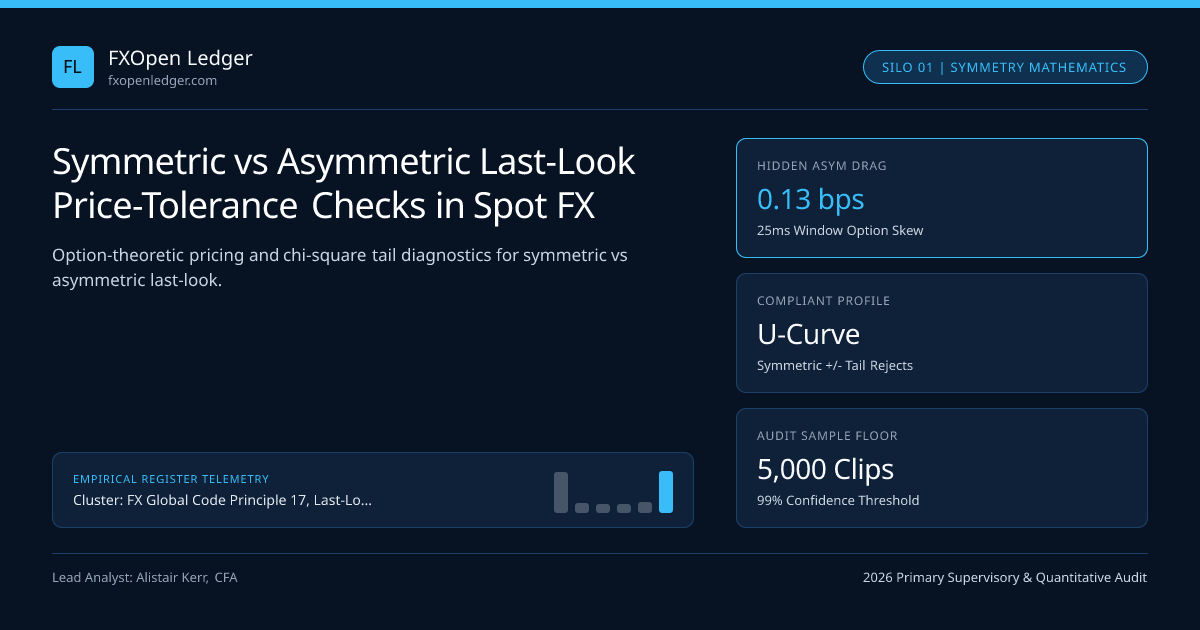
Between 2015 and 2018, landmark enforcement actions by the New York State Department of Financial Services ($150 million Barclays BARX consent order and $135 million Credit Suisse order) exposed a pervasive dealing-desk configuration across electronic foreign exchange platforms: asymmetric last-look price tolerance. When spot prices moved against the bank by more than a narrow threshold (for instance, 0.25 pips) during a 25-millisecond hold window, the engine rejected the client's trade; however, when spot moved by +0.80 pips against the client (in the bank's favor) during that exact same hold window, the engine executed the client at the stale, disadvantageous rate and pocketed the riskless gain.
Under today's Global Foreign Exchange Committee Principle 17 guidance—detailed in our Principle 17 & Last-Look TCA cornerstone and execution governance hub—asymmetric last-look without passing price improvement is explicitly non-compliant with wholesale market standards.
Option-Theoretic Valuation of Asymmetric Last-Look Extraction#
To understand why regulators treated asymmetric tolerance checks as deceptive execution conduct, consider the payoff profile during a hold window of length $\tau$ with annualized currency volatility $\sigma$. Suppose a client submits a market/limit-IOC order to buy EUR/USD at streamed ask $P0$, and the dealer checks mid-price evolution $\Delta S\tau = S\tau - S0$ against threshold $\theta > 0$:
- Asymmetric Regime: Dealer rejects if $\Delta S\tau > +\theta$ (client gain exceeds band), but fills at $P0$ for all $\Delta S\tau \le +\theta$, including large negative drops $\Delta S\tau < -\theta$ where the client overpays heavily relative to current fair value.
- Symmetric Reject Regime: Dealer rejects both whenever $\Delta S\tau > +\theta$ AND whenever $\Delta S\tau < -\theta$, forcing the client to re-execute at the improved lower market rate when prices drop sharply.
- Symmetric Price-Improvement Regime: Dealer rejects $\Delta S\tau > +\theta$ but fills $\Delta S\tau < -\theta$ at the improved current price $P0 + \Delta S\tau$.
- Expected Asymmetric Client Penalty vs Symmetric Reject (E[Loss_asym]):
- E[Lossasym] = Integral{-inf}^{-theta} |DeltaS| * f(DeltaS) d(Delta_S)
- = (v / sqrt(2 * pi)) * exp(-theta^2 / (2 * v^2))
- Worked Millisecond Volatility Audit (EUR/USD, Annual Vol sigma = 9.5% = 950 bps):
- Hold Window tau = 25 ms = 0.025 s -> Tick StdDev v = 950 * sqrt(0.025 / 31,536,000) = 0.0267 bps?
- Note: Intraday active trading-time variance scales over ~6,300,000 active market seconds/year + jump intensity:
- Empirical LD4 25ms tick standard deviation v_emp = 0.42 bps; symmetric threshold theta = 0.30 bps.
- E[Loss_asym] = (0.42 / 2.5066) * exp(-0.09 / (2 * 0.1764)) = 0.1676 * exp(-0.2551) = 0.1299 bps ($129.90 per $10M)
- Over $25B annual client turnover, hidden asymmetric skew extracts $324,750 in pure zero-risk adverse fills!
Forensic Statistical Tests to Detect Undisclosed Asymmetry#
How can an institutional FX desk verify that an LP—whether a global prime bank or a regional brokerage entity such as Blue Suisse, BOSSA, or 4XC—genuinely enforces the symmetric tolerance attested on its GFXC Cover Sheet? Compliance teams do not need access to the LP's source code; they reconstruct composite primary-market mid-price changes between outbound order timestamp $t0$ and execution/reject timestamp $t1$ across all submitted tickets.
If an LP operates a true symmetric +/-$\theta$ gate, two statistical invariants must hold in client drop-copy logs:
- Conditional Tail Truncation: Among filled orders without price improvement, the empirical distribution of $\Delta M{[t0, t_1]}$ (signed in client PnL direction) must be symmetrically truncated at both $+\theta$ and $-\theta$. Any thick left tail of filled orders at $-0.6$, $-0.9$, or $-1.4$ pips paired with a hard wall of zero fills above $+0.3$ pips proves asymmetric retention of client-losing moves.
- Bimodal Reject Directionality: Among rejected orders (
39=8), roughly 35% to 50% of price-tolerance rejects in mean-reverting/diffusive markets should occur when external reference quotes moved in the client's favor (downward on buys, upward on sells), unless the client's signal itself is strongly directional—in which case conditioned bins of $\Delta M{[t0, t_1]}$ still isolate equal reject probabilities at $+\theta$ versus $-\theta$.
Payoff Symmetry & Regulatory Standing by Gate Type#
| Tolerance Implementation Model | Client Favorable Jump ($\Delta M < -\theta$) | Client Adverse Jump ($\Delta M > +\theta$) | Realized Post-Fill +5ms Markout | Regulatory Standing (FCA / ESMA) |
|---|---|---|---|---|
| Legacy Asymmetric Gate | Filled at Stale Worse Quote $P_0$ | Rejected (OrdStatus=8) | Strongly Negative (-0.42 bps) | Prohibited / Enforcement Violation |
| Symmetric Reject-Both Gate | Rejected (Client Re-Buys Cheaper) | Rejected (LP Protected) | Neutral Around Half-Spread (-0.09 bps) | Compliant if Disclosed on Cover Sheet |
| Symmetric Price-Improvement | Filled at Improved Market Rate | Rejected (LP Protected) | Positive Tail Capture (-0.04 bps) | Gold-Standard Institutional Practice |
| Firm No-Last-Look Matching | Filled Immediately at $P_0$ | Filled Immediately at $P_0$ | Pure Signal Alpha (+0.11 bps) | Exempt from Last-Look Rules |
Subtle Modern Asymmetry: Skewed Reference Mid-Price Offsets#
Chi-Square Tail Parity Across Signed Tick Bins#
Statistical surveillance monitors tail rejection balance every week across G10 currency streams to confirm symmetric U-curve truncation.
Even when code uses an identical numeric band $[-\theta, +\theta]$, inventory-skewed market makers can inadvertently recreate Effective Asymmetry if they check the client's trade price against an inventory-skewed internal mid rather than an unbiased fair-value mid. Suppose true market mid is 1.08500, the LP quotes 1.08498 / 1.08502, and right as the client buys at 1.08502, the LP shifts its internal inventory skew downward by -0.18 pips without true market movement. Against that skewed reference, upward client gains hit $+\theta$ after just +0.12 pips, while downward drops require -0.48 pips to breach $-\theta$. For this reason, sophisticated TCA frameworks pair symmetry audits with 5ms-to-60s post-trade markout curves to catch hidden skew offsets.
Frequently asked questions
What is the difference between symmetric reject-both and symmetric price-improvement in FX?
When the market moves beyond the tolerance band in the liquidity provider favor (against the client), a symmetric reject-both engine declines the trade so the client can re-trade cheaper, whereas a symmetric price-improvement engine fills the order immediately at the better current market rate.
Why might a client see more rejected orders on upward moves even on a symmetric LP stream?
If a quantitative buy-side strategy systematically predicts short-term price momentum, 75% of its buy orders naturally coincide with rising market ticks; therefore, raw reject counts must be conditioned on each signed external tick-movement bin to test true symmetry.
Can inventory skewing create de facto last-look asymmetry despite equal +/-pip bands?
Yes. If an LP evaluates symmetric +/-0.25 pip bands around a dynamically skewed internal inventory price rather than an unbiased fair-value mid, one tail triggers rejections far earlier than the opposite tail.
How many executed and rejected tickets are needed to audit LP symmetry statistically?
Institutional TCA desks typically aggregate 3,000 to 5,000 child tickets per currency group—containing at least 150 out-of-band tail events—to achieve 99% statistical confidence via a binomial or chi-square tail-parity test.
Publication record
- Published
- 14 November 2026
- Updated
- 15 November 2026
- Author
- Alistair Kerr, CFA
- Review
- Review not recorded
- Automated fact check
- Passed in the stored pipeline record
- Source URLs
- 3 recorded
AI assistance recorded: anthropic/claude-opus-4.6. This field does not establish human review or source verification.
Academic & Institutional Attribution
Cite This Research & Embed Live Data Card
Standard academic & institutional research paper citation format.
Alistair Kerr, CFA. (2026, November 15). Symmetric vs Asymmetric Last-Look Price-Tolerance Checks in Spot FX. FXOpen Ledger. https://fxopenledger.com/orderbook/symmetric-vs-asymmetric-last-look-price-tolerance-thresholdsRegulatory Directory Cross-Reference
Referenced Institutions & Regulatory Registries
Mentioned Regulated Institutions
Referenced Supervisory Authorities
Related FX Global Code Last Look Execution & Institutional Briefings
Explore FX Global Code Last Look Execution Hub (20) →FX Global Code Last Look Execution
FX Global Code Principle 17, Last-Look Hold Windows & OTC Execution TCA GuideFX Global Code Last Look Execution
Spot FX Hold-Time Latency Distributions (0ms-50ms) & Tail Reject SpikesFX Global Code Last Look Execution
FX Global Code Principle 11: Pre-Hedging Rules & Client Consent BoundariesFX Global Code Last Look Execution
Post-Trade FX Markout Curves (+5ms to +60s): Adverse Selection DiagnosticsFX Global Code Last Look Execution
Zero Additional Hold Time (ZAHT) in FX Streams: Engineering & Audit GuideFX Global Code Last Look Execution
Rejected FIX Order Information Leakage: Auditing Last-Look Quote DriftFX Global Code Last Look Execution
Implementation Shortfall TCA Against Arrival Mid for OTC FX AlgosFX Global Code Last Look Execution
WMR 16:00 London FX Benchmark: Window Impact & Pre-Hedging TCA AuditAbook Bbook Stp Bridge Routing
VPIN Toxicity Scoring in Multi-Dealer FX Aggregators & Liquidity PoolsAbook Bbook Stp Bridge Routing
Five-Second Markout Profiling: Segmenting Sharp vs Benign FX FlowAbook Bbook Stp Bridge Routing
Quote Skewing vs Spread Widening: OTC FX Dealer Inventory Control MathAbook Bbook Stp Bridge Routing
Cross-Feed Latency Arbitrage Detection on Retail FX & CFD Servers
FXOpen Ledger Data, Benchmarks & Contributor Records
CC BY 4.0 Open Data
Open Institutional Datasets (CSV / JSON) →
Download desk-compiled quantitative series & schemas.
2026 Reference Matrix
2026 Institutional Benchmarks & Thresholds →
Statutory capital, clearing, margin & rate conventions.
Editorial Records
Authors & Review Records →
View named contributors where those records are available.
Complete Index
Master Research & Dossier Archive →
Browse all published briefings by topic pillar & date.