
Abook Bbook Stp Bridge Routing
Five-Second Markout Profiling: Segmenting Sharp vs Benign FX Flow
Wholesale foreign exchange market makers care very little whether a trader makes money over three weeks; dealing desks segment sharp versus benign flow by measuring statistical Z-scores of mid-price movement 100ms to 5 seconds after entry.
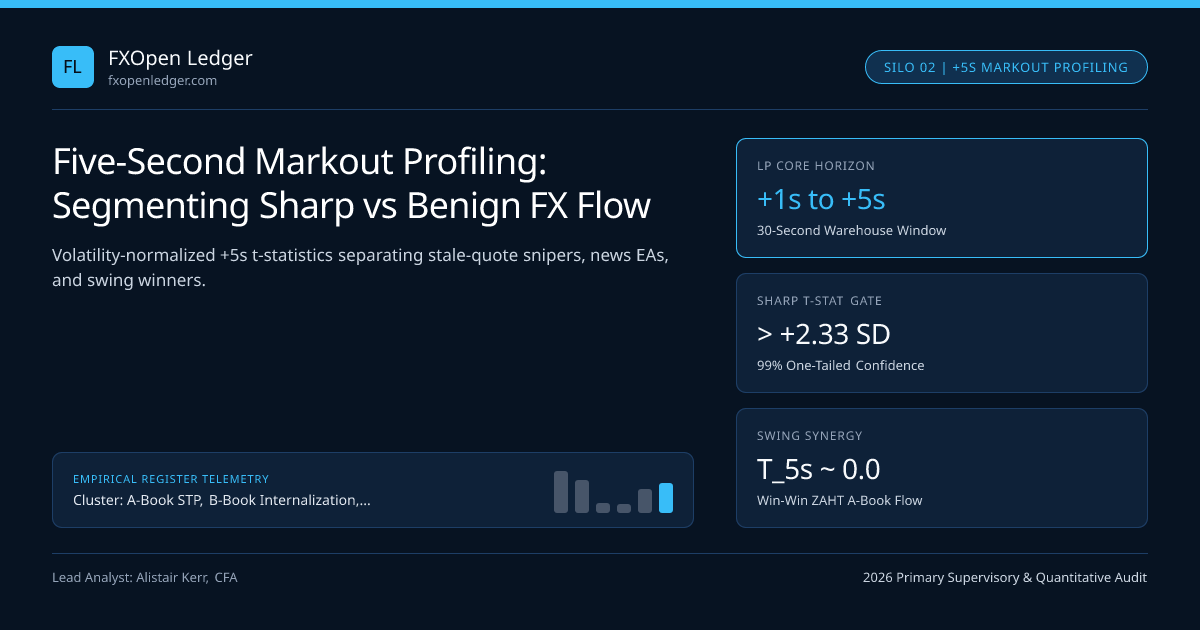
A macro hedge fund that buys EUR/USD at 1.0800 and sells six weeks later at 1.1050 (+250 pips profit!) is frequently welcomed as VIP Tier-1 benign flow by every wholesale FX market maker on Wall Street and Canary Wharf! Conversely, a high-frequency scalper whose monthly net account PnL is barely break-even after commissions can be banned from three liquidity providers within 48 hours. Why? Because automated market makers hedge and recycle inventory on horizons of 5 to 30 seconds, not six weeks! What determines whether an account destroys a liquidity provider's book is its Short-Horizon Post-Trade Markout Profile—specifically at +100ms, +1s, and +5s.
Connected to our A-Book, B-Book & C-Book FX Dealer Architecture guide and indexed inside the A-Book, B-Book & Bridge Routing hub, multi-horizon markout Z-scoring is the universal language spoken between broker risk desks and wholesale LPs.
Distinguishing Latency Snipers, Momentum Chasers & Benign Swing Traders#
By evaluating mid-price displacement simultaneously across four micro-horizons (+50ms, +500ms, +5s, and +60s), dealing-desk data scientists separate incoming accounts into four unmistakable behavioral archetypes:
- Sub-100ms Stale-Quote Sniper (
+50ms > +0.50 bps, flat thereafter): Exploits feed lag between CME futures/NY4 ECNs and a slower retail trade server—analyzed in cross-feed latency arbitrage detection. Toxic to both B-Books AND conditional A-Book LPs! - 1s–5s Order-Flow / News Momentum Sharp (
+50ms ~ 0,+5s > +0.85 bps): Trades genuine short-term breakout momentum or fast news parsing. Profitable over 5–60 seconds; must route 100% to deep firm/ZAHT A-Book pools via Bayesian C-Book profiling. - Long-Horizon Macro / Fundamental Winner (
+5s ~ 0.00 bps,+4h > +15 bps): Harmless to wholesale 30-second LP warehouses (great A-Book flow!), YET dangerous to an unhedged multi-week retail B-Book unless portfolio delta caps externalize the slow trend! - Contrarian Retail Mean-Reverter (
+5s = -0.18 bps, negative spread-adjusted alpha): Fades short-term spikes right into continuing momentum, giving the counterparty immediate positive markout on top of half-spread.
Vol-Normalized Markout t-Statistic Across Heterogeneous Pairs#
Raw pip or basis-point markouts cannot be averaged naively across EUR/USD (daily vol ~ 55 bps) and GBP/JPY or XAU/USD (daily vol ~ 115-140 bps), nor across quiet Tokyo afternoons versus volatile US payroll minutes. Quantitative dealing rooms normalize each trade $k$'s 5-second mid-price drift by concurrent rolling 1-second local volatility $hat{\sigma}{1s}(tk)$ to compute a unitless Volatility-Standardized Markout t-Statistic ($T_{5s}$):
- NotionalWeightedtStat (T5s) = ( Sum{k=1..N} wk * zk ) / sqrt( Sum{k=1..N} w_k^2 )
- Where:
- d_k = +1 for Client Buy, -1 for Client Sell on ticket k
- M(tk) = Independent composite ECN mid-price at execution timestamp tk
- sigma1s(tk)= EWMA 1-second mid-price volatility of that currency pair at t_k
- wk = Ticket USD notional Qk (weighting larger lot sizes proportionally)
- Worked Segmentation Audit (Account #40912, N = 36 Equal-Sized $500k Trades across EUR/USD & XAU/USD):
- Mean normalized 5-second drift z_bar = +0.48 standard deviations per trade:
- T_5s = (36 * 0.48) / sqrt(36 * 1^2) = 17.28 / 6.0 = +2.88 (p = 0.0020 < 0.01!).
- Spread-Adjusted LP 5s Margin: Mean half-spread earned = +0.18 bps; Mean 5s drift = +0.52 bps -> Net = -0.34 bps LOSS!
- Automated Action: Account #40912 exceeds T_5s > 2.33 cutoff -> Promote immediately to 100% Firm A-Book STP!
Routing Matrix: Matching Trader Horizon to Optimal Counterparty Venue#
Look how cleanly multi-horizon markout segmentation resolves the tension between retail brokers—such as City Index, 4XC, and ATG World—and institutional Prime-of-Prime desks (AMB Prime / ALB Prime) under FCA and ASIC execution governance:
| Trader Archetype | +50ms Drift | +5s $T$-Stat | >1h Closed PnL | Optimal Broker Routing | Upstream LP Reception |
|---|---|---|---|---|---|
| Cross-Feed Latency Sniper | +0.65 bps | +6.40 | Highly Positive | Fix Server Quote Lag + Firm CLOB | Rejected / Banned on Conditional Feeds |
| Intraday Breakout EA | +0.04 bps | +2.95 | Moderately Positive | 100% Firm / Speed-Bump ECN STP | Accepted on Firm Anonymous CLOBs |
| Fundamental Swing Winner | -0.02 bps | -0.15 | Strongly Positive | 100% Relationship ZAHT A-Book! | Loved by Tier-1 Bank Warehouses! |
| Retail Range Contrarian | -0.03 bps | -1.85 | Negative (-Spread) | B-Book Warehouse (Inside VaR Cap) | Kept In-House (High Spread Retention) |
Multi-Horizon Markout Decay Profiles by Client Flow Archetype#
Decomposing post-trade mid-price drift from +50 milliseconds out to +60 seconds separates sub-second feed snipers from slower fundamental momentum accounts:
The "Golden Synergy" Trade: Routing Profitable Swing Traders to Tier-1 Bank LPs#
Notice Row 3 in the matrix above—one of the most profitable institutional insights in OTC FX brokerage management! A disciplined fundamental swing trader who holds positions for four days and earns +$120,000 a year is dangerous to a broker's B-Book, yet exhibits T_5s = -0.15 (zero 5-second toxicity!). When the broker routes that swing trader to a Tier-1 relationship ZAHT A-Book stream, the broker locks in risk-free STP markup/swap revenue, AND the upstream Tier-1 bank loves the flow because its automated 30-second SDP warehouse internalizes the fill at +0.18 bps positive 5-second markout!
Frequently asked questions
Why does a Tier-1 FX bank welcome a hedge fund that makes millions on 2-week trends?
A Tier-1 e-FX spot engine typically holds warehoused client risk for 10 to 45 seconds before matching opposing flow; as long as the hedge fund entry does not move the market within 60 seconds, the bank earns steady spread while the fund profits from 2-week macro drift.
Why normalize 5-second markouts by 1-second EWMA volatility instead of measuring raw pips?
A +1.5 pip move in 5 seconds during a calm EUR/USD Asian session is a 5-sigma informed shock, whereas +1.5 pips in GBP/JPY during a BoE press conference is random background noise; volatility normalization weights both accurately.
How does +50ms markout separate broker server misconfiguration from skilled trading?
No human or macro model predicts 50-millisecond ticks without cross-venue arbitrage; if an account posts +0.60 bps markouts at +50ms with zero additional drift from +50ms to +5s, the broker trade server quote feed is lagging primary ECNs.
Can a trader manipulate their +5s markout score to stay on tight LP streams?
Attempting to mask sharp trades by firing decoy random micro-lots fails against notional-weighted t-statistics (w_k = Q_k), which weight $5M sweeps 500x heavier than $10k decoy tickets.
Publication record
- Published
- 14 November 2026
- Updated
- 14 November 2026
- Author
- Alistair Kerr, CFA
- Review
- Review not recorded
- Automated fact check
- Passed in the stored pipeline record
- Source URLs
- 3 recorded
AI assistance recorded: anthropic/claude-opus-4.6. This field does not establish human review or source verification.
Academic & Institutional Attribution
Cite This Research & Embed Live Data Card
Standard academic & institutional research paper citation format.
Alistair Kerr, CFA. (2026, November 14). Five-Second Markout Profiling: Segmenting Sharp vs Benign FX Flow. FXOpen Ledger. https://fxopenledger.com/orderbook/five-second-markout-profiling-to-segment-sharp-vs-benign-fx-flowRelated Abook Bbook Stp Bridge Routing & Institutional Briefings
Explore Abook Bbook Stp Bridge Routing Hub (20) →Abook Bbook Stp Bridge Routing
A-Book STP, B-Book Internalization & C-Book Routing: FX Dealer ArchitectureAbook Bbook Stp Bridge Routing
Quote Skewing vs Spread Widening: OTC FX Dealer Inventory Control MathAbook Bbook Stp Bridge Routing
Cross-Feed Latency Arbitrage Detection on Retail FX & CFD ServersAbook Bbook Stp Bridge Routing
STP Agency Commissions vs All-In Spread Markups: FX Cost DecompositionAbook Bbook Stp Bridge Routing
Holding-Period Cohort Clustering & Time-Decayed B-Book HedgingAbook Bbook Stp Bridge Routing
LP Stream Throttling & Quote-Rate Governors in Institutional FX PoolsAbook Bbook Stp Bridge Routing
Correlated G10 USD Delta Aggregation Across Multi-Pair FX B-BooksAbook Bbook Stp Bridge Routing
XAU/USD Crowd Herding & Loco London Bullion Dealer Hedge TriggersPrime of Prime Nop Credit Intermediation
ISDA 2016 VM-CSA Daily Variation Margin Calls & MTA DisputesPrime of Prime Nop Credit Intermediation
Omnibus Prime-of-Prime Margin Accounts vs Individual Give-UpsPrime of Prime Nop Credit Intermediation
FCA CASS 7 & Title Transfer Collateral Arrangements (TTCA) in PoPPrime of Prime Nop Credit Intermediation
Intraday Credit-Line Throttling & FIX Kill-Switch Governance
FXOpen Ledger Data, Benchmarks & Contributor Records
CC BY 4.0 Open Data
Open Institutional Datasets (CSV / JSON) →
Download desk-compiled quantitative series & schemas.
2026 Reference Matrix
2026 Institutional Benchmarks & Thresholds →
Statutory capital, clearing, margin & rate conventions.
Editorial Records
Authors & Review Records →
View named contributors where those records are available.
Complete Index
Master Research & Dossier Archive →
Browse all published briefings by topic pillar & date.