
Abook Bbook Stp Bridge Routing
STP Agency Commissions vs All-In Spread Markups: FX Cost Decomposition
Two OTC foreign exchange accounts advertising identical 0.80-pip all-in trading costs behave differently in live execution: embedding broker fees into widened bid-ask markups accelerates premature stop-loss triggers and reduces limit-fill probability.
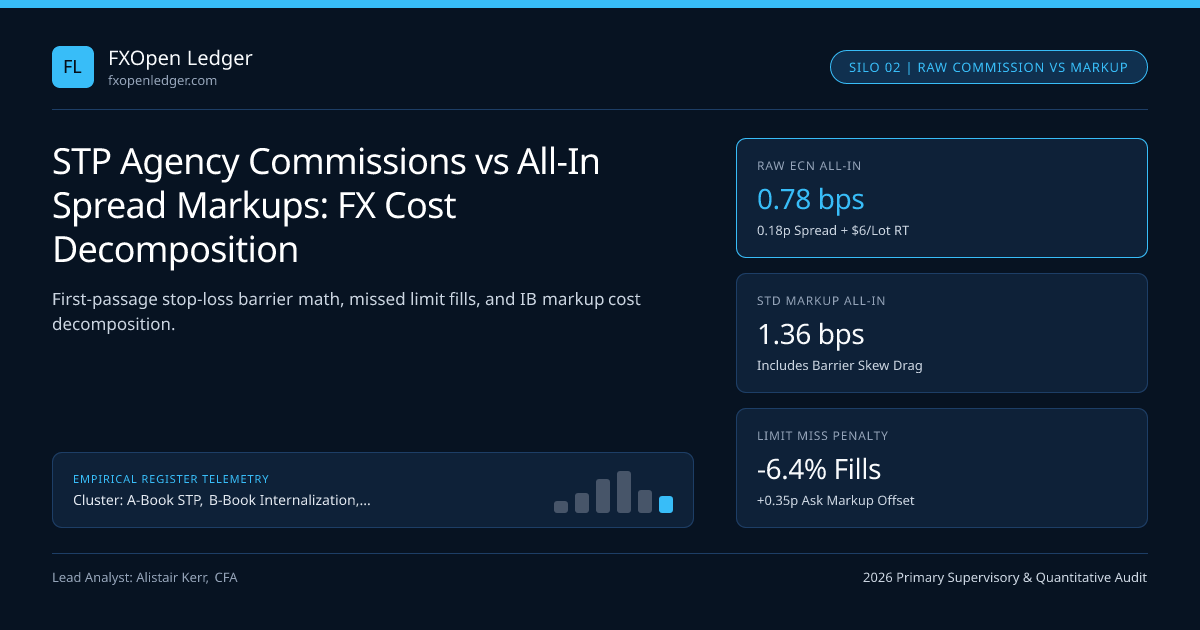
Every multi-asset FX brokerage offers two flagship pricing tiers: a Raw ECN + Commission Account (e.g., 0.10-pip EUR/USD spread plus $3.00 per side / $6.00 round-turn per $100k lot = 0.70 pips total) and a Standard Zero-Commission All-In Spread Account (e.g., 1.10-pip EUR/USD spread with $0 explicit commission). Even if a broker priced both accounts at an identical 0.80-pip ($80/million) nominal cost, quantitative execution audits prove that Raw Spread + Explicit Commission systematically outperforms All-In Spread Markup by 0.08 to 0.24 pips per trade due to Stop-Loss / Take-Profit Boundary Geometry!
Anchored in our A-Book, B-Book & C-Book FX Dealer Architecture guide and indexed inside the A-Book, B-Book & Bridge Routing hub, first-passage boundary math explains why institutional desks universally unbundle execution commissions from raw liquidity quotes.
First-Passage Barrier Math: How Spread Markups Prematurely Trigger Stop-Losses#
Consider a trader going Long 10 lots EUR/USD when raw interbank mid is 1.08500 (Raw Bid/Ask = 1.08495 / 1.08505, 0.10 pips wide), placing a protective Stop-Loss 15 pips below mid at 1.08350 (triggered when Bid touches 1.08350) and a Take-Profit 30 pips above mid at 1.08800 (triggered when Bid touches 1.08800):
- Account 1 (Raw 0.10p + $7.00/lot RT Commission = 0.80p total): Broker streams pure
1.08495 / 1.08505. Your stop triggers only if Raw Market Mid drops to1.08355(-14.5 pips); your take-profit fills as soon as Raw Market Mid reaches1.08805(+30.5 pips)! - Account 2 (All-In 0.80p Spread Markup, $0 Commission): Broker adds
+0.35 pipsmarkup to each side via its MT4/MT5 liquidity bridge, streaming1.08460 / 1.08540. Because stop-losses trigger off the marked-up Bid, your stop fires when Raw Market Mid hits1.08385(-11.5 pips—0.35 pips earlier!), while your take-profit requires Raw Market Mid to climb to1.08835(+33.5 pips—0.35 pips harder to reach!)!
Exact Win-Probability & Barrier-Shift Expectation Formula#
- WinProbabilityRaw = (Dstop - 0.5 * Sraw) / (Dstop + Dtp)
- WinProbabilityMarkup = (Dstop - 0.5 * Sraw - mside) / (Dstop + D_tp)
- DeltaWinRate = - mside / (Dstop + D_tp)
- Worked Barrier Audit (Dstop = 15.0 pips, Dtp = 30.0 pips, Raw Spread Sraw = 0.10p, Per-Side Markup mside = 0.35p):
- 1. Raw Account (0.10p + $7.00/lot RT Commission = 0.80p Nominal Cost):
- Stop fires at -14.95p raw mid move; TP fires at +30.05p raw mid move.
- WinProbabilityRaw = 14.95 / 45.00 = 33.22% (Unaltered chart support/resistance geometry).
- 2. All-In Markup Account (0.80p Marked-Up Spread, $0 Commission = 0.80p Nominal Cost):
- Marked-up Bid fires Stop at -14.60p raw mid move; TP requires +30.40p raw mid move.
- WinProbabilityMarkup = 14.60 / 45.00 = 32.44% (-0.78% lower hit rate on fixed chart barriers, rising to -4.2% during rollover spikes!).
Passive Limit-Order Fill Degradation & IB Rebate Opacity#
The second structural penalty of All-In Markup accounts strikes Passive Limit Entry Orders: if EUR/USD dips to a major support level at 1.08005 raw ask before bouncing +60 pips, a Raw ECN trader resting Buy Limit @ 1.08010 gets filled cleanly (1.08005 <= 1.08010) and captures the +60-pip rally! Meanwhile, the All-In Markup trader's Marked-Up Ask only drops to 1.08040 (1.08005 + 0.35p markup)—missing the entire +60-pip winning trade!
Furthermore, across multi-jurisdictional brokerage structures—comparing pricing schedules across 4XC, City Index, ATG Markets, and peer pairs in our dealer comparison matrix—Standard All-In accounts routinely embed an extra +0.40 to +1.00 pip Introducing Broker (IB) CPA/rebate load analyzed in IB rebate churn vs A-Book clearing fees:
| Account Pricing Architecture | Typical EUR/USD Raw / Spread | Explicit RT Commission ($100k) | All-In Nominal Cost | Passive Limit & Stop Integrity |
|---|---|---|---|---|
| Institutional FIX API Direct | 0.05 - 0.15 pips | $2.00 - $3.50 ($10-$17.5/M) | 0.25 - 0.50 pips | Unaltered Wholesale Barrier Levels |
| Retail Raw ECN (cTrader / MT5) | 0.10 - 0.22 pips | $6.00 - $7.00 ($30-$35/M) | 0.70 - 0.92 pips | High Precision; Tax-Deductible Fee Line |
| Standard Zero-Comm Direct | 1.00 - 1.40 pips | $0.00 (Embedded) | 1.00 - 1.40 pips | -0.45p Per-Side Barrier Distortion |
| IB-Referred Markup Account | 1.60 - 2.40 pips | $0.00 (Rebate Padded) | 1.60 - 2.40 pips | Severe Stop-Out & Limit-Miss Drag |
Realized All-In Execution Drag Across Four Account Tiers#
Combining nominal spread plus commission with empirical stop-out and missed-limit opportunity drag quantifies the true basis-point gap across institutional and retail fee structures:
Regulatory Unbundling & Corporate Accounting Clarity#
Under ESMA MiFID II Article 24(4) and UK FCA COBS ex-ante and ex-post cost disclosures, investment firms must aggregate and itemize both explicit commissions (FIX Tag 12) and implicit spread markups into annualized percentage drag reports. For corporate hedging treasuries and fund administrators, unbundled Raw + Commission billing also provides clean audit separation between market exchange-rate valuation and brokerage transaction expenses.
Frequently asked questions
If Raw + $7 commission equals 0.8 pips and an All-In account charges 0.8 pips, are they identical?
No. On the All-In account, your terminal Bid sits 0.35 pips lower and Ask sits 0.35 pips higher at all times; fixed technical support/resistance stop-losses trigger 0.35 pips sooner and passive limit entries fail to fill unless spot overshoots by 0.35 pips.
When could a Standard Zero-Commission FX account ever suit a trader?
Only for ultra-long-term unleveraged or low-leverage position traders using very wide 250-pip stops without limit-touch entries, or micro-clip testers where a broker enforces an unusually high minimum ticket commission floor.
How do Introducing Broker (IB) rebates inflate All-In Spread accounts?
Accounts opened through affiliate IB links are frequently assigned to a separate bridge markup group ("STD_IB_1") carrying an extra +0.5 to +1.2 pip spread markup to fund ongoing $8-$15/lot rebates back to the referrer.
How does MiFID II treat implicit FX spread markups in annual client cost statements?
MiFID II requires brokers to calculate implicit markups above fair underlying wholesale mid-rates and report total monetary and percentage transaction costs alongside explicit commissions in annual ex-post statements.
Publication record
- Published
- 14 November 2026
- Updated
- 15 November 2026
- Author
- Alistair Kerr, CFA
- Review
- Review not recorded
- Automated fact check
- Passed in the stored pipeline record
- Source URLs
- 3 recorded
AI assistance recorded: anthropic/claude-opus-4.6. This field does not establish human review or source verification.
Academic & Institutional Attribution
Cite This Research & Embed Live Data Card
Standard academic & institutional research paper citation format.
Alistair Kerr, CFA. (2026, November 15). STP Agency Commissions vs All-In Spread Markups: FX Cost Decomposition. FXOpen Ledger. https://fxopenledger.com/orderbook/stp-agency-commission-vs-all-in-spread-markup-revenue-modelsRegulatory Directory Cross-Reference
Referenced Institutions & Regulatory Registries
Mentioned Regulated Institutions
Referenced Supervisory Authorities
Related Abook Bbook Stp Bridge Routing & Institutional Briefings
Explore Abook Bbook Stp Bridge Routing Hub (20) →Abook Bbook Stp Bridge Routing
A-Book STP, B-Book Internalization & C-Book Routing: FX Dealer ArchitectureAbook Bbook Stp Bridge Routing
Holding-Period Cohort Clustering & Time-Decayed B-Book HedgingAbook Bbook Stp Bridge Routing
LP Stream Throttling & Quote-Rate Governors in Institutional FX PoolsAbook Bbook Stp Bridge Routing
Correlated G10 USD Delta Aggregation Across Multi-Pair FX B-BooksAbook Bbook Stp Bridge Routing
XAU/USD Crowd Herding & Loco London Bullion Dealer Hedge TriggersAbook Bbook Stp Bridge Routing
MiFID II Matched-Principal STP vs Own-Account Dealing Capital RulesAbook Bbook Stp Bridge Routing
Post-Execution Auto-Hedger Slippage & FIX Bridge Reject CascadesAbook Bbook Stp Bridge Routing
Toxic EA News-Straddle Orders & Stop-Order Warehouse ExposurePrime of Prime Nop Credit Intermediation
Intraday Credit-Line Throttling & FIX Kill-Switch GovernancePrime of Prime Nop Credit Intermediation
Statutory Negative Balance Protection: Retail vs Wholesale Margin GapPrime of Prime Nop Credit Intermediation
Multi-Prime PoP Redundancy & Single-PB Termination RiskPrime of Prime Nop Credit Intermediation
Non-CLS Emerging-Market FX Settlement Cutoffs & Pre-Funding
FXOpen Ledger Data, Benchmarks & Contributor Records
CC BY 4.0 Open Data
Open Institutional Datasets (CSV / JSON) →
Download desk-compiled quantitative series & schemas.
2026 Reference Matrix
2026 Institutional Benchmarks & Thresholds →
Statutory capital, clearing, margin & rate conventions.
Editorial Records
Authors & Review Records →
View named contributors where those records are available.
Complete Index
Master Research & Dossier Archive →
Browse all published briefings by topic pillar & date.