
Abook Bbook Stp Bridge Routing
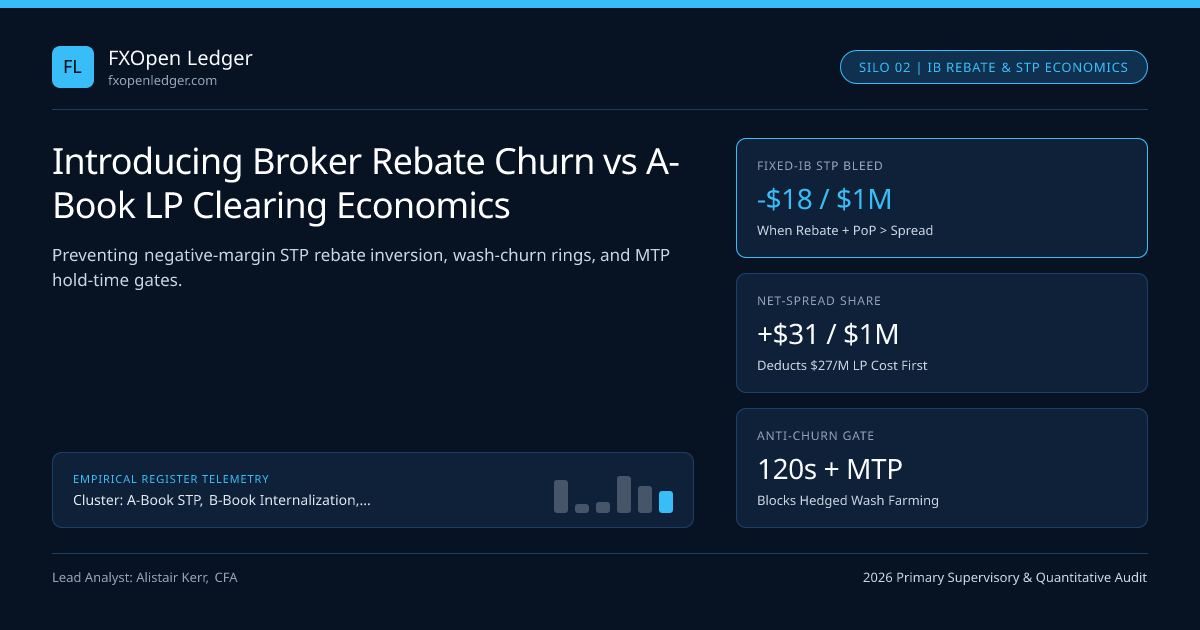
Introducing Broker Rebate Churn vs A-Book LP Clearing Economics
Paying generous per-lot Introducing Broker rebates on accounts routed to A-Book STP can invert dealing-desk unit economics into guaranteed net losses whenever rebate plus Prime-of-Prime clearing exceeds gross spread.
One of the fastest ways an expanding retail FX brokerage bleeds six figures per month—without suffering a single adverse market move!—is Negative Unit-Economics Inversion Between Introducing Broker (IB) Rebates and A-Book STP Clearing Costs. Marketing teams routinely sign aggressive master-IB agreements paying $8.00 to $12.00 per standard lot ($80–$120 per $1M) on "Standard 1.2-pip accounts," assuming those accounts will stay in the B-Book. The moment an automated risk rule flips a high-volume IB-referred scalper to 100% A-Book STP, the broker suddenly pays $100/M in IB rebates + $28/M in wholesale LP spread & PoP brokerage + $12/M in payment-gateway/platform fees = $140/M total cost while collecting only $120/M (1.2 pips) in gross client spread—losing -$20 on every million dollars traded!
Linked to our A-Book, B-Book & C-Book FX Dealer Architecture guide and cataloged in the A-Book, B-Book & Bridge Routing hub, institutional commercial teams tie IB rebate schedules directly to real-time bridge routing cost floors.
Wash-Trading Rebate-Churn Rings & Minimum-Hold-Time Clauses#
Predatory rebate-arbitrage rings actively weaponize generous fixed-per-lot IB payouts:
- Zero-Risk Hedged Rebate Churn: An unscrupulous IB opens two accounts under their referral link (or pairs with a second broker), going Long 20 lots EUR/USD in Account 1 and Short 20 lots EUR/USD in Account 2 during calm
0.9-pipspreads, closing 45 seconds later! If the IB rebate is1.0 pip ($10/lot)per account, the ring pays1.8 pipstotal spread across the two legs while collecting2.0 pipsin cash IB rebates—extracting+$4.00/lotrisk-free while churning 500 lots/day! - A-Book Scalper Rebate Inversion: Legitimate high-frequency EAs referred via cashback portals trigger five-second markout STP routing, turning every filled lot into a net cash subsidy paid by the broker's balance sheet!
Exact Unit-Economics Floor Equation for IB-Referred STP Accounts#
To guarantee every single A-Book or C-Book trade remains contribution-margin positive—extending our STP agency commission vs markup revenue model—treasury controllers enforce a hard mathematical ceiling on IB rebates whenever an account's externalization ratio $h_i > 0$:
- Minimum Required Client Markup on 100% A-Book Account (hi = 1.0) for Target Net Margin Mtarget:
- Markupmin ($/M) = LPEffectiveSpread + PoPTicketFee + BridgeVolFee + IBRebatePaid + Mtarget
- Worked Rebate-Inversion Audit (EUR/USD Standard Account: 1.1 pips = $110/M Gross Revenue; IB Contract = $9.50/lot = $95/M):
- 1. Unchecked Legacy Fixed-Lot Rebate After Account Flips to 100% A-Book (h_i = 1.0):
- Wholesale LP Spread = $16/M (0.16p) + PoP Clearing = $8/M + Bridge Fee = $3/M -> Total Direct STP Cost = $27/M.
- Net Broker Contribution = $110 (Gross) - $27 (STP) - $95 (IB Rebate) - $6 (PSP) = -$18.00 / $1M NET LOSS!
- On $400M/month of churned EA volume, the broker loses -$7,200/month in hard cash despite 100% hedged market risk!
- 2. Dynamic Net-Spread-Share Rebate Rule (IB = 55% of [Gross Client Rev - Direct STP Cost]):
- Net Spread Pool = $110 - $27 = $83/M -> IB Rebate = 0.55 * $83 = $45.65/M ($4.56/lot).
- Net Broker Contribution = $83.00 - $45.65 - $6.00 = +$31.35 / $1M (+$12,540/month positive profit!).
Supervisory Inducement Restrictions & Commercial Rebate Models#
Crucially, regulatory rules on Inducements and Volume-Based Conflicts of Interest differ sharply across jurisdictions! Under UK FCA COBS, ESMA MiFID II Article 24(9), CySEC Circular C168, and ASIC conflicted-remuneration rules—examined further in execution-venue conflicts-of-interest disclosures—firms like 4XC, ATG World, Blue Suisse, and BOSSA face strict controls on paying volume-linked rebates that incentivize churning retail accounts:
| Commercial Channel Model | IB / Partner Remuneration | STP Margin Inversion Risk | EU / UK / ASIC Regulatory Status | Anti-Churn Structural Safeguard |
|---|---|---|---|---|
| Raw ECN + Explicit Markup Share | % of Disclosed Markup/Comm Only | Zero (Scales Linearly w/ Net) | Permitted w/ Ex-Ante Disclosure | Rebate Cannot Exceed Markup Added |
| Net-Revenue / Net-Spread Share | 40%-60% of (Gross - LP Cost) | Zero (LP Costs Deducted First) | Permitted Under Strict Non-Advisory | Automatically Adjusts on A-Book Flip |
| Uncapped Fixed $/Lot Standard | Fixed $8-$12/lot Regardless of Book | Severe (-$18/M on STP Flip!) | Restricted / Banned if Churn-Inducing | Requires >180s Hold + STP Rebate Tier |
| CPA (Cost Per Acquisition) | One-Time Qualified Funded Fee | Zero Per-Lot Wash-Trade Incentive | Strictly Regulated in EU/UK Retail | Minimum Deposit + Genuine Activity Gate |
Net Contribution Margin Across Fixed vs Net-Spread Rebate Schedules#
Auditing realized per-million contribution across B-Book, flipped A-Book, and wash-churn scenarios demonstrates why deducting wholesale STP clearing before partner splits is mandatory:
Implementing the "MTP + Minimum Hold" Anti-Churn Gate#
Modern CRM and rebate engines enforce two deterministic anti-churn filters in partner agreements: Minimum Hold Duration (>= 120 seconds) and Minimum Trade Pips (MTP >= 2.0 pips absolute open-to-close price change). Why add MTP alongside hold time? Because sophisticated wash-trade rings simply hold two opposing EUR/USD accounts open for 4 minutes during a quiet Asian session where spot barely moves 0.3 pips, then close both legs! Requiring either >= 180 seconds unhedged exposure or an absolute market price move exceeding 2x the spread eliminates artificial rebate farming while paying 100% rebates on every genuine trade.
Frequently asked questions
How can an FX broker lose money on a 100% hedged A-Book STP client?
If the client trades on a 1.1-pip ($110/M) account tied to a $95/M Introducing Broker rebate, adding $27/M in wholesale LP spread plus Prime-of-Prime clearing fees and $6/M in PSP costs pushes total broker expenses to $128/M—losing -$18 per million traded.
What is wash-trading rebate churn in retail forex?
Rebate churn occurs when traders or unscrupulous IBs open simultaneous equal-and-opposite long and short positions across one or two accounts solely to generate lot volume and collect per-lot cashback rebates higher than the net bid-ask spread.
What is a Minimum Trade Pips (MTP) clause in an IB agreement?
An MTP clause requires the closing price of a trade to differ from its opening price by at least a specified threshold (e.g., 1.5 to 2.5 pips) to qualify for partner rebates, blocking riskless flat-market wash trades.
How do FCA, ESMA, and CySEC regulate Introducing Broker rebates?
Under MiFID II Article 24(9) inducement rules and CySEC Circular C168, payments to third parties must be transparently disclosed, enhance service quality, and never create a conflict of interest encouraging excessive client trading.
Publication record
- Published
- 14 November 2026
- Updated
- 15 November 2026
- Author
- Alistair Kerr, CFA
- Review
- Review not recorded
- Automated fact check
- Passed in the stored pipeline record
- Source URLs
- 3 recorded
AI assistance recorded: anthropic/claude-opus-4.6. This field does not establish human review or source verification.
Academic & Institutional Attribution
Cite This Research & Embed Live Data Card
Standard academic & institutional research paper citation format.
Alistair Kerr, CFA. (2026, November 15). Introducing Broker Rebate Churn vs A-Book LP Clearing Economics. FXOpen Ledger. https://fxopenledger.com/orderbook/introducing-broker-rebate-churn-vs-abook-lp-clearing-feesRegulatory Directory Cross-Reference
Referenced Institutions & Regulatory Registries
Mentioned Regulated Institutions
Related Abook Bbook Stp Bridge Routing & Institutional Briefings
Explore Abook Bbook Stp Bridge Routing Hub (20) →Abook Bbook Stp Bridge Routing
A-Book STP, B-Book Internalization & C-Book Routing: FX Dealer ArchitectureAbook Bbook Stp Bridge Routing
FCA, ASIC & CySEC Execution-Venue Conflicts-of-Interest DisclosuresAbook Bbook Stp Bridge Routing
Shadow A-Book Paper-Hedging Analytics for Dealing-Desk CalibrationAbook Bbook Stp Bridge Routing
MT4/MT5 Liquidity Bridge Topology: FIX Routing Latency & Markup AuditAbook Bbook Stp Bridge Routing
B-Book Risk Warehouse VaR Limits: Modeling Client PnL Tail VarianceAbook Bbook Stp Bridge Routing
Hybrid C-Book Alpha Profiling: Partial Delta Hedging & MultipliersAbook Bbook Stp Bridge Routing
VPIN Toxicity Scoring in Multi-Dealer FX Aggregators & Liquidity PoolsAbook Bbook Stp Bridge Routing
Five-Second Markout Profiling: Segmenting Sharp vs Benign FX FlowPrime of Prime Nop Credit Intermediation
Offshore Broker (Mauritius, Seychelles, BVI) PoP Onboarding KYBPrime of Prime Nop Credit Intermediation
Evaluating PoP Counterparty Solvency: ICARA, MIFIDPRU & AuditsTom Next Swap Rollover Triple Wednesday
Spot FX T+2 Settlement Calendar & Wednesday Triple-Rollover MechanicsTom Next Swap Rollover Triple Wednesday
USD/CAD & USD/TRY T+1 Settlement: The Thursday Triple-Swap Rule
FXOpen Ledger Data, Benchmarks & Contributor Records
CC BY 4.0 Open Data
Open Institutional Datasets (CSV / JSON) →
Download desk-compiled quantitative series & schemas.
2026 Reference Matrix
2026 Institutional Benchmarks & Thresholds →
Statutory capital, clearing, margin & rate conventions.
Editorial Records
Authors & Review Records →
View named contributors where those records are available.
Complete Index
Master Research & Dossier Archive →
Browse all published briefings by topic pillar & date.