
Abook Bbook Stp Bridge Routing
Shadow A-Book Paper-Hedging Analytics for Dealing-Desk Calibration
Changing C-Book routing thresholds on live dealer instinct wastes millions; Shadow A-Book simulation engines replay every historical trade against recorded L2 wholesale depth to prove counterfactual net PnL.
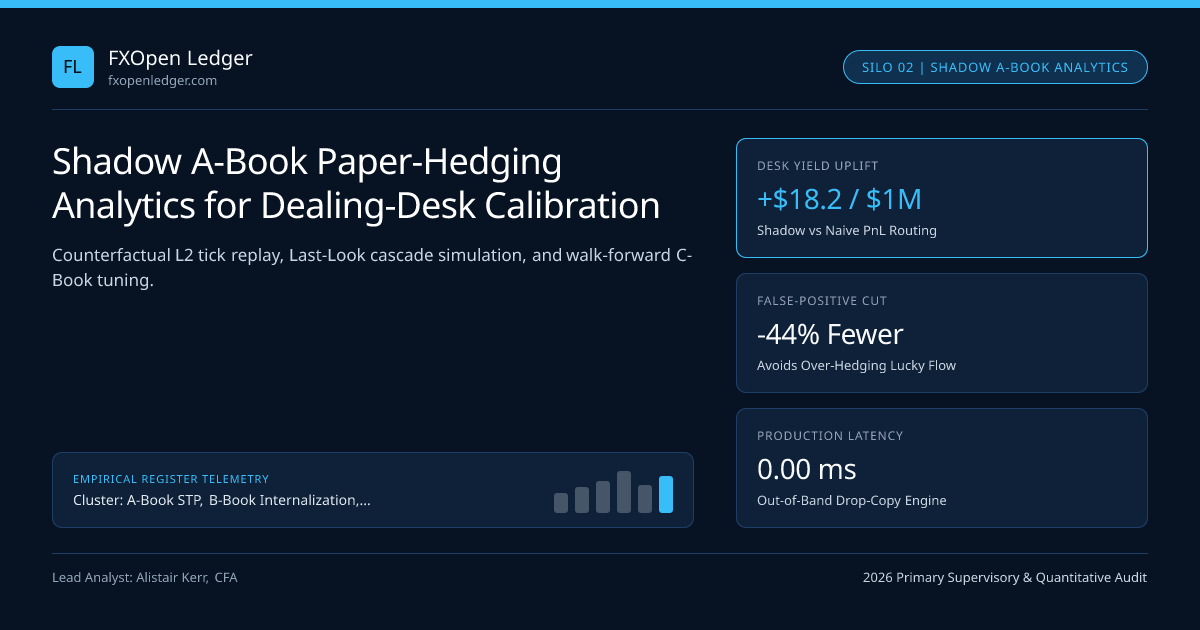
Every Monday morning, FX risk committees debate the same counterfactual question: "Did our C-Book hedge rules externalize too much benign flow last month—or keep too many sharp accounts inside the B-Book?" Answering that question by comparing realized B-Book PnL against naive mid-price charts overstates A-Book profitability by 30% to 55% because mid-price charts ignore wholesale half-spreads, L2 VWAP sweep impact, Prime-of-Prime ticket fees, and asymmetric Last-Look rejections! Institutional dealing desks resolve routing calibration scientifically using a Shadow A-Book Paper-Hedging Simulator—a parallel telemetry engine that records real-time L2 wholesale liquidity ticks alongside every live client trade to compute exact Counterfactual STP Net PnL down to the basis point.
Connected to our A-Book, B-Book & C-Book FX Dealer Architecture guide and indexed inside the A-Book, B-Book & Bridge Routing hub, Shadow A-Book backtesting prevents over-hedging false positives and under-hedging stealth alpha.
Why Naive "Client PnL Reversal" Fails as an A-Book Counterfactual#
Novice dealing desks assume that if Client X made +$42,000 in the B-Book over 90 days, routing Client X to A-Book would have saved the broker $42,000 plus commission! In reality, three real-world execution frictions separate theoretical mid-price hedging from live STP execution:
- Spread + Clearing Drag Can Exceed Modest Client Profit: Suppose Client X traded
$2,500 Millionof high-turnover scalping volume to earn that+$42,000(+$16.80/M), while the broker already earned$85/Mgross spread—leaving the B-Book net profitable by+$68.20/M(+$170,500)! Had the desk routed Client X to A-Book paying$29/Mwholesale STP cost, broker net yield would have dropped from+$68.20/Mto+$56.00/M—costing the desk-$30,500in lost margin! - Simulated Last-Look Reject Replay: During NFP spikes, post-execution auto-hedgers suffer
35%–50%Last-Look rejects; Shadow A-Book engines apply empirical LP reject curves (drift > tolerance -> re-price at t + 20ms) so simulated hedges include realistic cascade slippage. - IB Rebate Interaction: Shadow engines deduct account-specific IB rebate schedules automatically on every replayed ticket.
The Counterfactual Regret Equation & Confusion Matrix#
For every historical account $i$ over a rolling 30-day evaluation window, the Shadow A-Book engine compares Realized B-Book Desk PnL against Simulated Shadow-STP Desk PnL to classify every routing decision into a 2x2 Routing Confusion Matrix (True Sharp, False Positive Lucky, True Benign, False Negative Stealth Toxic):
- ShadowSTPNeti = GrossSpreadSwapRevi - (SimulatedLPVWAPSlipi + PoPClearingi + RejectCascadeEsti) - IBRebatei
- RoutingRegretUSDi = ShadowSTPNeti - BBookDeskNet_i
- = ClientGrossTradingPnLi - (SimulatedLPVWAPSlipi + PoPClearingi + RejectCascadeEst_i)
- Optimal Rule: Externalize Account i to A-Book IFF E[ClientGrossTradingPnLi / Volumei] > ShadowAllInSTPCostper_M!
- Worked 30-Day Shadow Calibration Audit across Two "Profitable" Client Accounts ($100M Monthly Volume Each):
- Account 1 ("Lucky High-Volume Day Trader"):
- Client Gross Trading Profit = +$1,900 (+$19/M); Shadow All-In STP Cost (LP spread + PoP + Cascade) = $31/M ($3,100).
- Routing_Regret = $1,900 - $3,100 = -$1,200! Keeping Account 1 in B-Book beats A-Book STP by +$1,200 (+$12/M)!
- Account 2 ("Stealth API Scalper Currently Down -$400 Due to One Fat-Finger Trade"):
- Headline Net PnL = -$400 (Looks harmless to naive PnL filter!), YET +5s Markout Alpha = +$54/M ($5,400 expected)!
- Shadow Walk-Forward Replay predicts +$5,400 - $31/M ($3,100) = +$2,300/100M saved by immediate A-Book promotion!
Routing Confusion Matrix & Calibration Benchmarks Across Cohorts#
Quantitative risk teams at institutional multi-asset venues—benchmarked across firms in our regulated dealers directory such as City Index, AMB Prime, 4XC, and Blue Suisse—evaluate C-Book rules quarterly using out-of-sample walk-forward validation rather than in-sample curve fitting:
| Confusion Matrix Quadrant | Account Empirical Reality | Naive PnL > 0 Rule Mistake | Shadow A-Book Engine Action | Desk Margin Impact ($ / $1M) |
|---|---|---|---|---|
True Sharp (Alpha > C_stp) | Genuine +5s markout > +$31/M | Slow (Waits for big drawdown) | Promotes in ~18 trades via Markout | Saves +$23 to +$65 / $1M |
False Positive (0 < Alpha < C_stp) | Modest winner (+$15/M < $31/M STP) | Over-hedges 100% to A-Book! | Retains in VaR-capped C/B-Book | Recaptures +$12 to +$18 / $1M |
False Negative (PnL < 0, Sharp Entry) | Sharp entry masked by 1 wide loss | Leaves 100% unhedged in B-Book! | Flags +0.45 bps 5s markout | Prevents future -$45/M shock |
True Benign (Alpha < 0) | Uninformed retail noise (-$42/M) | Correctly internalizes | Keeps 100% B-Book + 20s netting | Preserves full $85-$120 / $1M |
Walk-Forward Desk Yield & Sharpe Uplift From Shadow L2 Replay#
Out-of-sample 90-day evaluations across $4.2 billion of multi-asset flow quantify the exact revenue and Sharpe gains of full Level-2 counterfactual calibration:
Deploying Shadow A-Book on Read-Only Drop-Copy Streams#
Because a Shadow A-Book simulator subscribes strictly to read-only FIX Drop-Copy (35=8 / 35=AE) and passive market-data streams stored in ClickHouse, TimescaleDB, or kdb+, it introduces 0.0 microseconds of latency to the live production execution path and zero compliance friction under FCA, ASIC, and CySEC conduct rules. Furthermore, running parallel shadow profiles across candidate upstream Prime-of-Prime feeds lets liquidity managers test a prospective new LP's real L2 depth and hold-time behavior for 30 days on paper before committing a single dollar of live margin collateral.
Frequently asked questions
What is a Shadow A-Book simulator on an institutional FX dealing desk?
A Shadow A-Book is a read-only analytical engine that takes every live B-Book and C-Book client order and simulates what exact fill price, LP fee, and Last-Look rejection rate would have occurred had that trade been hedged live on wholesale ECN feeds.
Why shouldn’t a dealing desk route every profitable client account to A-Book?
If a high-turnover trader earns +$18 per million traded while paying $95/M in spread, the broker still nets +$77/M in B-Book; routing that trader to A-Book at $31/M wholesale clearing cost actually reduces broker net profit to +$64/M!
Does running Shadow A-Book analytics affect client order execution or latency?
No. Shadow A-Book operates asynchronously out-of-band using passive FIX Drop-Copy execution reports and archived market-data ticks in a time-series database (such as kdb+ or ClickHouse), adding zero latency to live orders.
How do liquidity managers use Shadow A-Book to evaluate new Liquidity Providers?
Before funding a new LP margin account, desks pipe the prospective LP live FIX market-data stream into the Shadow simulator for 30 days to measure realistic L2 VWAP depth across actual historical client clip sizes.
Publication record
- Published
- 14 November 2026
- Updated
- 14 November 2026
- Author
- Alistair Kerr, CFA
- Review
- Review not recorded
- Automated fact check
- Passed in the stored pipeline record
- Source URLs
- 3 recorded
AI assistance recorded: anthropic/claude-opus-4.6. This field does not establish human review or source verification.
Academic & Institutional Attribution
Cite This Research & Embed Live Data Card
Standard academic & institutional research paper citation format.
Alistair Kerr, CFA. (2026, November 14). Shadow A-Book Paper-Hedging Analytics for Dealing-Desk Calibration. FXOpen Ledger. https://fxopenledger.com/orderbook/shadow-abook-paper-hedging-analytics-for-dealing-desk-calibrationRegulatory Directory Cross-Reference
Referenced Institutions & Regulatory Registries
Mentioned Regulated Institutions
Related Abook Bbook Stp Bridge Routing & Institutional Briefings
Explore Abook Bbook Stp Bridge Routing Hub (20) →Abook Bbook Stp Bridge Routing
A-Book STP, B-Book Internalization & C-Book Routing: FX Dealer ArchitectureAbook Bbook Stp Bridge Routing
MT4/MT5 Liquidity Bridge Topology: FIX Routing Latency & Markup AuditAbook Bbook Stp Bridge Routing
B-Book Risk Warehouse VaR Limits: Modeling Client PnL Tail VarianceAbook Bbook Stp Bridge Routing
Hybrid C-Book Alpha Profiling: Partial Delta Hedging & MultipliersAbook Bbook Stp Bridge Routing
VPIN Toxicity Scoring in Multi-Dealer FX Aggregators & Liquidity PoolsAbook Bbook Stp Bridge Routing
Five-Second Markout Profiling: Segmenting Sharp vs Benign FX FlowAbook Bbook Stp Bridge Routing
Quote Skewing vs Spread Widening: OTC FX Dealer Inventory Control MathAbook Bbook Stp Bridge Routing
Cross-Feed Latency Arbitrage Detection on Retail FX & CFD ServersTom Next Swap Rollover Triple Wednesday
Spot FX T+2 Settlement Calendar & Wednesday Triple-Rollover MechanicsTom Next Swap Rollover Triple Wednesday
USD/CAD & USD/TRY T+1 Settlement: The Thursday Triple-Swap RuleTom Next Swap Rollover Triple Wednesday
Covered Interest Parity to Interbank Tom-Next Pips DerivationTom Next Swap Rollover Triple Wednesday
Retail FX Dealer Long/Short Swap Markup Asymmetry Benchmark
FXOpen Ledger Data, Benchmarks & Contributor Records
CC BY 4.0 Open Data
Open Institutional Datasets (CSV / JSON) →
Download desk-compiled quantitative series & schemas.
2026 Reference Matrix
2026 Institutional Benchmarks & Thresholds →
Statutory capital, clearing, margin & rate conventions.
Editorial Records
Authors & Review Records →
View named contributors where those records are available.
Complete Index
Master Research & Dossier Archive →
Browse all published briefings by topic pillar & date.