
Abook Bbook Stp Bridge Routing
B-Book Risk Warehouse VaR Limits: Modeling Client PnL Tail Variance
Internalizing uninformed retail foreign exchange flow yields high average spread capture, yet fat-tailed crowd herding combined with statutory Negative Balance Protection creates asymmetric left-tail ruin risk without strict intraday VaR caps.
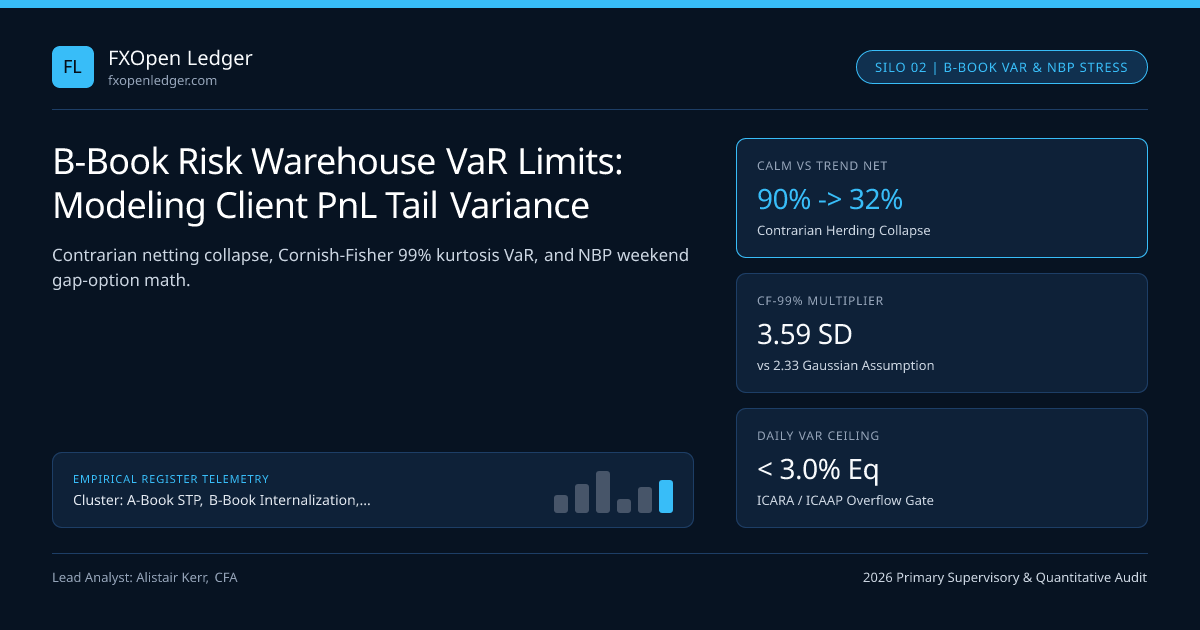
Why do dozens of under-capitalized offshore and mid-tier CFD brokerages suffer sudden solvency crises every three to five years despite posting 75% profitable trading days? The mathematical trap lies in Asymmetric B-Book Payoff Convexity: when retail accounts trade small random clips inside range-bound EUR/USD markets, natural client-versus-client netting absorbs 65% to 82% of gross volume and the dealing desk collects steady bid-ask spread plus overnight financing. Yet during a sustained 4-sigma macro breakout—or a weekend gap where Statutory Negative Balance Protection (NBP) caps client losses at deposited equity while surviving winning accounts claim uncapped profits—an unhedged B-Book warehouse behaves like a short out-of-the-money volatility strangle!
Grounded in our A-Book, B-Book & C-Book FX Dealer Architecture guide and housed inside the A-Book, B-Book & Bridge Routing hub, institutional risk managers govern B-Book warehouses using Cornish-Fisher Expected Shortfall (ES) and hard symbol-level auto-hedge ceilings.
Natural Internal Netting Ratios vs Crowd Herding Breakdown#
During normal diffusive sessions across a diversified 15,000-account brokerage book, roughly $54%$ of clients hold long EUR/USD and $46%$ hold short EUR/USD, yielding an Internal Netting Efficiency of $1 - |L - S| / (L + S) = 92%$! That means $100 million of gross client exposure leaves only $8 million of residual net currency delta on the house balance sheet.
However, retail traders systematically exhibit Contrarian Mean-Reversion Herding: whenever GBP/USD drops 180 pips intraday or XAU/USD breaks to an all-time high, retail net positioning rapidly skews to 84% one-way—collapsing internal netting from 92% down to just 32% at the exact moment currency volatility doubles!
Cornish-Fisher Tail VaR + NBP Gap-Option Capital Equation#
Standard Gaussian Value-at-Risk ($1.645 \sigma$ or $2.326 \sigma$) severely underestimates FX dealing-desk tail loss because spot currency returns exhibit excess kurtosis ($\kappa > 6$) AND statutory NBP grants losing leveraged accounts a free put/call floor at zero equity! Under UK FCA ICARA and EU ICAAP supervisory stress modeling, risk quants compute NBP-Adjusted 99% Tail Capital:
- zCF99 = 2.326 + (Sskew / 6)*(2.326^2 - 1) + (Kexcess / 24)(2.326^3 - 32.326) - (S_skew^2 / 36)(22.326^3 - 5*2.326)
- DailyWarehouseTailRisk = |NetDeltaUSD| * sigmadaily * zCF99 + Sum{winningside} Max(0, GrossWinAccountEquityJump - LosingSideMargin_Cap)
- Worked Stress Audit (Broker Own Funds = $12.0M; Max Permitted Daily Tail Loss = 3.0% Equity = $360,000):
- Client Ledger: $42M Long GBP/USD vs $12M Short GBP/USD -> Dealer Net Short = -$30.0M GBP/USD.
- Daily GBP/USD vol sigmadaily = 0.72%; Skew Sskew = 0.35; Excess Kurtosis K_excess = 4.50:
- zCF99 = 2.326 + 0.0583(4.41) + 0.1875(5.61) - 0.0034*(13.55) = 2.326 + 0.257 + 1.052 - 0.046 = 3.589! (vs 2.326 Normal!)
- Unhedged 99% Tail Risk (before NBP jump) = $30.0M * 0.0072 * 3.589 = $775,224 (6.46% of Own Funds -> BREACH!).
- Required Auto-Hedge Overflow: Externalize $16.1M to PoP A-Book, capping retained B-Book Net Short at $13.9M ($359,100 VaR).
Supervisory Prudential Governance Across Jurisdictions#
Prudential examiners at the UK FCA (MIFIDPRU / ICARA), CySEC (IFR K-NPR), ASIC, and FINMA require regulated dealing desks—such as multi-asset houses tracked across City Index, BOSSA, and Blue Suisse—to maintain automated pre-trade and post-trade net-open-position triggers tied directly to audited regulatory capital:
| Prudential Risk Tier | Max Single-Pair Net Delta (% Own Funds) | Aggregate Portfolio 99%CF-VaR Cap | NBP Weekend Gap Stress Buffer | Automated Breach Action |
|---|---|---|---|---|
| Tier-1 Publicly Listed Dealer | 25% - 40% of CET1 Capital | < 1.5% Daily CET1 | 8% G10 / 15% EM Jump Test | Automated TWAP/IOC PoP Hedge |
| Mid-Size EU/UK 750k Firm | 60% - 100% of Own Funds | < 3.0% Daily Own Funds | 5% G10 / 12% XAU Jump Test | Instant XCore Overflow STP Switch |
| Conservative C-Book Hybrid | 30% - 50% of Own Funds | < 2.0% Daily Own Funds | Paired w/ ISDA VM-CSA Margin | Dynamic Quote Skew + 75% Hedge |
| Unhedged Offshore B-Book | Often > 500% of Thin Equity! | Unmonitored (High Insolvency Risk) | Zero NBP Buffer | Frequent Withdrawal Freeze / Ruin |
Stress-Testing Tail Loss Under Fat-Tailed & NBP Gap Regimes#
Comparing naive Gaussian risk assumptions against kurtosis-adjusted Cornish-Fisher quantiles and weekend gap-option liabilities demonstrates why static position caps require automated bridge overflow:
Pairing Multi-Pair Correlation Matrices With NBP Margin Ladders#
Notice the vital interaction between retail leverage caps (30:1 = 3.33% initial margin in UK/EU/Australia vs 500:1 = 0.20% margin offshore) and B-Book NBP risk! If EUR/CHF or USD/JPY gaps 4.5% over a weekend, a 30:1 regulated account goes negative by only 1.17% of notional, whereas a 500:1 offshore account goes negative by 4.30% of notional—wiping out an unhedged offshore B-Book overnight! Consequently, institutional risk teams combine correlated G10 USD delta aggregation and gold XAU/USD crowd herding triggers with Friday afternoon tiered margin step-ups.
Frequently asked questions
Why do contrarian retail FX traders increase B-Book risk during strong trends?
Retail traders overwhelmingly fade breakouts—buying falling currencies and shorting rising ones; during a multi-week central bank trend without mean reversion, 80%+ of clients pile onto the losing side until a sudden reversal or NBP gap creates massive concentrated exposure.
How does Negative Balance Protection (NBP) hurt a hedged or B-Book broker on price gaps?
If half of clients are long at 100:1 leverage (1% margin) and half are short during a 4% weekend jump, winning longs earn +4% from the broker while losing shorts lose only their 1% margin deposit—leaving the broker a -3% net deficit despite a "flat" book!
What is K-NPR under EU IFR and UK FCA IFPR prudential rules?
K-NPR (Net Position Risk) is the mandatory regulatory capital requirement calculated on the net open foreign exchange, commodity, and equity positions warehoused on an investment firm own B-Book balance sheet.
How fast do automated B-Book VaR overflow hedges execute?
Liquidity bridges continuously recalculate net USD and symbol delta on every tick; the instant net B-Book exposure crosses a configured ceiling (e.g., $10M EUR/USD), the bridge fires an automated IOC or short-TWAP hedge to upstream PoP LPs in under 50ms.
Publication record
- Published
- 14 November 2026
- Updated
- 14 November 2026
- Author
- Alistair Kerr, CFA
- Review
- Review not recorded
- Automated fact check
- Passed in the stored pipeline record
- Source URLs
- 3 recorded
AI assistance recorded: anthropic/claude-opus-4.6. This field does not establish human review or source verification.
Academic & Institutional Attribution
Cite This Research & Embed Live Data Card
Standard academic & institutional research paper citation format.
Alistair Kerr, CFA. (2026, November 14). B-Book Risk Warehouse VaR Limits: Modeling Client PnL Tail Variance. FXOpen Ledger. https://fxopenledger.com/orderbook/bbook-risk-warehouse-var-limits-and-client-pnl-tail-varianceRegulatory Directory Cross-Reference
Referenced Institutions & Regulatory Registries
Mentioned Regulated Institutions
Related Abook Bbook Stp Bridge Routing & Institutional Briefings
Explore Abook Bbook Stp Bridge Routing Hub (20) →Abook Bbook Stp Bridge Routing
A-Book STP, B-Book Internalization & C-Book Routing: FX Dealer ArchitectureAbook Bbook Stp Bridge Routing
Hybrid C-Book Alpha Profiling: Partial Delta Hedging & MultipliersAbook Bbook Stp Bridge Routing
VPIN Toxicity Scoring in Multi-Dealer FX Aggregators & Liquidity PoolsAbook Bbook Stp Bridge Routing
Five-Second Markout Profiling: Segmenting Sharp vs Benign FX FlowAbook Bbook Stp Bridge Routing
Quote Skewing vs Spread Widening: OTC FX Dealer Inventory Control MathAbook Bbook Stp Bridge Routing
Cross-Feed Latency Arbitrage Detection on Retail FX & CFD ServersAbook Bbook Stp Bridge Routing
STP Agency Commissions vs All-In Spread Markups: FX Cost DecompositionAbook Bbook Stp Bridge Routing
Holding-Period Cohort Clustering & Time-Decayed B-Book HedgingPrime of Prime Nop Credit Intermediation
Four-Way FXPB Designation Notices & Traiana Harmony Give-UpsPrime of Prime Nop Credit Intermediation
CLS PvP Settlement vs Bilateral Netting & Herstatt Risk in OTC FXPrime of Prime Nop Credit Intermediation
SNB EUR/CHF Flash-Crash Contagion & Negative-Balance ControlsPrime of Prime Nop Credit Intermediation
ISDA 2016 VM-CSA Daily Variation Margin Calls & MTA Disputes
FXOpen Ledger Data, Benchmarks & Contributor Records
CC BY 4.0 Open Data
Open Institutional Datasets (CSV / JSON) →
Download desk-compiled quantitative series & schemas.
2026 Reference Matrix
2026 Institutional Benchmarks & Thresholds →
Statutory capital, clearing, margin & rate conventions.
Editorial Records
Authors & Review Records →
View named contributors where those records are available.
Complete Index
Master Research & Dossier Archive →
Browse all published briefings by topic pillar & date.