
FX Global Code Last Look Execution
Zero Additional Hold Time (ZAHT) in FX Streams: Engineering & Audit Guide
Zero Additional Hold Time (ZAHT) eliminates artificial pause timers in OTC foreign exchange last-look checks, yet execution quality still depends on whether the LP anchors price validation at network ingress or post-queue engine evaluation.
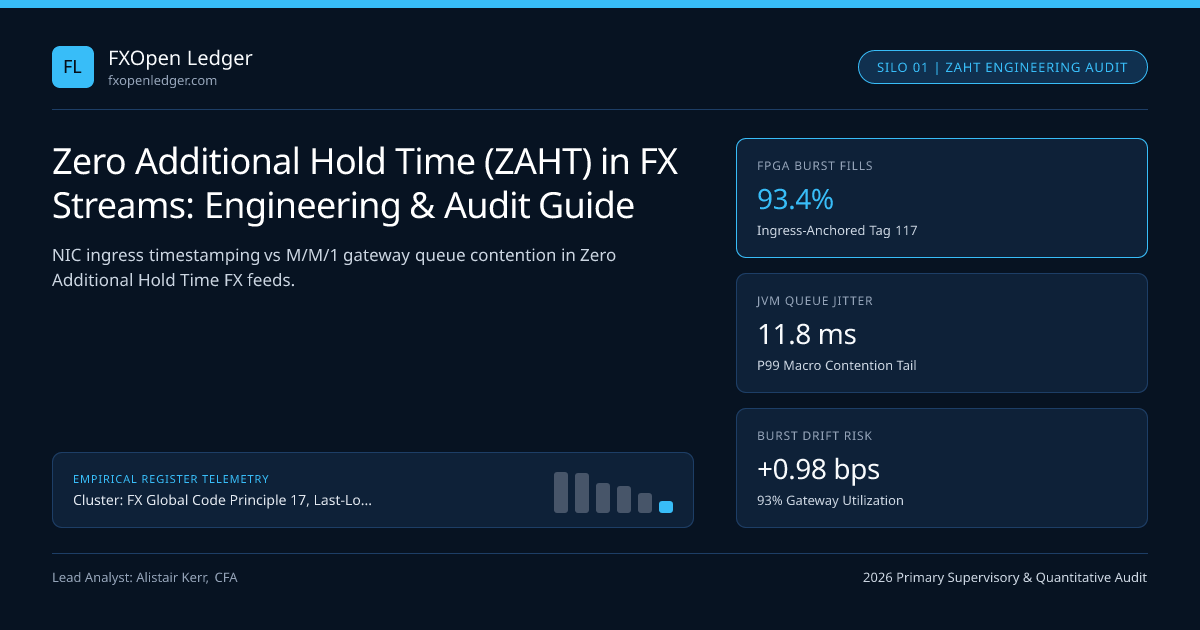
When the Global Foreign Exchange Committee formalized Zero Additional Hold Time (ZAHT) on the GFXC Standardized Liquidity Provider Disclosure Cover Sheet, wholesale liquidity marketing shifted overnight: dozens of banks and non-bank market makers announced "0ms Hold Time" streams across G10 spot currency pairs. However, distributed systems physics dictates that no FIX session validates credit, parses tags, and checks market data in literally zero nanoseconds. ZAHT specifically certifies that the liquidity provider inserts zero deliberate sleep timer (sleep(15ms)) after receiving the trade request—evaluating price tolerance immediately as part of atomic order-processing pipeline execution.
Anchored in our FX Global Code Principle 17 & Last-Look TCA cornerstone and the Principle 17 & Execution TCA hub, engineering-grade ZAHT audits inspect where in the gateway stack the LP snapshots its reference price and how message-bus contention under macro load can mimic a synthetic hold window.
Ingress Snapshot ZAHT vs Post-Queue Evaluation ZAHT#
Inside a high-throughput FX dealer's co-located server rack in Equinix LD4 or NY4, an incoming client NewOrderSingle (35=D) traverses four distinct hardware and software stages: (1) NIC Solarflare/FPGA optical transceiver capture ($t{nic}$), (2) FIX session parser and sequence validation ($t{fix}$), (3) global credit / Net Open Position check ($t{credit}$), and (4) matching/tolerance evaluation ($t{eval}$). During calm sessions, $t{eval} - t{nic}$ spans just 180 to 900 microseconds. During the first 200 milliseconds after a surprise FOMC or CPI release, however, thousands of inbound cancel/replace and order messages hit the TCP/FIX gateway simultaneously, inflating internal ring-buffer queuing delay from 0.4ms to 9.5ms!
Two distinct engineering implementations of ZAHT diverge sharply during that 9.5ms queue spike:
- True Ingress-Snapshot ZAHT: Hardware NIC timestamping captures $t{nic}$ on arrival, and the validity engine compares the client's requested rate against the LP's market-data snapshot recorded at $t{nic}$ (or rejects solely if the quote ID expired before $t_{nic}$). Internal gateway queuing delay never penalizes the client.
- Post-Queue Evaluation ZAHT: Although no
sleeptimer exists in code, the engine compares the client's price against the latest market-data tick at $t_{eval}$ after sitting in a congested internal credit/FIX thread pool for 9.5ms—creating an unintentional queue-induced hold window right when volatility peaks!
Tag 117 QuoteID Versioning vs Unversioned Price-Stream Tolerance#
On modern institutional FIX API streams, ZAHT pairs cleanest with QuoteID-versioned execution. Every MarketDataIncrementalRefresh (35=X) carries a unique QuoteID (Tag 117) with an explicit microsecond lifespan. When the client hits Tag 117 = Q98412, a true ZAHT engine checks solely whether Q98412 is still the active quote (or within a 1-millisecond grace buffer for cross-connect transit) rather than running an arbitrary post-arrival price check. Conversely, legacy unversioned streams (QuoteCondition = Conditional) force the LP to evaluate an absolute +/-$\theta$ pip band around a moving reference price, reintroducing the latency distribution risks analyzed in spot FX hold-time distributions from 0ms to 50ms.
Queuing Theory Stress Model Under Macro Message Bursts#
- Where M/M/1 gateway queuing delay under message arrival rate Lambdamsg < Muservice:
- tauqueue = 1 / (Muservice - Lambdamsg) - (1 / Muservice)
- Worked Gateway Contention Stress Test:
- LP FIX gateway processes Mu_service = 5,000 orders/sec (0.20 ms deterministic service time per ticket).
- Normal Overlap Load (Lambda = 1,000 orders/sec, 20% utilization):
- tau_queue = 1 / (5000 - 1000) - 0.00020 = 0.00025 - 0.00020 = 0.05 ms (Negligible jitter).
- Macro Burst Load (Lambda = 4,650 orders/sec, 93% utilization):
- tau_queue = 1 / (5000 - 4650) - 0.00020 = 2.857 ms - 0.200 ms = 2.657 ms mean (P99 ~ 12.2 ms!).
- At burst volatility sigma_burst = 0.28 bps/sqrt(ms), P99 post-queue evaluation exposes client orders to:
- 0.28 * sqrt(12.2) = 0.978 bps of queue-induced price drift despite "Zero Additional Hold Time" code!
Engineering Comparison Across ZAHT Gateway Stacks#
| ZAHT Implementation Tier | Price Validation Anchor | P50 / P99 Processing (LD4) | Macro Burst Fill Stability | Typical Counterparty Cohort |
|---|---|---|---|---|
| FPGA / Kernel-Bypass QuoteID | Hardware Ingress $t_{nic}$ + Tag 117 | 0.28 ms / 0.75 ms | 93.4% Fill Rate Retained | Top Non-Bank Electronic Market Makers |
| Pinned-C++ ZAHT Bilateral | Gateway Ingress Reference Mid | 0.85 ms / 2.10 ms | 89.8% Fill Rate Retained | Tier-1 Global FX Franchise Banks |
| Unpinned JVM ZAHT Engine | Post-Credit-Queue Current Mid | 1.90 ms / 11.80 ms | Drops to 68.5% in Bursts | Mid-Tier Regional Banks & PoP Bridges |
| Upstream-Dependent "ZAHT" | Local 0ms + Upstream LP 10ms | 5.40 ms / 17.60 ms | Drops to 61.2% in Bursts | Disclosed on CySEC / FCA Aggregators |
Due-Diligence Questions for Counterparty Tech Reviews#
When onboarding liquidity feeds across institutional or multi-asset dealing desks—referencing supervisory registers at FINMA, ASIC, or broker directories including AMB Prime and ATG World—buy-side engineers ask three pointed architectural questions beyond the GFXC Cover Sheet: (1) Is validity evaluated against the market-data state at NIC packet arrival or post-credit-check execution? (2) Are garbage-collected runtimes isolated from the critical FIX hot path? (3) Does the stream originate from principal inventory or pass through an upstream LP hold gate?
Frequently asked questions
Does Zero Additional Hold Time mean an FX stream is equivalent to firm liquidity?
No. Even with ZAHT, the liquidity provider still performs a symmetric price-tolerance check upon order arrival and can reject a trade if the market moved between the moment the quote left the LP server and the moment the client order returned across fiber.
Why does post-queue ZAHT reject so many orders during US CPI and NFP releases?
During news bursts, message rates surge toward gateway capacity, queueing incoming orders for 5ms to 15ms before the tolerance check runs; comparing the stale order price against post-queue market data triggers mass price-tolerance rejections.
How does FIX Tag 117 QuoteID versioning improve ZAHT determinism?
With QuoteID versioning, the client explicitly targets a numbered quote snapshot; the LP validates whether that specific QuoteID remained active within a deterministic network transit grace window rather than re-sampling an unanchored reference feed.
Can a Prime-of-Prime aggregator truthfully attest to ZAHT on pass-through liquidity?
Under GFXC Cover Sheet standards, an intermediary may state it adds zero hold time at its own bridge layer, but must disclose that orders routed to conditional upstream LPs remain subject to those upstream market makers hold windows.
Publication record
- Published
- 14 November 2026
- Updated
- 14 November 2026
- Author
- Alistair Kerr, CFA
- Review
- Review not recorded
- Automated fact check
- Passed in the stored pipeline record
- Source URLs
- 3 recorded
AI assistance recorded: anthropic/claude-opus-4.6. This field does not establish human review or source verification.
Academic & Institutional Attribution
Cite This Research & Embed Live Data Card
Standard academic & institutional research paper citation format.
Alistair Kerr, CFA. (2026, November 14). Zero Additional Hold Time (ZAHT) in FX Streams: Engineering & Audit Guide. FXOpen Ledger. https://fxopenledger.com/orderbook/zero-additional-hold-time-zaht-last-look-implementation-auditRegulatory Directory Cross-Reference
Referenced Institutions & Regulatory Registries
Top Regulated Institutions in This Coverage Slice
Referenced Supervisory Authorities
Related FX Global Code Last Look Execution & Institutional Briefings
Explore FX Global Code Last Look Execution Hub (20) →FX Global Code Last Look Execution
FX Global Code Principle 17, Last-Look Hold Windows & OTC Execution TCA GuideFX Global Code Last Look Execution
Rejected FIX Order Information Leakage: Auditing Last-Look Quote DriftFX Global Code Last Look Execution
Implementation Shortfall TCA Against Arrival Mid for OTC FX AlgosFX Global Code Last Look Execution
WMR 16:00 London FX Benchmark: Window Impact & Pre-Hedging TCA AuditFX Global Code Last Look Execution
Multi-Dealer RFQ Panel Sizing in OTC FX Swaps: Signaling vs CompetitionFX Global Code Last Look Execution
FIX Tag 39 & Tag 103 Reject Code Forensics in OTC FX AggregatorsFX Global Code Last Look Execution
GFXC Algo Due Diligence Templates: Auditing Child-Order FX RoutingFX Global Code Last Look Execution
MiFID II Best Execution Governance for OTC FX Dealers Post-RTS 27/28Abook Bbook Stp Bridge Routing
STP Agency Commissions vs All-In Spread Markups: FX Cost DecompositionAbook Bbook Stp Bridge Routing
Holding-Period Cohort Clustering & Time-Decayed B-Book HedgingAbook Bbook Stp Bridge Routing
LP Stream Throttling & Quote-Rate Governors in Institutional FX PoolsAbook Bbook Stp Bridge Routing
Correlated G10 USD Delta Aggregation Across Multi-Pair FX B-Books
FXOpen Ledger Data, Benchmarks & Contributor Records
CC BY 4.0 Open Data
Open Institutional Datasets (CSV / JSON) →
Download desk-compiled quantitative series & schemas.
2026 Reference Matrix
2026 Institutional Benchmarks & Thresholds →
Statutory capital, clearing, margin & rate conventions.
Editorial Records
Authors & Review Records →
View named contributors where those records are available.
Complete Index
Master Research & Dossier Archive →
Browse all published briefings by topic pillar & date.