
FX Global Code Last Look Execution
FIX Tag 39 & Tag 103 Reject Code Forensics in OTC FX Aggregators
Lumping every rejected FIX ExecutionReport into a single fill-ratio KPI blinds OTC foreign exchange desks; parsing Tag 103 OrdRejReason and normalized Tag 58 reason codes separates Prime Broker NOP breaches from LP last-look tolerance rejects.
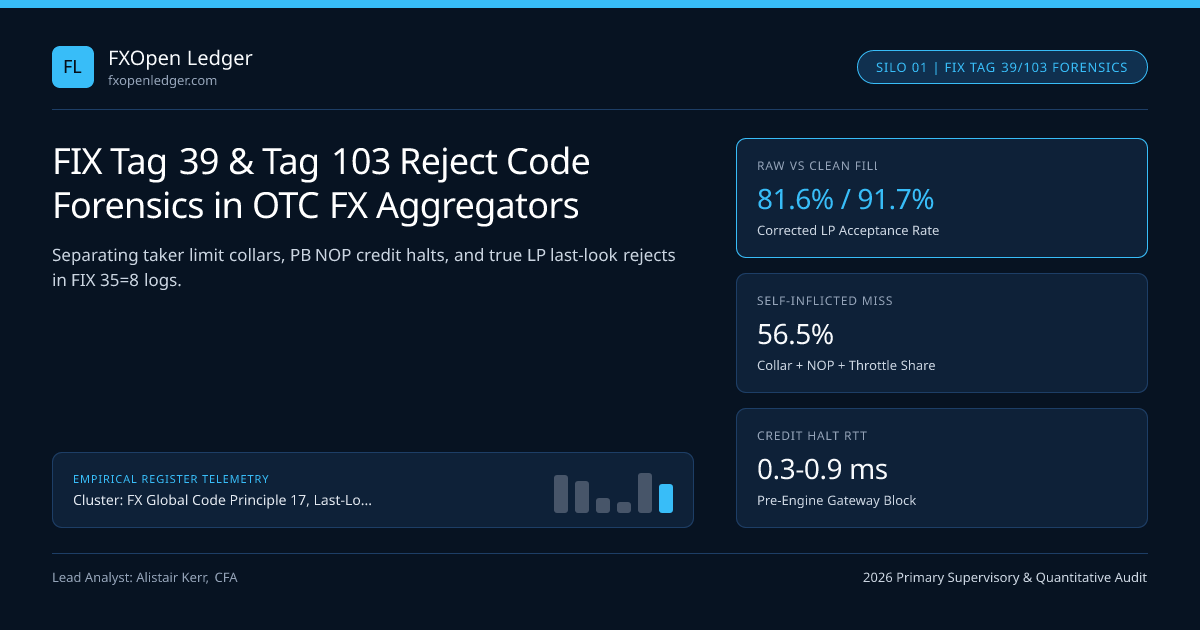
When an institutional FX desk sees its weekly fill ratio on Liquidity Provider Delta drop from 93% to 74%, penalizing LP Delta on the quarterly scorecard without inspecting underlying FIX 4.4 / FIX 5.0 ExecutionReport (35=8) tags frequently misdiagnoses an internal operational failure as LP misconduct! In electronic foreign exchange aggregators, an outbound NewOrderSingle (35=D) returning Tag 39 (OrdStatus) = 8 (Rejected) or Tag 39 = 4 (Canceled - IOC Expired) can stem from six completely unrelated layers: client-side limit-price collar protection, ECN message-rate throttling, FX Prime Brokerage Designation Notice Net Open Position exhaustion, stale Tag 117 QuoteID collision, or true LP last-look price-tolerance rejection.
Embedded within our FX Global Code Principle 17 & Execution TCA cornerstone and the Principle 17 & Execution TCA hub, Tag-level FIX log normalization is the prerequisite for accurate GFXC LP cover sheet reconciliation.
Taxonomic Mapping of FIX Tag 39, Tag 103, and Tag 58 Strings#
Standard FIX protocol defines Tag 103 (OrdRejReason) integers (0 = Broker/Exchange option, 1 = Unknown symbol, 3 = Order exceeds limit, 6 = Duplicate order, 11 = Unsupported order characteristic, 13 = Incorrect quantity, 15 = Unknown account, 99 = Other), yet historically many bank gateways lazily stamped 39=8 | 103=0 or 103=99 on everything and buried the real cause inside free-text Tag 58 (Text)! Under GFXC transparency guidelines, major multi-dealer ECNs and FIX API liquidity bridges (OneZero, PrimeXM, Integral, Lucera) now normalize reject telemetry into five canonical buckets:
- Taker Limit-Collar Expiration (
39=4IOC Unfilled /58=LimitPriceMissed): Client sent a Marketable Limit IOC with 0.0-pip slippage tolerance (Price=1.08502), and top-of-book ticked to1.08503while the packet was in flight on fiber. Zero LP fault—pure tight client slippage cap! - QuoteID / MQL Race Collision (
103=99 | 58=QuoteExpired_Tag117): Two takers hit the exact same firm or ZAHTQuoteIDwithin 50 microseconds; the first taker swept the full $5M displayed size, leaving zero liquidity for the second packet. - PB / PoP Credit & NOP Gate Halt (
103=3 | 58=CreditLimitBreach_NOP): Prime Broker or Prime-of-Prime pre-trade risk filter blocked the ticket before the LP pricing engine ever evaluated price. - Throttle / Quote-to-Trade Governor (
103=99 | 58=MaxOrderRateExceeded): Client algo burst exceeded max messages per second on that session. - True LP Last-Look Price-Tolerance Reject (
103=0 | 58=LastLook_PriceTolerance): Conditional LP invoked Principle 17 tolerance check and declined the trade.
Clean LP Fill Ratio Formula vs Raw Unfiltered Fill Rate#
Evaluating market makers using unfiltered fill ratios distorts smart-order-router shadow-spread weights (derived in firm vs last-look reject economics). By excluding client-induced limit collar misses ($R{collar}$), credit breaches ($R{credit}$), and session throttles ($R{throttle}$), execution engineers compute the unbiased **Clean LP Acceptance Ratio ($p{clean}$)**:
Deriving Clean LP Acceptance Ratios From Raw Drop-Copies#
- pclean = Nfilled / (Nfilled + Rlastlook + wrace * Rquoterace)
- Where:
- N_filled = Count of fully or partially filled tickets (OrdStatus 39=2 or 39=1)
- R_collar = Client limit-price IOC misses where LP quote already updated prior to ingress
- R_credit = Prime Broker / PoP NOP credit blocks (Tag 103=3)
- R_throttle = Message-rate governor blocks
- Rquoterace = Valid simultaneous depletion of displayed QuoteID size (weighted w_race = 0.25 to 0.50 if phantom depth suspected)
- Rlastlook = True LP Principle 17 conditional price-tolerance rejections
- Worked Drop-Copy Audit (10,000 Outbound USD/CAD 2M IOC Tickets on Stream Delta):
- Nfilled = 8,160; Rcollar = 790 (client set 0.0p max slippage!); R_credit = 210 (Friday afternoon NOP cap);
- Rthrottle = 40; Rquoterace = 130; Rlast_look = 670.
- p_raw = 8,160 / 10,000 = 81.60% (Falsely breaches 85% router demotion threshold!)
- p_clean = 8,160 / (8,160 + 670 + 0.5 * 130) = 8,160 / 8,895 = 91.74% (Healthy ZAHT LP; fix client 0.0p limit collar & NOP line!)
FIX 35=8 Tag Attribution & Desk Remediation Matrix#
FIX Tag Signature (35=8 / 35=9) | Normalized Failure Root Cause | Typical RTT Latency | Responsible Desk Owner | Immediate Remediation Action | ||
|---|---|---|---|---|---|---|
| `39=4 | 59=3 | 58=IOC_NoMatch` | Tight Taker Limit Collar Miss | 0.8 - 2.2 ms | Buy-Side Algo Trader | Relax IOC limit band from 0.0p to 0.2p |
| `39=8 | 103=3 | 58=NOPLimitExceeded` | PB / PoP Intraday Credit Halt | 0.3 - 0.9 ms | Prime / Treasury Ops | Rebalance NOP across AMB Prime / ALB Prime |
| `39=8 | 103=99 | 58=QuoteStale_117` | Co-Located Race / Phantom Pull | 0.7 - 1.8 ms | ECN Connectivity Eng | Check cross-connect jitter vs peer takers |
| `39=8 | 103=0 | 58=PriceTolerance` | LP Conditional Last-Look Gate | 2.0 - 28.0 ms | Liquidity Mgmt Desk | Cross-check symmetry & Cover Sheet max hold |
Mandating Machine-Readable Reject Taxonomy in LP Onboarding#
Regulated dealing venues supervised by the UK FCA, CySEC, and ASIC under algorithmic governance standards (such as MiFID II RTS 6) must maintain deterministic kill-switches and unambiguous error telemetry. Buy-side FX desks refuse to onboard any bilateral FIX feed that returns generic 39=8 | 103=0 | 58=Rejected strings without distinguishing credit, throttle, QuoteID expiration, and last-look tolerance—ensuring complete transparency across quarterly LP scorecard reviews.
Frequently asked questions
Why does FIX Tag 39=4 (Canceled) appear on unfilled Immediate-or-Cancel FX orders?
In standard FIX 4.4/5.0 execution semantics, when a Marketable Limit IOC order arrives after the target price level has already cleared or refreshed beyond the client limit price, compliant matching engines expire the unfilled balance via OrdStatus=4 rather than OrdStatus=8.
How can an execution desk spot an LP hiding last-look rejects behind QuoteStale codes?
If an LP stamps QuoteStale on 20% of directional sweep clips with a 15ms RTT delay while sub-1ms calm clips never collide, latency forensics proves a conditional hold window disguised under a stale-quote text string.
What triggers FIX Tag 103=3 (Order Exceeds Limit) on a Prime-of-Prime session?
Tag 103=3 typically fires at the pre-trade credit gateway when an order would breach either the per-ticket maximum clip size (e.g., $10M cap) or the account aggregate intraday Net Open Position (NOP) margin threshold.
Does GFXC guidance encourage standardized reject reason codes?
Yes. GFXC Last-Look and Cover Sheet working groups strongly recommend unambiguous reject reason codes separating credit, operational/rate limits, and price-validity rejections so clients can audit Principle 17 compliance accurately.
Publication record
- Published
- 14 November 2026
- Updated
- 14 November 2026
- Author
- Alistair Kerr, CFA
- Review
- Review not recorded
- Automated fact check
- Passed in the stored pipeline record
- Source URLs
- 3 recorded
AI assistance recorded: anthropic/claude-opus-4.6. This field does not establish human review or source verification.
Academic & Institutional Attribution
Cite This Research & Embed Live Data Card
Standard academic & institutional research paper citation format.
Alistair Kerr, CFA. (2026, November 14). FIX Tag 39 & Tag 103 Reject Code Forensics in OTC FX Aggregators. FXOpen Ledger. https://fxopenledger.com/orderbook/fix-tag-39-ordstatus-reject-code-forensics-in-fx-aggregatorsRegulatory Directory Cross-Reference
Referenced Institutions & Regulatory Registries
Top Regulated Institutions in This Coverage Slice
Referenced Supervisory Authorities
Related FX Global Code Last Look Execution & Institutional Briefings
Explore FX Global Code Last Look Execution Hub (20) →FX Global Code Last Look Execution
FX Global Code Principle 17, Last-Look Hold Windows & OTC Execution TCA GuideFX Global Code Last Look Execution
GFXC Algo Due Diligence Templates: Auditing Child-Order FX RoutingFX Global Code Last Look Execution
MiFID II Best Execution Governance for OTC FX Dealers Post-RTS 27/28FX Global Code Last Look Execution
Spot FX Fill-Ratio Decay Across 1M, 5M & 25M Clips in G10 vs EM PairsFX Global Code Last Look Execution
Passive Mid-Peg vs Aggressive Sweep Child Execution TCA in Spot FXFX Global Code Last Look Execution
Cross-Atlantic Latency Arbitrage vs Legitimate Last-Look DefenseFX Global Code Last Look Execution
Single-Dealer Platform (SDP) FX Internalization Ratios & Markout SkewFX Global Code Last Look Execution
Quarterly FX LP Scorecard Design: Weighting Spread, Hold Time & MarkoutsAbook Bbook Stp Bridge Routing
MiFID II Matched-Principal STP vs Own-Account Dealing Capital RulesAbook Bbook Stp Bridge Routing
Post-Execution Auto-Hedger Slippage & FIX Bridge Reject CascadesAbook Bbook Stp Bridge Routing
Toxic EA News-Straddle Orders & Stop-Order Warehouse ExposureAbook Bbook Stp Bridge Routing
Synthetic Cross-Pair Auto-Hedging: EUR/GBP & GBP/NZD Triangulation
FXOpen Ledger Data, Benchmarks & Contributor Records
CC BY 4.0 Open Data
Open Institutional Datasets (CSV / JSON) →
Download desk-compiled quantitative series & schemas.
2026 Reference Matrix
2026 Institutional Benchmarks & Thresholds →
Statutory capital, clearing, margin & rate conventions.
Editorial Records
Authors & Review Records →
View named contributors where those records are available.
Complete Index
Master Research & Dossier Archive →
Browse all published briefings by topic pillar & date.