
FX Global Code Last Look Execution
GFXC Algo Due Diligence Templates: Auditing Child-Order FX Routing
The Global Foreign Exchange Committee FX Algo Due Diligence Template standardizes buy-side scrutiny of bank execution algorithms, exposing whether child slices preferentially route into affiliated principal market-making books.
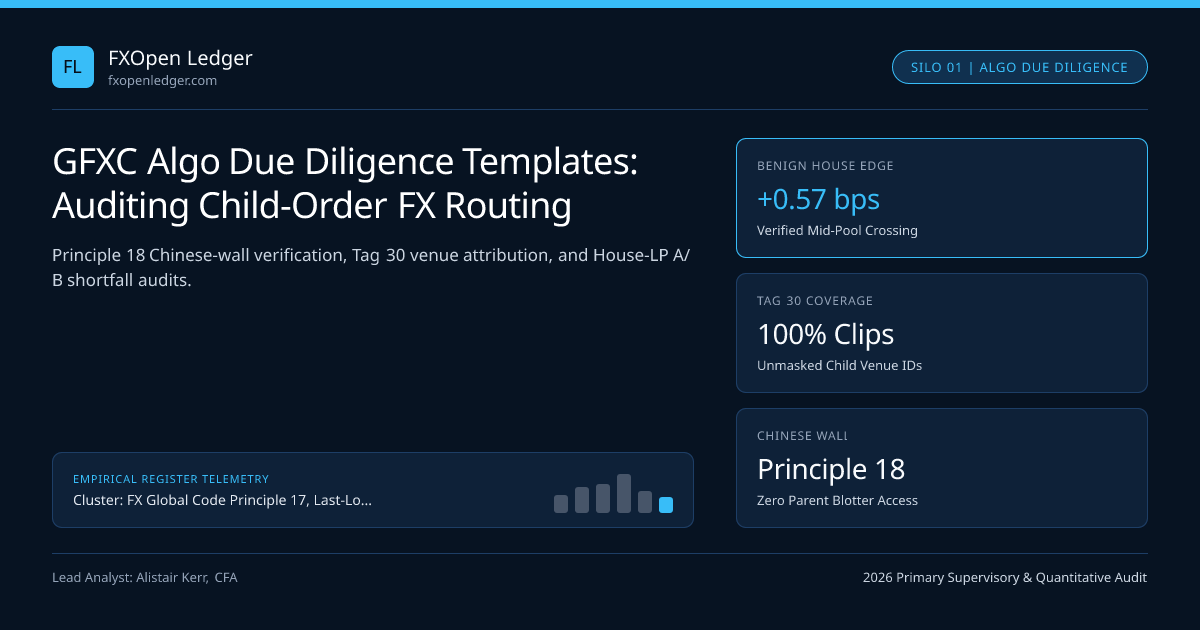
Delegating a $200 million currency execution program to a Tier-1 bank algorithm hands microsecond venue-selection authority to code written and maintained by the same financial institution that operates a proprietary spot market-making desk down the hall. To address Principle 18 of the FX Global Code—which mandates full transparency around algorithmic operation, conflicts of interest, and liquidity access—the Global Foreign Exchange Committee published the FX Algo Due Diligence Template, compelling algo providers to disclose exact child-order routing hierarchies, internal liquidity-pool interaction rules, and fee pass-through mechanics.
Integrated with our FX Global Code Principle 17 & Last-Look TCA cornerstone and indexed inside the Principle 17 & Execution TCA hub, completing an Algo Due Diligence audit is now a mandatory onboarding step before deploying arrival-mid IS algorithms.
Conflict-of-Interest Scrutiny: Affiliated Principal Stream Preferencing#
The single highest-stakes question inside the GFXC Algo Template asks whether the provider's algorithm routes child orders against the bank's own internal principal market-making stream, and if so, whether the internal desk receives preferential queue priority ("last-look or first-look advantage") or sees live parent-order parameters (TargetQty, EndTime, LimitPrice). Under strict Principle 18 chinese-wall architecture, the algo engine must reside on physically or logically segregated servers where the affiliated spot desk interacts solely as one anonymous liquidity source competing on equal shadow-cost footing against external ECNs and primary CLOBs!
Buy-side fiduciaries regulated by the UK FCA and ESMA verify five operational disclosures before whitelisting a provider's algo suite:
- Information Barrier Certification: Zero visibility of live algo parent blotters to principal FX traders or voice sales desks.
- Affiliated Desk Opt-Out Toggle: Client ability via FIX custom parameter to exclude the bank's own principal stream (
ExcludeHouseLP = Y) and run controlled A/B TCA experiments. - External Venue Rebate / Brokerage Pass-Through: Whether ECN maker rebates or primary-CLOB exchange fees are absorbed inside the flat algo commission (e.g., $12/million) or billed separately.
- Conditional vs Firm Pool Filtering: Whether passive or aggressive child clips route to conditional last-look LPs or strictly to firm Minimum Quote Life (MQL) books.
- Kill-Switch & Runaway Order Protections: Automated fat-finger and disconnection behavior (
CancelOnDisconnect) across FIX API sessions.
Controlled A/B Testing: Quantifying Whether House Crossing Helps or Hurts#
Should an institutional treasury desk turn off a bank algo's internal franchise stream? Not blindly! Crossing inside an internalized mid-pool saves half-spread and leaves zero lit CLOB footprint—unless the affiliated principal desk cherry-picks benign clips while stepping out of informed clips, leaving toxic residuals to pay wider lit spreads. Execution analysts run randomized 50/50 parent-order A/B tests comparing House_Enabled versus House_Excluded shortfall:
Randomized A/B Parent-Order Shortfall Model#
- Decomposition:
- ISarrival(HouseEnabled) = whouse * (Spreadhouse + Driftposthouse) + (1 - whouse) * (Spreadext + Driftadverseresidual)
- Worked A/B Controlled Audit (120 Parent Orders, $50M EUR/USD Each, Bank Alpha TWAP):
- Arm 1 (HouseExcluded, whouse = 0%):
- Mean child crossing/peg spread = +0.08 bps; intra-horizon drift = +1.36 bps; fee = +0.12 bps -> Total IS = 1.56 bps.
- Arm 2 (HouseEnabled, whouse = 38%):
- House fills execute at mid (0.00 bps spread) with +0.06 bps post-fill drift; external 62% residual shows +1.28 bps drift; fee = +0.12 bps:
- Total IS = 0.38 * (0.00 + 0.06) + 0.62 * (0.08 + 1.28) + 0.12 = 0.0228 + 0.8432 + 0.12 = 0.986 bps!
- NetInternalizationEdge = 1.560 - 0.986 = +0.574 bps SAVINGS -> Retain House_Enabled!
- (Contrast: If external residual drift jumped to +2.45 bps due to cherry-picking, Total IS = 1.71 bps -> Disable House LP!)
Principle 18 Governance Across Algo Provider Archetypes#
| Algo Due Diligence Dimension | Tier-1 Segregated Bank Suite | Independent Non-Bank Agency Algo | Unsegregated Multi-Asset Broker Algo | Audit Verification Method |
|---|---|---|---|---|
| Affiliated Principal Desk Access | Optional (Default On, Opt-Out Ready) | Zero Principal Desk (100% External) | Mandatory Internal Routing | Check FIX Tag 30 (LastMkt) |
| External Venue Fee Structure | All-In Bundled Commission | Pass-Through Cost + Agency Fee | Embedded Markup Spread | Reconcile vs Raw ECN Tape |
| Last-Look Pool Inclusion | Configurable (Firm-Only Option) | Configurable by Taker Profile | Conditional Bridges Default | Cross-Check Single-Dealer Internalization |
| Regulatory Governance Framework | MiFID II RTS 6 & GFXC Principle 18 | FCA / CFTC Agency Rules | ASIC / CySEC Best-Ex | Annual Template Re-Attestation |
Demanding Granular FIX Tag 30 (LastMkt) Venue Attribution#
No buy-side institution—whether routing via major prime banks or evaluating execution conduits alongside AMB Prime and City Index—should accept opaque drop-copy fills stamped LastMkt = XXXX. Requiring unmasked Tag 30 codes distinguishing EBS, RTM (LSEG), CBOE, LMAX, INTERNAL_MID, and HOUSE_LP empowers execution committees to audit child-slice routing independently every evening.
Frequently asked questions
What isFX Global Code Principle 18 regarding algorithmic trading?
Principle 18 requires market participants providing algorithmic execution to disclose clear, comprehensive information on how their algorithms route orders, manage conflicts with affiliated principal desks, and handle market data and fees.
How can affiliated principal crossing inside a bank FX algo hurt a client?
If the house market-making desk selectively fills calm, mean-reverting child slices while rejecting momentum slices, the remaining external child orders face concentrated adverse selection and wider lit-venue spreads.
What does FIX Tag 30 (LastMkt) prove in an institutional FX algo audit?
Tag 30 identifies the exact execution venue or liquidity pool where each individual child slice matched, allowing TCA systems to measure fill rates and +500ms markouts separately for house internal fills versus external ECNs.
Should buy-side desks prefer bank algos or independent non-bank agency algos?
Both play distinct roles: independent agency algos eliminate principal-desk conflicts entirely, while top bank algos offer unique zero-footprint internalization against corporate/wealth franchise flow when verified via A/B shortfall testing.
Publication record
- Published
- 14 November 2026
- Updated
- 14 November 2026
- Author
- Alistair Kerr, CFA
- Review
- Review not recorded
- Automated fact check
- Passed in the stored pipeline record
- Source URLs
- 3 recorded
AI assistance recorded: anthropic/claude-opus-4.6. This field does not establish human review or source verification.
Academic & Institutional Attribution
Cite This Research & Embed Live Data Card
Standard academic & institutional research paper citation format.
Alistair Kerr, CFA. (2026, November 14). GFXC Algo Due Diligence Templates: Auditing Child-Order FX Routing. FXOpen Ledger. https://fxopenledger.com/orderbook/algo-due-diligence-template-gfxc-child-order-routing-auditRegulatory Directory Cross-Reference
Referenced Institutions & Regulatory Registries
Top Regulated Institutions in This Coverage Slice
Related FX Global Code Last Look Execution & Institutional Briefings
Explore FX Global Code Last Look Execution Hub (20) →FX Global Code Last Look Execution
FX Global Code Principle 17, Last-Look Hold Windows & OTC Execution TCA GuideFX Global Code Last Look Execution
MiFID II Best Execution Governance for OTC FX Dealers Post-RTS 27/28FX Global Code Last Look Execution
Spot FX Fill-Ratio Decay Across 1M, 5M & 25M Clips in G10 vs EM PairsFX Global Code Last Look Execution
Passive Mid-Peg vs Aggressive Sweep Child Execution TCA in Spot FXFX Global Code Last Look Execution
Cross-Atlantic Latency Arbitrage vs Legitimate Last-Look DefenseFX Global Code Last Look Execution
Single-Dealer Platform (SDP) FX Internalization Ratios & Markout SkewFX Global Code Last Look Execution
Quarterly FX LP Scorecard Design: Weighting Spread, Hold Time & MarkoutsFX Global Code Last Look Execution
Auditing GFXC Liquidity Provider Cover Sheets: Last-Look & Hold-Time MetricsAbook Bbook Stp Bridge Routing
Post-Execution Auto-Hedger Slippage & FIX Bridge Reject CascadesAbook Bbook Stp Bridge Routing
Toxic EA News-Straddle Orders & Stop-Order Warehouse ExposureAbook Bbook Stp Bridge Routing
Synthetic Cross-Pair Auto-Hedging: EUR/GBP & GBP/NZD TriangulationAbook Bbook Stp Bridge Routing
Introducing Broker Rebate Churn vs A-Book LP Clearing Economics
FXOpen Ledger Data, Benchmarks & Contributor Records
CC BY 4.0 Open Data
Open Institutional Datasets (CSV / JSON) →
Download desk-compiled quantitative series & schemas.
2026 Reference Matrix
2026 Institutional Benchmarks & Thresholds →
Statutory capital, clearing, margin & rate conventions.
Editorial Records
Authors & Review Records →
View named contributors where those records are available.
Complete Index
Master Research & Dossier Archive →
Browse all published briefings by topic pillar & date.