
FX Global Code Last Look Execution
WMR 16:00 London FX Benchmark: Window Impact & Pre-Hedging TCA Audit
Executing passive portfolio currency rebalances at the FTSE Russell WMR 16:00 London FX Benchmark concentrates month-end demand into a five-minute window, generating predictable pre-fix drift and sharp post-16:02:30 mean reversion.
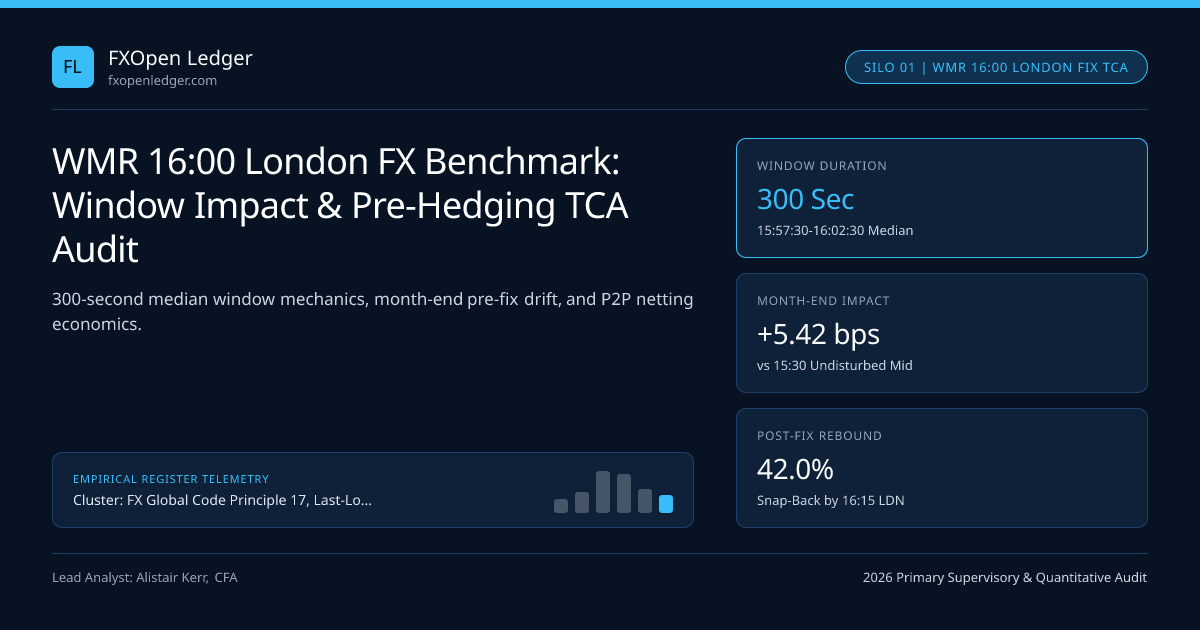
Global equity and fixed-income index trackers managing trillions in cross-border assets value international holdings using the FTSE Russell WMR 16:00 London FX Benchmark—calculated over a five-minute observation window spanning 15:57:30 to 16:02:30 London time (+/- 2.5 minutes around 4:00 p.m., widened from 60 seconds following the Financial Stability Board's 2014 FX benchmark reforms). Because passive index managers prioritize minimizing tracking error relative to index NAV over minimizing absolute transaction cost, guaranteeing execution at the exact published WMR fix rate concentrates massive, one-sided rebalancing flows at month-end and quarter-end—creating an unmistakable V-shaped price distortion that active TCA desks quantify down to the basis point.
Positioned within our FX Global Code Principle 17 & Execution TCA cornerstone and the Principle 17 & Execution TCA hub, WMR fixing analysis links benchmark microstructure directly to Principle 11 pre-hedging boundaries.
How FTSE Russell Computes the Five-Minute WMR Spot Fix#
For the 21 primary "Trade Currency" pairs (including EUR/USD, USD/JPY, GBP/USD, AUD/USD, USD/CAD, and USD/CHF), FTSE Russell captures actual executed trades—supplemented by order-book snapshots when trade density falls below threshold—from primary institutional matching venues (EBS Market, LSEG Matching, and Currenex) at one-second intervals across all 300 seconds from 15:57:30 to 16:02:30. For each second, valid bid and offer trades/quotes are pooled, outliers are filtered, and the median bid and median offer across the 5-minute sample establish the official benchmark mid-rate.
Using a 300-second median rather than a volume-weighted average makes "banging the close" in the final five seconds mathematically ineffective: moving the median requires sustaining directional pressure across more than 150 one-second snapshots! Nevertheless, when global equity markets rally +4% in the US while European bourses lag, currency-hedged pension funds simultaneously sell billions of USD at month-end 16:00 London.
Quantifying the Hidden Cost of Guaranteed Zero-Spread At-Fix Execution#
Banks traditionally execute guaranteed WMR orders either on a Zero-Fee / Bid-or-Offer Fix basis (charging half the published WMR bid-offer spread, typically ~0.50 to 1.25 bps) or on a Mid-Plus-Fee basis (charging a flat 0.25 to 0.60 bps execution fee over WMR mid, mandated under UK FCA and US CFTC post-2015 conduct settlements to eliminate incentives to widen the fix spread). Yet even a 0.30 bps Mid-Plus-Fee ticket hides substantial Pre-Fix Market Impact relative to the undisturbed 15:30 London mid-price ($M_{15:30}$):
Pre-Fix Drift & Post-Window Snap-Back Valuation#
- TemporaryImpactComponent (bps) = d * (WMRMid1600 - M1615) / M1530 * 10,000
- Where:
- d = +1 for Client Buy at WMR Fix, -1 for Client Sell at WMR Fix
- M_1530 = Undisturbed spot mid-price at 15:30:00 London (prior to pre-fix order cut-offs)
- WMRMid1600 = Official published 16:00 WMR Benchmark Mid-Rate
- M_1615 = Settled post-window spot mid-price at 16:15:00 London (12.5 mins after window close)
- Fee_fix = Explicit Mid-Plus-Fee commission (bps)
- Worked Month-End Pension Rebalance ($250M GBP/USD Sell, d = -1):
- M1530 = 1.27620; WMRMid1600 = 1.27548; M1615 = 1.27580; Fee_fix = 0.35 bps
- HiddenFixCost = -1 * (1.27548 - 1.27620) / 1.27620 * 10,000 + 0.35 = +5.64 + 0.35 = 5.99 bps ($149,750!)
- TemporaryImpactComponent = -1 * (1.27548 - 1.27580) / 1.27620 * 10,000 = +2.51 bps ($62,750 pure snap-back loss!)
- Alternative: A 45-minute TWAP spanning 14:30-15:15 LDN costs ~1.45 bps arrival IS, saving 4.54 bps ($113,500)!
Institutional WMR Fixing Alternatives & Tracking Error#
| Fixing Execution Alternative | Tracking Error vs WMR | Explicit Fee / Spread | Month-End Impact Drag | Ideal Institutional Mandate |
|---|---|---|---|---|
| Guaranteed Dealer WMR (Mid + Fee) | 0.00 bps (Exact NAV Match) | 0.25 - 0.60 bps | +4.20 to +6.50 bps | Strict Passive Index ETFs / UCITS |
| Peer-to-Peer Fixing Crossing Network | 0.00 bps (Matched Mid) | 0.15 - 0.30 bps | 0.00 bps on Matched Slice | Asset Managers Netting Prior to 15:45 |
| Algorithmic 5-Min Window Slicer | 0.35 - 0.85 bps RMS | 0.10 - 0.20 bps | +3.90 to +5.80 bps | Unbundled Agency Execution Mandates |
| Pre-Fix Shifted TWAP (14:00-15:15) | 6.50 - 11.20 bps RMS | 0.12 - 0.18 bps | +0.85 to +1.45 bps | Total-Return Pension & Sovereign Funds |
Peer-to-Peer Netting Utilities and Multi-Time-Zone Decoupling#
Supervised under the UK Benchmarks Regulation by the UK FCA and European rules at ESMA, fiduciaries whose mandates permit modest NAV tracking variance increasingly decouple currency hedging from 16:00 London—either crossing offsetting buy-side interest anonymously in pre-15:45 peer-to-peer fixing pools before routing net residuals to bank desks, or shifting execution to Tokyo 15:00, ECB 14:15 CET, or arrival-mid IS algorithms during peak 13:30–15:00 London-New York liquidity.
Frequently asked questions
Why was the WMR 4pm London fixing window widened from 60 seconds to 5 minutes?
Following the 2014 Financial Stability Board FX benchmark review and global enforcement actions against chat-room collusion, widening the window to 300 seconds and taking a 1-second median made short-burst close manipulation vastly harder and costlier.
Why do passive ETFs still trade at the 4pm WMR Fix despite 4-6 bps month-end impact?
Passive index funds are judged primarily on tracking error against MSCI, FTSE, or Bloomberg multi-currency indices, which convert foreign asset prices using the exact 16:00 WMR rate; trading earlier introduces unhedged intraday FX tracking variance.
Can an FX dealer execute its own net fixing hedge outside the 5-minute window?
Under GFXC Principle 11 and FSB benchmark guidance, dealers netting internal client fixing books may execute residual market risk smoothly before and during the window provided conduct does not intentionally distort the benchmark or disadvantage clients.
How do peer-to-peer WMR fixing venues reduce month-end market impact?
Peer-to-peer fixing pools match buy-side buyers and sellers directly at the eventual published 16:00 WMR mid-rate prior to 15:45 without sending matched volume into lit primary CLOBs, eliminating market impact on matched notional.
Publication record
- Published
- 14 November 2026
- Updated
- 14 November 2026
- Author
- Alistair Kerr, CFA
- Review
- Review not recorded
- Automated fact check
- Passed in the stored pipeline record
- Source URLs
- 3 recorded
AI assistance recorded: anthropic/claude-opus-4.6. This field does not establish human review or source verification.
Academic & Institutional Attribution
Cite This Research & Embed Live Data Card
Standard academic & institutional research paper citation format.
Alistair Kerr, CFA. (2026, November 14). WMR 16:00 London FX Benchmark: Window Impact & Pre-Hedging TCA Audit. FXOpen Ledger. https://fxopenledger.com/orderbook/wmr-4pm-london-benchmark-pre-hedging-and-window-impact-tcaRegulatory Directory Cross-Reference
Referenced Institutions & Regulatory Registries
Top Regulated Institutions in This Coverage Slice
Referenced Supervisory Authorities
Related FX Global Code Last Look Execution & Institutional Briefings
Explore FX Global Code Last Look Execution Hub (20) →FX Global Code Last Look Execution
FX Global Code Principle 17, Last-Look Hold Windows & OTC Execution TCA GuideFX Global Code Last Look Execution
Multi-Dealer RFQ Panel Sizing in OTC FX Swaps: Signaling vs CompetitionFX Global Code Last Look Execution
FIX Tag 39 & Tag 103 Reject Code Forensics in OTC FX AggregatorsFX Global Code Last Look Execution
GFXC Algo Due Diligence Templates: Auditing Child-Order FX RoutingFX Global Code Last Look Execution
MiFID II Best Execution Governance for OTC FX Dealers Post-RTS 27/28FX Global Code Last Look Execution
Spot FX Fill-Ratio Decay Across 1M, 5M & 25M Clips in G10 vs EM PairsFX Global Code Last Look Execution
Passive Mid-Peg vs Aggressive Sweep Child Execution TCA in Spot FXFX Global Code Last Look Execution
Cross-Atlantic Latency Arbitrage vs Legitimate Last-Look DefenseAbook Bbook Stp Bridge Routing
Correlated G10 USD Delta Aggregation Across Multi-Pair FX B-BooksAbook Bbook Stp Bridge Routing
XAU/USD Crowd Herding & Loco London Bullion Dealer Hedge TriggersAbook Bbook Stp Bridge Routing
MiFID II Matched-Principal STP vs Own-Account Dealing Capital RulesAbook Bbook Stp Bridge Routing
Post-Execution Auto-Hedger Slippage & FIX Bridge Reject Cascades
FXOpen Ledger Data, Benchmarks & Contributor Records
CC BY 4.0 Open Data
Open Institutional Datasets (CSV / JSON) →
Download desk-compiled quantitative series & schemas.
2026 Reference Matrix
2026 Institutional Benchmarks & Thresholds →
Statutory capital, clearing, margin & rate conventions.
Editorial Records
Authors & Review Records →
View named contributors where those records are available.
Complete Index
Master Research & Dossier Archive →
Browse all published briefings by topic pillar & date.