
Editorial Research Index
Institutional briefings & primary regulatory analysis
Financial analysis and briefings published by FXOpen Ledger.
- Published briefings
- 243
- Thematic pillar hubs
- 22
20 matching briefings
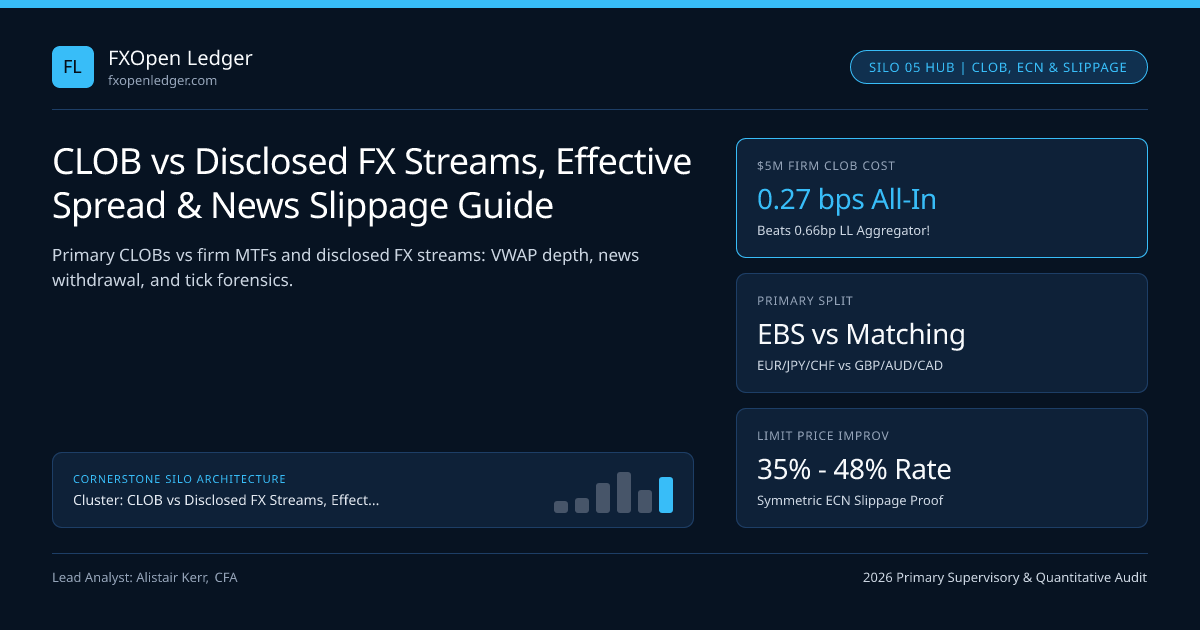
CLOB vs Disclosed FX Streams, Effective Spread & News Slippage Guide
Modern OTC foreign exchange splits price discovery across anonymous Central Limit Order Books (EBS Market, LSEG Matching, LMAX Exchange) and disclosed relationship streams—creating wide divergences between quoted 0.0-pip top-of-book spreads and realized all-in execution costs.
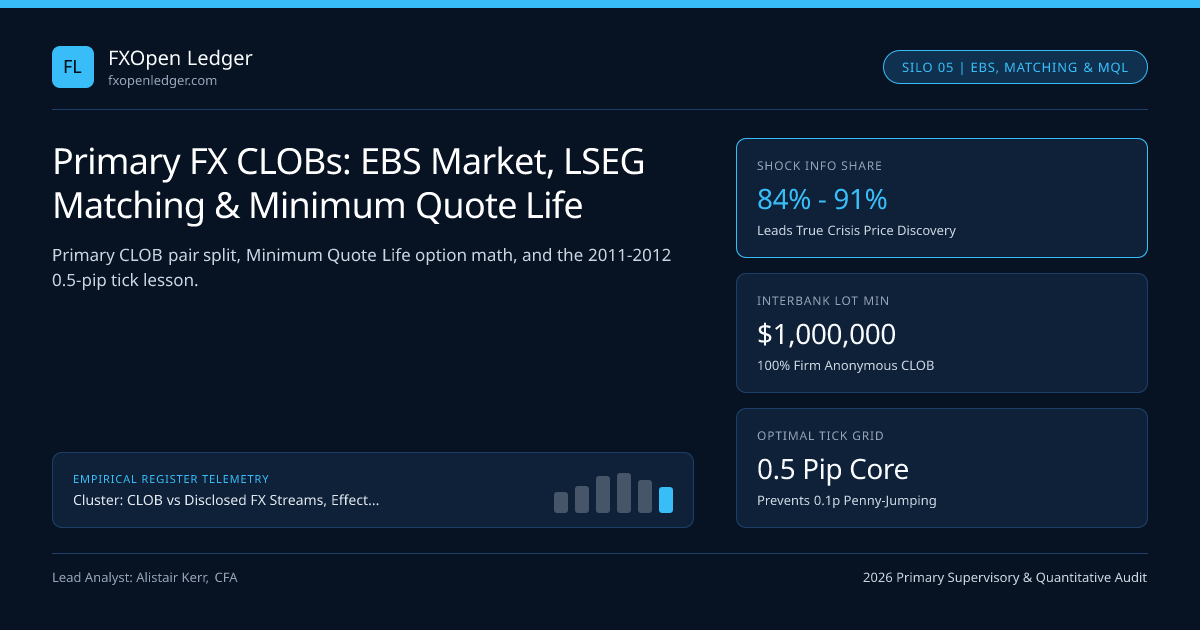
Primary FX CLOBs: EBS Market, LSEG Matching & Minimum Quote Life
CME EBS Market and LSEG Refinitiv Matching remain the wholesale anchor of spot FX reference pricing during macro shocks, defending maker liquidity via Minimum Quote Life (MQL) rules and calibrated half-pip tick increments.
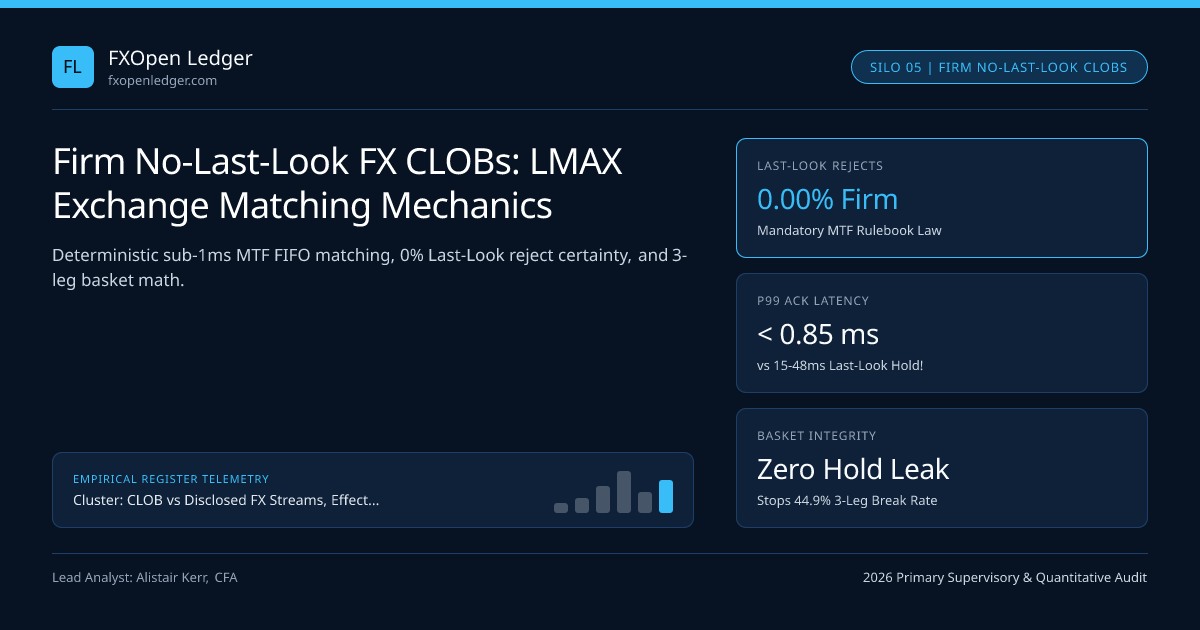
Firm No-Last-Look FX CLOBs: LMAX Exchange Matching Mechanics
Regulated Multilateral Trading Facility (MTF) Central Limit Order Books operating exclusively on 100% firm limit orders eliminate Last-Look hold delays and asymmetric rejections—delivering deterministic sub-millisecond FIFO execution.
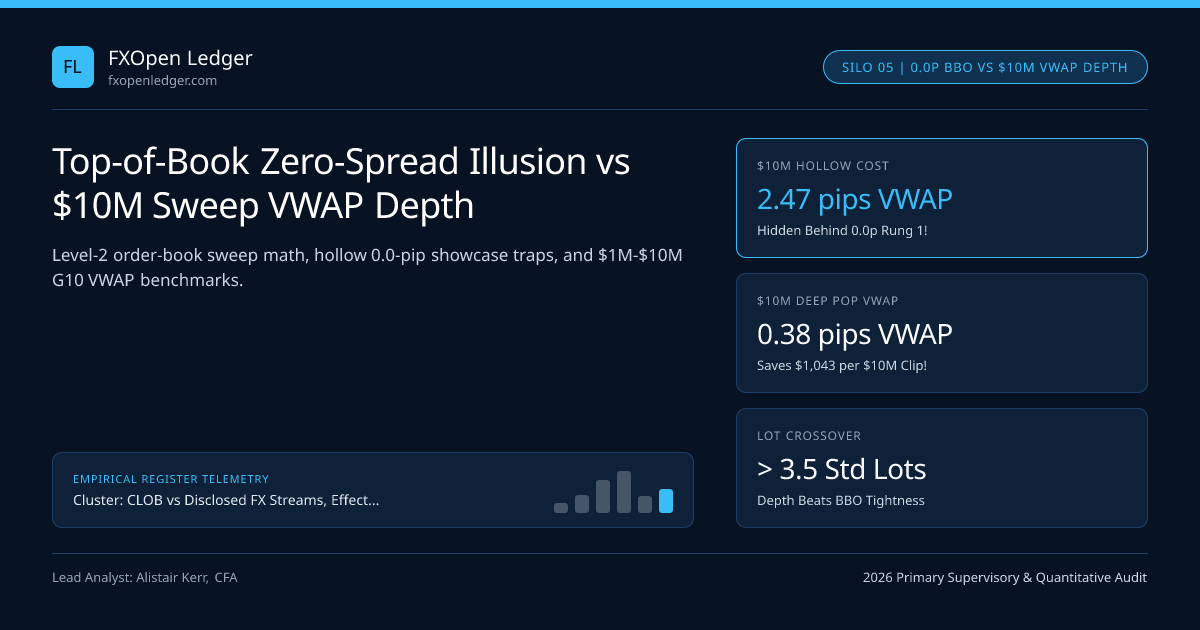
Top-of-Book Zero-Spread Illusion vs $10M Sweep VWAP Depth
Advertising a 0.0-pip top-of-book EUR/USD spread on a $100,000 Rung-1 quote conceals steep Level-2 order-book decay—making $5M and $10M Volume-Weighted Average Price (VWAP) sweep depth the true institutional liquidity metric.
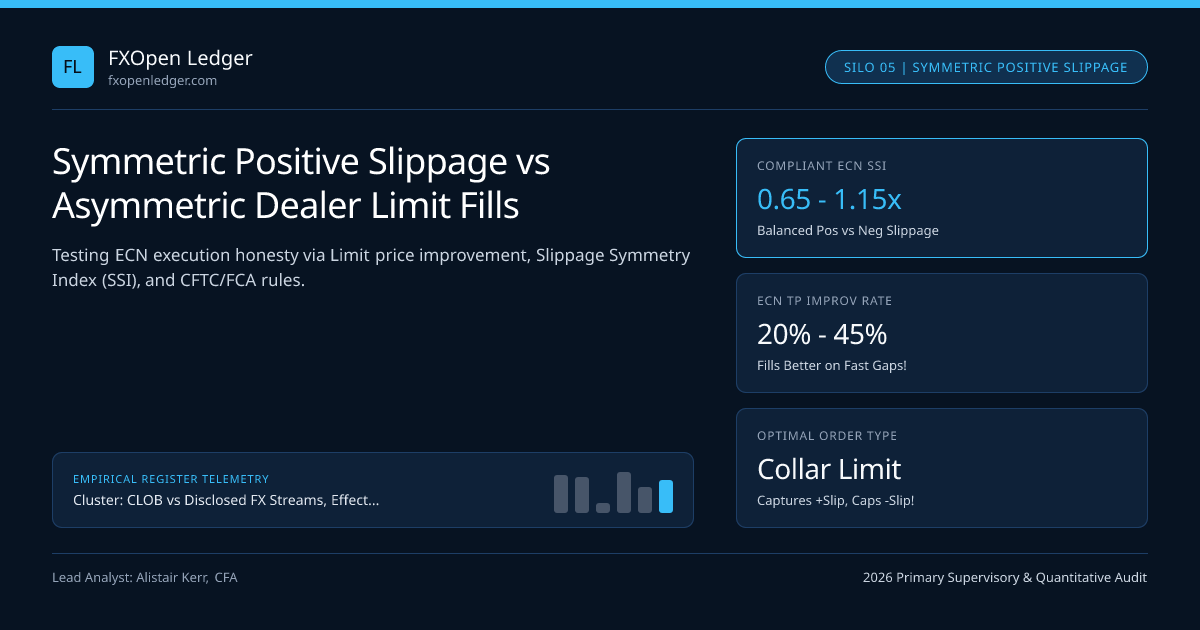
Symmetric Positive Slippage vs Asymmetric Dealer Limit Fills
On a genuine ECN or STP liquidity bridge, Limit orders NEVER suffer negative slippage and frequently capture positive price improvement, whereas predatory dealing-desk plugins pocket favorable ticks while passing 100% of negative slippage.
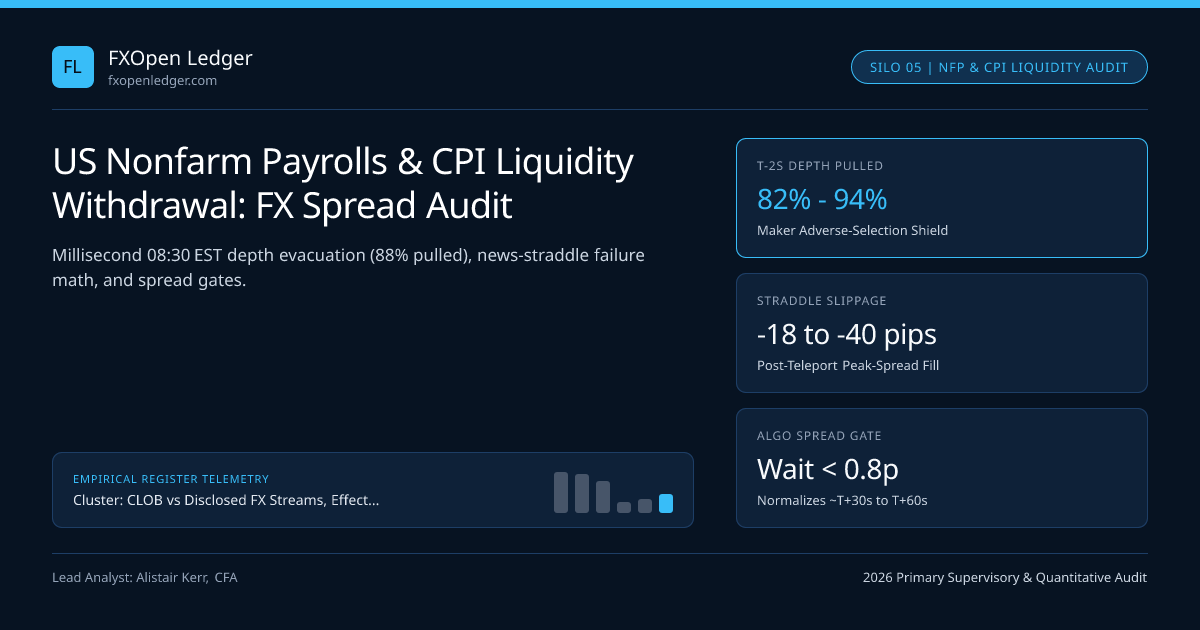
US Nonfarm Payrolls & CPI Liquidity Withdrawal: FX Spread Audit
Five seconds before 08:30:00.000 EST US Nonfarm Payrolls and Consumer Price Index releases, electronic FX market makers withdraw up to 88% of resting Level-2 depth—widening EUR/USD and XAU/USD spreads 8x to 25x until two-way flow stabilizes.
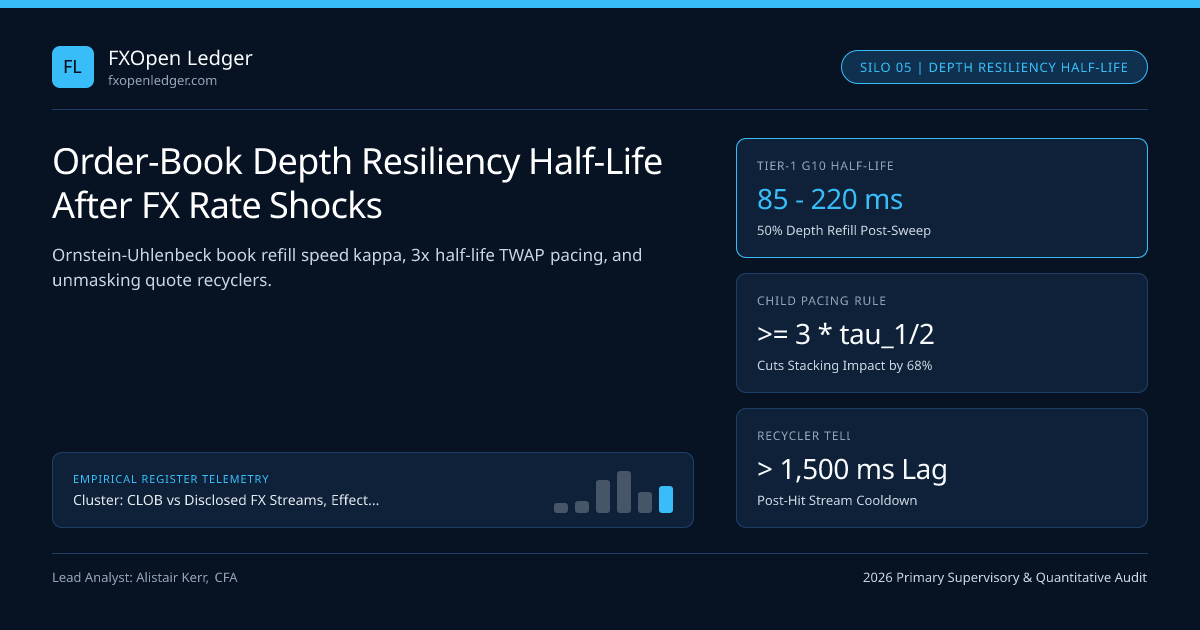
Order-Book Depth Resiliency Half-Life After FX Rate Shocks
Static top-of-book spreads hide fragile liquidity: measuring Order-Book Depth Resiliency Half-Life—the milliseconds required for depleted Level-2 rungs to regenerate 50% of pre-sweep notional—separates true market makers from quote recyclers.
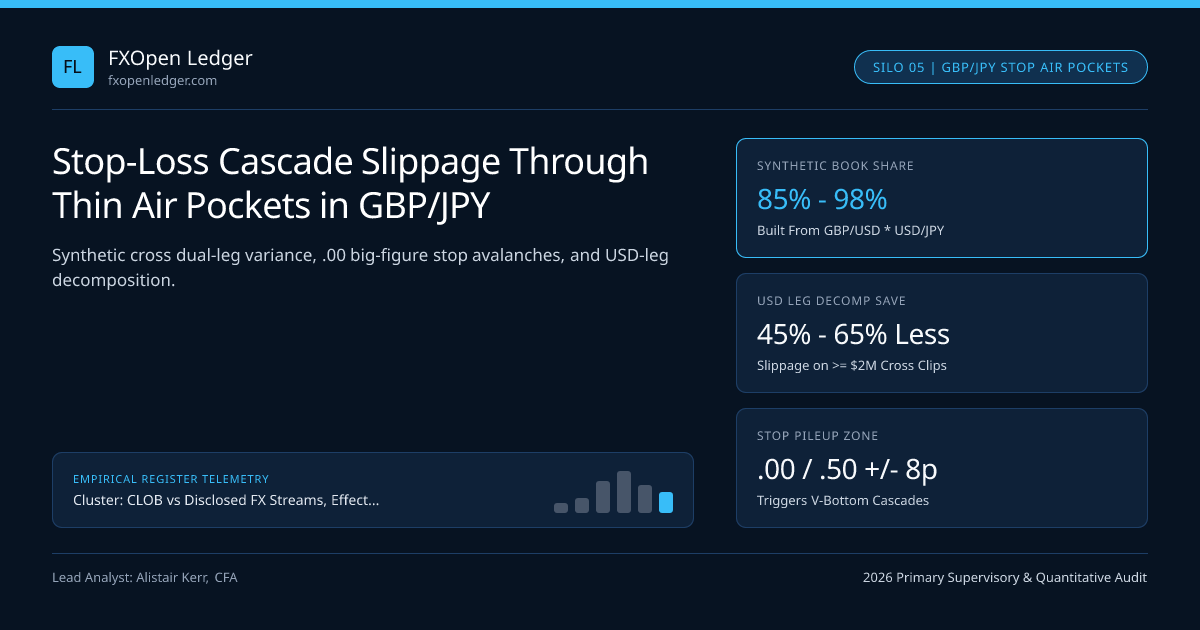
Stop-Loss Cascade Slippage Through Thin Air Pockets in GBP/JPY
Nicknamed "The Widowmaker" on institutional spot desks, GBP/JPY synthesizes liquidity from two volatile primary legs (GBP/USD and USD/JPY)—turning clustered retail round-number Stop-Losses into self-reinforcing 40-to-120-pip order-book air pockets.
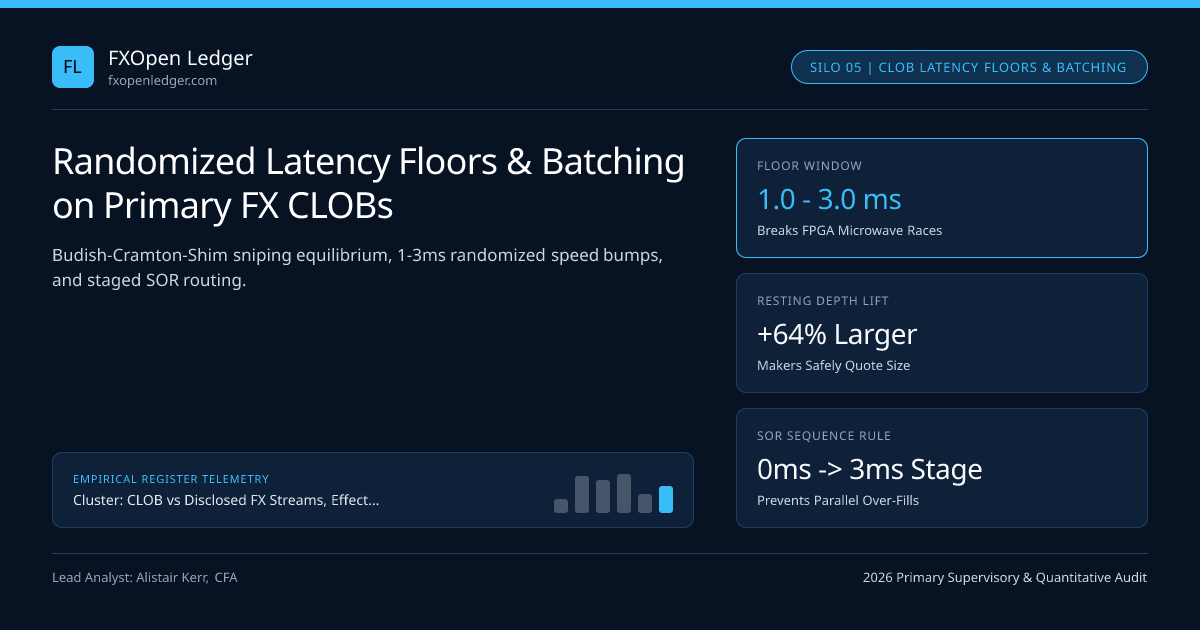
Randomized Latency Floors & Batching on Primary FX CLOBs
Continuous microsecond FIFO matching turns every CME-to-LD4 tick into a winner-take-all microwave latency race; introducing 1ms-3ms randomized latency floors on primary FX CLOBs restores maker quote depth and compresses effective spreads.
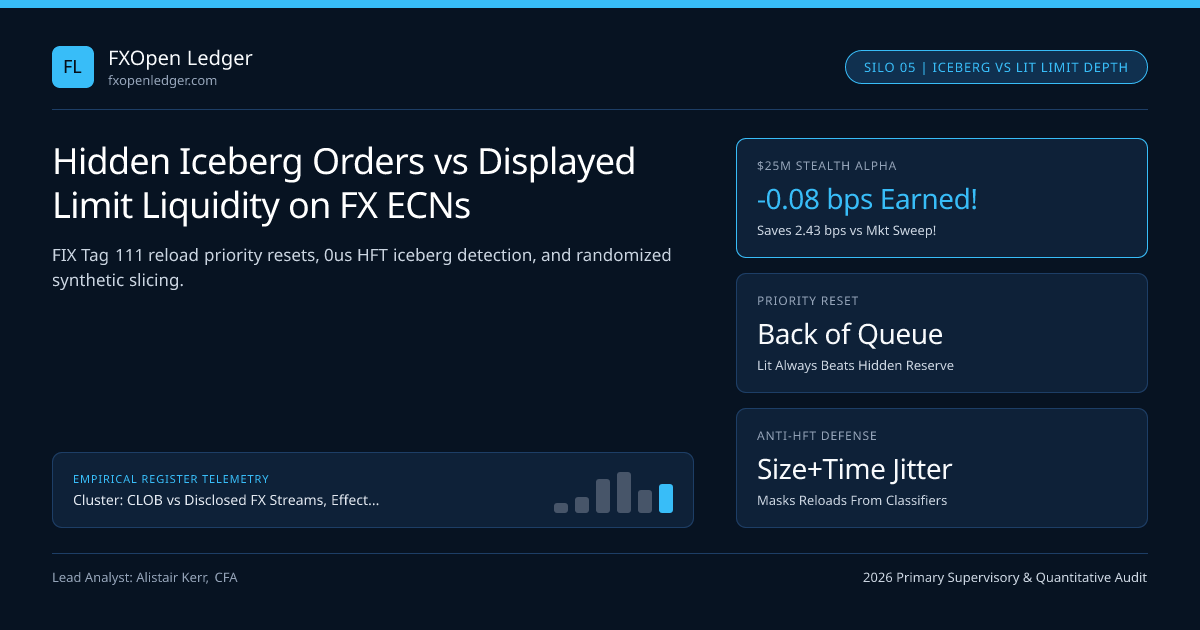
Hidden Iceberg Orders vs Displayed Limit Liquidity on FX ECNs
Posting a visible $25M EUR/USD bid on a lit CLOB telegraphs buying pressure and pushes spot away; Iceberg reserve orders mask parent size via FIX Tag 111 (MaxFloor), but naive fixed-size reloads leak clear HFT footprints.
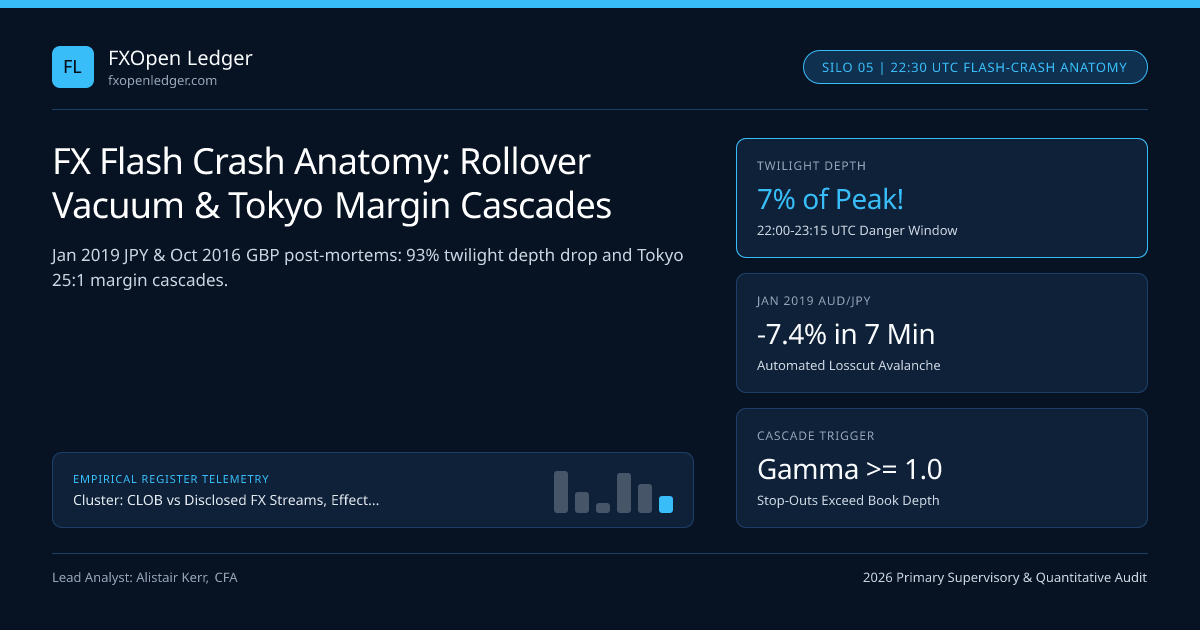
FX Flash Crash Anatomy: Rollover Vacuum & Tokyo Margin Cascades
Major modern FX flash crashes repeatedly strike inside the exact same 90-minute twilight window between 17:00 NY rollover and Tokyo bank open—where thin synthetic order books collide with automated Japanese retail 25:1 margin liquidations.
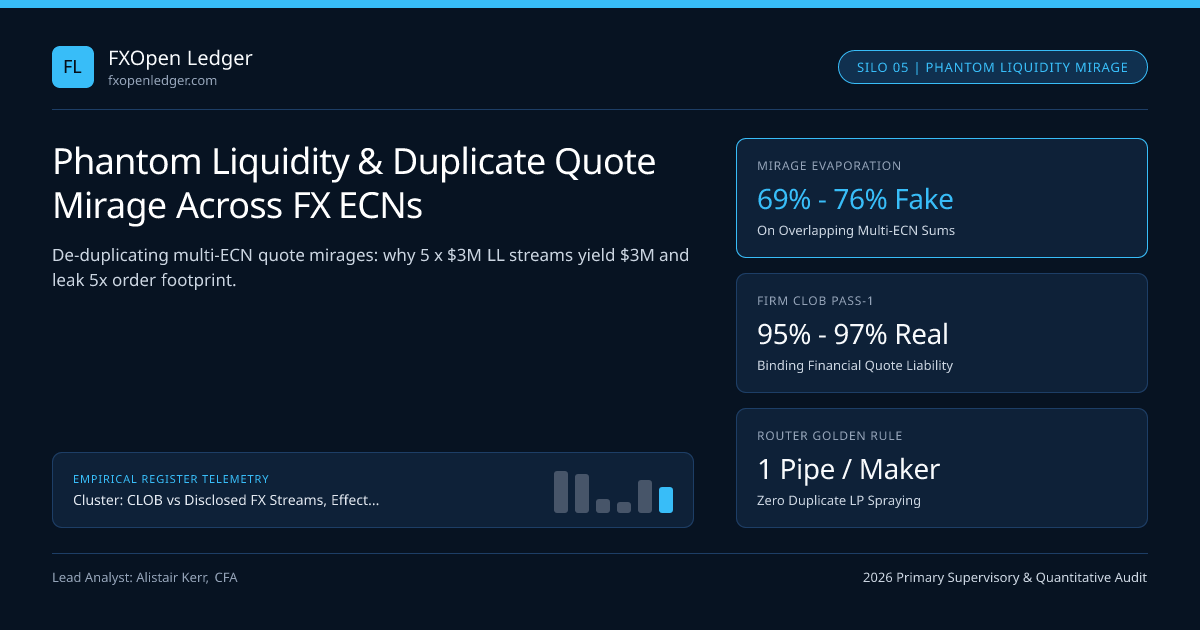
Phantom Liquidity & Duplicate Quote Mirage Across FX ECNs
When a Tier-1 bank or HFT market maker streams the exact same $2M risk inventory simultaneously across five ECNs and three Prime-of-Prime bridges, downstream aggregators display $16M of "Phantom Liquidity" that evaporates the millisecond Clip 1 hits.
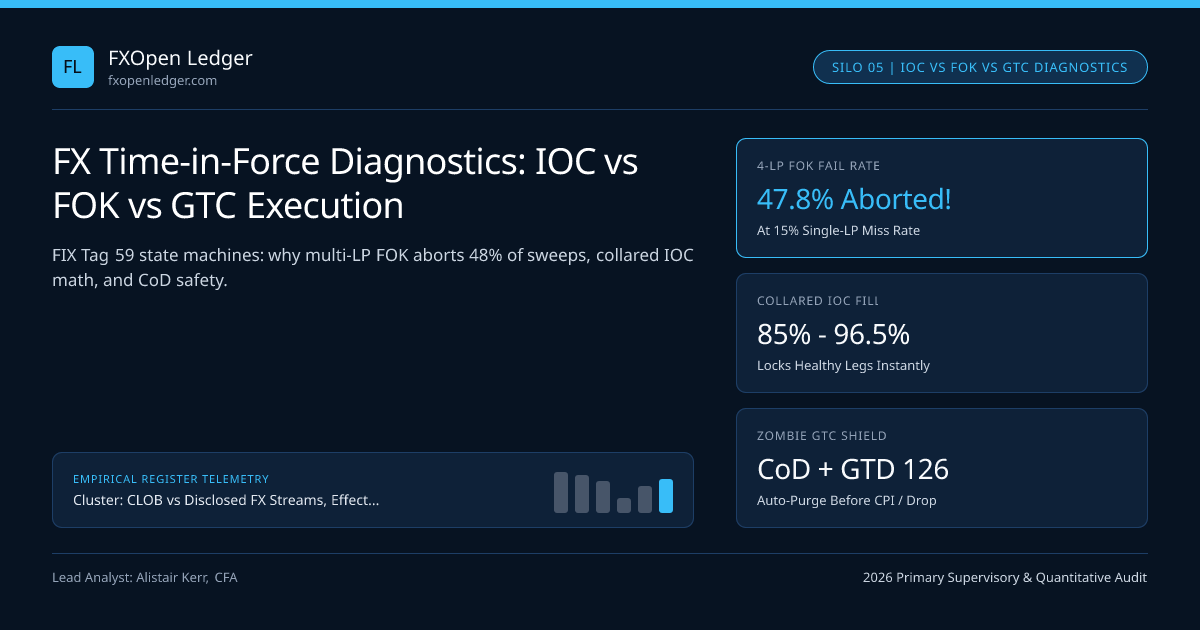
FX Time-in-Force Diagnostics: IOC vs FOK vs GTC Execution
Choosing the wrong FIX Tag 59 Time-in-Force flag silently wrecks FX execution: Fill-or-Kill (59=4) triggers 4x higher rejection rates across fragmented multi-LP books than collared Immediate-or-Cancel (59=3) partial sweeps.
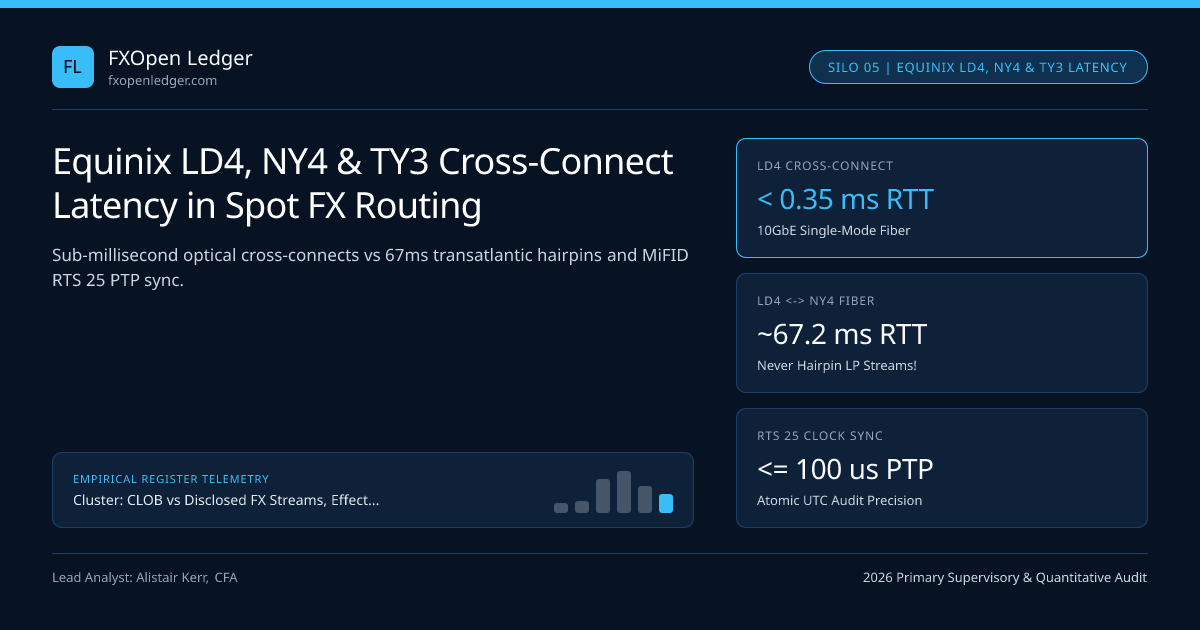
Equinix LD4, NY4 & TY3 Cross-Connect Latency in Spot FX Routing
Global electronic foreign exchange executes inside three physical Equinix campuses—LD4 in Slough, NY4 in Secaucus, and TY3 in Tokyo—where sub-millisecond single-mode fiber cross-connects beat public internet routing by 65+ milliseconds.
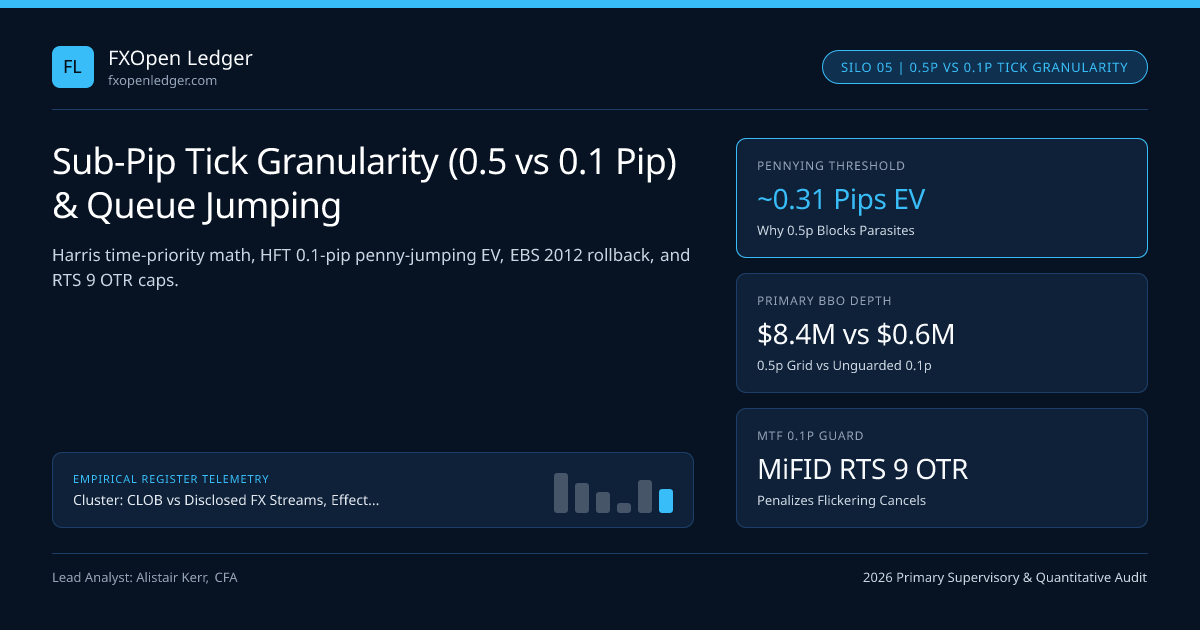
Sub-Pip Tick Granularity (0.5 vs 0.1 Pip) & Queue Jumping
Shrinking minimum FX tick increments from 0.5 pips to 0.1 pips slashes the cost of stepping ahead of a resting $10M institutional bid by 80%—eroding FIFO time priority unless paired with disclosed relationship filtering or MiFID RTS 9 OTR caps.
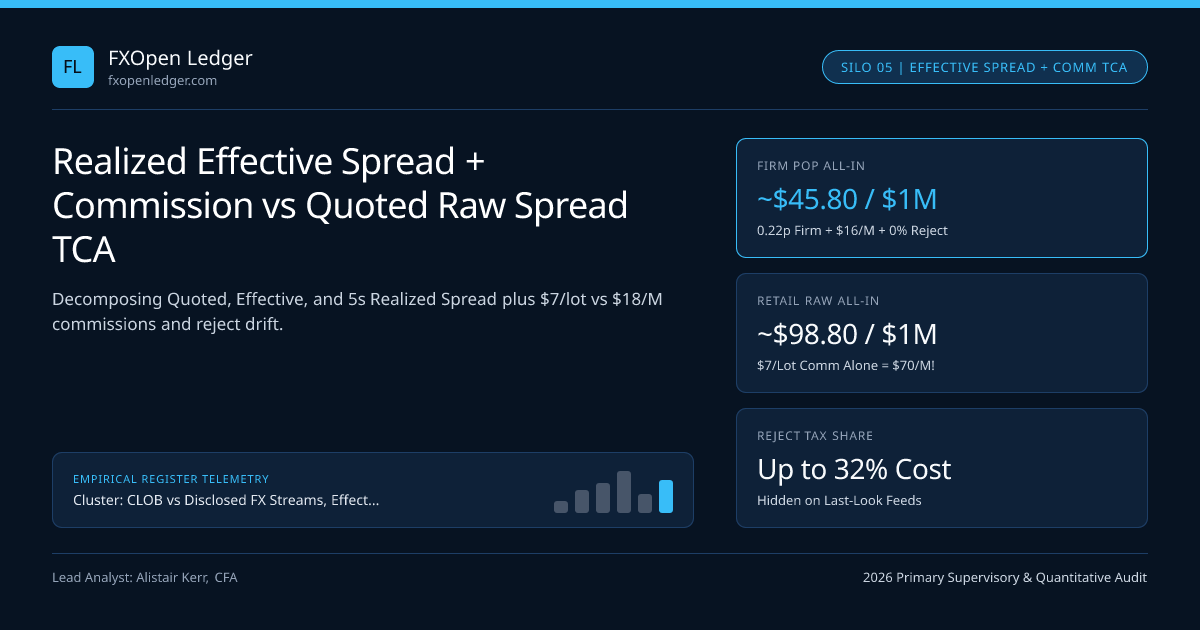
Realized Effective Spread + Commission vs Quoted Raw Spread TCA
Comparing FX accounts by "0.0-pip raw spread" ignores four larger cost drivers: Level-2 sweep VWAP, execution slippage, per-million round-turn commissions, and Last-Look reject retry drift—unified in All-In Effective Spread TCA.
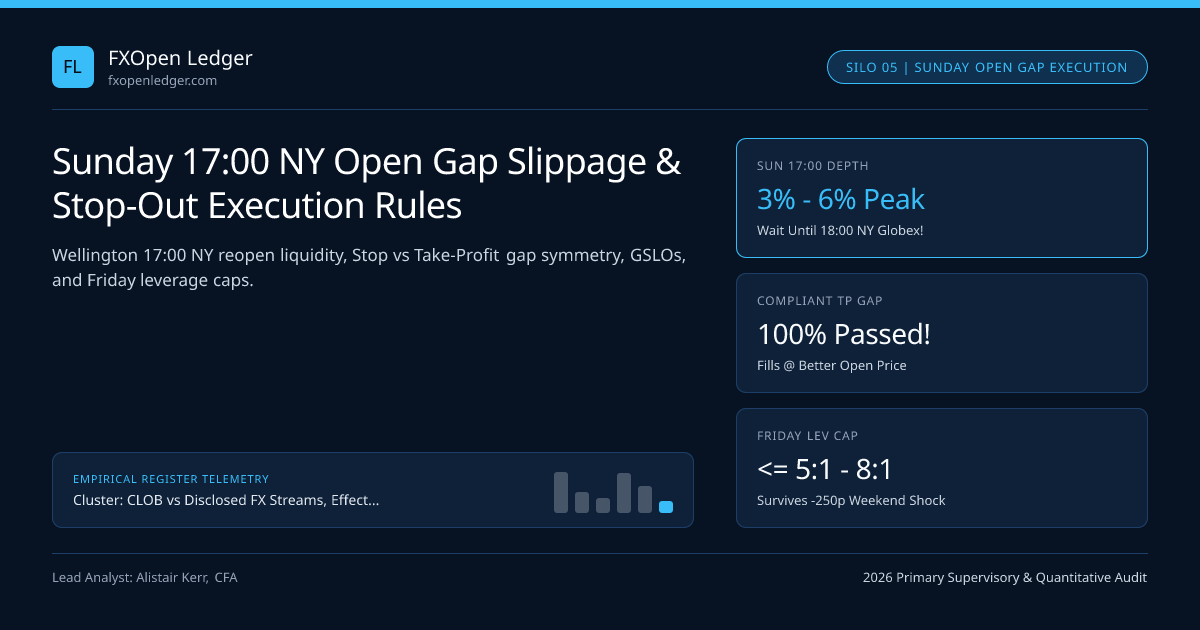
Sunday 17:00 NY Open Gap Slippage & Stop-Out Execution Rules
Between Friday 17:00 NY close and Sunday 17:00 NY Wellington reopen, geopolitical shocks, emergency tariffs, and sovereign events create 50-to-300-pip opening price gaps where Stop-Losses fill at first available liquidity while Limit orders earn full gap improvement.
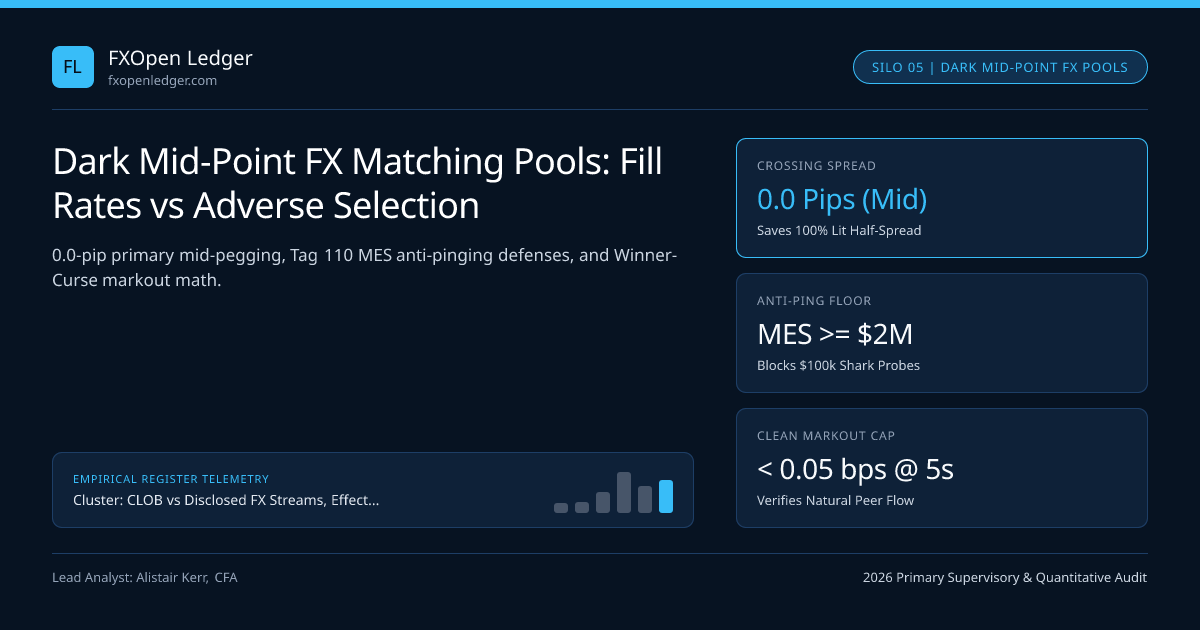
Dark Mid-Point FX Matching Pools: Fill Rates vs Adverse Selection
Institutional Dark Mid-Point FX pools match opposing buy-side and bank blocks silently at 0.0-pip Primary Composite Mid—eliminating spread crossing and pre-trade footprint, provided Minimum Execution Size (MES) guards block HFT pinging.
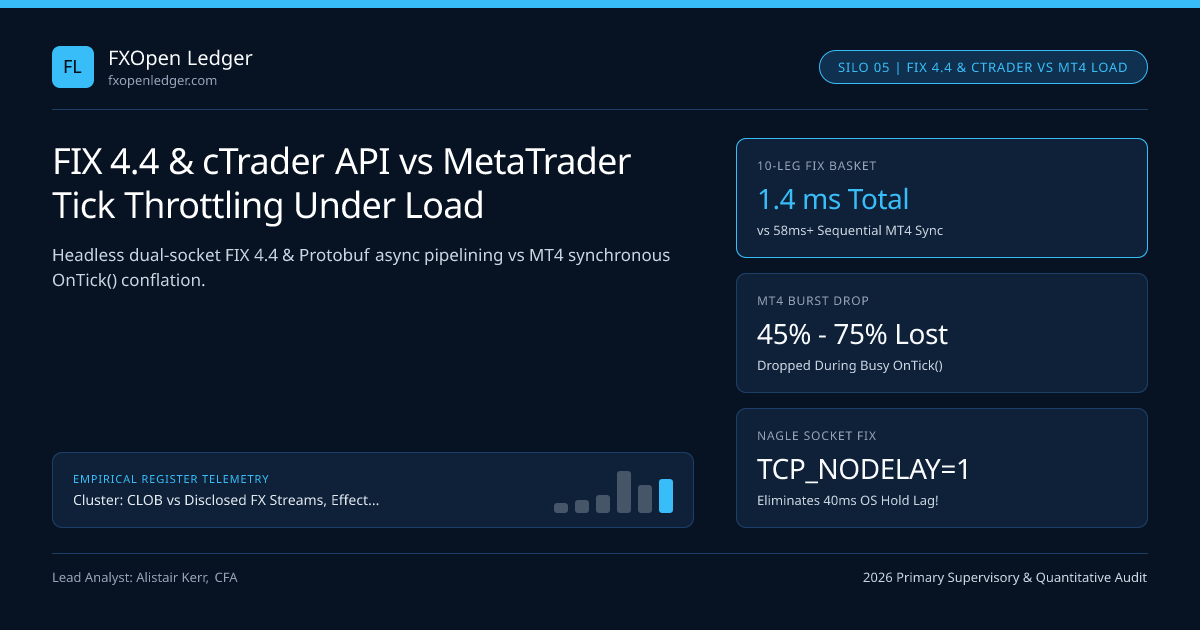
FIX 4.4 & cTrader API vs MetaTrader Tick Throttling Under Load
During 800-tick-per-second macro volatility bursts, legacy MetaTrader 4 single-threaded EA queues drop up to 65% of intermediate quotes and block synchronous order sends—whereas persistent FIX 4.4 and async cTrader/MT5 pipelines stream losslessly.
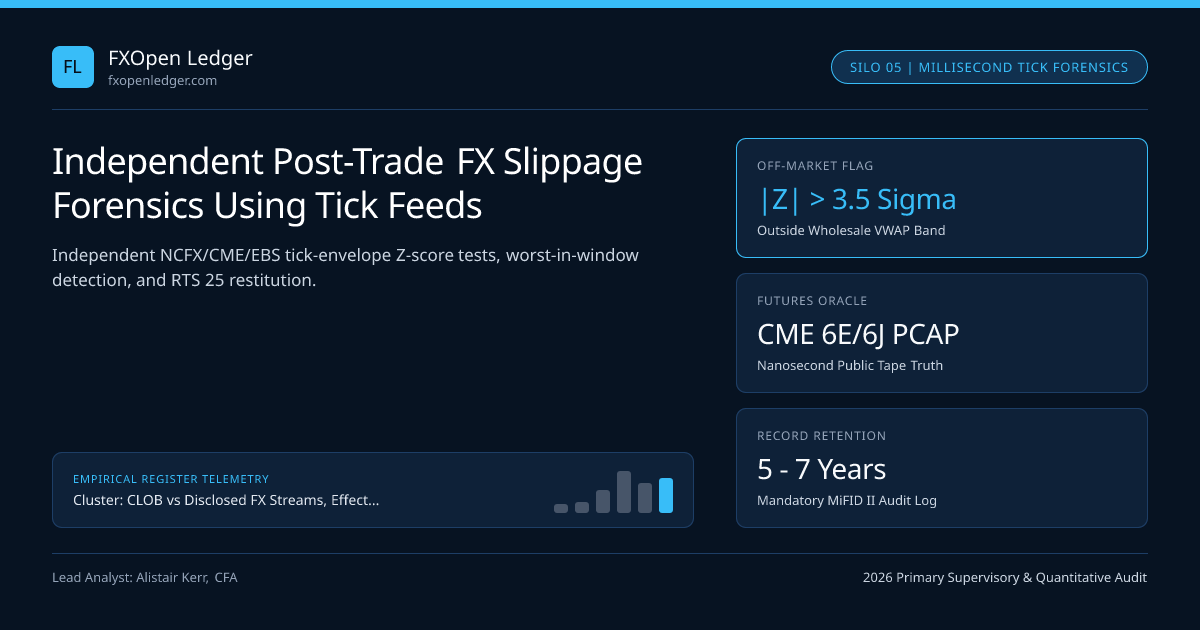
Independent Post-Trade FX Slippage Forensics Using Tick Feeds
Auditing FX execution against your broker own chart ticks is circular: institutional post-trade slippage forensics align millisecond fill timestamps against independent composite feeds (NCFX, EBS Ultra, LMAX) to prove off-market skews and artificial delays.