
Tom Next Swap Rollover Triple Wednesday
Institutional PoP Auto-Roll Netting vs Historic Rate Rollovers (HRR)
Institutional Prime-of-Prime desks compress dozens of intraday spot fills into a single 17:00 NY market-rate Tom-Next Auto-Roll, whereas off-market Historic Rate Rollovers trigger strict FX Global Code Principle 50 credit controls.
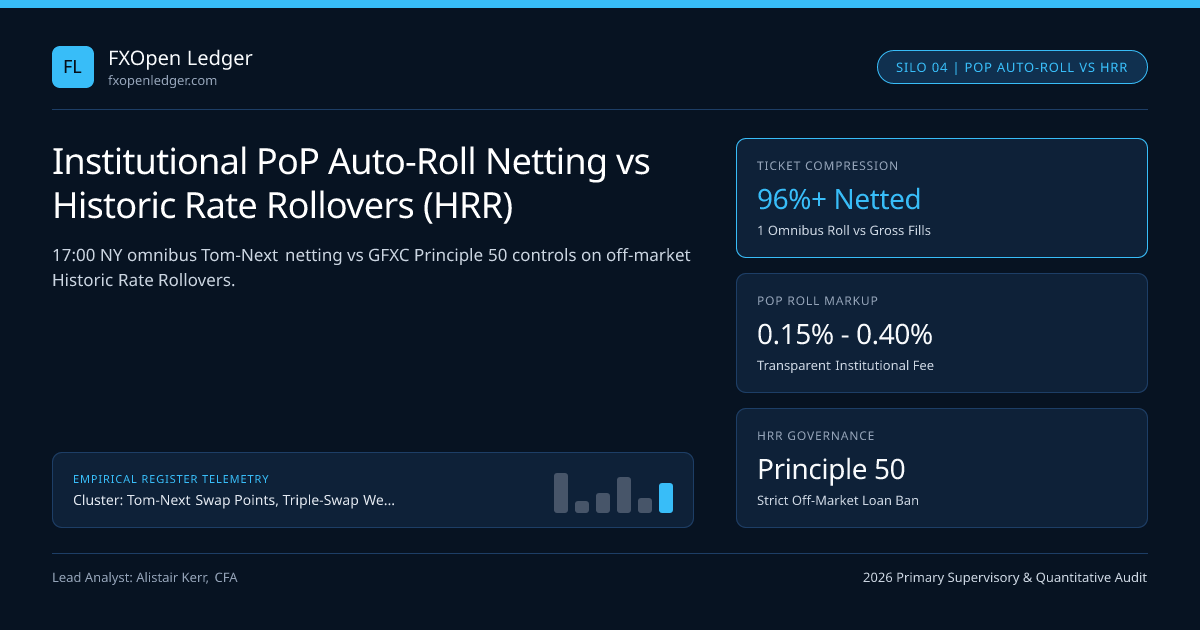
When a systematic hedge fund or downstream brokerage executes 140 separate EUR/USD spot clips across nine Liquidity Providers during Tuesday's London and New York sessions—ending 16:59:59 NY with a net residual inventory of Long EUR 4,500,000—how does its institutional Prime-of-Prime prevent 140 gross settlements on Thursday while simultaneously complying with Global Foreign Exchange Committee (GFXC) Principle 50? By executing a Market-Rate Net Position Auto-Roll rather than an off-market Historic Rate Rollover (HRR)! Understanding why off-market HRRs were weaponized in past corporate treasury scandals—from Allied Irish Banks (Rusnak) to Showa Shell Sekiyu—explains why modern Tier-1 Prime Brokers and PoPs enforce strict current-market Tom-Next resets.
Anchored in our Tom-Next Swap Points & Dealer Rollover Guide and indexed inside the Tom-Next Swaps & Rollover Mechanics hub, contrasting market-rate Auto-Rolls against Historic Rate Rollovers clarifies daily realized cash flows versus unrealized mark-to-market equity.
Market-Rate Auto-Roll Netting vs Historic Rate Rollovers (HRR)#
Suppose a corporate treasurer or fund bought EUR 10,000,000 two weeks ago at 1.1100, and today Spot EUR/USD trades at 1.0800 (-$300,000 cumulative market loss):
- Market-Rate
17:00 NYAuto-Roll (Standard PoP / FXPB Standard): At17:00 NY, the Prime-of-Prime nets all openTomorrowvalue-date legs and executes one Interbank Tom-Next FX Swap anchored at today's prevailing1.0800market mid-rate: sellingEUR 10Mfor Tomorrow at1.0800and buyingEUR 10Mfor Next Business Day at1.0800 + SwapPoints. Crucial effect: the-$300,000cumulative loss is crystallized transparently on cash settlement ledgers, preventing concealed loss accumulation! - Historic Rate Rollover (
HRR— Restricted Under GFXC Principle 50): Instead of rolling at1.0800, the client asks the dealer to extend maturity at the stale historic1.1100rate! Rolling an underwater contract at1.1100when spot is1.0800embeds an implicit$300,000uncollateralized loan from the FX dealer to the client—historically abused by rogue traders to hide realized cash losses from treasury auditors!
Exact Cash-Flow & Embedded Credit Formula in HRRs vs Market Auto-Rolls#
When a dealer grants a Historic Rate Rollover at stale exchange rate $S{hist}$ while current Spot stands at $S{mkt}$, the swap forward price must absorb not only Covered Interest Parity swap points ($P{CIP}$), but also **interest on the off-market principal discrepancy ($S{hist} - S_{mkt}$)**:
- OffMarketHRRAdjustedForwardPrice = Shist + SwapPointsCIP(Smkt) + (Shist - Smkt) * (rquote * Days / 360) + CreditCharge
- EmbeddedOffMarketCreditExtensionUSD = NotionalBase * | Shist - Smkt |
- Worked Treasury Audit (Long EUR 10,000,000 Bought @ Shist = 1.1100; Current Spot Smkt = 1.0800; 30-Day Roll @ SOFR = 4.55%, ESTR = 3.15%):
- 1. Standard Market-Rate Roll @ 1.0800:
- Client settles -$300,000 realized cash MTM on Value Tomorrow; new 1M Forward opens cleanly @ 1.0800 + 0.00126 = 1.08126.
- 2. Off-Market HRR Requested @ 1.1100:
- Client avoids wiring -$300,000 cash today -> Dealer implicitly lends $300,000 unsecured for 30 days!
- Extra USD funding surcharge on the $300k loan = $300,000 * (0.0455 * 30 / 360) = $1,137.50 (+1.14 pips penalty) PLUS Basel SA-CCR credit charge!
Comparing Rollover Mechanics Across Institutional & Retail Platforms#
Institutional Prime-of-Prime houses (AMB Prime, ALB Prime, Climax Prime) and regulated multi-asset brokers (City Index, 4XC) operating under UK FCA, FINMA, and ASIC supervision implement four distinct rollover accounting models:
| Rollover Architecture | Entry Price Behaviour at 17:00 NY | Swap Reflection Method | GFXC Principle 50 Status | Typical User Base |
|---|---|---|---|---|
| FXPB Direct Give-Up T/N | Yesterday Spot closes; new T+2 trade opens at S_mkt + T/N | Embedded directly in reopened price | 100% Compliant Market Roll | Macro Hedge Funds & Banks |
| PoP Omnibus Auto-Roll (FIX / GUI) | Net position re-priced daily to 17:00 NY + Swap | Realized daily MTM + explicit T/N pip adjustment | 100% Compliant Market Roll | Institutional Desks & Brokers |
| MT4 / MT5 / cTrader Cash-Swap | Display entry stays S_entry; Equity marked live to S_mkt! | Separate cash Swap column debited/credited daily | Compliant (100% Collateralized VM) | Retail & Prop CFD Accounts |
Corporate Off-Market HRR | Rolls forward contract at stale S_hist without cash MTM | Buried inside distorted forward points | Restricted! Needs Senior Officer Approval | Audited Corporate Hedgers Only |
Why MT5 "Unchanged Open Price" Is NOT an Uncollateralized HRR#
New institutional analysts sometimes ask why MT5 or cTrader displays a client's original 1.1100 open price weeks later rather than rewriting the ticket price every night at 17:00 NY. Because on a margined CFD/spot ledger, 100% of the -$300,000 floating PnL is already deducted second-by-second from Real-Time Equity and Free Margin (unlike a corporate forward HRR where cash variation margin was deferred!), while thebroker's upstream PoP omnibus account executes a netted market-rate Tom-Next Auto-Roll behind the scenes.
Governance Checklist for Institutional Auto-Roll Subscriptions#
Before enabling automated 17:00 NY rolls on a FIX API Prime-of-Prime session, execution engineers verify three contractual parameters: (1) whether Tom-Next points are benchmarked against composite primary ECN mid-rates (FXall / 360T / EBS Institutional Swap feed) plus a fixed transparent bps fee rather than discretionary dealer tables, (2) how partial intraday closes before 17:00 NY net out without generating broken-date value stubs, and (3) that any corporate client requesting a non-market rate extension undergoes formal GFXC Principle 50 credit-committee authorization.
Frequently asked questions
What is the difference between a Market-Rate Auto-Roll and a Historic Rate Rollover (HRR)?
A Market-Rate Auto-Roll closes tomorrow settlement at today current 17:00 NY spot rate and reopens T+2 at current spot plus wholesale swap points, realizing mark-to-market cash daily. An HRR rolls at a stale historical price, embedding an off-market loan.
Why does FX Global Code Principle 50 restrict Historic Rate Rollovers?
Because rolling losing FX forwards at stale historic exchange rates allows a rogue trader or corporate treasury employee to defer cash outflows and conceal massive mark-to-market losses from auditors and senior management.
How does PoP omnibus Auto-Roll netting save money compared to gross rolling?
If an algorithm buys and sells 100 clips intraday and finishes flat or with a small residual position, omnibus netting rolls only the net residual inventory at 17:00 NY rather than paying swap spreads and PB fees on all 100 gross tickets.
Does MT5 keeping my original open price visible mean my broker is doing an HRR?
No. MT5 deducts 100% of unrealized profit or loss continuously from your real-time Margin Equity every tick while posting daily cash Swap adjustments, so zero off-market uncollateralized credit is ever extended.
Publication record
- Published
- 13 November 2026
- Updated
- 14 November 2026
- Author
- Alistair Kerr, CFA
- Review
- Review not recorded
- Automated fact check
- Passed in the stored pipeline record
- Source URLs
- 3 recorded
AI assistance recorded: anthropic/claude-opus-4.6. This field does not establish human review or source verification.
Academic & Institutional Attribution
Cite This Research & Embed Live Data Card
Standard academic & institutional research paper citation format.
Alistair Kerr, CFA. (2026, November 14). Institutional PoP Auto-Roll Netting vs Historic Rate Rollovers (HRR). FXOpen Ledger. https://fxopenledger.com/orderbook/institutional-pop-auto-roll-aggregation-vs-historic-rate-rollsRegulatory Directory Cross-Reference
Referenced Institutions & Regulatory Registries
Mentioned Regulated Institutions
Referenced Supervisory Authorities
Related Tom Next Swap Rollover Triple Wednesday & Institutional Briefings
Explore Tom Next Swap Rollover Triple Wednesday Hub (20) →Tom Next Swap Rollover Triple Wednesday
Tom-Next Swap Points, Triple-Swap Wednesday & FX Dealer Rollover GuideTom Next Swap Rollover Triple Wednesday
Cross-Currency Basis Swaps: EUR/USD & USD/JPY Dollar Funding PremiaTom Next Swap Rollover Triple Wednesday
Multi-Asset FX & Index Books: Dividend Cash Adjustments vs FinancingTom Next Swap Rollover Triple Wednesday
Locked Long/Short FX Hedges: Net Swap Decay & 17:00 Stop-Out MathTom Next Swap Rollover Triple Wednesday
Central-Bank Decision-Eve Overnight FX Swap Pricing JumpsTom Next Swap Rollover Triple Wednesday
MiFID II Ex-Ante Cost Disclosure: Auditing Annualized FX Swap DragTom Next Swap Rollover Triple Wednesday
Spot FX T+2 Settlement Calendar & Wednesday Triple-Rollover MechanicsTom Next Swap Rollover Triple Wednesday
USD/CAD & USD/TRY T+1 Settlement: The Thursday Triple-Swap RuleLmax Ebs Ecn Spread Slippage Audit
Realized Effective Spread + Commission vs Quoted Raw Spread TCALmax Ebs Ecn Spread Slippage Audit
Sunday 17:00 NY Open Gap Slippage & Stop-Out Execution RulesLmax Ebs Ecn Spread Slippage Audit
Dark Mid-Point FX Matching Pools: Fill Rates vs Adverse SelectionLmax Ebs Ecn Spread Slippage Audit
FIX 4.4 & cTrader API vs MetaTrader Tick Throttling Under Load
FXOpen Ledger Data, Benchmarks & Contributor Records
CC BY 4.0 Open Data
Open Institutional Datasets (CSV / JSON) →
Download desk-compiled quantitative series & schemas.
2026 Reference Matrix
2026 Institutional Benchmarks & Thresholds →
Statutory capital, clearing, margin & rate conventions.
Editorial Records
Authors & Review Records →
View named contributors where those records are available.
Complete Index
Master Research & Dossier Archive →
Browse all published briefings by topic pillar & date.