
Tom Next Swap Rollover Triple Wednesday
Cross-Currency Basis Swaps: EUR/USD & USD/JPY Dollar Funding Premia
Post-2008 bank leverage rules broke textbook Covered Interest Parity, creating persistent negative EUR/USD and USD/JPY cross-currency basis spreads where synthetic Dollar borrowers pay a structural premium over SOFR.
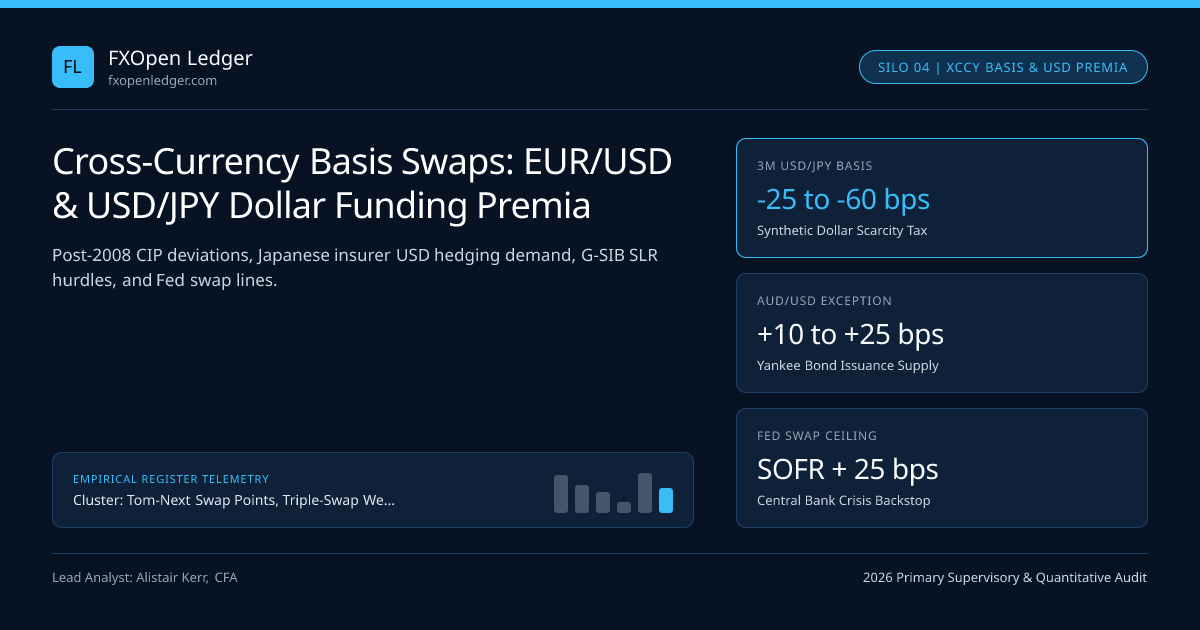
For sixty years before September 2008, every international finance textbook taught Covered Interest Rate Parity (CIP) as an iron law of arbitrage-free pricing: borrowing US Dollars directly at SOFR had to cost the exact same interest rate as borrowing Euros at ESTR (or Yen at TONAR) and swapping those funds into US Dollars via an FX Swap! Since the 2008 Global Financial Crisis and Basel III leverage-ratio enforcement, Covered Interest Parity Basis (`XCCY Basis`) has remained persistently non-zero—frequently reaching -15 to -45 bps in EUR/USD and -30 to -95 bps in USD/JPY (and plunging below -250 bps during March 2020 and year-end G-SIB turn squeezes)!
Connected to our Tom-Next Swap Points & Dealer Rollover Guide and expanding our CIP-to-Tom-Next pips derivation inside the Tom-Next Swaps & Rollover Mechanics hub, reading the cross-currency basis tells you the exact global scarcity premium of offshore US Dollar liquidity.
Why Non-US Institutions Pay a Negative Basis Premium to Borrow Synthetic Dollars#
Who drives persistent negative EUR/USD and USD/JPY cross-currency basis?
- Structural Demand Side (Japanese Life Insurers, European Pension Funds & Corporates): Japanese institutional investors hold over $2.5 trillion in US Treasury, agency MBS, and corporate credit bonds (seeking higher USD yields than domestic JGBs), but lack direct access to US retail deposit funding or Fed discount windows. To hedge currency risk, they roll massive Buy-Spot-JPY / Sell-Forward-JPY FX Swaps (= borrowing synthetic USD while lending JPY collateral)!
- Constrained Supply Side (G-SIB Bank Balance Sheets): Under Basel III Supplementary Leverage Ratio (
SLR) and G-SIB surcharges, a Tier-1 bank arbitraging a-25 bpsCIP basis must expand its gross repo/swap balance sheet—requiring a minimum20–35 bpsreturn on leverage exposure just to clear internal RoE hurdles! Arbitrage doesn't fail; balance-sheet rental space simply has a positive shadow price documented extensively by the Bank for International Settlements!
Exact Implied Synthetic USD Rate & Basis Extraction Formula#
By comparing observed wholesale FX swap points ($F - S$) against overnight indexed swap rates ($r{USD}, r{foreign}$), institutional desks solve directly for the Implied Synthetic USD Borrowing Rate and the Cross-Currency Basis ($alpha_{ccy}$):
- CrossCurrencyBasisAlpha (bps) = ( rUSDSOFR - rUSD_synthetic ) * 10,000
- [Convention: Negative alpha (-35 bps) means Synthetic USD costs +35 bps MORE than direct cash SOFR!]
- Worked 3-Month (90-Day) USD/JPY Hedged US Treasury Yield Audit (Spot = 152.00; US 10Y = 4.35%; US 3M SOFR = 4.55%; JPY 3M TONAR = 0.25%):
- 1. Pure Textbook CIP Forward (alpha = 0):
- F_CIP = 152.00 * (1 + 0.0025 * 90/365) / (1 + 0.0455 * 90/360) = 152.00 * (1.000616 / 1.011375) = 150.383 (-161.7 pips).
- 2. Real Interbank Market Quotes 3M USD/JPY Swap @ -175.2 pips (F_mkt = 150.248) due to alpha = -36 bps (-0.36%) JPY basis!
- Synthetic 3M USD Hedging Cost = (4.55% - 0.25%) + 0.36% (Basis Penalty!) = 4.66% APR!
- Result for Tokyo Life Insurer buying 4.35% 10Y US Treasury FX-hedged: 4.35% - 4.66% = -0.31% NEGATIVE hedged yield (vs +1.05% unhedged 10Y JGB)!
Comparing Cross-Currency Basis Regimes Across G10 Currencies#
Why is the cross-currency basis negative in EUR, JPY, GBP, and CHF (foreign investors crave USD), yet often positive (+10 to +25 bps) in AUD/USD? Institutional macro traders across Prime-of-Prime feeds (AMB Prime, ALB Prime, Climax Prime) monitored by FINMA, FFAJ Japan, and ASIC track net external debt vs asset imbalances:
| Currency Pair | Typical 3M XCCY Basis ($\$) | Structural Flow Driver | Effect on Spot FX Rollover Carry |
|---|---|---|---|
USD/JPY (TONAR vs SOFR) | -25 to -60 bps | Massive Japanese insurer/GPIF USD bond hedging | Boosts wholesale Long USD/JPY swap points above pure CIP! |
EUR/USD (ESTR vs SOFR) | -10 to -30 bps | Eurozone insurer USD credit holdings & bank USD funding | Boosts wholesale Short EUR/USD (Long USD) swap points! |
USD/CHF (SARON vs SOFR) | -15 to -40 bps | Swiss private-wealth & corporate global USD asset hedges | Widens negative Short USD/CHF rollover cost beyond CIP |
AUD/USD (AONIA vs SOFR) | +10 to +25 bps (Positive!) | Australian major banks issue USD Yankee bonds & swap back into AUD! | Slightly compresses Long AUD/USD forward points vs CIP |
How Standing Central Bank Swap Lines Cap Crisis Basis Blowouts#
During acute global Dollar shortages (September 2008, November 2011 Euro Crisis, March 2020 COVID Dash-for-Cash), private bank balance sheets freeze and 3-month EUR/USD and USD/JPY basis plunges toward -150 to -300 bps. At that threshold, the Federal Reserve's Standing Central Bank Liquidity Swap Network (with the ECB, BoJ, BoE, SNB, and BoC, priced at OIS/SOFR + 25 bps since 2020) acts as a hard wholesale ceiling—supplying unlimited collateralized 7-day Dollars through domestic central banks!
Trading Signal: Why Negative FX-Hedged US Bond Yields Fuel Unhedged Spot Trends#
Notice the macro feedback loop buried in our worked USD/JPY formula above: when SOFR + |JPY Basis| (4.66%) exceeds the 10-Year US Treasury Yield (4.35%), FX-hedged US Treasuries yield less than 0% for Tokyo life insurers! Forced out of FX-hedged bonds, Japanese institutions either repatriate into JGBs or drop their FX swap hedges (buying USD/JPY outright unhedged)—a structural catalyst behind USD/JPY surging past 150–160!
Frequently asked questions
What does a -35 bps cross-currency basis on USD/JPY actually mean?
It means borrowing US Dollars synthetically—by borrowing Japanese Yen at TONAR and swapping Yen into Dollars via an FX swap—costs 35 basis points (0.35% annualized) MORE than borrowing cash US Dollars directly at SOFR.
Why do arbitrageurs not eliminate a -30 bps Covered Interest Parity deviation immediately?
Arbitraging CIP requires expanding a bank gross repo and FX swap balance sheet. Under Basel III Supplementary Leverage Ratio (SLR) and G-SIB capital surcharges, balance-sheet capacity costs ~20-35 bps/year, creating a no-arbitrage band.
Why is the AUD/USD cross-currency basis positive when EUR/USD and USD/JPY are negative?
Australian major banks raise substantial wholesale funding in US corporate bond markets and swap those US Dollars back into Australian Dollars—creating net supply of USD in the AUD/USD swap market.
How does the cross-currency basis affect daily Tom-Next swap points on my FX account?
A negative EUR/USD or USD/JPY basis increases the wholesale implied Dollar interest rate, making Long USD (Short EUR/USD or Long USD/JPY) earn slightly MORE positive wholesale carry than pure SOFR-minus-ESTR/TONAR suggests.
Publication record
- Published
- 13 November 2026
- Updated
- 14 November 2026
- Author
- Alistair Kerr, CFA
- Review
- Review not recorded
- Automated fact check
- Passed in the stored pipeline record
- Source URLs
- 3 recorded
AI assistance recorded: anthropic/claude-opus-4.6. This field does not establish human review or source verification.
Academic & Institutional Attribution
Cite This Research & Embed Live Data Card
Standard academic & institutional research paper citation format.
Alistair Kerr, CFA. (2026, November 14). Cross-Currency Basis Swaps: EUR/USD & USD/JPY Dollar Funding Premia. FXOpen Ledger. https://fxopenledger.com/orderbook/cross-currency-basis-swaps-eur-usd-and-usd-jpy-funding-premiaRegulatory Directory Cross-Reference
Referenced Institutions & Regulatory Registries
Top Regulated Institutions in This Coverage Slice
Referenced Supervisory Authorities
Related Tom Next Swap Rollover Triple Wednesday & Institutional Briefings
Explore Tom Next Swap Rollover Triple Wednesday Hub (20) →Tom Next Swap Rollover Triple Wednesday
Tom-Next Swap Points, Triple-Swap Wednesday & FX Dealer Rollover GuideTom Next Swap Rollover Triple Wednesday
Multi-Asset FX & Index Books: Dividend Cash Adjustments vs FinancingTom Next Swap Rollover Triple Wednesday
Locked Long/Short FX Hedges: Net Swap Decay & 17:00 Stop-Out MathTom Next Swap Rollover Triple Wednesday
Central-Bank Decision-Eve Overnight FX Swap Pricing JumpsTom Next Swap Rollover Triple Wednesday
MiFID II Ex-Ante Cost Disclosure: Auditing Annualized FX Swap DragTom Next Swap Rollover Triple Wednesday
Spot FX T+2 Settlement Calendar & Wednesday Triple-Rollover MechanicsTom Next Swap Rollover Triple Wednesday
USD/CAD & USD/TRY T+1 Settlement: The Thursday Triple-Swap RuleTom Next Swap Rollover Triple Wednesday
Covered Interest Parity to Interbank Tom-Next Pips DerivationLmax Ebs Ecn Spread Slippage Audit
Sunday 17:00 NY Open Gap Slippage & Stop-Out Execution RulesLmax Ebs Ecn Spread Slippage Audit
Dark Mid-Point FX Matching Pools: Fill Rates vs Adverse SelectionLmax Ebs Ecn Spread Slippage Audit
FIX 4.4 & cTrader API vs MetaTrader Tick Throttling Under LoadLmax Ebs Ecn Spread Slippage Audit
Independent Post-Trade FX Slippage Forensics Using Tick Feeds
FXOpen Ledger Data, Benchmarks & Contributor Records
CC BY 4.0 Open Data
Open Institutional Datasets (CSV / JSON) →
Download desk-compiled quantitative series & schemas.
2026 Reference Matrix
2026 Institutional Benchmarks & Thresholds →
Statutory capital, clearing, margin & rate conventions.
Editorial Records
Authors & Review Records →
View named contributors where those records are available.
Complete Index
Master Research & Dossier Archive →
Browse all published briefings by topic pillar & date.